
Wristwatches · Wristwatch
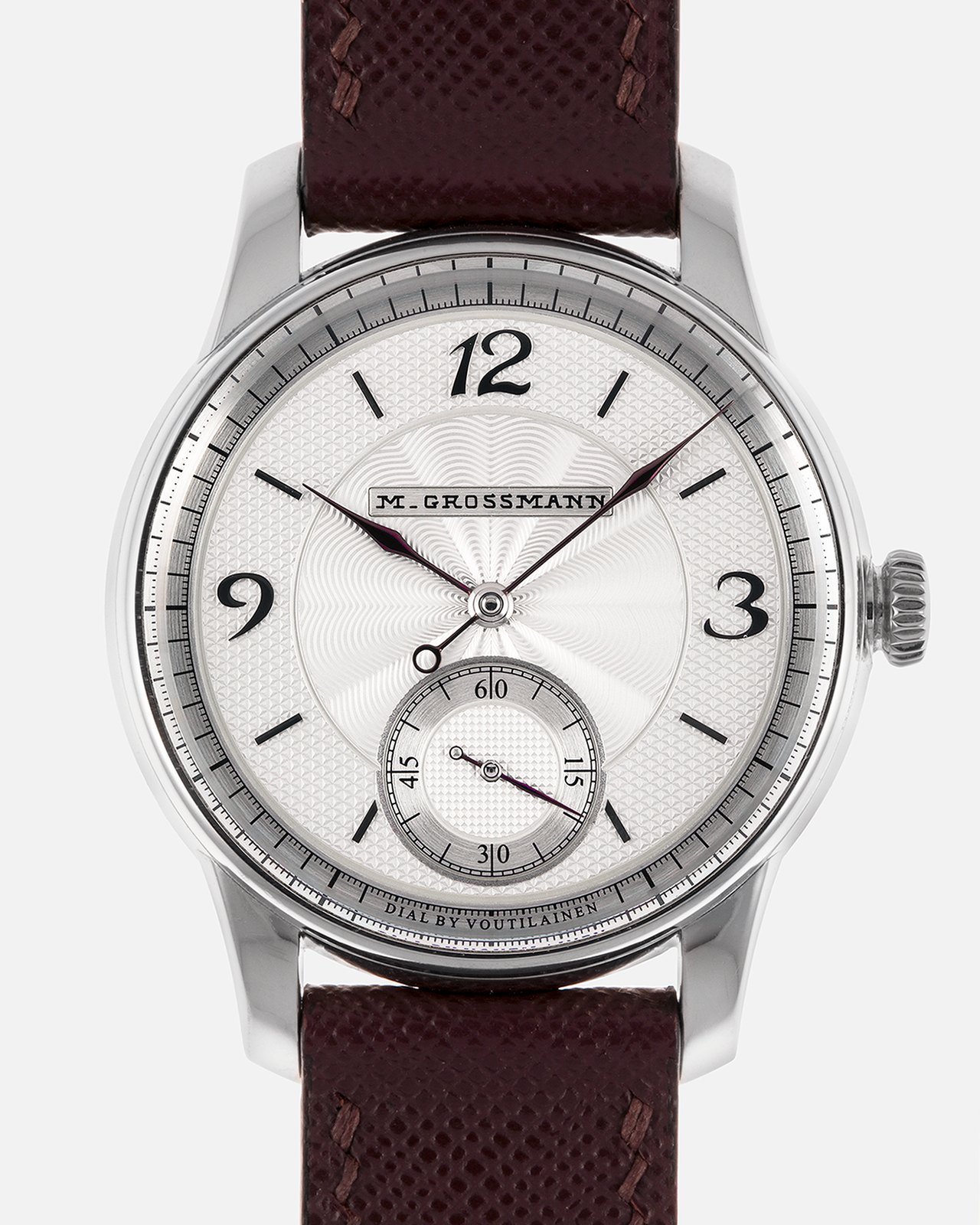
Moritz Grossman X Kari Voutilainen Benu 37 Grail Watch ‘Silver Bullet’ MG-003588, 2023
- Maker / attribution
- Moritz Grossmann (maker)
- Date
- 2023
- Historical period
- Contemporary Horology (2010 – Present)
- Country of origin
- Unrecorded in source
- Object type
- Wristwatch
- Materials / technique
- silver
- Dimensions
- Case 37 mm
- Stock no.
- Product 7739313422423
- Credit line
- Dealer listing, S.Song Watches (product 7739313422423)
- Catalogue title (original)
- Moritz Grossman X Kari Voutilainen Benu 37 Grail Watch ‘Silver Bullet’ MG-003588 (English)
View the source record (dealer listing) ↗ (opens another website in a new tab)Suggest a correction
Record summary
Catalogued by S.Song Watches (dealer), Seattle (stock number Product 7739313422423), this is a wristwatch by Moritz Grossmann, dated 2023. The Atlas places it in the Contemporary Horology period (2010 – Present) of its Wristwatches collection. Materials and techniques recorded by the source: silver. Recorded dimensions: Case 37 mm. The record is illustrated with 6 photographs.
Assembled from the source record's structured fields. Dates and attributions are given as the source states them; where a field is missing the Atlas leaves it blank rather than estimating.
Catalogue description
Dealer description — S.Song Watches
In a world where independent watchmaking has become increasingly celebrated, I still feel there are a handful of brands that remain criminally overlooked. Moritz Grossmann is certainly one of them. Based in Glashütte and revived in 2008 by watchmaker Christine Hutter, the brand has quietly built some of the finest watches coming out of Germany, combining traditional Saxon watchmaking with a level of hand finishing that can comfortably stand alongside the very best. The watch we have here is the Moritz Grossmann Benu 37 ‘Silver Bullet’, released in 2023 as Grail Watch 9 and limited to an exceptionally small run of just six pieces. Founded by Revolution and The Rake's Wei Koh, Grail Watch was created to collaborate directly with some of the world's most interesting watchmakers and brands to produce small, highly considered editions specifically for collectors. Previous projects have involved names such as Ressence, Franck Muller, and Ludovic Ballouard, with the Silver Bullet bringing Moritz Grossmann and Kari Voutilainen into the mix. Based on the wonderfully proportioned Benu 37, it combines an 18-carat white gold case with Grossmann's signature purpled hands and an incredible hand-guilloché dial produced by Voutilainen's dial manufacture, Comblémine. The addition of a Voutilainen-made dial is certainly a major plus, but as we will get into later, there is already an enormous amount to appreciate about the watch beneath it. Measuring just 37mm, the proportions are wonderfully restrained and classical. At only 9.4mm thick, it sits beautifully on the wrist, while the long, individually fabricated and hand-welded lugs give what is otherwise a relatively simple round case plenty of character. It feels like a dress watch from another era, but with the quality and refinement of something thoroughly modern. The dial is undoubtedly one of the highlights. Made from German silver and subsequently silvered, it is painstakingly engine-turned using vintage guilloché machines at Voutilainen's Comblémine dial manufacture. Several different patterns are used across its surface, with a beautiful radiating pattern dominating the centre, surrounded by a contrasting Clous de Paris pattern that is repeated within the deeply recessed small seconds register. Despite being almost entirely monochromatic, the different textures constantly play with the light and give the dial an incredible amount of depth. Adding contrast are the applied white gold Arabic numerals and hour markers, together with Moritz Grossmann's wonderfully delicate hands. Rather than the conventional heat-blued finish, the hands are flame-treated to achieve the brand's signature brown-purple hue. Depending on the light, they can appear deep violet, burgundy, or almost black, and against the silver dial the effect is stunning. The same treatment is carried through to the movement screws, creating a subtle connection between the front and back of the watch. Speaking of the movement, turning the watch over reveals what I think is one of the best-kept secrets in modern watchmaking. The manual-winding Cal. 102.1 is constructed around a traditional three-fifths plate made from untreated German silver, with broad Glashütte stripes, gold chatons, clear sapphire jewels, and extensive hand finishing throughout. The balance and escape wheel cocks are beautifully engraved by hand, while even details most would never notice, such as the teeth and inner spokes of the wheels, receive an extraordinary level of finishing. I particularly love how traditional the movement feels. There is no attempt to make it look overly contemporary or complicated. Instead, everything is rooted in old-school Glashütte watchmaking, from the German silver construction and screwed chatons to the hand engraving and purpled screws. Yet the closer you look, the more impressive it becomes. Offering a 48-hour power reserve and beating at 21,600 vibrations per hour, the Cal. 102.1 is technically straightforward, but executed to an exceptional level. For me, this is where Moritz Grossmann really deserves more recognition. There are very few brands producing watches today with this level of attention to detail, particularly when it comes to the movement. The finishing is spectacular, the construction is deeply traditional, and even something as seemingly simple as the hands is treated as an opportunity for craftsmanship. Add to that a hand-guilloché dial produced by Kari Voutilainen, and the Silver Bullet becomes an especially compelling expression of what the brand is capable of. Most importantly, only six examples were ever made. At a time when the word ‘limited’ is thrown around rather loosely, six watches is genuinely rare. With its classical 37mm proportions, incredible movement, beautiful guilloché dial, and those unmistakable purpled hands and screws, the Benu 37 ‘Silver Bullet’ is an exceptionally complete watch and, in my opinion, a wonderful example of just how overlooked Moritz Grossmann still is.
Historical context
Contemporary Horology (2010 – Present)
Silicon components, connected watches, optical-lattice research clocks and a thriving independent scene.
Smartwatches became the world's best-selling watches, while mechanical watchmaking focuses on craft, innovation (silicon components, new escapements) and independent makers.
Read the period in the timelineMore wristwatches from this periodEarlier: Mechanical Renaissance
Atlas type guide
Wristwatches
Bracelet watches were worn by women from the early nineteenth century — Breguet made one for Caroline Murat, Queen of Naples, in 1810–12 — but the wristwatch only became a man's instrument with military use and aviation in the early twentieth century. Between the World Wars it overtook the pocket watch; the 1920s and 1930s brought rectangular Art Deco cases, water-resistant cases and the first automatic winding systems.
After 1945 the wristwatch became a carrier of identity — dress watches, sports and dive watches, chronographs, calendars — produced by Swiss, American, Japanese, German, Soviet and Chinese industries. The quartz revolution after 1969 and the mechanical renaissance since the 1990s, including the rise of independent watchmakers, complete the story.
What to look for
- The reference number (between the lugs or inside the case back) and serial number, the starting point for dating.
- The calibre: its maker and number are often stamped under the dial or on the bridge.
- Originality of dial, hands and crown — refinished ('redial') dials are common.
- Case material marks: 18K/750, 14K/585, stainless steel, gold-filled, plated.
Dating clues
- Wire-lug cases: before c. 1925.
- Water-resistant screw-down cases: from 1926.
- Quartz movements: from 1969; sapphire crystals widespread after c. 1980.
General guidance written by the Atlas editors about this kind of object. It is not a statement about this particular piece; for that, rely on the source record above and on physical examination.
Related records
Wristwatches · 2010
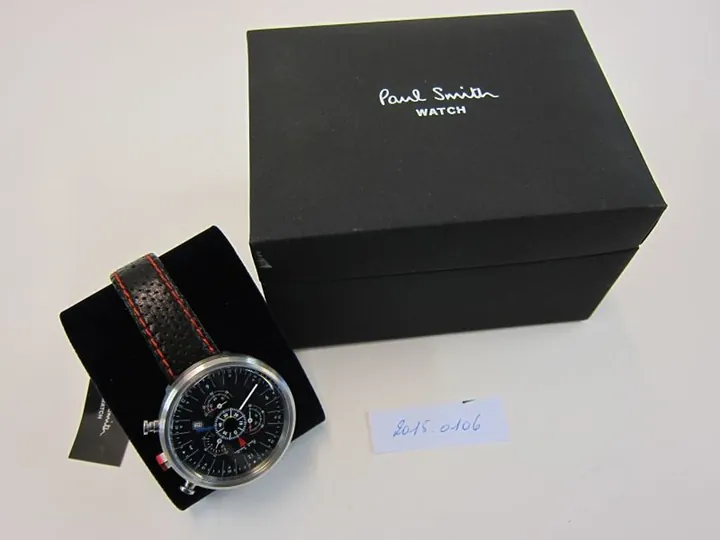
Wristwatch, 2010
Modemuseum Hasselt
Wristwatches · 2018 (Series 4 released in September 2018; '1977' in the source is the model number A1977)
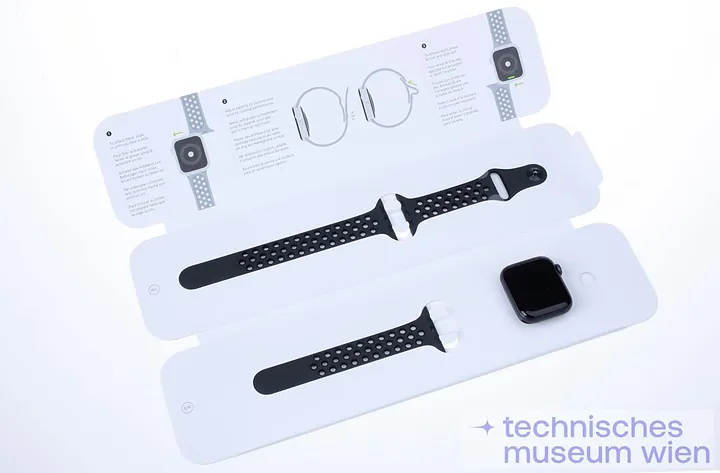
Apple Watch Series 4 (GPS, 40 mm, model A1977), 2018
Vienna Museum of Science and Technology
Wristwatches · c. 2010s
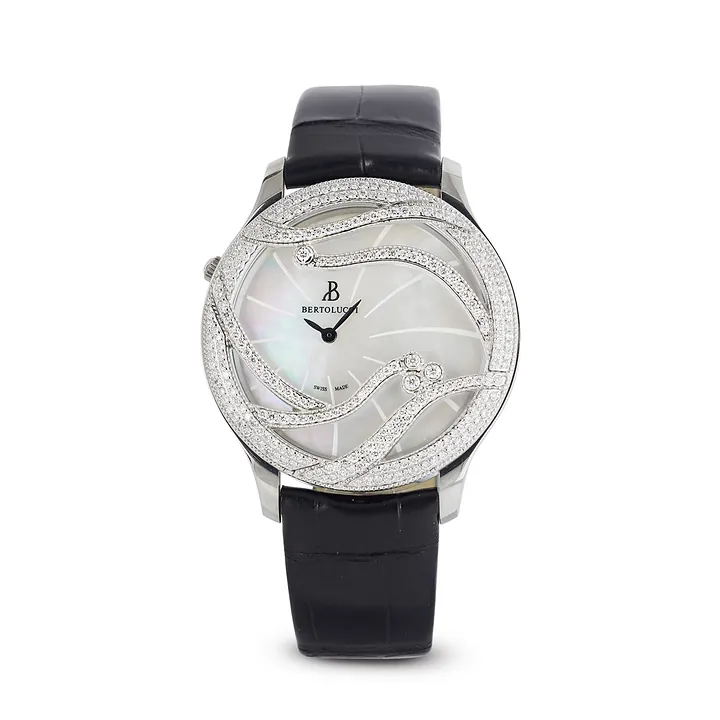
Bertolucci Stria III, ref. 11513.50.45.B88.6C1.501, c. 2010s
Antiquorum auction archive, Geneva
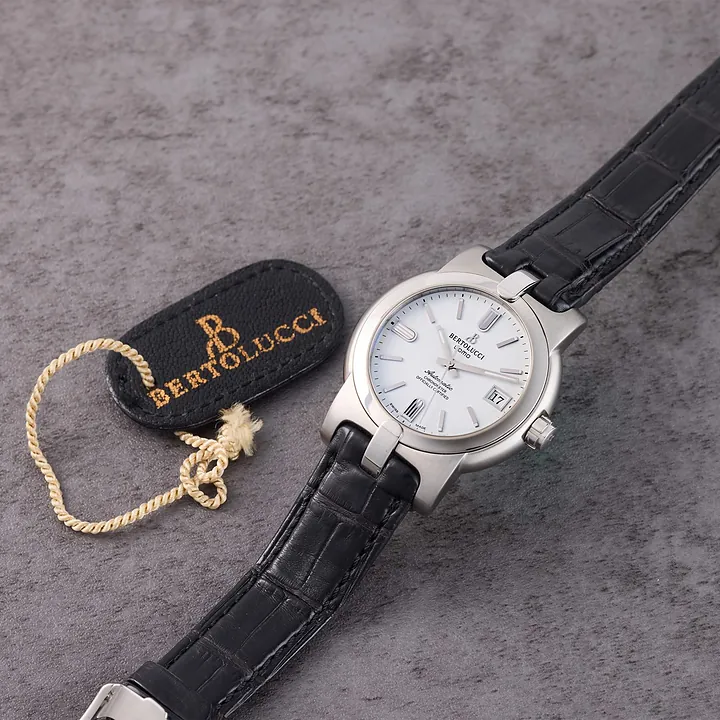
Wristwatches · c. 2010s
Bertolucci Uoma, ref. 824.51.41.10B, c. 2010s
Antiquorum auction archive, Geneva

Wristwatches · c. 2010s
Breguet Type XXI, ref. 3810, c. 2010s (Antiquorum Lot 381-24)
Antiquorum auction archive, Geneva

Wristwatches · c. 2010s
Breguet Type XXI, ref. 3810, c. 2010s (Antiquorum Lot 386-229)
Antiquorum auction archive, Geneva

Wristwatches · Sold in September 2010
Breitling Cosmonaute, ref. A 22322, Sold in September 2010
Antiquorum auction archive, Geneva
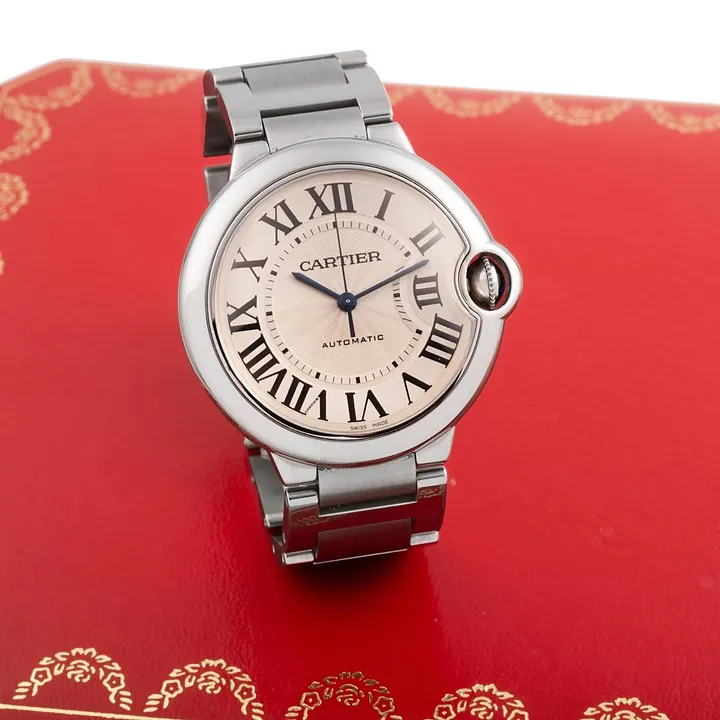
Wristwatches · c. 2010s
Cartier Ballon Bleu, ref. 3284, c. 2010s
Antiquorum auction archive, Geneva