
Wristwatches · Wristwatch
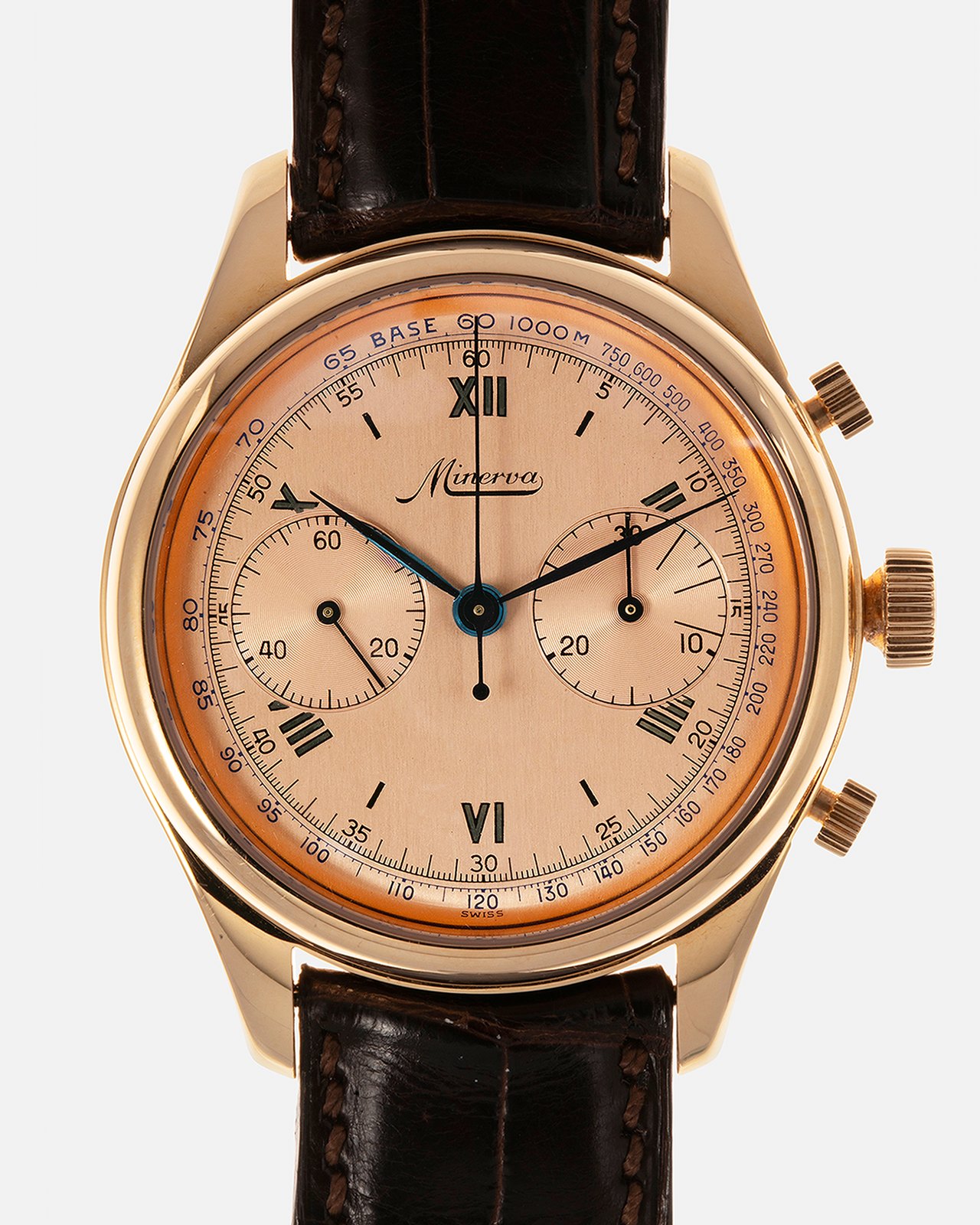
Minerva Chronograph M132000 'Salmon' RG, 2000s
- Maker / attribution
- Minerva (maker)
- Date
- 2000s
- Historical period
- Mechanical Renaissance (1990 – 2010)
- Country of origin
- Switzerland
- Object type
- Wristwatch
- Dimensions
- Case 40 mm
- Stock no.
- Product 7450307821655
- Credit line
- Dealer listing, S.Song Watches (product 7450307821655)
- Catalogue title (original)
- Minerva Chronograph M132000 'Salmon' RG (English)
View the source record (dealer listing) ↗ (opens another website in a new tab)Suggest a correction
Record summary
Catalogued by S.Song Watches (dealer), Seattle (stock number Product 7450307821655), this is a wristwatch by Minerva, made in Switzerland, dated 2000s. The Atlas places it in the Mechanical Renaissance period (1990 – 2010) of its Wristwatches collection. Recorded dimensions: Case 40 mm. The record is illustrated with 6 photographs.
Assembled from the source record's structured fields. Dates and attributions are given as the source states them; where a field is missing the Atlas leaves it blank rather than estimating.
Catalogue description
Dealer description — S.Song Watches
Minerva may have remained under the radar for much of its history, but it holds a revered place among watch enthusiasts, particularly for its contributions to chronograph development. Founded in 1858 in the small town of Villeret in the canton of Bern, Switzerland, by brothers Charles and Hyppolite Robert, the brand began producing pocket watches powered by third-party calibres before transitioning to in-house movement production towards the end of the 19th century. Historically, Minerva has long been hailed as a pioneer in the development of wrist-worn chronographs, with its exceptional reliability and accuracy earning it the role of official timing partner for the 1936 Olympic Games in Germany. Despite undergoing several changes in management between the 1930s and 1990s, most notably under the stewardship of André Frey and his son Jean-Jacques Frey, the brand remained steadfast in its commitment to traditional watchmaking. The Frey family, who helmed Minerva for much of the 20th century, played a pivotal role in preserving the manufacture’s independence and mechanical heritage during an era when many others pivoted toward mass production and quartz technology. A trained watchmaker himself, André Frey oversaw the technical aspects of the operation, while Jean-Jacques focused on its business and strategic direction. Under their leadership, Minerva continued to produce hand-finished, high-quality, in-house mechanical calibres, reinforcing its reputation for precision and reliability. This unwavering dedication enabled the manufacture to weather the quartz crisis of the 1970s with its identity intact. One of the standout highlights of Gnutti’s tenure was the M132000 Chronograph—the very watch being offered here today. Introduced in the early 2000s, the M132000 features a nicely proportioned 40mm x 13mm rose gold case that houses a striking salmon dial with a refined pinkish hue. Visually, it evokes the spirit of the 1920s, thanks to its well-balanced, period-matching and symmetrical dial layout, which pays homage to the golden age of traditional chronograph design. At 9:00, you’ll find a running seconds display, complemented by a 30-minute counter at 3:00 as well as an attractive cursive ‘Minerva’ signature at 12:00. An intricately printed blue tachymeter scale encircles the outer periphery of the dial, framing some compact Roman hour numerals within and a set of thermally blued hands that provide a striking contrast against the warm salmon backdrop. Looking at it as a whole, the dial is perfectly executed and beautifully composed. Its charm is further elevated by the pairing of a lustrous rose gold case, featuring an alluring stepped concave bezel and a knurled signed crown that is flanked by a set of matching chronograph pushers, tying the entire aesthetic together with seamless elegance and vintage-inspired flair. Powering the M132000 from within is the Minerva Cal.13-20, a manual-winding chronograph movement originally introduced in 1923. For those who are unaware, the Cal. 13-20 was initially conceived by Minerva as a monopusher calibre but was later evolved into a dual pusher configuration, as featured in this example. Visible through the M13200’s exhibition caseback, the Cal. 13-20 is, needless to say, a visually stunning movement, distinguished by high-level hand finishing and traditional craftsmanship throughout—hallmarks of a manufacture long celebrated for its chronograph expertise. I genuinely believe there is something undeniably special about pieces like these from the early 2000s; they remain some of the most underrated timepieces a collector can own. In the context of today’s collecting landscape, these Minerva designs embody a unique intersection of vintage design and modern craftsmanship. More than that, they tell the story of a well-respected manufacture that has stayed fiercely true to its roots while gracefully evolving with the times, which is no small feat by any means. If you are a chronograph fan seeking something a little off the beaten path, yet rich in storied heritage, look no further than this exceptional example.
Historical context
Mechanical Renaissance (1990 – 2010)
Mechanical watches return as cultural objects; independent watchmaking flourishes.
Mechanical watches returned as cultural and luxury objects. Complications, tourbillons and new materials proliferated; independent watchmakers such as George Daniels, F.P. Journe and Philippe Dufour revived artisanal watchmaking; collecting vintage watches became a major field.
Read the period in the timelineMore wristwatches from this periodEarlier: Quartz Revolution
Atlas type guide
Chronographs and split-seconds watches
A chronograph is a watch with an additional seconds hand that can be started, stopped and returned to zero independently of the timekeeping. Louis Moinet built an early example in 1816 and Nicolas Rieussec a recording 'chronographe' in 1821; Adolphe Nicole's heart-shaped reset cam (patented 1862) made the modern return-to-zero possible. Split-seconds (rattrapante) chronographs add a second hand that can be stopped for intermediate times; flyback chronographs restart instantly.
Chronographs were essential tools for doctors (pulsometer scales), artillery (telemeter), engineers and sport. In wristwatches, Valjoux, Venus, Lemania and later the automatic chronographs of 1969 (Zenith El Primero, the Chronomatic Calibre 11 group and Seiko 6139) are milestones.
What to look for
- Push-pieces on the case band or a single button in the crown (monopusher).
- Subsidiary registers for minutes and hours; tachymeter, telemeter or pulsometer scales.
- Column wheel versus cam control visible in the movement.
- Calibre markings of specialist makers (Valjoux, Lemania, Venus, Landeron).
Dating clues
- Pocket chronographs with heart cam reset: after 1862.
- Wrist chronographs: from c. 1910; two-button designs from the 1930s.
- Automatic chronographs: from 1969.
General guidance written by the Atlas editors about this kind of object. It is not a statement about this particular piece; for that, rely on the source record above and on physical examination.
Read next:Flyback chronographChronograph
Related records
Wristwatches · c. 1960s
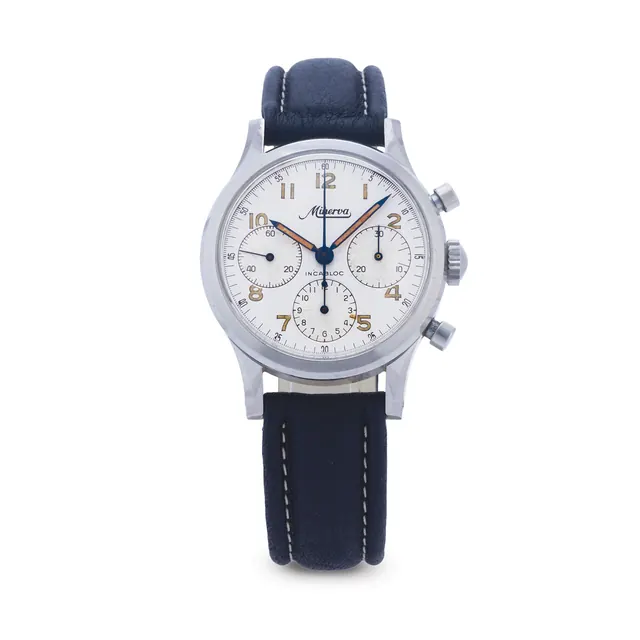
Minerva wristwatch, ref. VD712, Chronograph, circa 1960s
Antiquorum auction archive, Geneva
Pocket Watches · c. 1930s
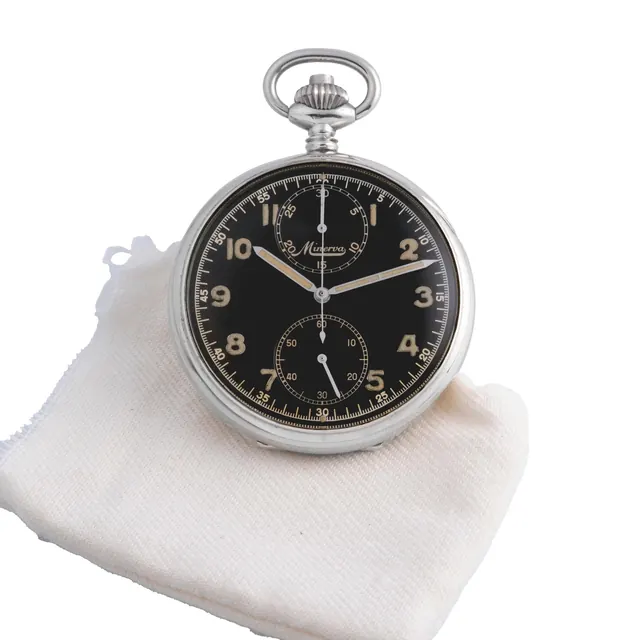
Minerva pocket watch, Single Button Chronograph Black Luminous Dial, circa 1930's
Antiquorum auction archive, Geneva
Wristwatches · c. 1940s
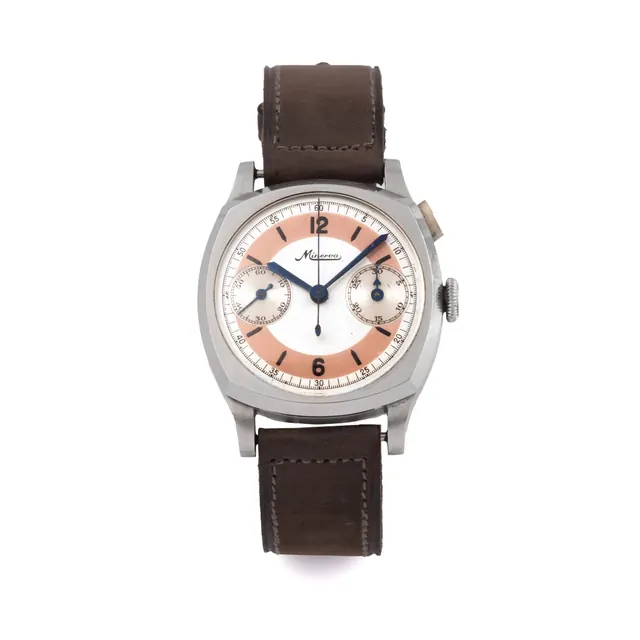
Minerva wristwatch, Single Button Chronograph New Old Stock, circa 1940's
Antiquorum auction archive, Geneva
Pocket Watches · c. 1930s
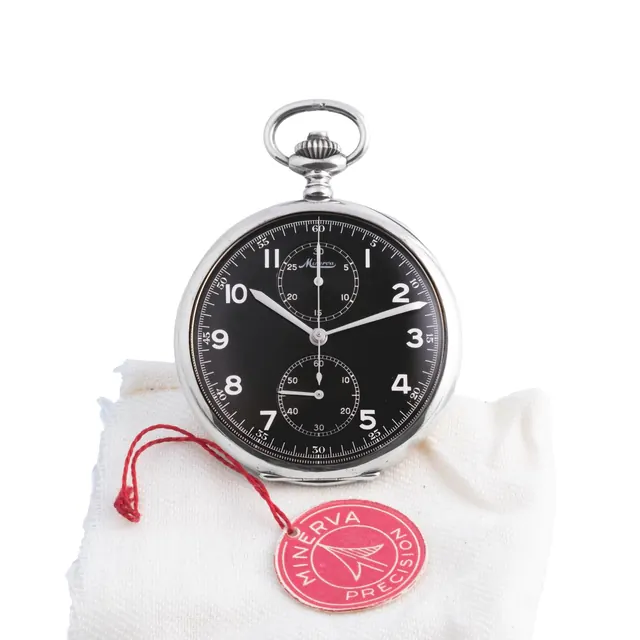
Minerva pocket watch, Single Button Chronograph Black Dial, circa 1930's
Antiquorum auction archive, Geneva

Wristwatches · 2008
Wristwatch by Breitling?, 2008
Museum Rotterdam

Wristwatches · c. 1990s
Audemars Piguet Bamboo, c. 1990s
Antiquorum auction archive, Geneva

Wristwatches · c. 1990
Audemars Piguet Huitieme Perpetual Calendar, ref. 25696PT, c. 1990
Antiquorum auction archive, Geneva

Wristwatches · c. 1990
Breitling Chronomat, ref. b13050.1, c. 1990
Antiquorum auction archive, Geneva