
Wristwatches · Wristwatch
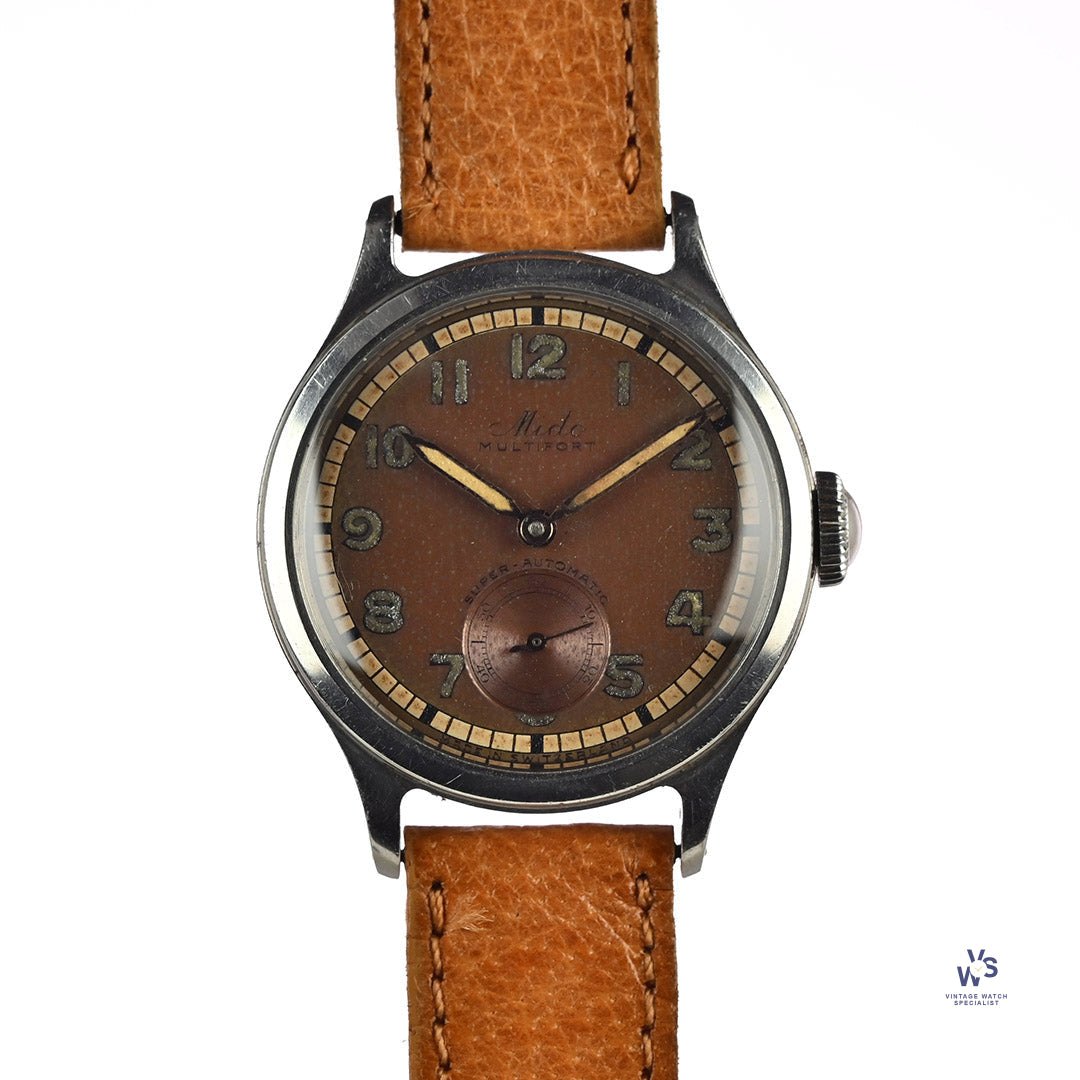
Mido Multifort Super Automatic, Tropical Chocolate Dial and Borgel Case, circa 1940s
- Maker / attribution
- Mido (maker)
- Date
- c. 1940s
- Historical period
- Golden Age of Mechanical Watchmaking (1900 – 1945)
- Country of origin
- Unrecorded in source
- Object type
- Wristwatch
- Stock no.
- vws3011cs
- Credit line
- Dealer listing, Vintage Watch Specialist (vws3011cs)
- Catalogue title (original)
- Mido Multifort Super Automatic - Tropical Chocolate Dial and Borgel Case - c.1940s (English)
View the source record (dealer listing) ↗ (opens another website in a new tab)Suggest a correction
Record summary
Catalogued by Vintage Watch Specialist (dealer), United Kingdom (stock number vws3011cs), this is a wristwatch by Mido, dated c. 1940s. The Atlas places it in the Golden Age of Mechanical Watchmaking period (1900 – 1945) of its Wristwatches collection. The record is illustrated with 6 photographs.
Assembled from the source record's structured fields. Dates and attributions are given as the source states them; where a field is missing the Atlas leaves it blank rather than estimating.
Catalogue description
Dealer description — Vintage Watch Specialist
A Stunning Mido Multifort Super Automatic with a Stunning Tropical Dial, Original Lume and (Borgel) Taubert Frères SA Decagonal Steel Case. Founded in Switzerland by Georges Schaeren in 1918, Mido is today based in the town of Le Locle, in the heart of the Swiss Jura mountains. The name Mido comes from the Spanish «Yo mido», meaning «I measure». Since its inception, Mido's philosophy has combined innovation, aesthetics and functionality.1934 saw the launch of the Multifort line which was one of the first antimagnetic watches with a self-winding movement and built-in water- and shock resistance. What’s On Offer For those who appreciate the beauty of a 'tropical' or chocolate-dialed watch, this is truly one of nature's marvels! Just look at that rich deep colour, it is stunning! As well as being beautifully tropical, the dial boasts bold Arabic numerals, lumed hands and a recessed sub-seconds counter at 6 o'clock. The lume on the hands has also aged nicely to a nice caramel colour - this dial is like a box of chocolates- delicious! The chocolate dial is encapsulated underneath an acrylic crystal and encased in a stainless steel d ecagonal case designed by Taubert Frères SA - see the ten straight edges to the caseback, Taubert was the company who took over the famous case maker, Borgel watch case-making company of Geneva. The watch is in beautiful vintage condition and wears wonderfully on the wrist. It is running well and keeping good time thanks to a recent service.
Historical context
Golden Age of Mechanical Watchmaking (1900 – 1945)
The wristwatch displaces the pocket watch; waterproof cases, self-winding and grand complications.
The wristwatch overtook the pocket watch. Military use in the First World War, aviation, water-resistant cases (1926), automatic winding (1923–31), rectangular Art Deco designs and early chronographs and calendars defined the period.
Read the period in the timelineMore wristwatches from this periodEarlier: Industrial Revolution
Atlas type guide
Automatic (self-winding) watches
Self-winding watches use the wearer's motion to wind the mainspring. Abraham-Louis Perrelet and Breguet made 'perpétuelle' pocket watches with oscillating weights in the late eighteenth century, but the principle only became practical in the wristwatch. John Harwood patented a bumper automatic in 1923; Rolex's Perpetual rotor (1931) winding in one direction, and later bidirectional rotors (Eterna, Felsa Bidynator), established the modern form. Micro-rotors (Universal Genève, Buren) and peripheral rotors made automatic watches thinner.
What to look for
- A semicircular rotor turning 360° over the movement, or a 'bumper' weight that rebounds between springs.
- 'Automatic', 'Perpetual' or 'Self-winding' on the dial.
- A sealed screw-back case, since automatic watches are wound less often by the crown.
Dating clues
- Bumper automatics: 1923–c. 1955.
- Full rotors: from 1931 (Rolex); widespread after c. 1950.
- Micro-rotors: from 1954–1958.
General guidance written by the Atlas editors about this kind of object. It is not a statement about this particular piece; for that, rely on the source record above and on physical examination.
Related records
Wristwatches · c. 1962
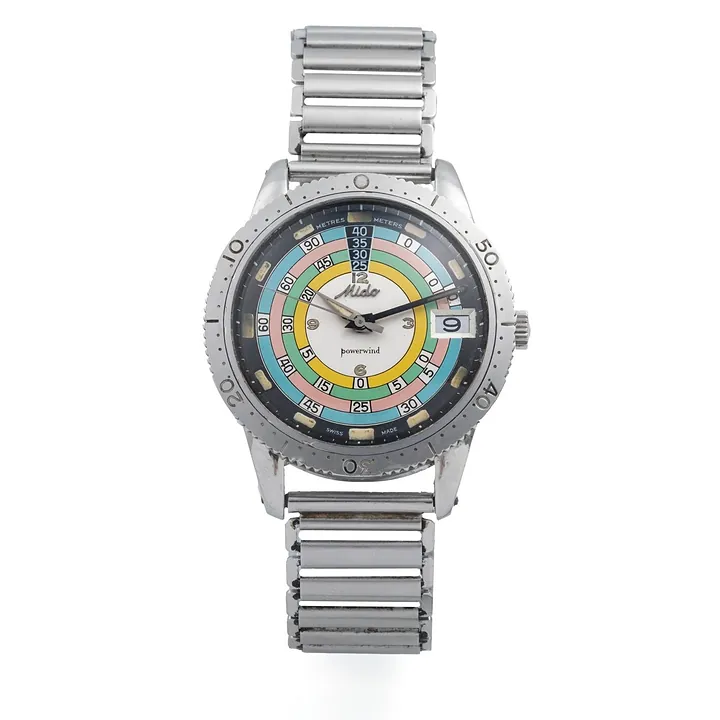
Mido Powerwind Rainbow, ref. 5907, c. 1962
Antiquorum auction archive, Geneva
Wristwatches · c. 1940s
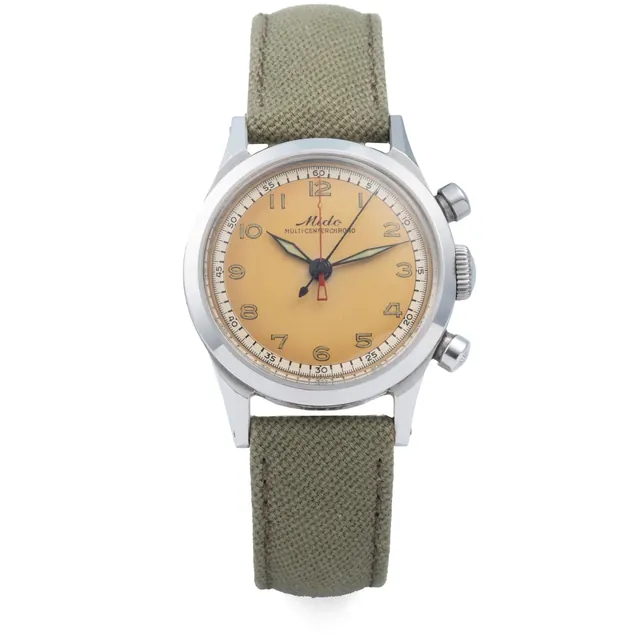
Mido wristwatch, Multi-Centerchrono Taubert/Borgel Case, circa 1940's
Antiquorum auction archive, Geneva
Wristwatches · c. 1940-1950s
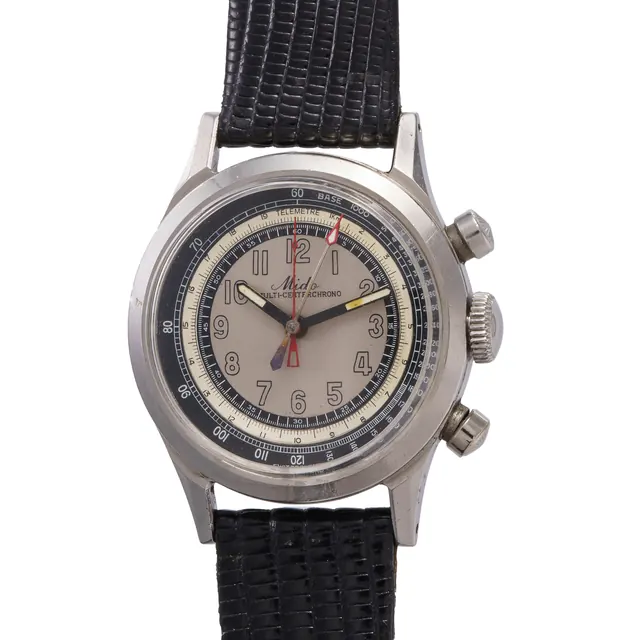
Mido wristwatch, Multi-Centerchrono, circa 1940-1950s
Antiquorum auction archive, Geneva
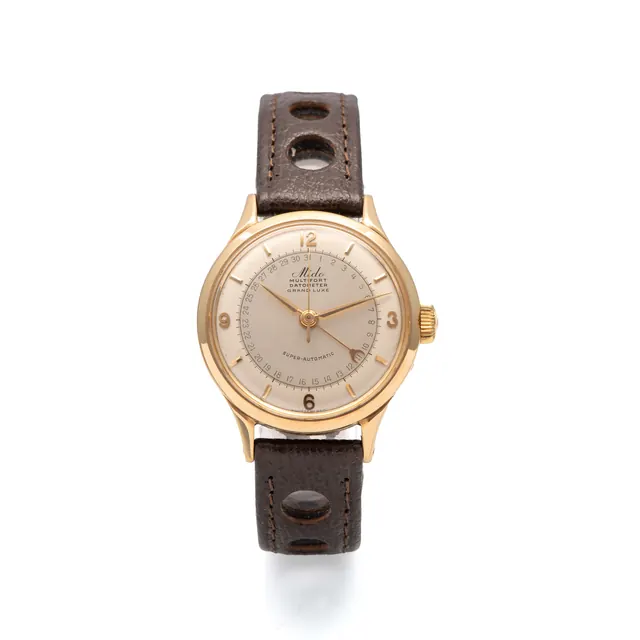
Wristwatches · c. 1950s
Mido wristwatch, Multifort Datometer Grand Luxe Waterproof, circa 1950's
Antiquorum auction archive, Geneva
Wristwatches · 1900–1999
Wristwatch by Mercury, 1900–1999
Modemuseum Hasselt
Wristwatches · 1900–1999
Wristwatch by Nutrix, 1900–1999
Modemuseum Hasselt
Wristwatches · 1920
Wristwatch, 1920
Modemuseum Hasselt

Wristwatches · 1931
Rolex 'Oyster Perpetual' rotor self-winding wrist-watch, lever escapement, in steel case with glass in back, Montres Rolex SA, Geneva, Switzerland, 1931
Science Museum Group, London