
Wristwatches · Wristwatch
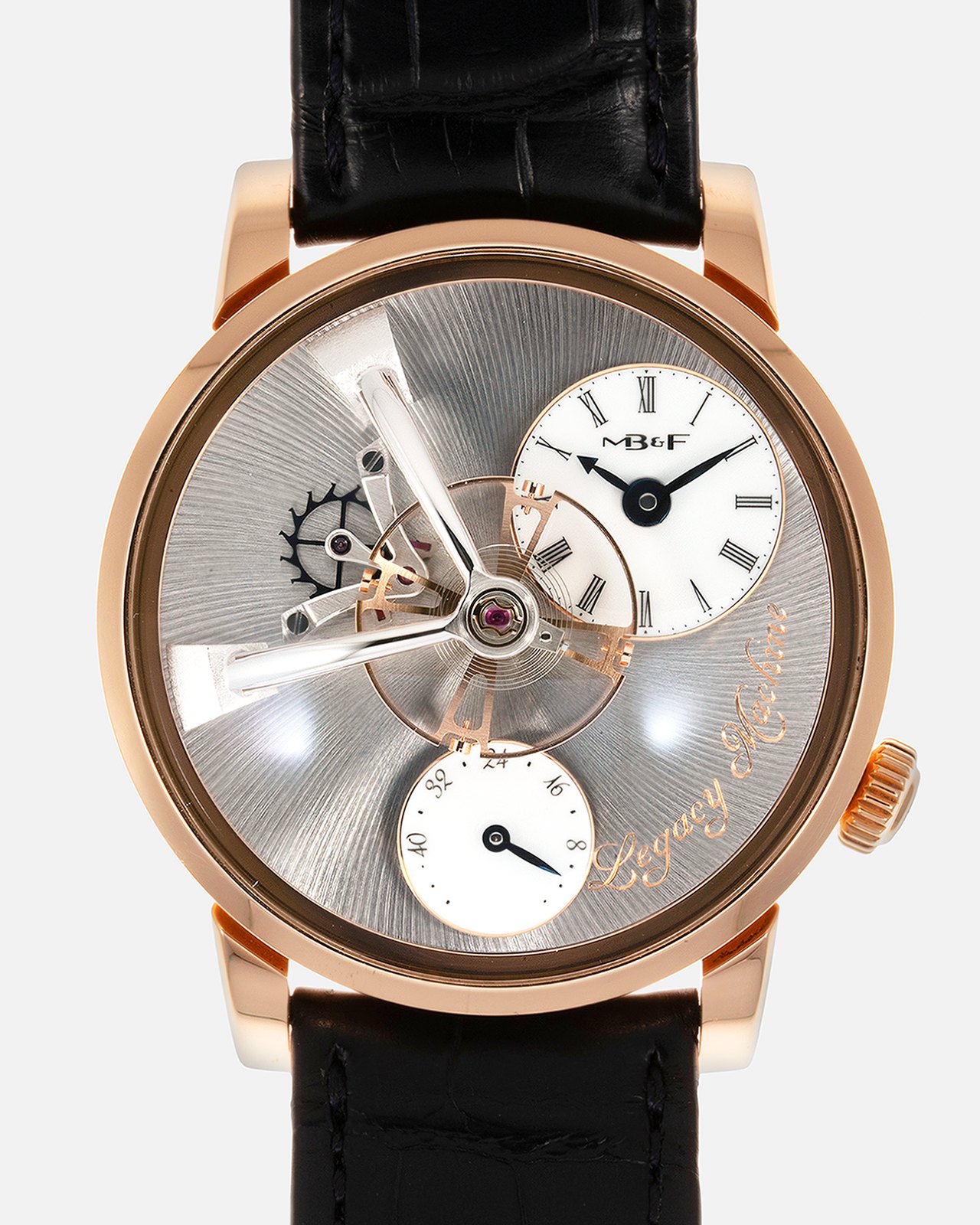
MB&F LM101 Rose Gold, 2022
- Maker / attribution
- MB&F (maker)
- Date
- 2022
- Historical period
- Contemporary Horology (2010 – Present)
- Country of origin
- Switzerland
- Object type
- Wristwatch
- Materials / technique
- rose gold
- Dimensions
- Case 40 mm
- Stock no.
- Product 6915524231255
- Credit line
- Dealer listing, S.Song Watches (product 6915524231255)
- Catalogue title (original)
- MB&F LM101 Rose Gold (English)
View the source record (dealer listing) ↗ (opens another website in a new tab)Suggest a correction
Record summary
Catalogued by S.Song Watches (dealer), Seattle (stock number Product 6915524231255), this is a wristwatch by MB&F, made in Switzerland, dated 2022. The Atlas places it in the Contemporary Horology period (2010 – Present) of its Wristwatches collection. Materials and techniques recorded by the source: rose gold. Recorded dimensions: Case 40 mm. The record is illustrated with 6 photographs.
Assembled from the source record's structured fields. Dates and attributions are given as the source states them; where a field is missing the Atlas leaves it blank rather than estimating.
Catalogue description
Dealer description — S.Song Watches
Maximillian Büsser and Friends, or as we more familiarly know it, MB&F, is one of the most exciting and avant-garde independent watch brands in the watch collecting scene today. Known famously for its ethos of collaborating and acknowledging other master watchmakers in the industry, it is helmed by Max Büsser who together have created some of the most radical and out-there watch designs. The brand is divided into two distinct segments: the HM series, which stands for Horological Machine, and features their most unconventional and audacious timepieces, and the LM series, which stands for Legacy Machine, representing watches that embody the style of a century ago. This structure of the brand is remarkable as it signifies a deep respect for the past, drawing inspiration from it, while simultaneously forging ahead with futuristic and innovative designs. It's a beautiful balance between honoring tradition and creating original, forward-looking horological machines (in other words, highly unique timepieces). The LM101, as denoted, is part of the Legacy Machine series and is the most wearable MB&F by a long margin. First introduced back in 2014, it took the watch world by storm with its unconventional expression of how a watch movement could be constructed. At 40mm, it is sized more conservatively than the other 44mm LM’s and for me, sits the best on the wrist. While the LM101 is considered the entry-level MB&F, it is my favorite because of its fine balance between being simple and looking crazy at the same time. What we have here today is the ‘Red Gold’ variant of the LM101, housed within an 18-carat red gold case and features a contrasting sunburst silver baseplate. In ‘typical’ MB&F fashion, what sets this design apart from other independents is the distinctive signature that made the brand renowned — the large 14mm floating balance positioned on the front of the watch. With a V-shaped 3D bridge suspending the balance above the dial, this watch is far from being "classical" and I assure you, you'll find yourself captivated by it throughout the day. Additionally, a 45-hour power reserve and time indication sub-dial with lacquered finish float above the silver sunburst dial, adding the final touch to this three-dimensional masterpiece. When you turn the watch over, you'll notice that MB&F didn't only focus on the front side. The entire movement is impeccably finished, demonstrating their commitment to perfection. What I particularly appreciated about the movement is its visual proximity to the surface of the sapphire caseback, which enhances the overall viewing experience and makes it even more captivating to admire. The overall aesthetic design of the movement is beautiful, with huge spaces between the bridges and Geneva-striped bridges. Interestingly, the LM101 movement is the first entirely developed and assembled in-house movement from the brand, with the help of course from a long-time friend of the house, Kari Voutilainen.
Historical context
Contemporary Horology (2010 – Present)
Silicon components, connected watches, optical-lattice research clocks and a thriving independent scene.
Smartwatches became the world's best-selling watches, while mechanical watchmaking focuses on craft, innovation (silicon components, new escapements) and independent makers.
Read the period in the timelineMore wristwatches from this periodEarlier: Mechanical Renaissance
Atlas type guide
Wristwatches
Bracelet watches were worn by women from the early nineteenth century — Breguet made one for Caroline Murat, Queen of Naples, in 1810–12 — but the wristwatch only became a man's instrument with military use and aviation in the early twentieth century. Between the World Wars it overtook the pocket watch; the 1920s and 1930s brought rectangular Art Deco cases, water-resistant cases and the first automatic winding systems.
After 1945 the wristwatch became a carrier of identity — dress watches, sports and dive watches, chronographs, calendars — produced by Swiss, American, Japanese, German, Soviet and Chinese industries. The quartz revolution after 1969 and the mechanical renaissance since the 1990s, including the rise of independent watchmakers, complete the story.
What to look for
- The reference number (between the lugs or inside the case back) and serial number, the starting point for dating.
- The calibre: its maker and number are often stamped under the dial or on the bridge.
- Originality of dial, hands and crown — refinished ('redial') dials are common.
- Case material marks: 18K/750, 14K/585, stainless steel, gold-filled, plated.
Dating clues
- Wire-lug cases: before c. 1925.
- Water-resistant screw-down cases: from 1926.
- Quartz movements: from 1969; sapphire crystals widespread after c. 1980.
General guidance written by the Atlas editors about this kind of object. It is not a statement about this particular piece; for that, rely on the source record above and on physical examination.
Related records
Wristwatches · c. 2022
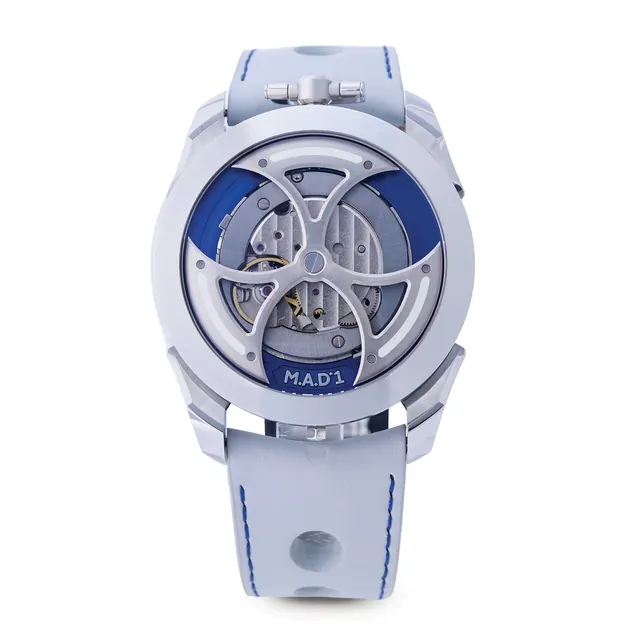
MB&F wristwatch, M.A.D 1 Blue M.A.D.Editions, circa 2022
Antiquorum auction archive, Geneva
Wristwatches · 2025
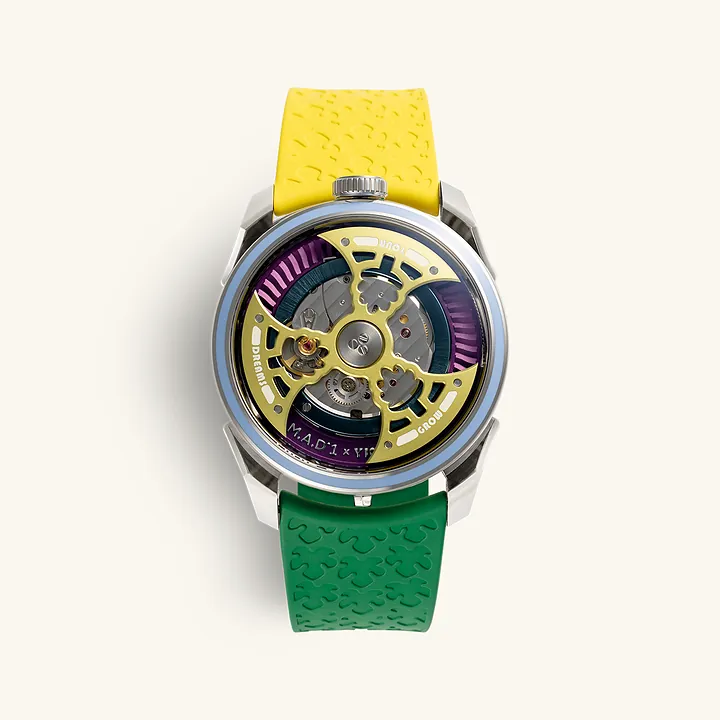
MB&F M.A.D Editions Yinka Ilori “Grow Your Dreams’ Sun Edition, 2025
Watches of Knightsbridge (dealer), London
Wristwatches · 2022
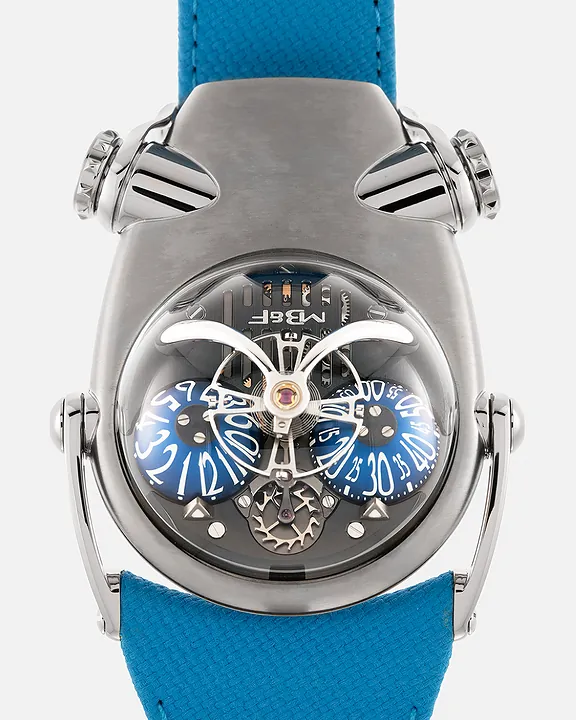
MB&F HM10 Bulldog Titanium, 2022
S.Song Watches (dealer), Seattle
Wristwatches · 2021
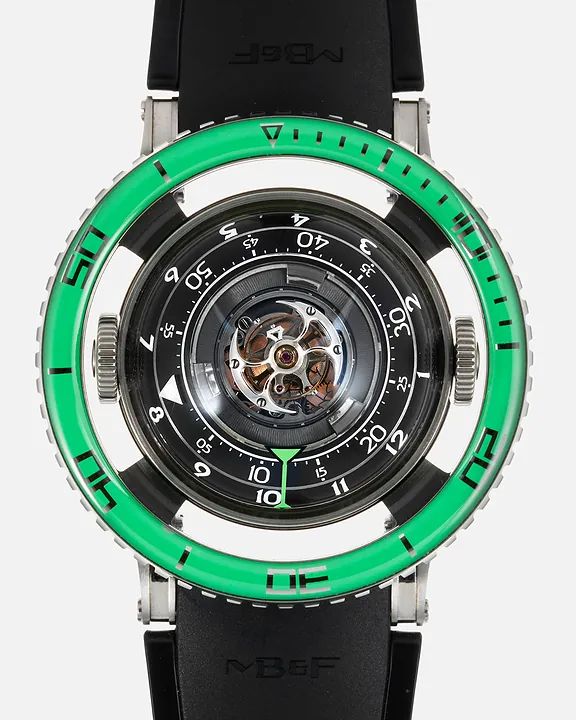
MB&F HM7 Aquapod Flying Tourbillon, 2021
S.Song Watches (dealer), Seattle

Wristwatches · c. 2010s
Breguet Type XXI, ref. 3810, c. 2010s (Antiquorum Lot 381-24)
Antiquorum auction archive, Geneva

Wristwatches · c. 2010s
Breguet Type XXI, ref. 3810, c. 2010s (Antiquorum Lot 386-229)
Antiquorum auction archive, Geneva

Wristwatches · Sold in September 2010
Breitling Cosmonaute, ref. A 22322, Sold in September 2010
Antiquorum auction archive, Geneva

Wristwatches · c. 2010
Corum Bubble Chrono, ref. 396.150.20, c. 2010
Antiquorum auction archive, Geneva