
Wristwatches · Wristwatch
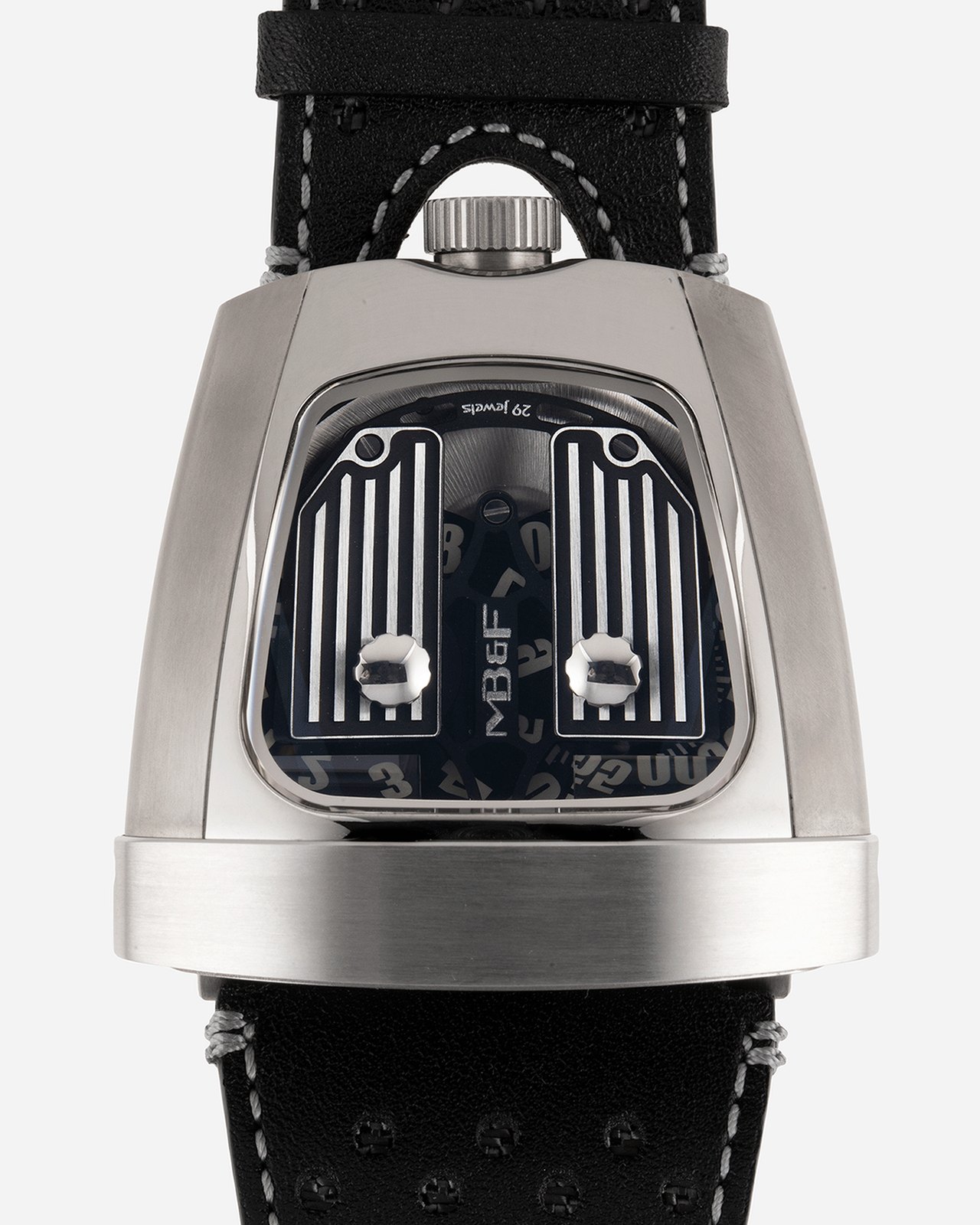
MB&F HMX Lotus Black 10th Anniversary, 2016
- Maker / attribution
- MB&F (maker)
- Date
- 2016
- Historical period
- Contemporary Horology (2010 – Present)
- Country of origin
- Switzerland
- Object type
- Wristwatch
- Stock no.
- Product 6634595156055
- Credit line
- Dealer listing, S.Song Watches (product 6634595156055)
- Catalogue title (original)
- MB&F HMX Lotus Black 10th Anniversary (English)
View the source record (dealer listing) ↗ (opens another website in a new tab)Suggest a correction
Record summary
Catalogued by S.Song Watches (dealer), Seattle (stock number Product 6634595156055), this is a wristwatch by MB&F, made in Switzerland, dated 2016. The Atlas places it in the Contemporary Horology period (2010 – Present) of its Wristwatches collection. The record is illustrated with 6 photographs.
Assembled from the source record's structured fields. Dates and attributions are given as the source states them; where a field is missing the Atlas leaves it blank rather than estimating.
Catalogue description
Dealer description — S.Song Watches
Famed for their unique take on watchmaking and all of its various intricacies, MB&F has gone from a fledgling watchmaker to independent superstar on the back of Max Busser's incredible creativity and MB&F's customer-focused ideals. Founded in 2005, MB&F celebrated their 10th anniversary in 2015, and instead of following the convention by releasing a rehashed version of an old design, MB&F released the HMX as a way to thank their clients and friends and continue where the legendary brand took off. Often drawing inspiration from some of the most unsuspecting of places, MB&F's timepieces are unique in their design, and the HMX is no different. Inspired by a supercar, the HMX is a driver's watch with the express purpose of emulating a racecar in just about every facet of its design. Starting with its rectangular case, the HMX uses a titanium and stainless steel construction that blends polished surfaces with brushed and smooth undulating curves and sharp corners and edges. With a sapphire crystal sitting atop its case like a sunroof, the HMX's movement's bridges are designed to look like a supercar's engine viewable through an engine bay, like most modern supercars. Featuring a proprietary system of gears and rotors, the HMX's movement drives an incredibly unique and interesting display. Offered in four colors with just 20 pieces each, the example I have here is the Lotus Black, named after the legendary F1 team and automaker. Inspired by a car's dashboard, the HMX's display is a digital jumping hours display with a trailing digital minutes display next to it. Powered by circular discs rotating flat on top of the movement, this display faces the wearer from the bottom portion of the watch so that its display is legible for the wearer while they are holding a car's steering wheel as they drive. With its crown mounted to the case at 12 o'clock like a car's exhaust and a 22ct gold winding rotor underneath the watch like a car's undercarriage, the HMX is a driver's watch through and through in every facet of its incredible design and mechanical prowess.
Historical context
Contemporary Horology (2010 – Present)
Silicon components, connected watches, optical-lattice research clocks and a thriving independent scene.
Smartwatches became the world's best-selling watches, while mechanical watchmaking focuses on craft, innovation (silicon components, new escapements) and independent makers.
Read the period in the timelineMore wristwatches from this periodEarlier: Mechanical Renaissance
Atlas type guide
Wristwatches
Bracelet watches were worn by women from the early nineteenth century — Breguet made one for Caroline Murat, Queen of Naples, in 1810–12 — but the wristwatch only became a man's instrument with military use and aviation in the early twentieth century. Between the World Wars it overtook the pocket watch; the 1920s and 1930s brought rectangular Art Deco cases, water-resistant cases and the first automatic winding systems.
After 1945 the wristwatch became a carrier of identity — dress watches, sports and dive watches, chronographs, calendars — produced by Swiss, American, Japanese, German, Soviet and Chinese industries. The quartz revolution after 1969 and the mechanical renaissance since the 1990s, including the rise of independent watchmakers, complete the story.
What to look for
- The reference number (between the lugs or inside the case back) and serial number, the starting point for dating.
- The calibre: its maker and number are often stamped under the dial or on the bridge.
- Originality of dial, hands and crown — refinished ('redial') dials are common.
- Case material marks: 18K/750, 14K/585, stainless steel, gold-filled, plated.
Dating clues
- Wire-lug cases: before c. 1925.
- Water-resistant screw-down cases: from 1926.
- Quartz movements: from 1969; sapphire crystals widespread after c. 1980.
General guidance written by the Atlas editors about this kind of object. It is not a statement about this particular piece; for that, rely on the source record above and on physical examination.
Related records
Wristwatches · c. 2022
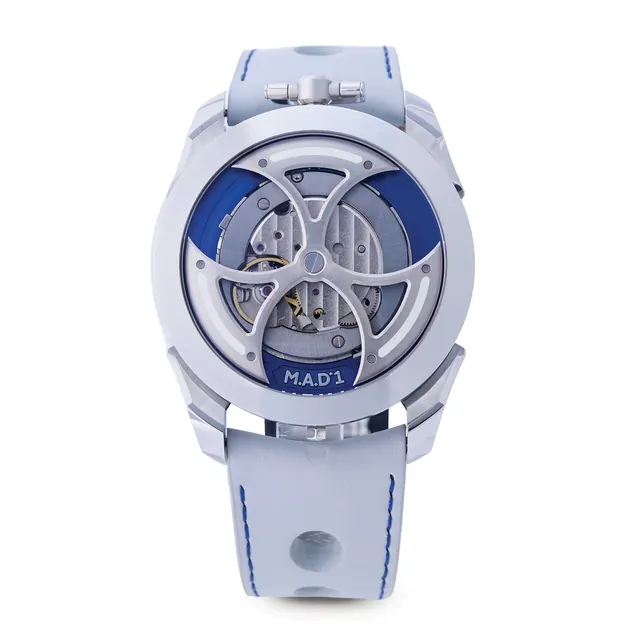
MB&F wristwatch, M.A.D 1 Blue M.A.D.Editions, circa 2022
Antiquorum auction archive, Geneva
Wristwatches · 2025
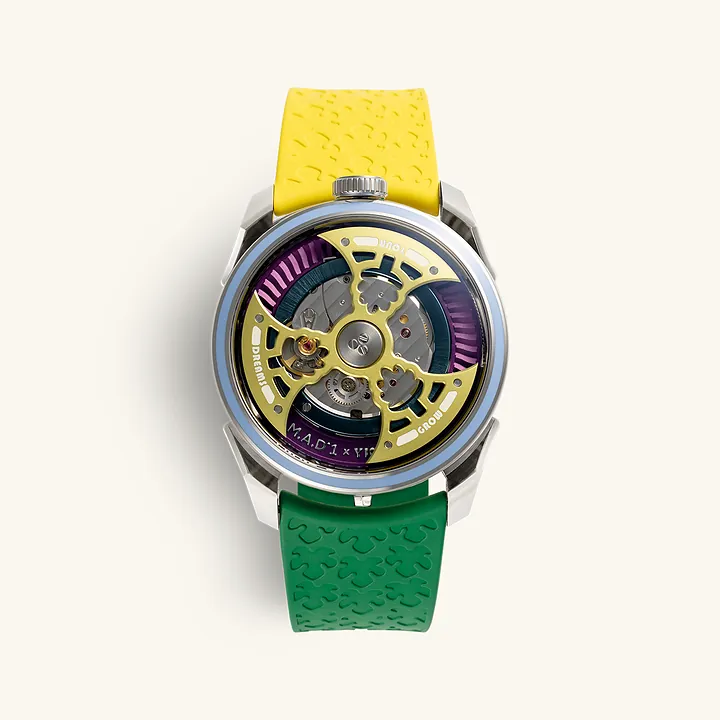
MB&F M.A.D Editions Yinka Ilori “Grow Your Dreams’ Sun Edition, 2025
Watches of Knightsbridge (dealer), London
Wristwatches · 2022
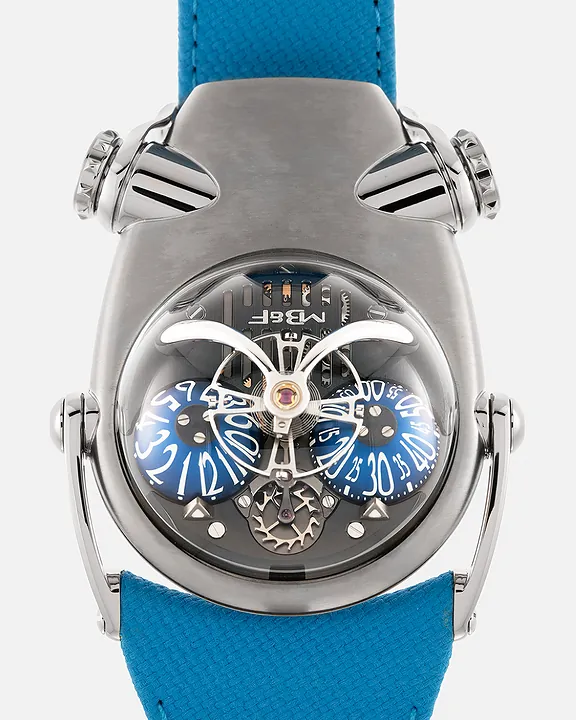
MB&F HM10 Bulldog Titanium, 2022
S.Song Watches (dealer), Seattle
Wristwatches · 2021
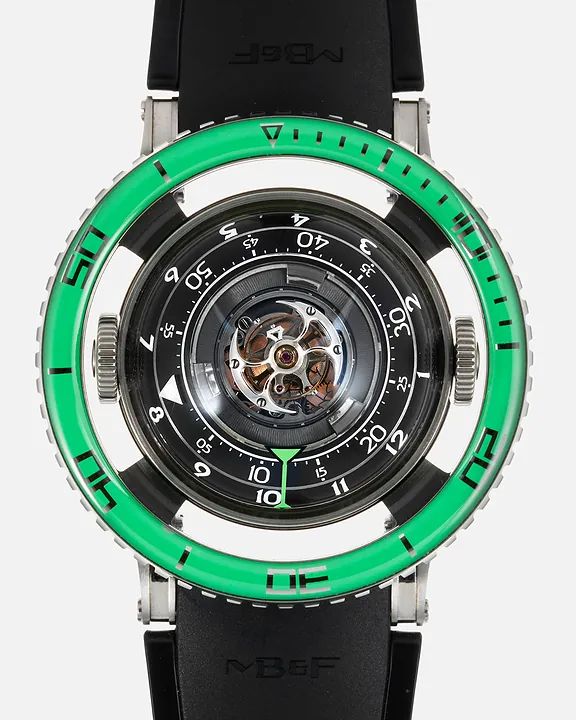
MB&F HM7 Aquapod Flying Tourbillon, 2021
S.Song Watches (dealer), Seattle

Wristwatches · c. 2010s
Breguet Type XXI, ref. 3810, c. 2010s (Antiquorum Lot 381-24)
Antiquorum auction archive, Geneva

Wristwatches · c. 2010s
Breguet Type XXI, ref. 3810, c. 2010s (Antiquorum Lot 386-229)
Antiquorum auction archive, Geneva

Wristwatches · Sold in September 2010
Breitling Cosmonaute, ref. A 22322, Sold in September 2010
Antiquorum auction archive, Geneva

Wristwatches · c. 2010
Corum Bubble Chrono, ref. 396.150.20, c. 2010
Antiquorum auction archive, Geneva