
Pocket Watches · Pocket watch
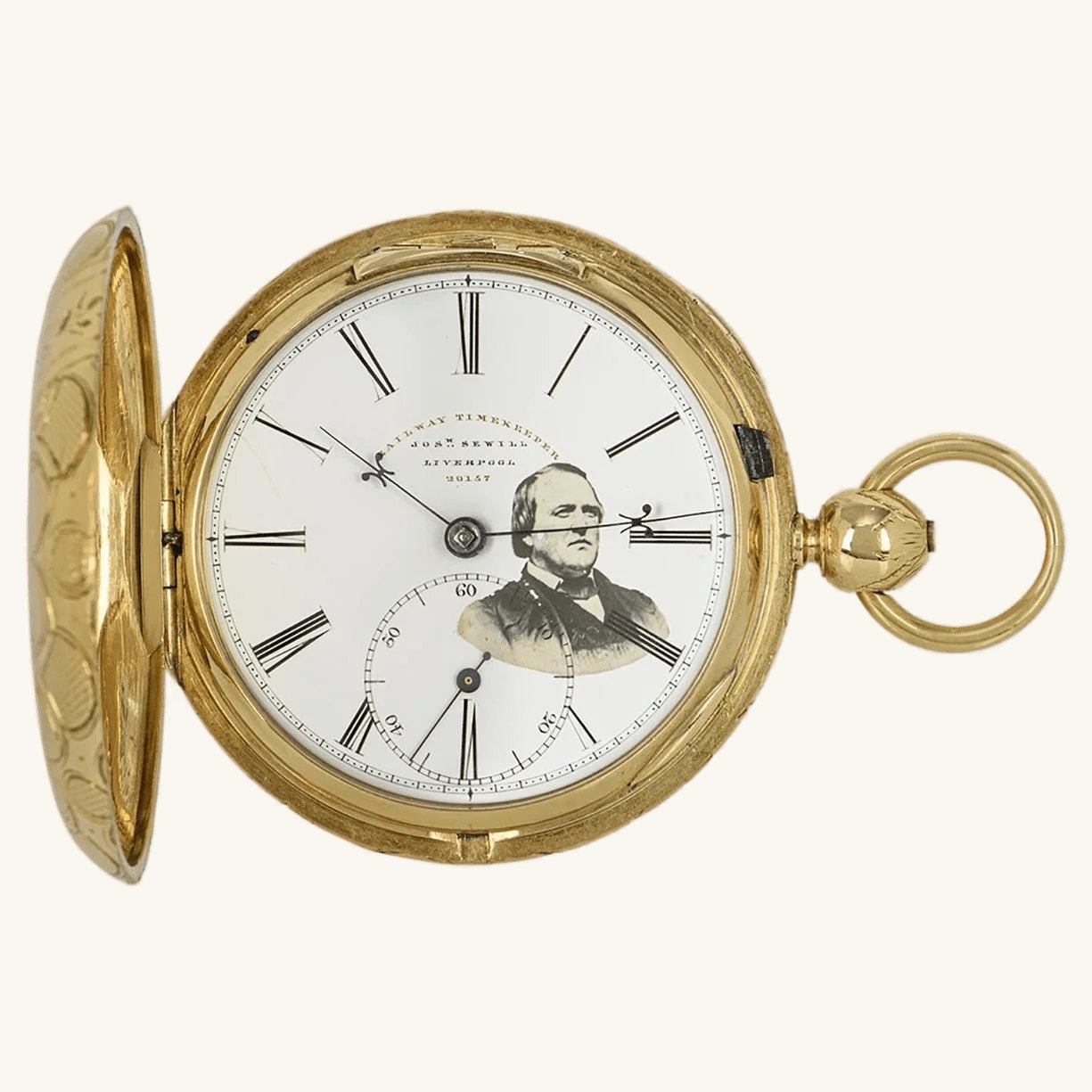
Massive Yellow Gold Keywind Fusee Railway Timepiece, 1849
- Maker / attribution
- Unrecorded in source
- Date
- 1849
- Historical period
- Precision & Scientific Horology (1750 – 1850)
- Country of origin
- Unrecorded in source
- Object type
- Pocket watch
- Materials / technique
- gold
- Dealer
- WatchMuseum.org shop
- Stock no.
- Product 3979
- Credit line
- Dealer listing, WatchMuseum.org shop (product 3979)
- Catalogue title (original)
- Massive Yellow Gold Keywind Fusee Railway Timepiece (English)
View the source record (dealer listing) ↗ (opens another website in a new tab)Suggest a correction
Record summary
Catalogued by WatchMuseum.org shop (stock number Product 3979), this is a pocket watch, dated 1849. The Atlas places it in the Precision & Scientific Horology period (1750 – 1850) of its Pocket Watches collection. Materials and techniques recorded by the source: gold. The record is illustrated with 6 photographs.
Assembled from the source record's structured fields. Dates and attributions are given as the source states them; where a field is missing the Atlas leaves it blank rather than estimating.
Catalogue description
Dealer description — WatchMuseum.org shop
Presenting a truly remarkable timepiece of great historical significance, the Massive Yellow Gold Keywind Fusee Railway Timepiece from 1849 is an exquisite example of 19th-century horological craftsmanship. This luxurious watch, encased in opulent yellow gold, embodies the precision and elegance that were paramount during the golden age of railway travel. Its keywind mechanism, a hallmark of the era, offers a nostalgic journey back to a time when the synchronization of railway schedules was a marvel of modern engineering. The fusee movement, designed to ensure consistent force and accuracy, highlights the meticulous attention to detail and ingenuity of its makers. This timepiece is not only a functional instrument but also a piece of art, reflecting the grandeur and sophistication of its period. Whether you are a collector of antique watches or a connoisseur of historical artifacts, this 1849 railway timepiece represents a unique convergence of history, technology, and luxury that is sure to captivate and inspire. Presenting a truly remarkable timepiece of great historical significance – a massive 55mm full hunter 18kt yellow gold keywind fusee railway watch. The exquisite front cover of the case is adorned with an elaborately engraved railway locomotive, complete with a coal store and carriage attached. The rear cover features a belt and buckle motif, while the edges are adorned with delicate floral engravings. The inner case bears an interesting presentation engraving that reads, “James C Robinson Springfield Illinois 1852,” revealing that this watch was likely a special gift marking an important occasion. It also bears a further engraving that reads “R Walker Briscoe Kansas 1909.” The white enamel dial of the watch is adorned with Roman numerals and features blued steel Fleur-de-Lys-style hands. It is inscribed with the words ‘Railway Timekeeper,’ in distinctive red writing, making it clear that this was a watch of great importance in the world of railway. The watchmaker, Joseph Sewill of Liverpool, is also noted on the dial. Interestingly, the dial also features a picture of James C Robinson – the man for whom this watch was presented. The keywind fusee lever movement of the watch is a true masterpiece. It features a large Liverpool Jewelling and a cut compensation balance, and comes complete with an original dust cover that opens from the front of the watch. The entire mechanism is fully signed and numbered. What makes this watch truly fascinating is the rich history behind it. James C Robinson was a distinguished solicitor who served as a Democratic Congressman from the State of Illinois a remarkable 5 times. This beautiful timepiece is a testament to his accomplishments and legacy. Creator: Fusee Case Material: 18k Gold,Yellow Gold Case Shape: Round Case Dimensions: Diameter: 55 mm (2.17 in) Place of Origin: United Kingdom Period: 19th Century Date of Manufacture: 1849 Condition: Good
Historical context
Precision & Scientific Horology (1750 – 1850)
Harrison solves longitude; Mudge invents the lever; Breguet's Paris workshop defines the modern watch.
From 1750 to 1850 the watch became a precision instrument. Mudge's lever escapement, the cylinder escapement, Lépine's thin bar calibre, Breguet's innovations (overcoil, tourbillon, perpétuelle) and the pocket chronometer of Arnold and Earnshaw all date from this period, while verge watches remained common in cheaper production.
Read the period in the timelineMore pocket watches from this periodEarlier: Early Modern Horology
Atlas type guide
Railroad and railway watches
Timetables made accurate timekeeping a matter of safety. After a fatal collision at Kipton, Ohio, in 1891, American railroads adopted strict standards: open-face watches, lever setting, at least 17 jewels, adjustment to temperature and five positions, and a performance within 30 seconds a week, inspected regularly by approved watch inspectors. Waltham, Elgin, Hamilton, Illinois and Ball made railroad-grade watches in large numbers.
European railways issued service watches to guards, drivers and station staff, often engraved with the railway's initials and a staff number. Such watches link industrial timekeeping with the standardisation of time zones (Greenwich Mean Time adopted by British railways in 1847; North American standard time in 1883).
What to look for
- Open-face cases with the crown at 12 and lever setting under the bezel.
- Montgomery dials with every minute numbered, or bold Arabic numerals.
- 'Railroad grade', '21 Jewels', 'Adjusted 5 positions' on the movement.
- Railway initials and issue numbers engraved on the case back.
Dating clues
- American railroad standards: from 1891–93, revised c. 1908.
- Serial numbers of American makers allow dating to within a year.
General guidance written by the Atlas editors about this kind of object. It is not a statement about this particular piece; for that, rely on the source record above and on physical examination.
Read next:Detached lever escapement
Related records
Pocket Watches · 1800–1899
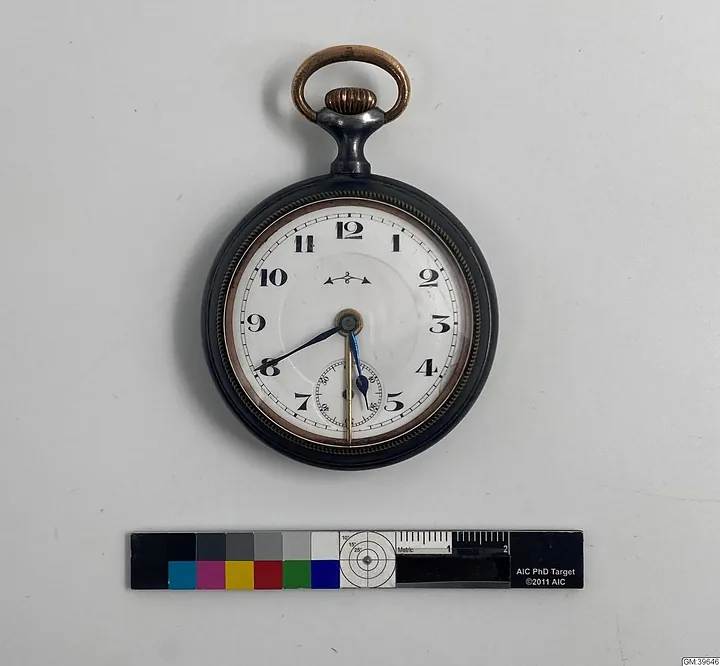
Alarm pocket watch by Eterna w, Gothenburg, 1800–1899
Museum of Gothenburg
Pocket Watches · 1820
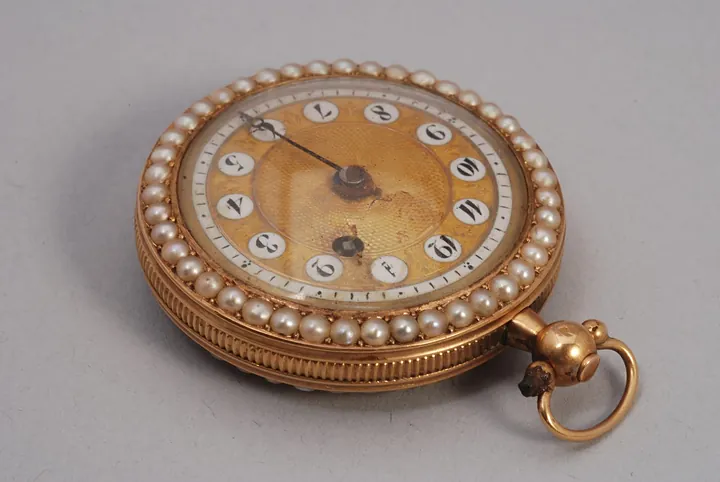
Pocket watch by Chevalier & Cochet, 1820
Museum Rotterdam
Pocket Watches · c. 1740–60
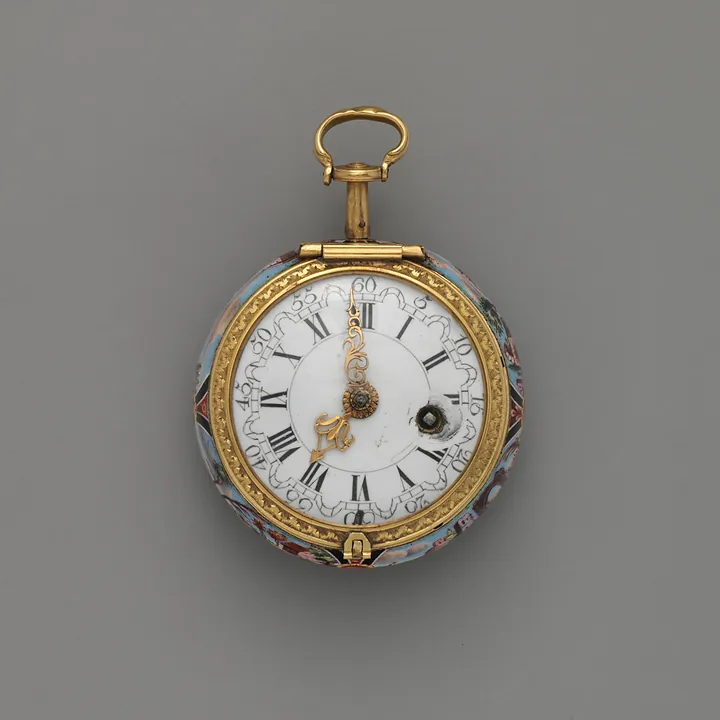
Watch by Charles Cabrier II, England, c. 1740–60 (The Met 17.190.1458)
The Metropolitan Museum of Art, New York
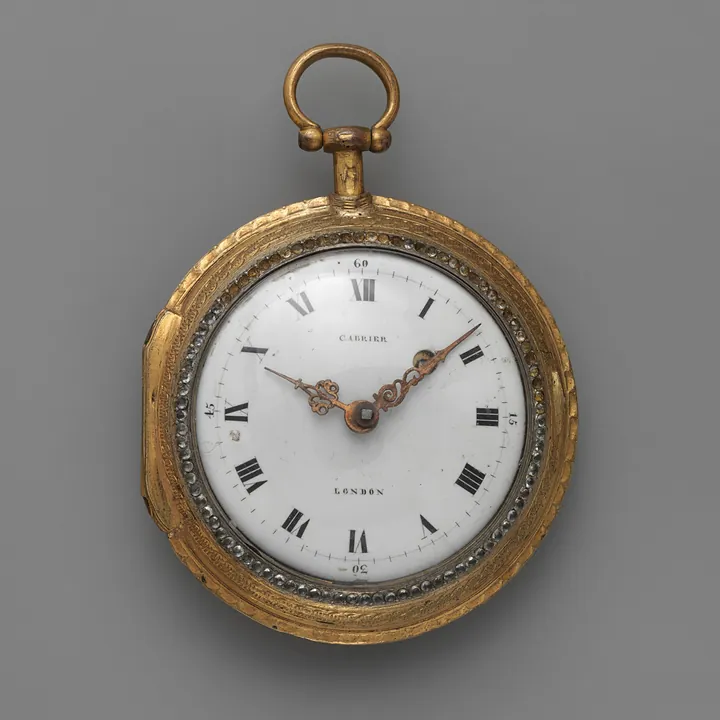
Pocket Watches · c. 1740–60
Watch by Charles Cabrier II, England, c. 1740–60 (The Met 17.190.1461)
The Metropolitan Museum of Art, New York
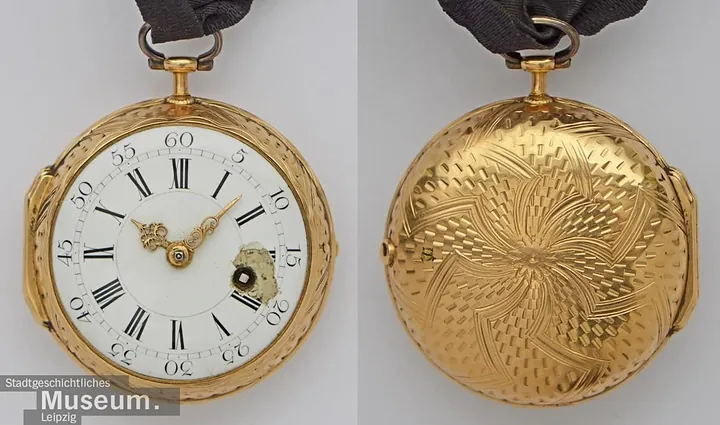
Pocket Watches · 1745–1755
Pocket watch by Jean Baptiste Baillon, France, 1745–1755
Museum of City History Leipzig
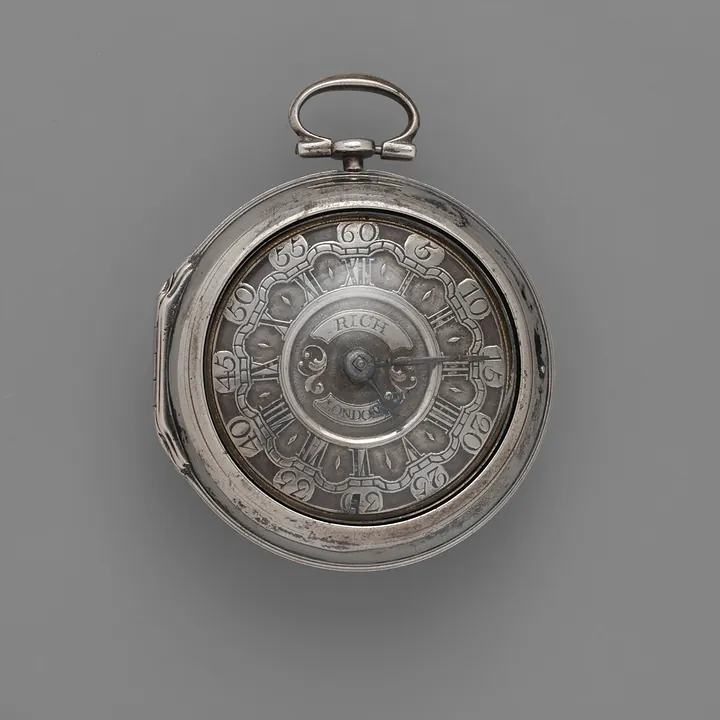
Pocket Watches · c. 1751–52
Watch by John Rich, England, c. 1751–52
The Metropolitan Museum of Art, New York
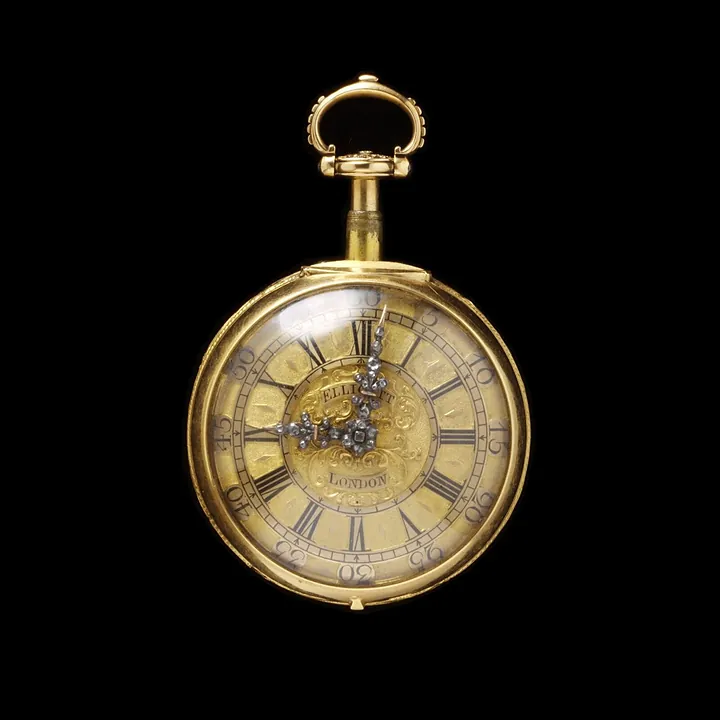
Pocket Watches · c. 1753
Gold watch, signed 'Jno. Ellicott, London, 3719', the inner case pierced and engraved, with a casemaker's mark 'JB', London, about 1753
Victoria and Albert Museum, London
Pocket Watches · 1750–1810
Astronomical watch by George Margetts No.3043 in pair case, 1750–1810
Science Museum Group, London