
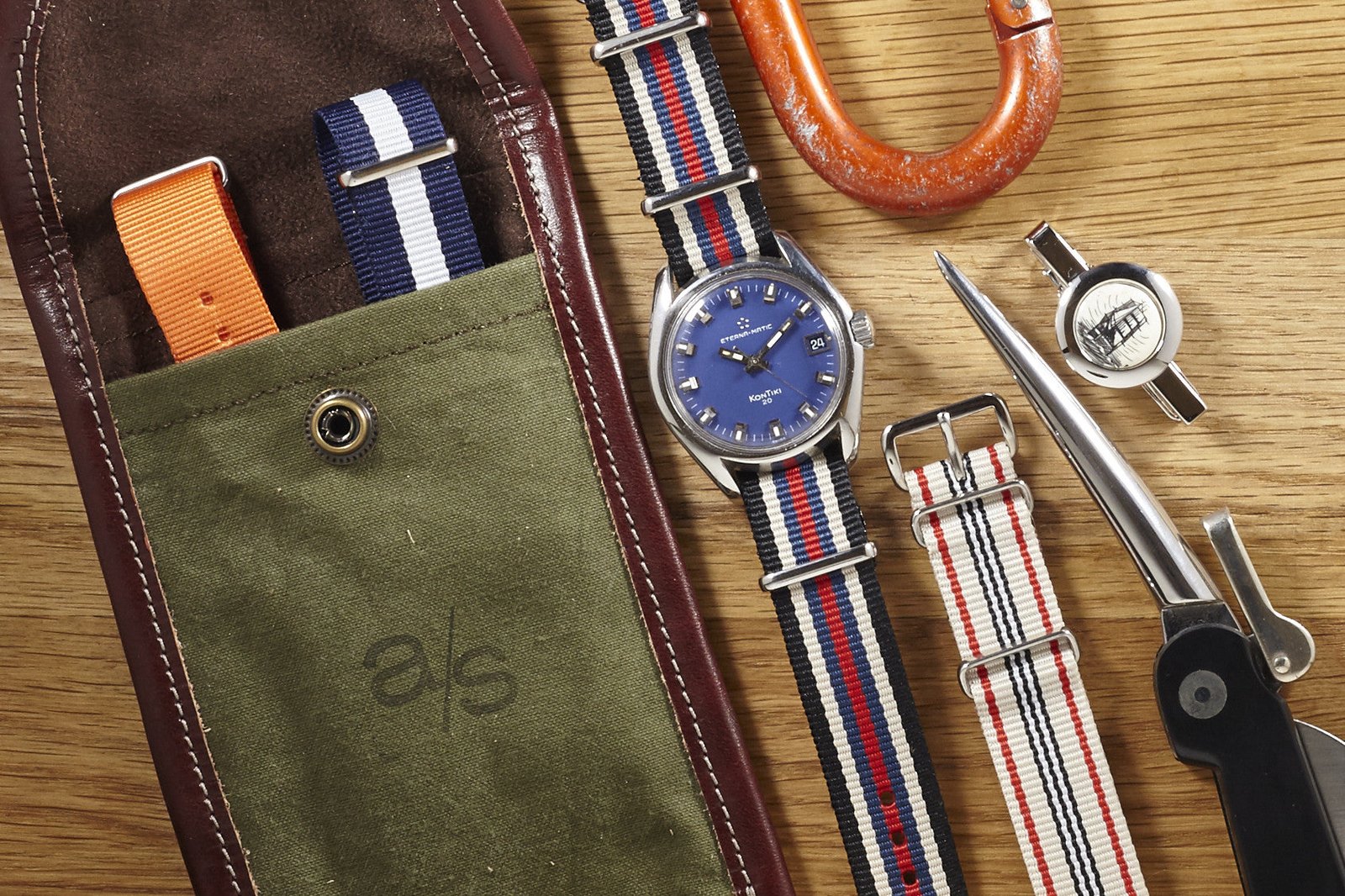
Wristwatches · Wristwatch
Mariner - Eterna Kon-Tiki, late 1960s
- Maker / attribution
- Eterna (maker)
- Date
- late 1960s
- Historical period
- Modern Mechanical Horology (1945 – 1969)
- Country of origin
- Switzerland
- Object type
- Wristwatch
- Stock no.
- Product 982689601
- Credit line
- Dealer listing, Analog/Shift (product 982689601)
- Catalogue title (original)
- Mariner - Eterna Kon-Tiki (English)
View the source record (dealer listing) ↗ (opens another website in a new tab)Suggest a correction
Record summary
Catalogued by Analog/Shift (dealer), New York (stock number Product 982689601), this is a wristwatch by Eterna, made in Switzerland, dated late 1960s. The Atlas places it in the Modern Mechanical Horology period (1945 – 1969) of its Wristwatches collection. The record is illustrated with 6 photographs.
Assembled from the source record's structured fields. Dates and attributions are given as the source states them; where a field is missing the Atlas leaves it blank rather than estimating.
Catalogue description
Dealer description — Analog/Shift
After 101 grueling days and 4,300 nautical miles, Thor Heyerdahl and his crew sailed their rickety wooden craft into a reef on the shores of Raroia, one of the Tuamotu Islands, completing one of the most historic and controversial crossings of the Pacific Ocean. Heyerdahl, a Norwegian ethnographer, botanist and zoologist, devised the voyage in order to prove his hypothesis that the South Pacific was populated from east to west, contrary to the popular belief. Despite the presence of evidence to support his claims, the larger scientific community remained unconvinced that crafts of such rudimentary design could survive a cross-Pacific voyage. To prove the journey was possible, Heyerdahl constructed a raft, which he christened the Kon-Tiki after the Incan king who had made the journey according to South American lore, using only materials and technology that would have been common to the people of South America in early history. Defiant of the odds, Heyerdahl and his team struck out, using only the current and the trade winds to propel them across the Pacific. The crew assembled a collection of modern and ancient equipment, including a store of U.S. Army rations, hand-crank radios and six Eterna wristwatches. Eterna had been building timepieces since the mid 1800s and had made many horological benchmarks along the way: They filed for the first patent for a mechanical alarm wristwatch in 1908 and the design of the worlds smallest production wristwatch in 1930. The simple watches that Heyerdahl and his crew used were subjected to - and survived – conditions to which many watches would have quickly succumbed. Shortly after the news of Heyerdahl’s success reached Switzerland, Eterna began assembling a new line of watches in his honor. The new line, the Kon-Tiki Series, came to exemplify the spirit of maritime adventure and exploration. In addition to bearing the name of Heyerdahl’s vessel, the case back of each Kon-Tiki was adorned with a likeness of the raft. This particular piece, dating to the late 1960s, has a gorgeous sea-blue dial and elegant baton hands. Whether paired with a colorful nylon strap or worn on its original steel bracelet, this watch is dripping with vintage nautical appeal, making it the perfect accoutrement for sea-borne summer fun.
Historical context
Modern Mechanical Horology (1945 – 1969)
Tool watches for divers, pilots and astronauts; electric watches anticipate the electronic age.
The classic era of the mechanical wristwatch: dive watches, chronographs for motor racing and space flight, GMT watches for jet travel, slim dress watches, automatic calendars, and the rise of Japanese manufacturers alongside Swiss, American, German and Soviet industries.
Read the period in the timelineMore wristwatches from this periodEarlier: Golden Age of Mechanical Watchmaking
Atlas type guide
Dive and water-resistant watches
Keeping water and dust out of a wristwatch was a long-standing challenge. Rolex's screw-down Oyster case (1926) and Omega's Marine (1932) were landmarks; in the early 1950s Blancpain's Fifty Fathoms and Rolex's Submariner defined the professional dive watch with rotating bezels for timing dives, luminous dials and high water resistance. The ISO 6425 standard (1982) later codified what a 'diver's watch' must do.
Dive watches became icons of post-war design and exploration, and their evolution — helium escape valves, ceramic bezels, saturation-diving depth ratings — records the history of underwater work.
What to look for
- Unidirectional or bidirectional rotating bezel with minute markings.
- Screw-down crown and case back; depth rating printed on the dial.
- Luminous hands and markers (radium before c. 1960, tritium c. 1960–1998, then Super-LumiNova).
- Reference numbers on the case between the lugs or inside the back.
Dating clues
- Screw-down Oyster cases: from 1926.
- Professional dive watches: from 1953.
- Tritium 'T' marks on dials: c. 1960–1998.
General guidance written by the Atlas editors about this kind of object. It is not a statement about this particular piece; for that, rely on the source record above and on physical examination.
Related records

Wristwatches · 1945
Wristwatch by Eterna, 1945
Museum Rotterdam
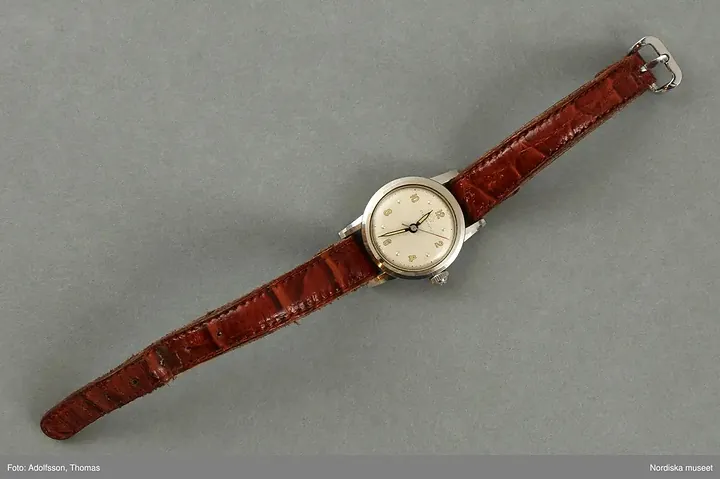
Wristwatches · 1900–1999
Wristwatch by Eterna, Sweden, 1900–1999
Nordic Museum Foundation
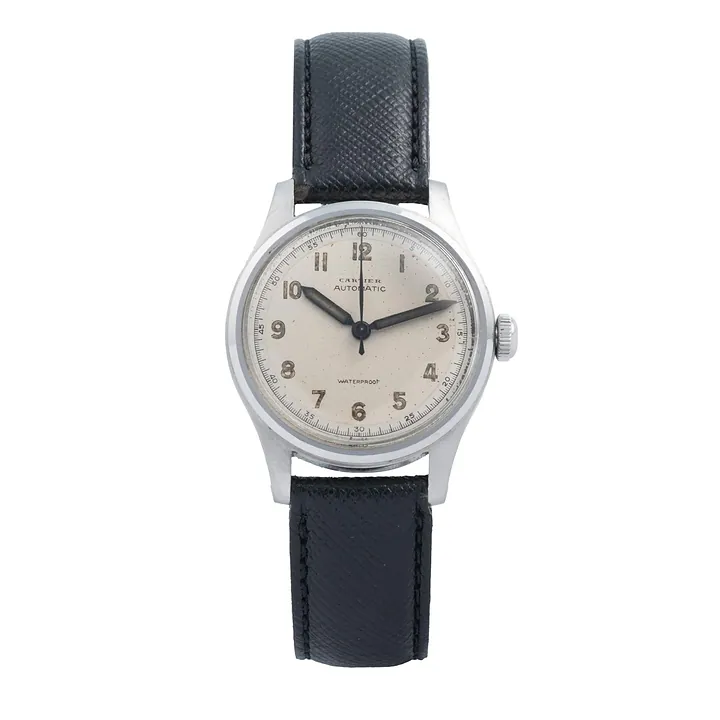
Wristwatches · c. 1930s
Eterna wristwatch, c. 1930s
Antiquorum auction archive, Geneva
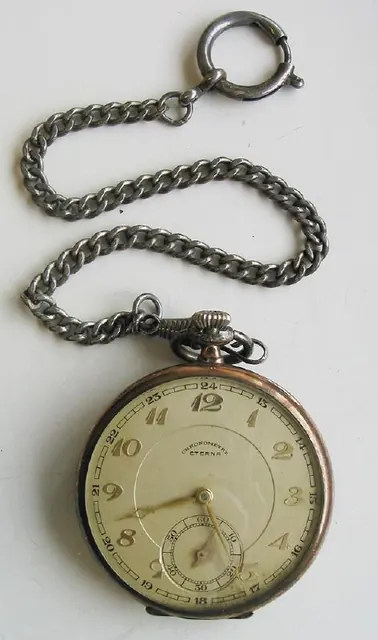
Pocket Watches · 1934
Pocket watch by Eterna, Switzerland, 1934
Turun kaupunginmuseo

Wristwatches · c. 1945
Breitling Premier, ref. 790, c. 1945
Antiquorum auction archive, Geneva

Wristwatches · c. 1945
Universal Genève Uni-Compax, ref. 22492, c. 1945
Antiquorum auction archive, Geneva

Wristwatches · c. 1950s
Baume & Mercier wristwatch, c. 1950s
Antiquorum auction archive, Geneva
Wristwatches · c. 1950
Jaeger Lecoultre Triple Calendar, c. 1950
Antiquorum auction archive, Geneva