
Wristwatches · Dress watch
Luch Caliber 2209 Model 903xxx Wristwatch
- Maker / attribution
- Minsk Watch Factory (source attribution)
- Date
- 1970s
- Historical period
- Quartz Revolution (1969 – 1990)
- Country of origin
- USSR
- Object type
- Dress watch
- Holding institution
- Watches of the USSR
- Accession / object no.
- luch-caliber-2209-model-903xxx-wristwatch-f56fee32e1
- Credit line
- Watches of the USSR
- Catalogue title (original)
- Luch | Watches of the USSR (English)
View the source record ↗ (opens another website in a new tab)Suggest a correction
Record summary
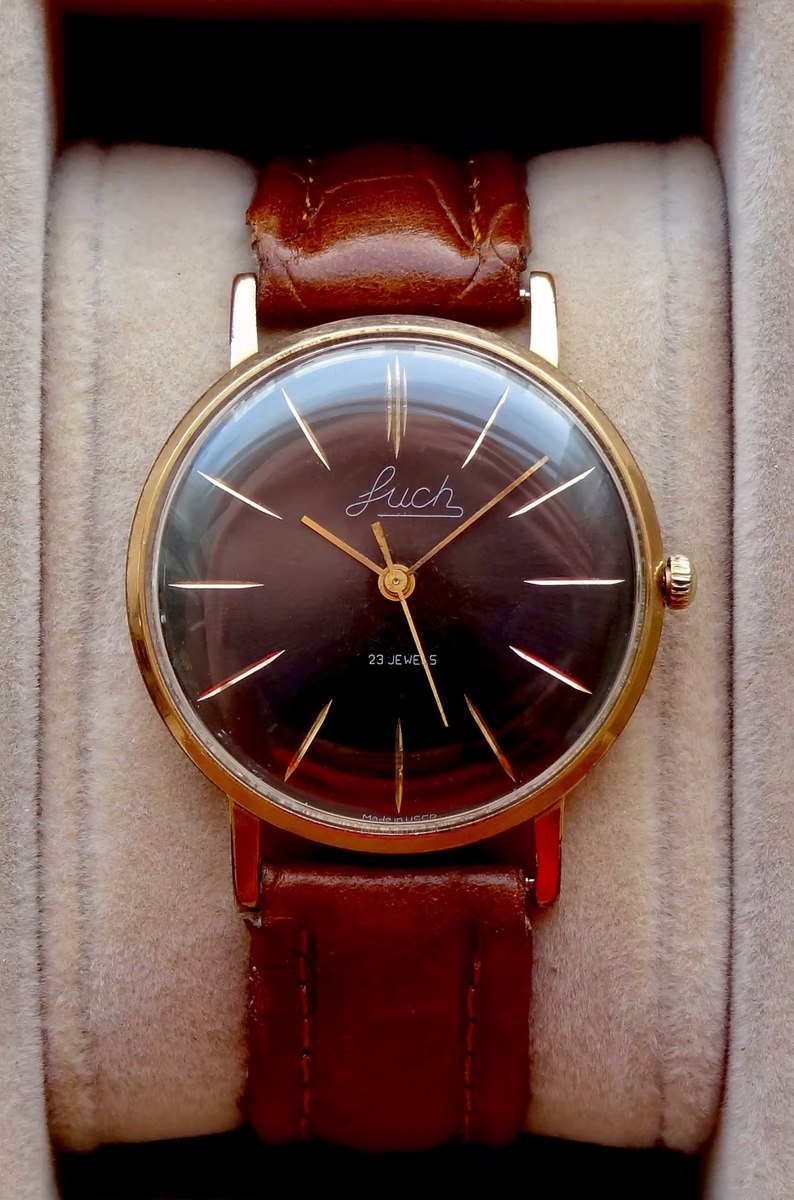
Held and catalogued by Watches of the USSR (object number luch-caliber-2209-model-903xxx-wristwatch-f56fee32e1), this is a dress watch attributed to Minsk Watch Factory, made in USSR, dated 1970s. The Atlas places it in the Quartz Revolution period (1969 – 1990) of its Wristwatches collection. The record is illustrated with 1 photograph.
Assembled from the source record's structured fields. Dates and attributions are given as the source states them; where a field is missing the Atlas leaves it blank rather than estimating.
Catalogue description
Original object description
Dating to the 1970s and originating from the USSR, this Soviet dress watch is identified under Luch model reference 903xxx and documented within Watches of the USSR. Factory records connect its manufacture to the Minsk Watch Factory. Encased in polished gold-toned metal, the timepiece is built with delicate straight lugs, a setting crown placed at 3 o'clock, and is fitted to a textured brown leather band. The dark, rounded dial is styled with lengthened, faceted indices extending outward from the center, over which traverse three matching gold-toned central hands. Dial text printed in Latin lettering includes the brand name 'Luch' in cursive below the 12 o'clock mark, the notation '23 JEWELS' positioned above the 6 o'clock location, and 'Made in USSR' along the dial's lower edge. While historical accounts associate the 23-jewel caliber 2209—an ultra-slim movement developed in 1961 by the First Moscow Watch Factory—with high-volume assembly in Minsk from 1963 onward, the interior movement in this specific piece has not been verified by direct examination due to the case back remaining sealed, resting entirely on collector documentation.
Historical context
Quartz Revolution (1969 – 1990)
Seiko's Astron begins mass quartz timekeeping; traditional industries contract sharply.
Quartz and digital watches transformed the market after 1969. Swiss employment collapsed, Japanese and Hong Kong production soared, and the Swatch (1983) helped the Swiss industry recover; mechanical watches survived as luxury goods.
Read the period in the timelineMore wristwatches from this periodEarlier: Modern Mechanical Horology
Atlas type guide
Wristwatches
Bracelet watches were worn by women from the early nineteenth century — Breguet made one for Caroline Murat, Queen of Naples, in 1810–12 — but the wristwatch only became a man's instrument with military use and aviation in the early twentieth century. Between the World Wars it overtook the pocket watch; the 1920s and 1930s brought rectangular Art Deco cases, water-resistant cases and the first automatic winding systems.
After 1945 the wristwatch became a carrier of identity — dress watches, sports and dive watches, chronographs, calendars — produced by Swiss, American, Japanese, German, Soviet and Chinese industries. The quartz revolution after 1969 and the mechanical renaissance since the 1990s, including the rise of independent watchmakers, complete the story.
What to look for
- The reference number (between the lugs or inside the case back) and serial number, the starting point for dating.
- The calibre: its maker and number are often stamped under the dial or on the bridge.
- Originality of dial, hands and crown — refinished ('redial') dials are common.
- Case material marks: 18K/750, 14K/585, stainless steel, gold-filled, plated.
Dating clues
- Wire-lug cases: before c. 1925.
- Water-resistant screw-down cases: from 1926.
- Quartz movements: from 1969; sapphire crystals widespread after c. 1980.
General guidance written by the Atlas editors about this kind of object. It is not a statement about this particular piece; for that, rely on the source record above and on physical examination.
Related records

Wristwatches · 1970
Wristwatch by Heno, Switzerland, 1970
Museum Rotterdam
Wristwatches · 1970s
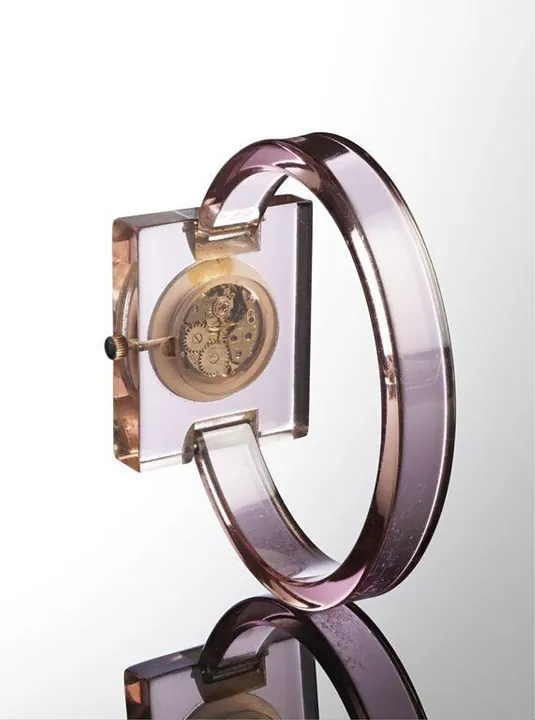
Wristwatch, plastic, by Gucci; Italy, 1970s.
Victoria and Albert Museum, London
Wristwatches · 1973
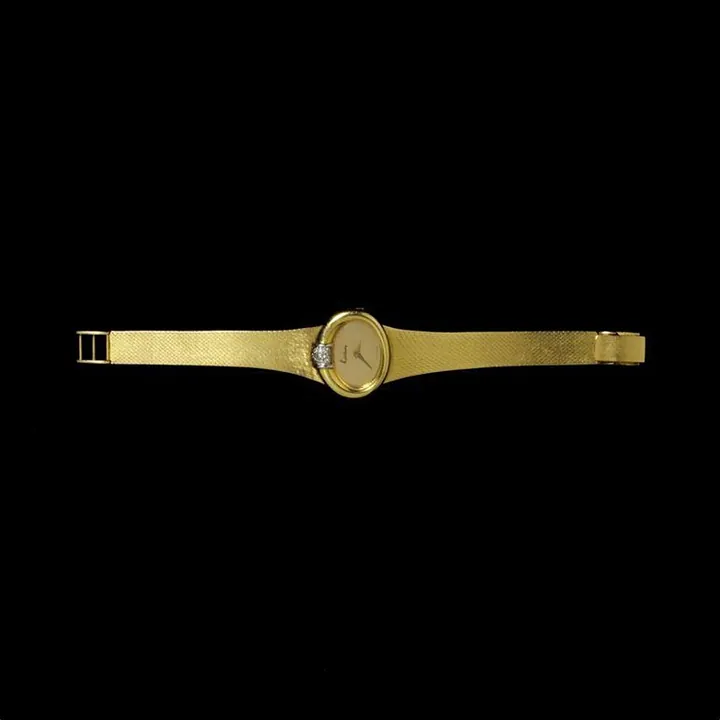
Woman's watch, gold with diamonds set in platinum. Made for Kutchinsky, London by Chopard et Cie. Switzerland, 1973
Victoria and Albert Museum, London
Wristwatches · 1978
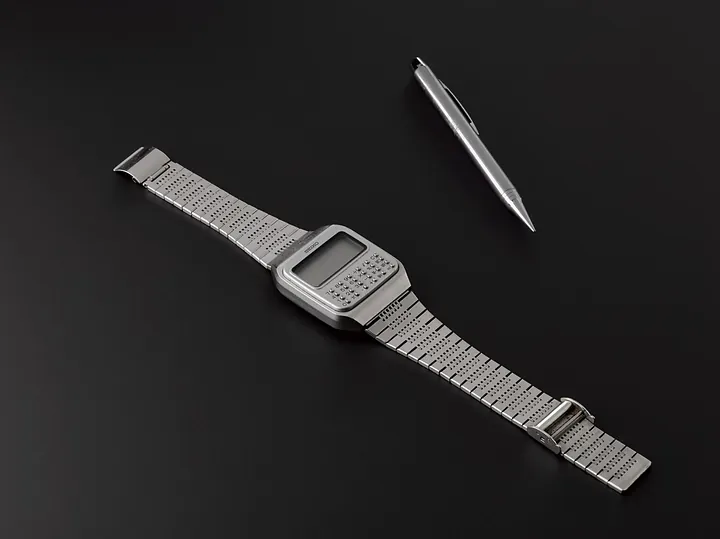
Calculator wristwatch by Suwa Seikosha Co. Limited, Japan, 1978
Science Museum Group, London
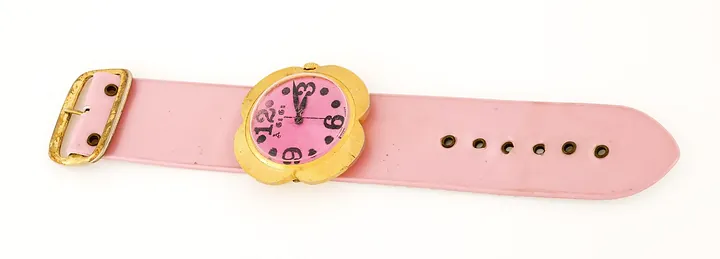
Wristwatches · 1980
Wristwatch, 1980 (no. 71413)
Museum Rotterdam
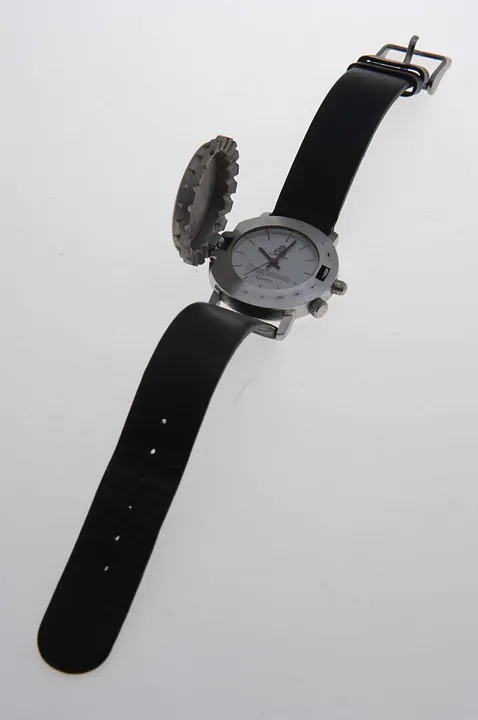
Wristwatches · 1980
Wristwatch, 1980 (no. 91477)
Museum Rotterdam
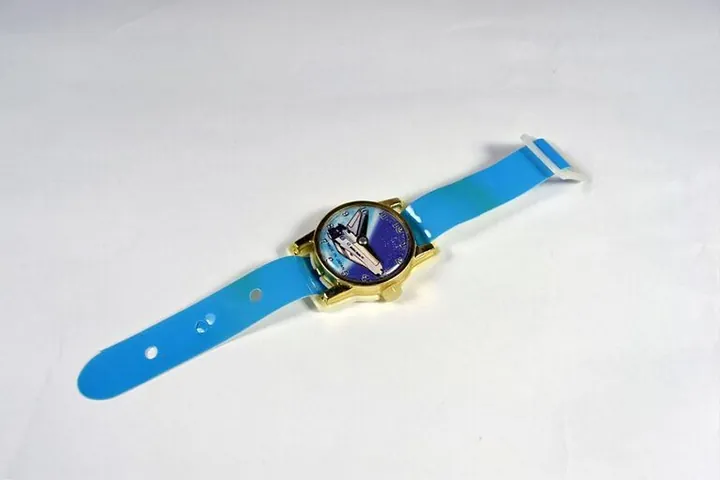
Wristwatches · 1980–1982
Wristwatch, Space Shuttle; plastic, Japan, 1970-1979?
Victoria and Albert Museum, London

Wristwatches · 1982
Fake Rolex watch, gold coloured metal, possibly made in Taiwan, 1982; part of a casual outfit, UK, 1982-84.
Victoria and Albert Museum, London