
Wristwatches · Wristwatch
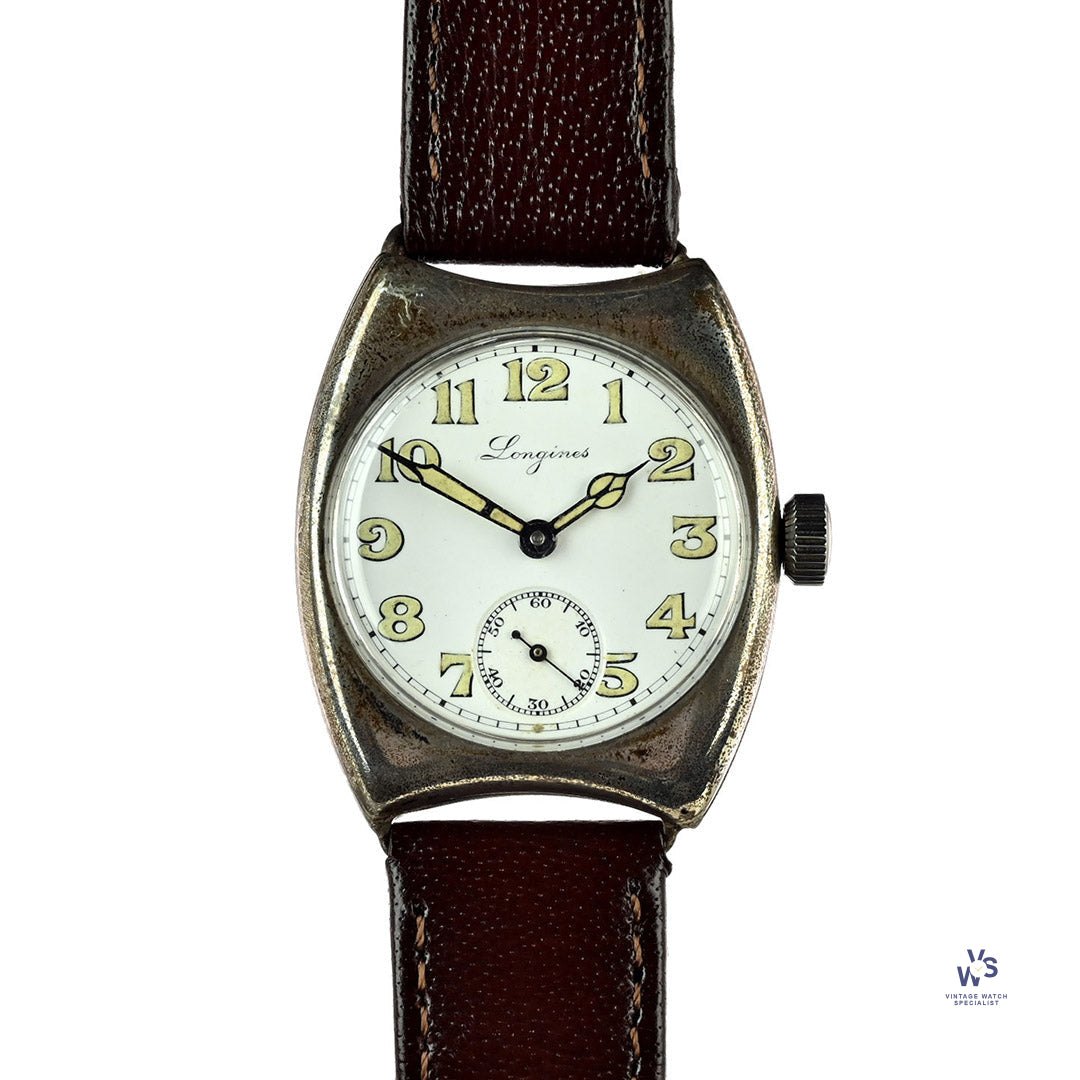
Longines Silver Cased Trench Watch WW1, circa 1917
- Maker / attribution
- Longines (maker)
- Date
- c. 1917
- Historical period
- Golden Age of Mechanical Watchmaking (1900 – 1945)
- Country of origin
- Switzerland
- Object type
- Wristwatch
- Materials / technique
- silver
- Stock no.
- vws3478
- Credit line
- Dealer listing, Vintage Watch Specialist (vws3478)
- Catalogue title (original)
- Longines - Silver Cased Trench Watch WW1 - c.1917 (English)
View the source record (dealer listing) ↗ (opens another website in a new tab)Suggest a correction
Record summary
Catalogued by Vintage Watch Specialist (dealer), United Kingdom (stock number vws3478), this is a wristwatch by Longines, made in Switzerland, dated c. 1917. The Atlas places it in the Golden Age of Mechanical Watchmaking period (1900 – 1945) of its Wristwatches collection. Materials and techniques recorded by the source: silver. The record is illustrated with 6 photographs.
Assembled from the source record's structured fields. Dates and attributions are given as the source states them; where a field is missing the Atlas leaves it blank rather than estimating.
Catalogue description
Dealer description — Vintage Watch Specialist
A Beautiful and Well Preserved WW1 Silver Cased Trench Watch with a Stunning Breguet Dial and Original Lume, c.1917 Longines, a renowned Swiss watchmaker, was founded in 1832 by Auguste Agassiz in Saint-Imier. Initially producing pocket watches, the company quickly gained a reputation for precision and reliability. In 1867, Longines introduced its first in-house movement, the 20A, which earned an award at the Universal Exhibition in Paris. The iconic winged hourglass logo was registered in 1889, becoming one of the oldest unchanged trademarks still active today. By the early 20th century, Longines was known for its pioneering role in sports timing, providing chronographs for events such as the Olympics and horse racing. In 1931, Longines launched its first wristwatch with an automatic movement. The post-World War II era saw further innovation with ultra-thin models and high-frequency movements like the Ultra-Chron. Today, Longines remains a symbol of elegance and performance, blending tradition with modern technology to create timeless timepieces cherished worldwide. What's on Offer Introduced in 1910, the Longines 13.34 movement was used in many Longines wristwatches during the Great War. Using a Longines serial number decoder has given us a rough estimate that this watch was produced in around 1917, which could well mean it was issued to the military during the Great War, although there are no markings to note this watch as property of the MoD, it is certainly a trench watch style. By the by, the watch is in incredible condition given its age of over 100 years! The brilliant white dial is stunning with its Breguet numerals and beautifully aged pale buttery lume and graceful cathedral hands. A recessed sub-seconds dial at 6 o'clock completes the dial which is presented in an unusual tonneau cushion-shaped case crafted from silver. Paired with a simple leather strap, this watch is still in working order and keeps good time. It would make a beautiful addition to any collection - a very special piece!
Historical context
Golden Age of Mechanical Watchmaking (1900 – 1945)
The wristwatch displaces the pocket watch; waterproof cases, self-winding and grand complications.
The wristwatch overtook the pocket watch. Military use in the First World War, aviation, water-resistant cases (1926), automatic winding (1923–31), rectangular Art Deco designs and early chronographs and calendars defined the period.
Read the period in the timelineMore wristwatches from this periodEarlier: Industrial Revolution
Atlas type guide
Military, pilot and travel watches
The wristwatch owes much of its adoption by men to warfare and aviation. Wristlets — small pocket watches soldered with lugs and worn on a strap — were used in colonial campaigns and became standard equipment in the First World War, with protective grilles over the crystal ('shrapnel guards'). Louis Cartier's Santos (1904), designed for the aviator Alberto Santos-Dumont, is often cited as an early purpose-made pilot's watch.
In the Second World War governments specified watches in detail: the German B-Uhr observation watches, the American A-11, and the British 'W.W.W.' (the 'Dirty Dozen' set of 1945). After the war, jet travel brought GMT and world-time watches, which show two or more time zones at once — Louis Cottier's world-time mechanism and the Rolex GMT-Master (1955) are examples.
What to look for
- Military markings on the case back: broad arrow, issue numbers, 'W.W.W.', 'A.T.P.'
- High-legibility black dials with luminous Arabic numerals; oversized crowns for gloved hands.
- 24-hour hands and rotating 24-hour bezels or city rings on GMT/world-time watches.
- Wire lugs on early wristlets converted from pocket watches.
Dating clues
- Wire-lug wristlets: c. 1900–1925.
- Military specifications of the Second World War: 1939–1945.
- GMT and world-time wristwatches: mainly after 1950.
General guidance written by the Atlas editors about this kind of object. It is not a statement about this particular piece; for that, rely on the source record above and on physical examination.
Related records
Instruments · c. 1940
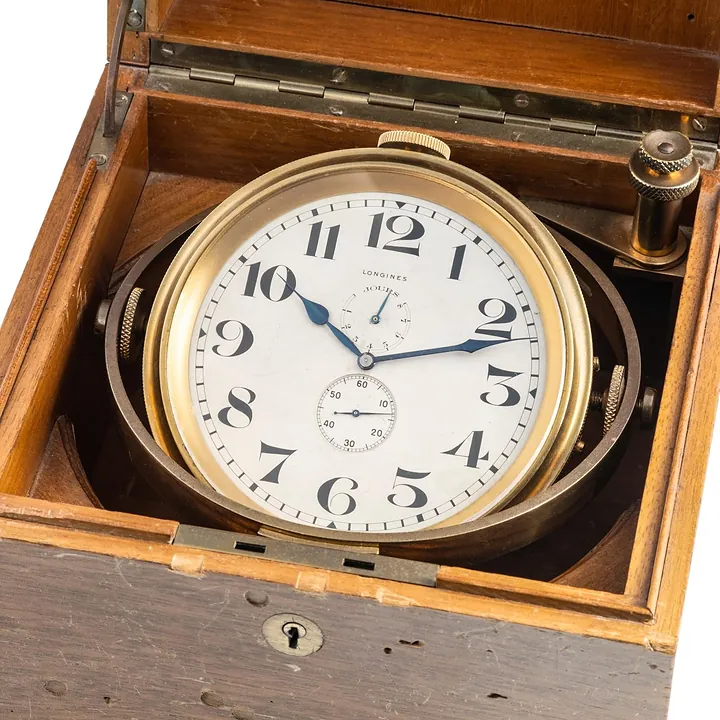
Longines marine chronometer, c. 1940
Antiquorum auction archive, Geneva
Pocket Watches · c. 1910-1920s
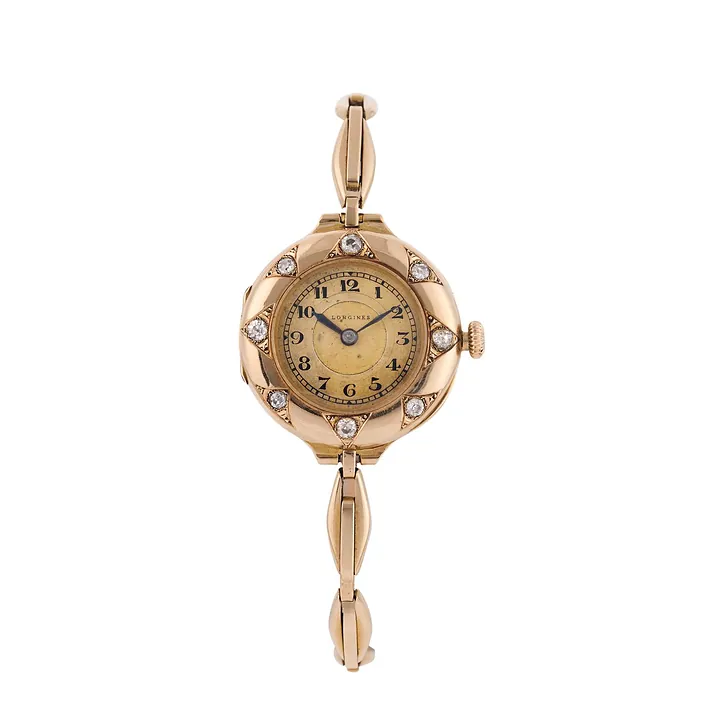
Longines watch, c. 1910-1920s
Antiquorum auction archive, Geneva
Pocket Watches · c. 1915
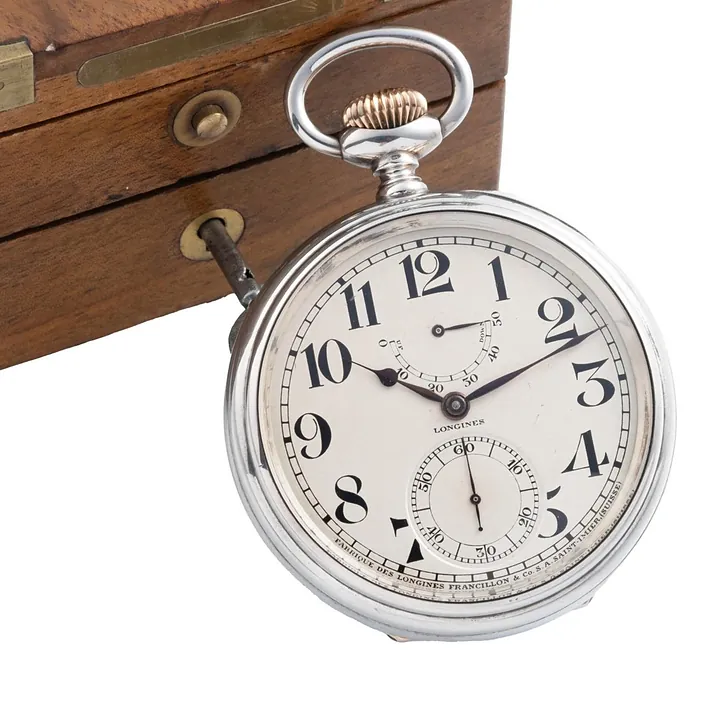
Longines ''torpedo-Boat Watch'', c. 1915
Antiquorum auction archive, Geneva
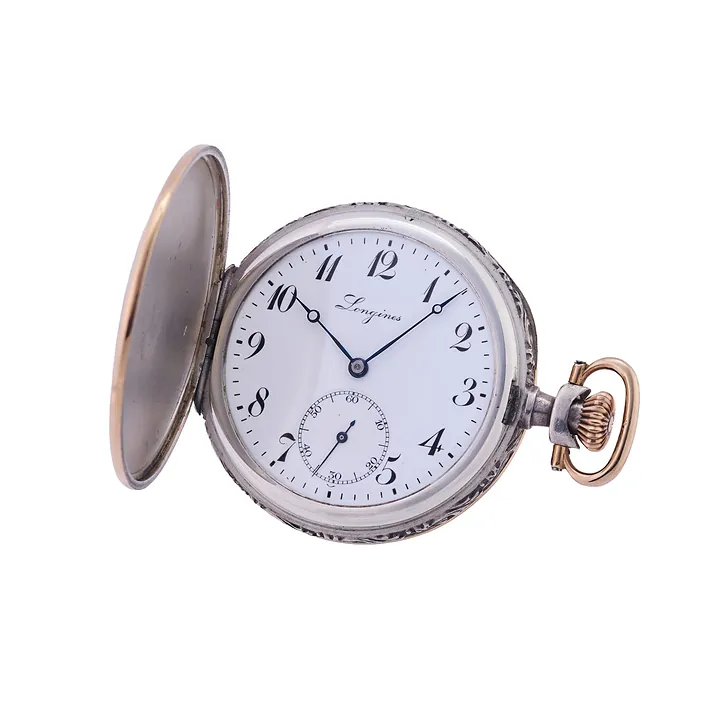
Pocket Watches · c. 1920s
Longines pocket watch, c. 1920s (Antiquorum Lot 389-59)
Antiquorum auction archive, Geneva

Wristwatches · 1931
Rolex 'Oyster Perpetual' rotor self-winding wrist-watch, lever escapement, in steel case with glass in back, Montres Rolex SA, Geneva, Switzerland, 1931
Science Museum Group, London

Wristwatches · 1900–1999
Wristwatch by Certina, Switzerland, 1900–1999
Nordic Museum Foundation
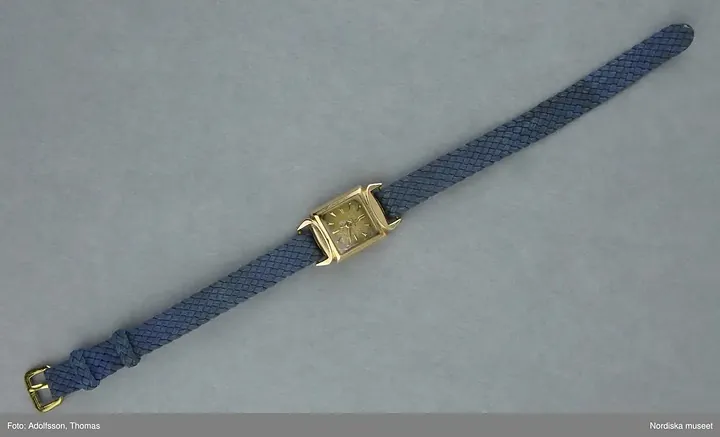
Wristwatches · 1900–1999
Wristwatch by Omega, Västerås, 1900–1999
Nordic Museum Foundation
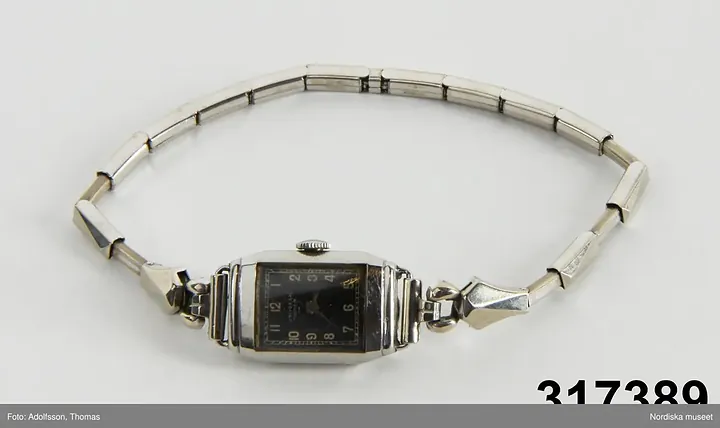
Wristwatches · 1900–1999
Wristwatch by Universal, Switzerland, 1900–1999
Nordic Museum Foundation