
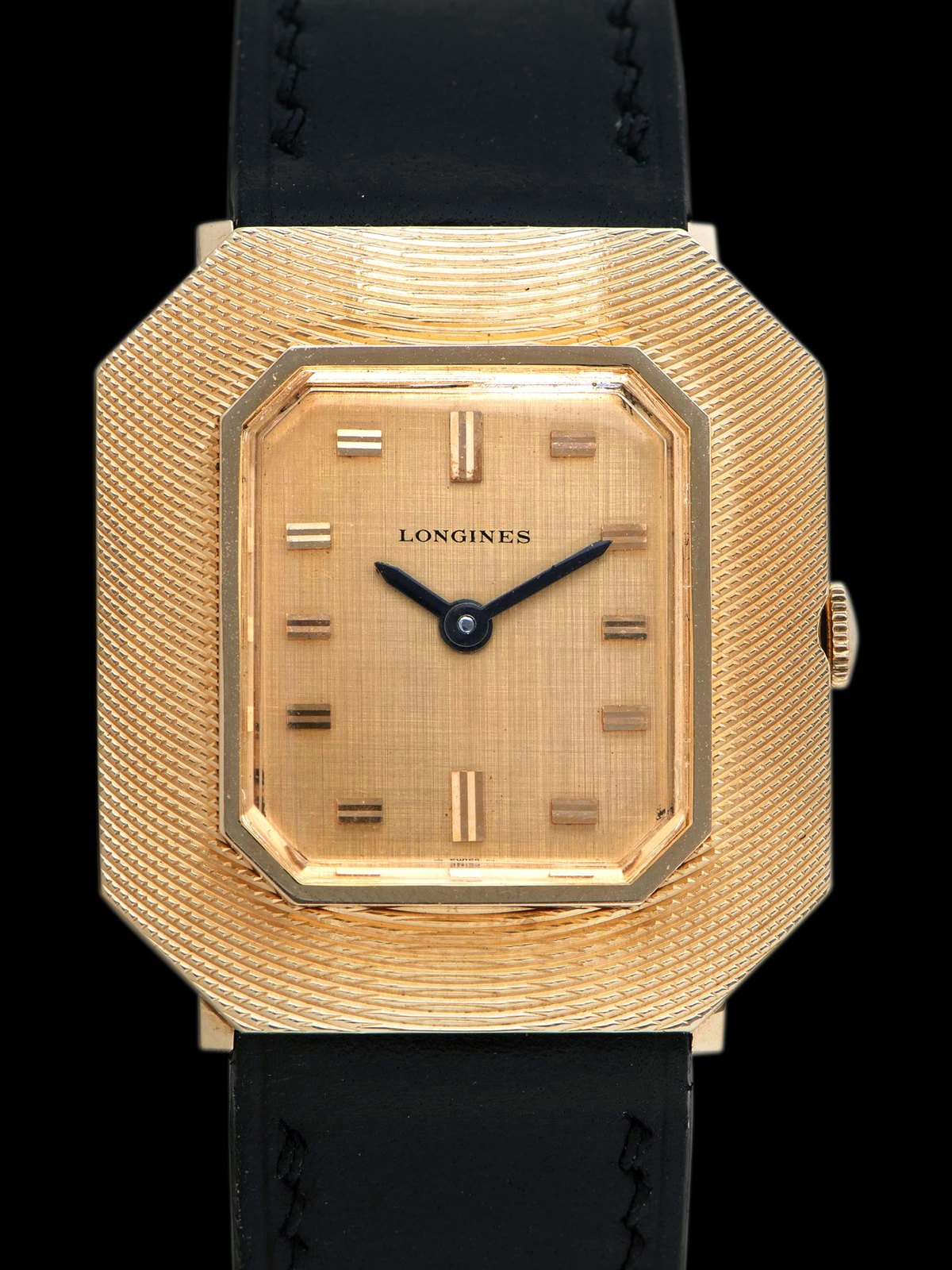
Wristwatches · Wristwatch
Longines 14K YG Dress Watch (Ref. 216) Cal. 428, 1970s
- Maker / attribution
- Longines (maker)
- Date
- 1970s
- Historical period
- Quartz Revolution (1969 – 1990)
- Country of origin
- Switzerland
- Object type
- Wristwatch
- Stock no.
- LGS14K216
- Credit line
- Dealer listing, Craft & Tailored (LGS14K216)
- Catalogue title (original)
- 1970s Longines 14K YG Dress Watch (Ref. 216) Cal. 428 (English)
View the source record (dealer listing) ↗ (opens another website in a new tab)Suggest a correction
Record summary
Catalogued by Craft & Tailored (dealer), Los Angeles (stock number LGS14K216), this is a wristwatch by Longines, made in Switzerland, dated 1970s. The Atlas places it in the Quartz Revolution period (1969 – 1990) of its Wristwatches collection. The record is illustrated with 6 photographs.
Assembled from the source record's structured fields. Dates and attributions are given as the source states them; where a field is missing the Atlas leaves it blank rather than estimating.
Catalogue description
Dealer description — Craft & Tailored
Longines is one of the oldest continuously operating watch manufacturers in the world, with roots dating all the way back to 1832. Over that immense period of time, the brand has crafted some truly incredible—and incredibly accurate—timepieces. In fact, it's one of the reasons Longines is the official timekeeper of the Kentucky Derby, where accuracy is paramount. Whether it's a chronograph, diving watch, or a simple dress model, a Longines wristwatch never seems to disappoint. Longines' history is sprawling with an array of beautiful and functional watches, including military-issued timepieces, beautiful sports watches, and unique dress watches. This fantastic piece falls squarely into the latter category. With a 14k gold case reminiscent of a vintage picture frame, a champagne linen dial and markers to match the case, plus semi-hidden lugs and a dainty crown, this watch is tailor-made for a black tie affair. SPECS Stock # LGS14K216 Brand Longines Style Dress Watch Model 216 Serial 14XXXXXX Size Men's/ Unisex Material 14K Yellow Gold Dial Champagne Linen Millimeters 28x31 Bracelet 2pc Leather Strap CASE & BRACELET The textured, octagonal, 14k gold case has been lightly polished but is in fantastic condition with very few signs of wear. The watch features its original, unsigned crown. The watch comes supplied on a 2pc handmade leather strap. DIAL & HANDS The champagne-colored linen texture dial is in excellent overall condition and shows minimal age. The gold, applied hour markers are simple rectangles, which add to the classy restraint. Small, black hour and minute hands add a bit of contrast. ACCESSORIES
Historical context
Quartz Revolution (1969 – 1990)
Seiko's Astron begins mass quartz timekeeping; traditional industries contract sharply.
Quartz and digital watches transformed the market after 1969. Swiss employment collapsed, Japanese and Hong Kong production soared, and the Swatch (1983) helped the Swiss industry recover; mechanical watches survived as luxury goods.
Read the period in the timelineMore wristwatches from this periodEarlier: Modern Mechanical Horology
Atlas type guide
Wristwatches
Bracelet watches were worn by women from the early nineteenth century — Breguet made one for Caroline Murat, Queen of Naples, in 1810–12 — but the wristwatch only became a man's instrument with military use and aviation in the early twentieth century. Between the World Wars it overtook the pocket watch; the 1920s and 1930s brought rectangular Art Deco cases, water-resistant cases and the first automatic winding systems.
After 1945 the wristwatch became a carrier of identity — dress watches, sports and dive watches, chronographs, calendars — produced by Swiss, American, Japanese, German, Soviet and Chinese industries. The quartz revolution after 1969 and the mechanical renaissance since the 1990s, including the rise of independent watchmakers, complete the story.
What to look for
- The reference number (between the lugs or inside the case back) and serial number, the starting point for dating.
- The calibre: its maker and number are often stamped under the dial or on the bridge.
- Originality of dial, hands and crown — refinished ('redial') dials are common.
- Case material marks: 18K/750, 14K/585, stainless steel, gold-filled, plated.
Dating clues
- Wire-lug cases: before c. 1925.
- Water-resistant screw-down cases: from 1926.
- Quartz movements: from 1969; sapphire crystals widespread after c. 1980.
General guidance written by the Atlas editors about this kind of object. It is not a statement about this particular piece; for that, rely on the source record above and on physical examination.
Related records
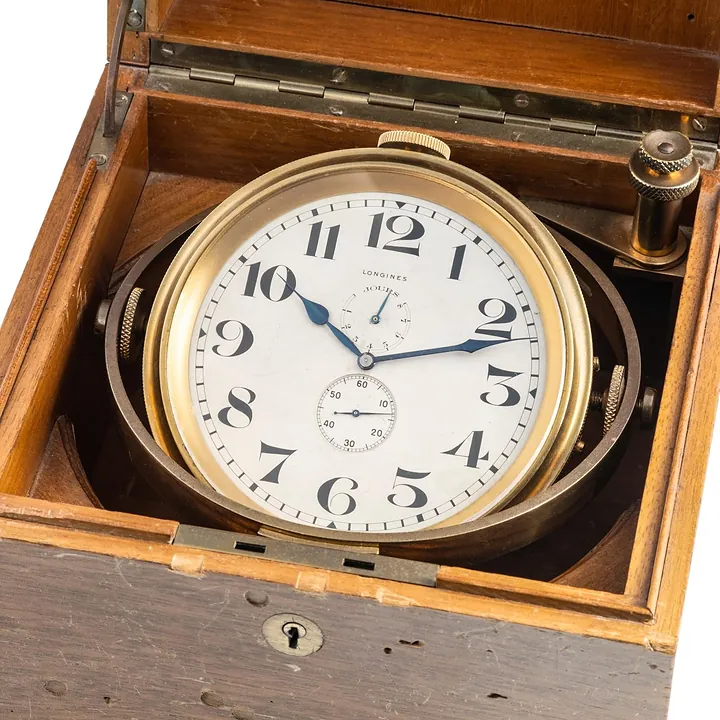
Instruments · c. 1940
Longines marine chronometer, c. 1940
Antiquorum auction archive, Geneva
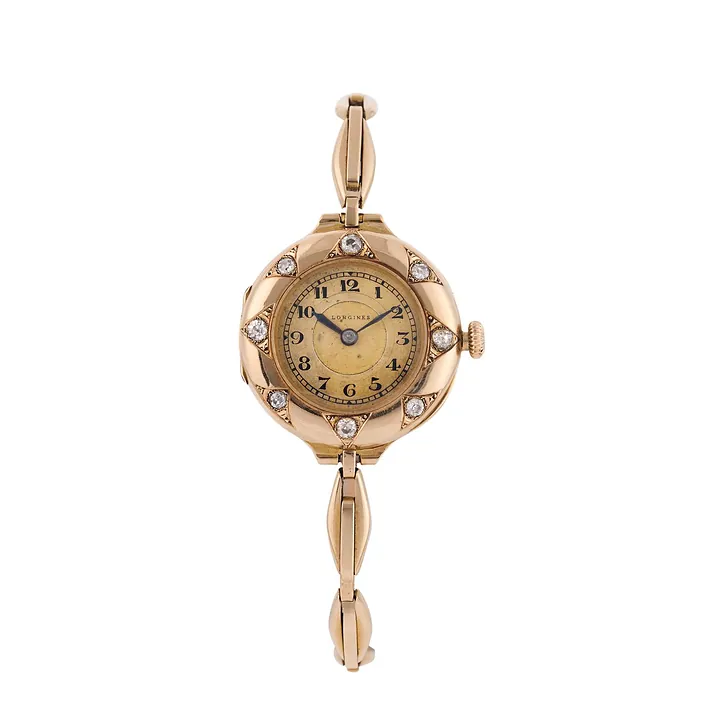
Pocket Watches · c. 1910-1920s
Longines watch, c. 1910-1920s
Antiquorum auction archive, Geneva
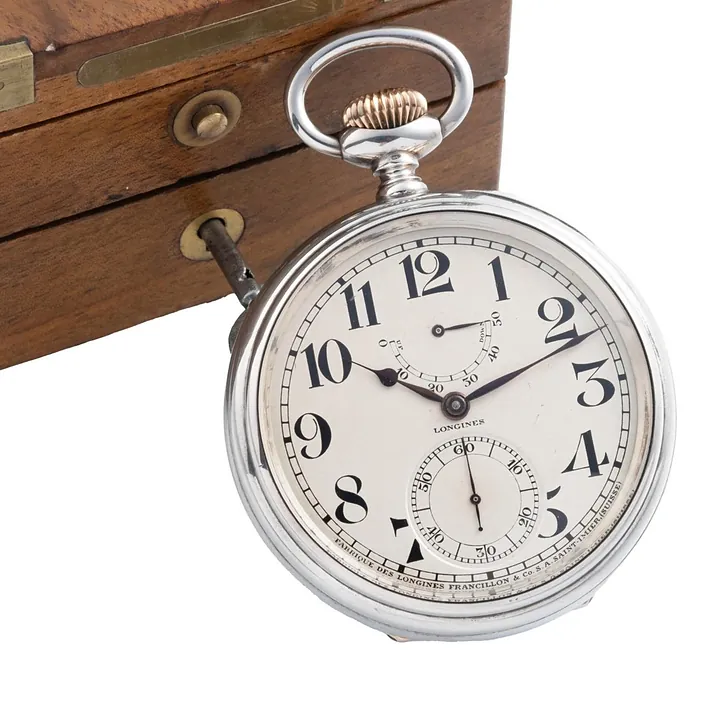
Pocket Watches · c. 1915
Longines ''torpedo-Boat Watch'', c. 1915
Antiquorum auction archive, Geneva
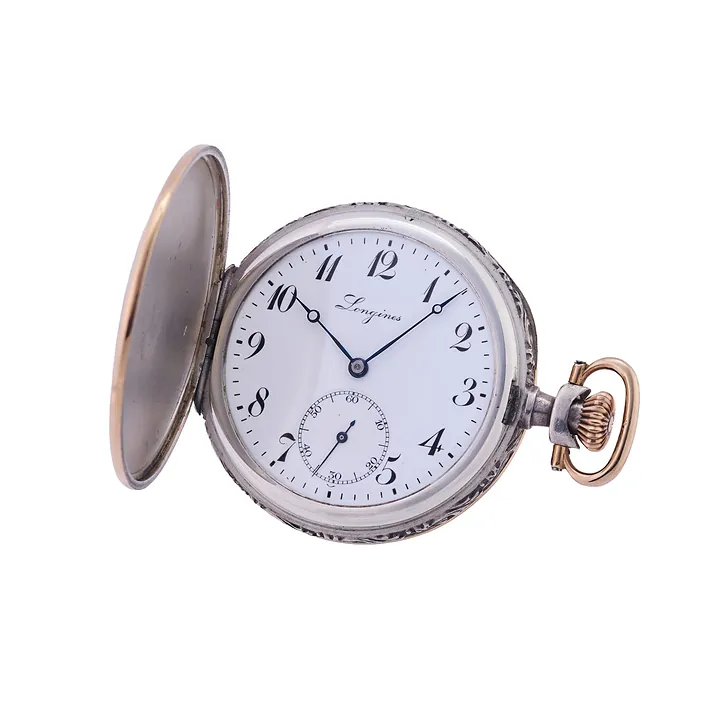
Pocket Watches · c. 1920s
Longines pocket watch, c. 1920s (Antiquorum Lot 389-59)
Antiquorum auction archive, Geneva

Wristwatches · 1970
Wristwatch by Heno, Switzerland, 1970
Museum Rotterdam

Wristwatches · 1960–1986
'Tri-Compax' calendar chronograph wristwatch in gold case, by Universal, Geneva, Switzerland, 1960–1986.
Science Museum Group, London

Wristwatches · 1969–1970
Beta 21 Quartz wristwatch movement, made in Switzerland, 1970.
Science Museum Group, London

Wristwatches · c. 1969
Omega Speedmaster Moonwatch, ref. 145022-69st, c. 1969
Antiquorum auction archive, Geneva