
Instruments · Military stopwatch
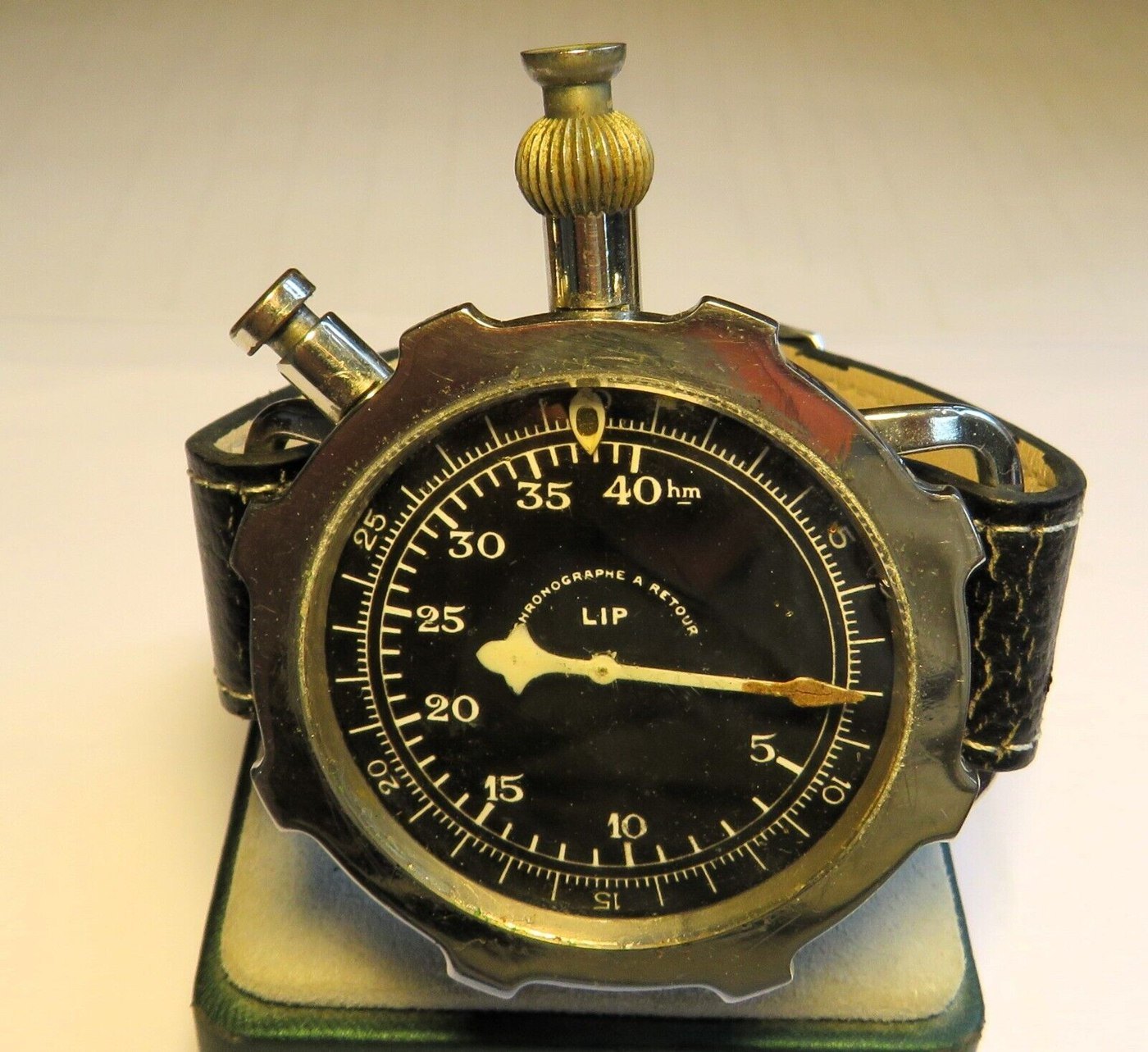
LIP Chronographe à Retour Bombenabwurf Stoppuhr
- Maker / attribution
- LIP (source attribution)
- Date
- c. 1933
- Historical period
- Golden Age of Mechanical Watchmaking (1900 – 1945)
- Country of origin
- France
- Object type
- Military stopwatch
- Dimensions
- 46 mm
- Holding institution
- Sammler-Uhren
- Accession / object no.
- lip-chronographe-a-retour-bombenabwurf-stoppuhr-2eb02fadb2
- Credit line
- Sammler-Uhren
- Catalogue title (original)
- LIP A Ritorno Reverso Bomben Abwurf Rücklauf Stoppuhr Luftwaffe 2. Weltkrieg (English)
View the source record ↗ (opens another website in a new tab)Suggest a correction
Record summary
Held and catalogued by Sammler-Uhren (object number lip-chronographe-a-retour-bombenabwurf-stoppuhr-2eb02fadb2), this is a military stopwatch attributed to LIP, made in France, dated c. 1933. The Atlas places it in the Golden Age of Mechanical Watchmaking period (1900 – 1945) of its Instruments collection. Recorded dimensions: 46 mm. The record is illustrated with 1 photograph.
Assembled from the source record's structured fields. Dates and attributions are given as the source states them; where a field is missing the Atlas leaves it blank rather than estimating.
Catalogue description
Original object description
Designated as a 'Chronographe à Retour' for the French Air Force, this bomb-release stopwatch is attributed to LIP and placed around 1933. Engineered to measure mission duration concurrently with countdown intervals prior to payload deployment, the 46 mm casing features a rotatable bezel framing a black dial marked with white indices and inscribed 'CHRONOGRAPHE A RETOUR LIP'. The manual-wind mechanism is gilt-finished and employs a column-wheel system to coordinate chronograph functions, along with a lever escapement, flat hairspring, and monometallic ring balance; the case back is engraved with the number '348'. Literature notes its distinctive dual-direction timing capacity, and Konrad Knirim illustrates the type on page 155 of his work 'Militäruhren'. Although the LIP designation appears on the dial, reference sources do not identify the movement's manufacturer. Auction commentary classifies the piece as being in excellent, age-consistent condition, showing light wear, smooth bezel rotation, and a flush-fitting rear cover, with minor oxidation visible on the running mechanism, whose precision has not been formally verified.
Inscriptions & marks
348
Historical context
Golden Age of Mechanical Watchmaking (1900 – 1945)
The wristwatch displaces the pocket watch; waterproof cases, self-winding and grand complications.
Timing instruments became electrical and specialised: industrial time recorders, sports timers and aviation instruments.
Read the period in the timelineMore instruments from this periodEarlier: Industrial Revolution
Atlas type guide
Timers, stopwatches, chronoscopes and time recorders
Instruments for measuring short intervals or recording when something happened form a large and practical branch of horology. Sports stopwatches and split-seconds timers, laboratory chronoscopes (such as Hipp's, which measured thousandths of a second for psychology and ballistics experiments), metronomes for music, watchmen's clocks that recorded patrol rounds, and the time recorders that clocked factory workers in and out all derive from clock and watch technology.
These objects matter historically because they show timekeeping leaving the observatory and the drawing room and entering industry, science and sport. Many were mass-produced, and their dials, scales and patents chart the rise of electrification and industrial management.
What to look for
- Scales graduated in fifths, tenths or hundredths of a second, or decimal minutes for industrial use.
- Start, stop and reset push-pieces; a second hand that can be stopped independently (split seconds).
- Recording devices: paper discs or tapes, printing mechanisms, keys or punches.
- Patent numbers and dates on the dial or case, which give a terminus post quem.
Dating clues
- Hipp chronoscopes were made from the 1840s into the twentieth century.
- Employee time recorders spread from the 1890s (Bundy, IBM, International Time Recording Co.).
- Quartz and electronic timers replaced mechanical stopwatches in sport from the 1970s.
General guidance written by the Atlas editors about this kind of object. It is not a statement about this particular piece; for that, rely on the source record above and on physical examination.
Read next:Flyback chronograph
Related records
Pocket Watches · 1949
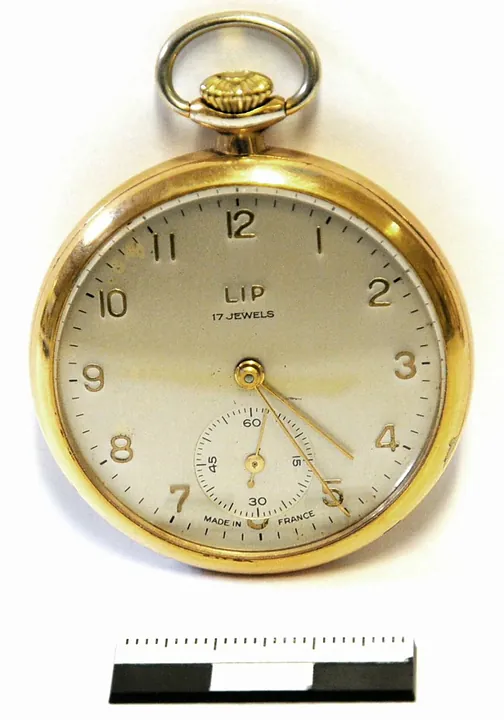
LIP honorary pocket watch for Régie des Mines de la Sarre miners
Montanhistorisches Dokumentationszentrum via Europeana
Instruments · 1902
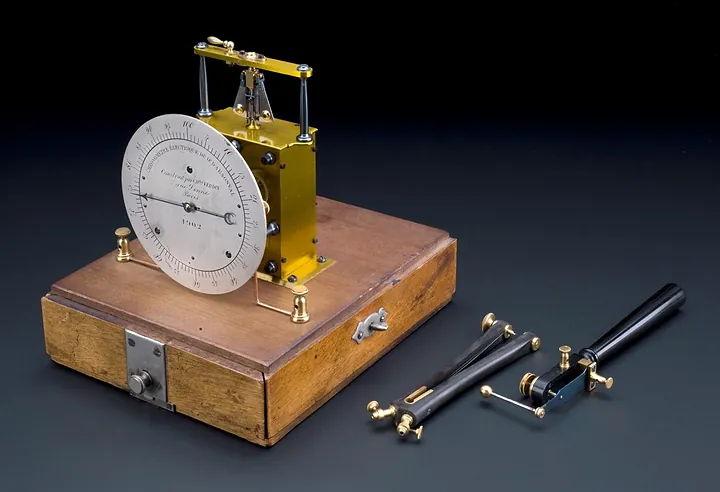
D'Arsonval electric chronometer, for measuring reflex reaction time, by Charles Verdin, Paris, 1902
Science Museum Group, London
Instruments · 1921–1940
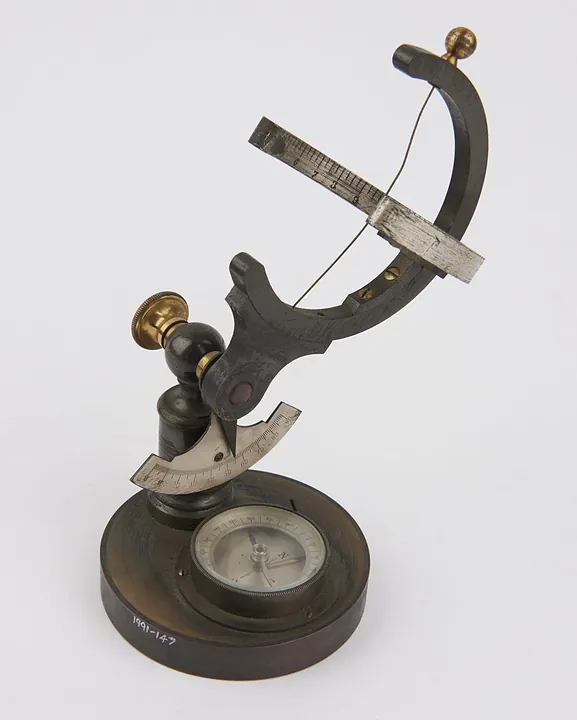
Universal equinoctial sundial. French, c.1930
Science Museum Group, London
Instruments · (Suspension ring and rule: 1939)
Astrolabe, France, (Suspension ring and rule: 1939)
Royal Museums Greenwich
Instruments · 1900
Astrolabe, France, 1900
Royal Museums Greenwich
Instruments · c. 1915
L. Leroy & Cie marine chronometer, France Marine Chronometer, circa 1915
Antiquorum auction archive, Geneva
Instruments · 1920-1925 (uncertain)
Aircraft chronometer by Leborne & Cie
British Museum
Instruments · c. 1930
Edmond Jaeger Service Hydrographique de la Marine silver deck watch
Schmitt Horan & Co.