
Wristwatches · Wristwatch
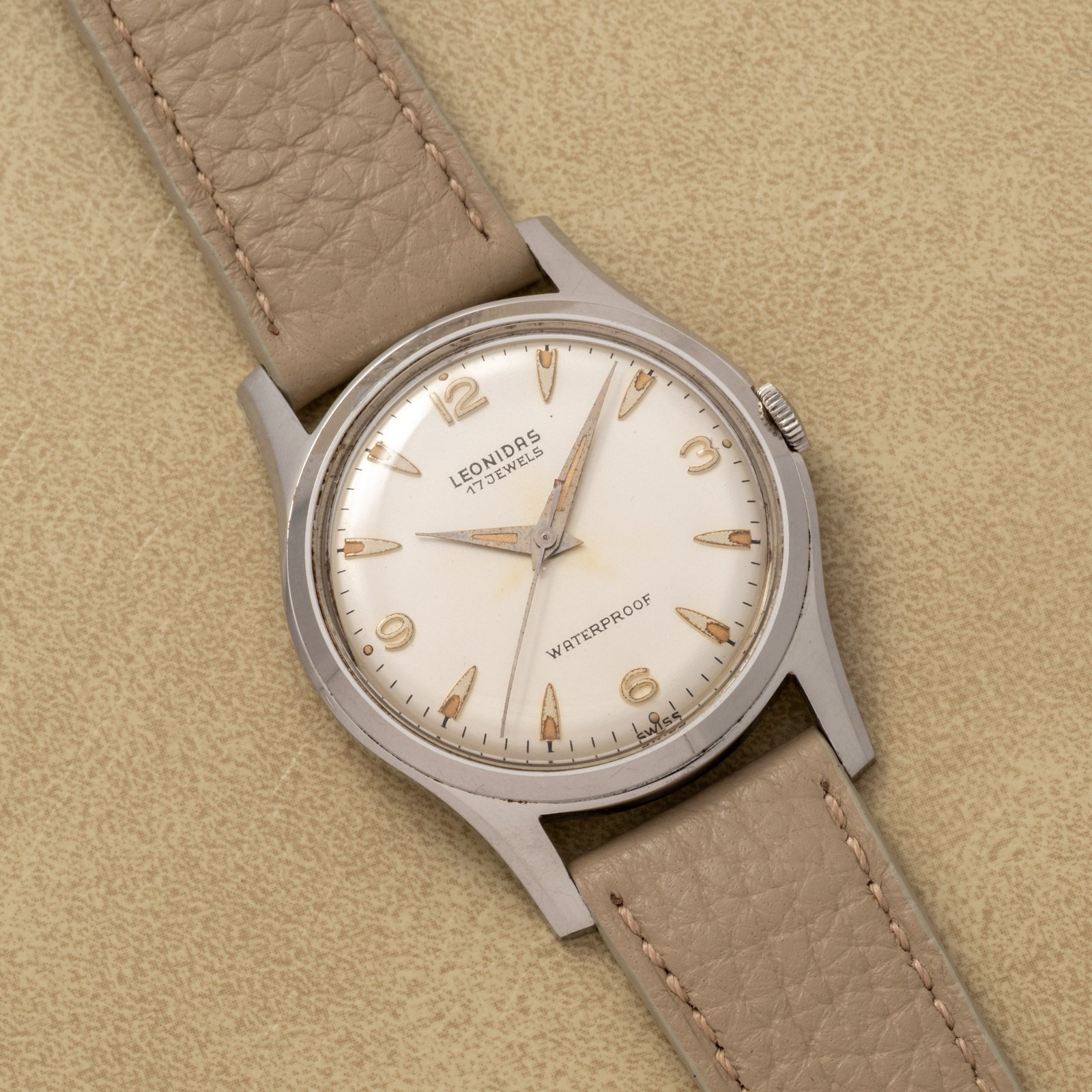
Leonidas 'Explorer' Field Watch, c. 1960s
- Maker / attribution
- Leonidas (maker)
- Date
- c. 1960s
- Historical period
- Modern Mechanical Horology (1945 – 1969)
- Country of origin
- Unrecorded in source
- Object type
- Wristwatch
- Dimensions
- Case 34 mm
- Stock no.
- 40992478
- Credit line
- Dealer listing, Analog/Shift (40992478)
- Catalogue title (original)
- Leonidas 'Explorer' Field Watch (English)
View the source record (dealer listing) ↗ (opens another website in a new tab)Suggest a correction
Record summary
Catalogued by Analog/Shift (dealer), New York (stock number 40992478), this is a wristwatch by Leonidas, dated c. 1960s. The Atlas places it in the Modern Mechanical Horology period (1945 – 1969) of its Wristwatches collection. Recorded dimensions: Case 34 mm. The record is illustrated with 6 photographs.
Assembled from the source record's structured fields. Dates and attributions are given as the source states them; where a field is missing the Atlas leaves it blank rather than estimating.
Catalogue description
Dealer description — Analog/Shift
Leonidas was founded in 1841 in St. Imier, Switzerland, and was purchased by Constant Jeanneret-Droz in 1914. Constant Jeanneret-Droz, in turn, was the son of Jules Frédéric Jeanneret, founder of renowned chronograph èbauche maker Excelsior Park . With an already-strong background in producing chronographs, Leonidas continued to produce chronographs and complicated wristwatches throughout the 20th century, supplying watches to the militaries of the Central and Axis powers during the two World Wars. That said, the brand wasn't only making chronos. In fact, they had quite a few time-only pieces that were equally unique. Take this Reference 2265, for example. Powered by a 17 jewel movement and outfitted with a waterproof case, this piece represented the utilitarian side of Leonidas's production capabilities. In addition to the more refined complicated pieces with which the brand cut its teeth, they were making a variety of other noteworthy pieces like this one that occupy a unique middle grown of everyday watch. This particular piece dates from roughly the 1960s, shortly before the brand's merger with Heuer. With its tidy 34mm stainless steel case, explorer dial and tritium lume that has developed an awesome patina, it has much in common with other field watches from the era. Anyone can collect a watch from one of the big brands. Having something with this degree of specificity and uniqueness alllows it to punch far above its weight. And it has a cool story too!
Historical context
Modern Mechanical Horology (1945 – 1969)
Tool watches for divers, pilots and astronauts; electric watches anticipate the electronic age.
The classic era of the mechanical wristwatch: dive watches, chronographs for motor racing and space flight, GMT watches for jet travel, slim dress watches, automatic calendars, and the rise of Japanese manufacturers alongside Swiss, American, German and Soviet industries.
Read the period in the timelineMore wristwatches from this periodEarlier: Golden Age of Mechanical Watchmaking
Atlas type guide
Wristwatches
Bracelet watches were worn by women from the early nineteenth century — Breguet made one for Caroline Murat, Queen of Naples, in 1810–12 — but the wristwatch only became a man's instrument with military use and aviation in the early twentieth century. Between the World Wars it overtook the pocket watch; the 1920s and 1930s brought rectangular Art Deco cases, water-resistant cases and the first automatic winding systems.
After 1945 the wristwatch became a carrier of identity — dress watches, sports and dive watches, chronographs, calendars — produced by Swiss, American, Japanese, German, Soviet and Chinese industries. The quartz revolution after 1969 and the mechanical renaissance since the 1990s, including the rise of independent watchmakers, complete the story.
What to look for
- The reference number (between the lugs or inside the case back) and serial number, the starting point for dating.
- The calibre: its maker and number are often stamped under the dial or on the bridge.
- Originality of dial, hands and crown — refinished ('redial') dials are common.
- Case material marks: 18K/750, 14K/585, stainless steel, gold-filled, plated.
Dating clues
- Wire-lug cases: before c. 1925.
- Water-resistant screw-down cases: from 1926.
- Quartz movements: from 1969; sapphire crystals widespread after c. 1980.
General guidance written by the Atlas editors about this kind of object. It is not a statement about this particular piece; for that, rely on the source record above and on physical examination.
Related records
Clocks · c. 1950s
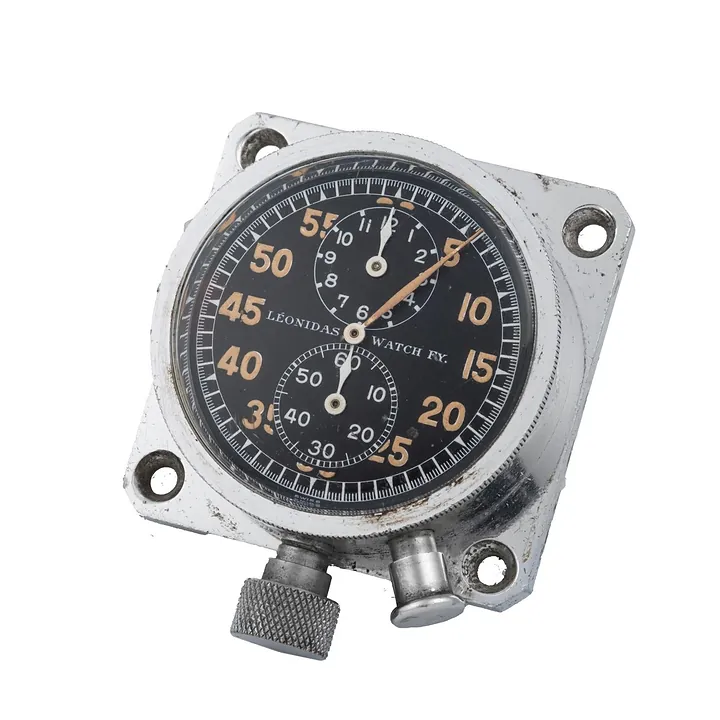
Leonidas clock, ref. 68901, c. 1950s
Antiquorum auction archive, Geneva
Wristwatches · c. 1940s
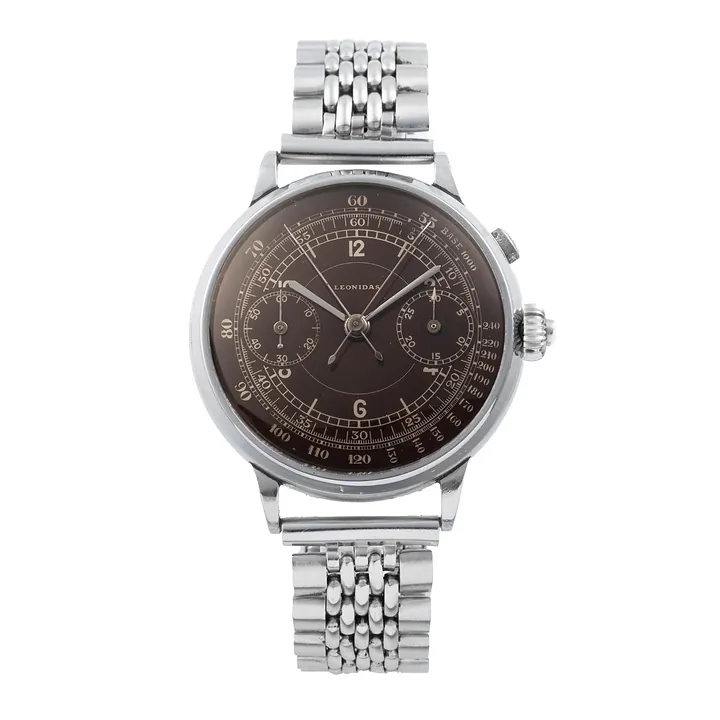
Leonidas wristwatch, c. 1940s
Antiquorum auction archive, Geneva
Wristwatches · c. 1950s
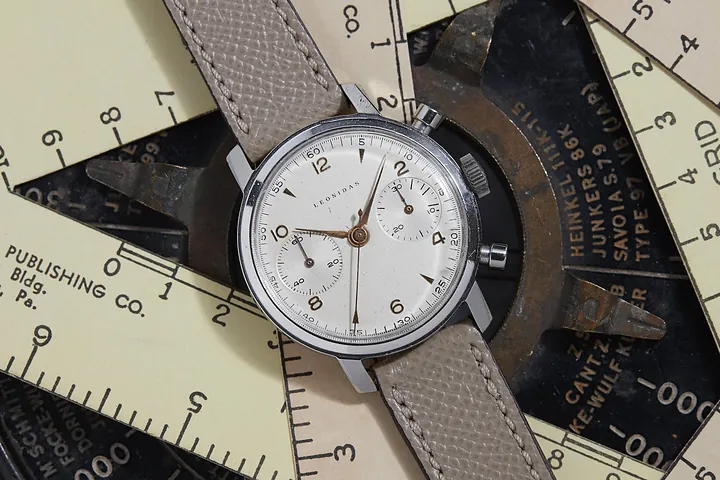
Leonidas Two-Register Chronograph, c. 1950s
Analog/Shift (dealer), New York
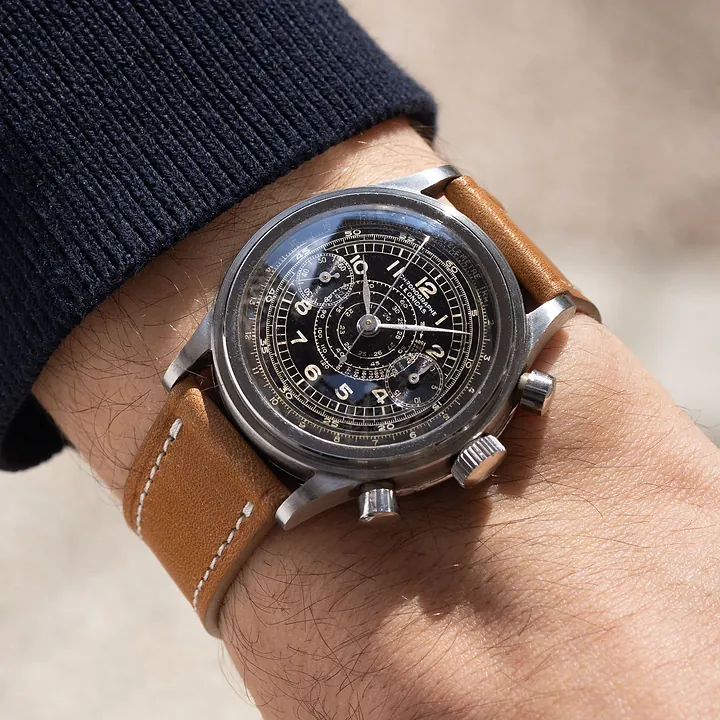
Instruments · 1940s
Leonidas Oversized Steel Step Case Millitary Style Chronograph Black Dial Valjoux 22, 1940s
Bulang & Sons (dealer), Copenhagen

Wristwatches · 1945
Wristwatch by Eterna, 1945
Museum Rotterdam

Wristwatches · c. 1945
Breitling Premier, ref. 790, c. 1945
Antiquorum auction archive, Geneva

Wristwatches · c. 1945
Universal Genève Uni-Compax, ref. 22492, c. 1945
Antiquorum auction archive, Geneva
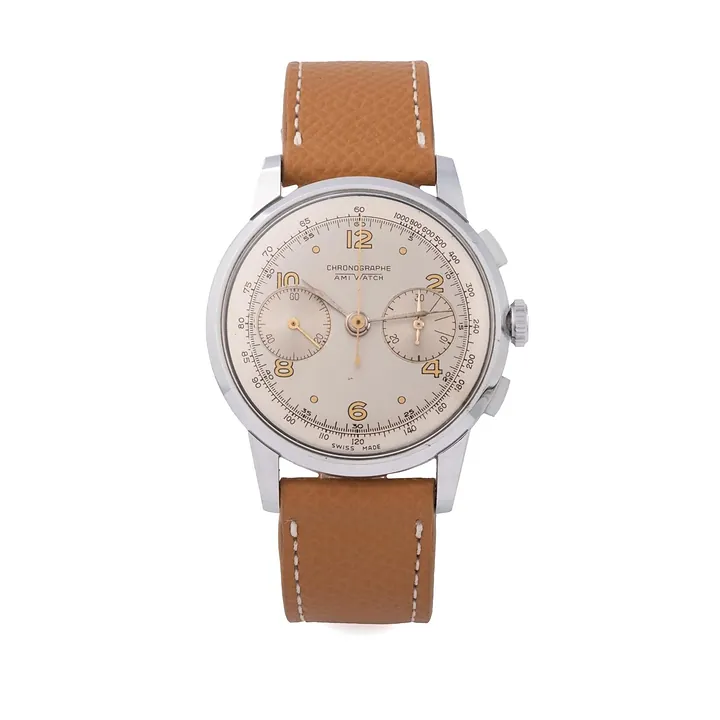
Wristwatches · c. 1950s
Ami Watch Chronographe, c. 1950s
Antiquorum auction archive, Geneva