
Wristwatches · Wristwatch
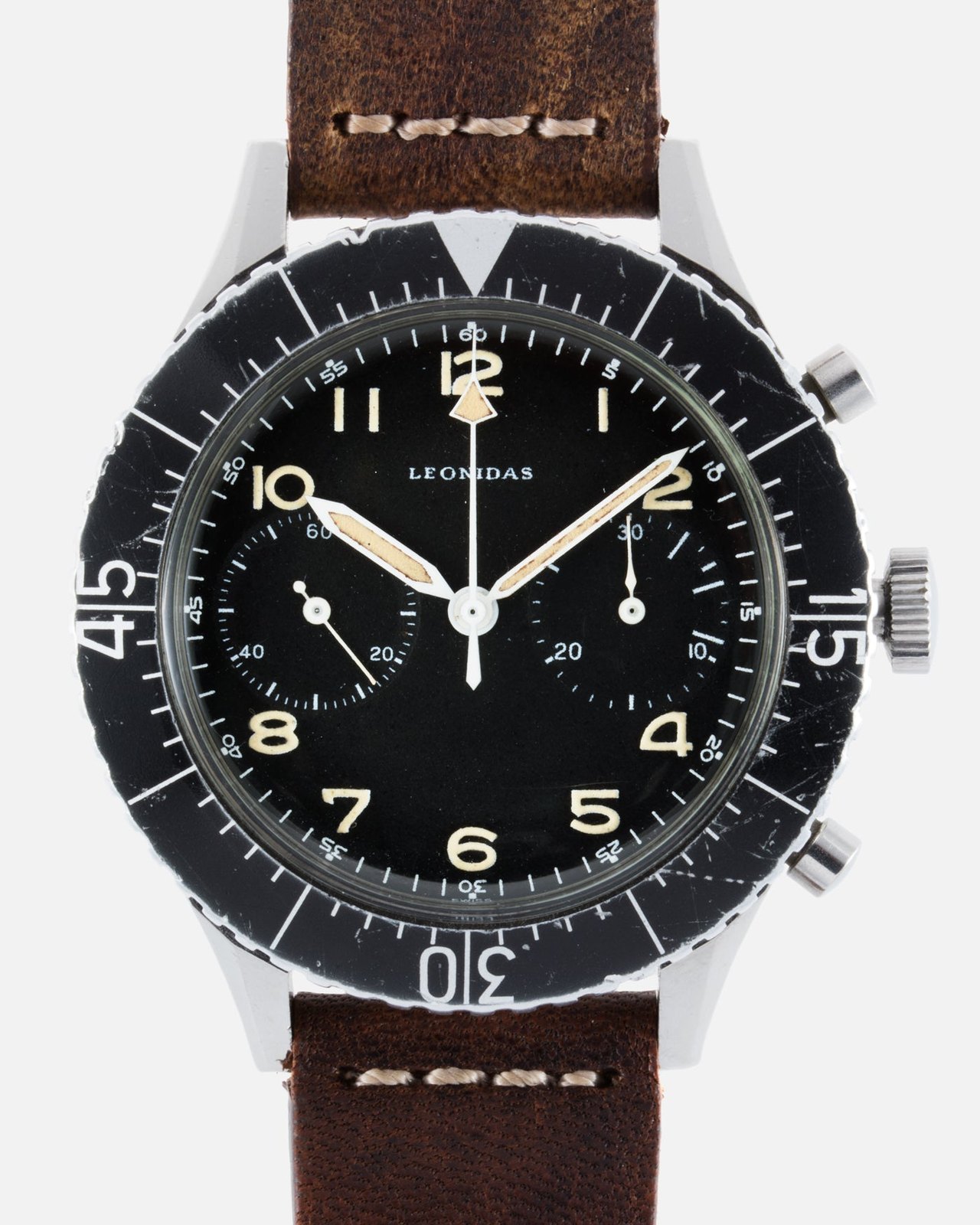
Leonidas CP-2 'Esercito Italiano' Flyback Chronograph Italian Army, 1960s
- Maker / attribution
- Leonidas (maker)
- Date
- 1960s
- Historical period
- Modern Mechanical Horology (1945 – 1969)
- Country of origin
- Italy
- Object type
- Wristwatch
- Dimensions
- Case 43 mm
- Stock no.
- Product 1310423646295
- Credit line
- Dealer listing, S.Song Watches (product 1310423646295)
- Catalogue title (original)
- Leonidas CP-2 'Esercito Italiano' Flyback Chronograph Italian Army (English)
View the source record (dealer listing) ↗ (opens another website in a new tab)Suggest a correction
Record summary
Catalogued by S.Song Watches (dealer), Seattle (stock number Product 1310423646295), this is a wristwatch by Leonidas, made in Italy, dated 1960s. The Atlas places it in the Modern Mechanical Horology period (1945 – 1969) of its Wristwatches collection. Recorded dimensions: Case 43 mm. The record is illustrated with 6 photographs.
Assembled from the source record's structured fields. Dates and attributions are given as the source states them; where a field is missing the Atlas leaves it blank rather than estimating.
Catalogue description
Dealer description — S.Song Watches
The Leonidas CP-2 follows a long line of military watches issued to the Italian Armed Forces and this, without a doubt is a badass watch. Sized at a muscular 43mm, these were made and designed for military use only and is purely a utilitarian piece. This specific example is an issued piece, giving it interesting provenance and making it a seriously rare timepiece. This CP-2, with its E.I markings on the caseback stands for Esercito Italiano, which translates to the Italian Army. As this is a CP (Cronometro da Polso/Wrist Chronometer) watch, it was issued to those involved in aviation. As the Italian Air Force had their own specific markings (A.M.I.), this Leonidas was not issued to the Aeronautica Militaire Italiano but instead to helicopter pilots in the Italian Army. As mentioned, this is a big watch. With a thick aluminium bezel and a stainless steel case that is held together via four screws at the back, these were made to the same spec as the more common Heuer Bundeswehr and features the same black dial and hands layout. Powering this watch is a Valjoux 222 chronograph movement with a flyback function. Most notably, this calibre was first used for the Breguet and other Type 20 watches that were issued to the French Air Force. With all of the historical provenance aside, at the end of the day, this is just a downright cool watch with a complicated movement. With its heft, it is still a very wearable watch by modern standards and on top of this, you get to strap a piece on your wrist that was part of the Italian Army’s history.
Historical context
Modern Mechanical Horology (1945 – 1969)
Tool watches for divers, pilots and astronauts; electric watches anticipate the electronic age.
The classic era of the mechanical wristwatch: dive watches, chronographs for motor racing and space flight, GMT watches for jet travel, slim dress watches, automatic calendars, and the rise of Japanese manufacturers alongside Swiss, American, German and Soviet industries.
Read the period in the timelineMore wristwatches from this periodEarlier: Golden Age of Mechanical Watchmaking
Atlas type guide
Chronographs and split-seconds watches
A chronograph is a watch with an additional seconds hand that can be started, stopped and returned to zero independently of the timekeeping. Louis Moinet built an early example in 1816 and Nicolas Rieussec a recording 'chronographe' in 1821; Adolphe Nicole's heart-shaped reset cam (patented 1862) made the modern return-to-zero possible. Split-seconds (rattrapante) chronographs add a second hand that can be stopped for intermediate times; flyback chronographs restart instantly.
Chronographs were essential tools for doctors (pulsometer scales), artillery (telemeter), engineers and sport. In wristwatches, Valjoux, Venus, Lemania and later the automatic chronographs of 1969 (Zenith El Primero, the Chronomatic Calibre 11 group and Seiko 6139) are milestones.
What to look for
- Push-pieces on the case band or a single button in the crown (monopusher).
- Subsidiary registers for minutes and hours; tachymeter, telemeter or pulsometer scales.
- Column wheel versus cam control visible in the movement.
- Calibre markings of specialist makers (Valjoux, Lemania, Venus, Landeron).
Dating clues
- Pocket chronographs with heart cam reset: after 1862.
- Wrist chronographs: from c. 1910; two-button designs from the 1930s.
- Automatic chronographs: from 1969.
General guidance written by the Atlas editors about this kind of object. It is not a statement about this particular piece; for that, rely on the source record above and on physical examination.
Read next:Chronograph
Related records
Clocks · c. 1950s
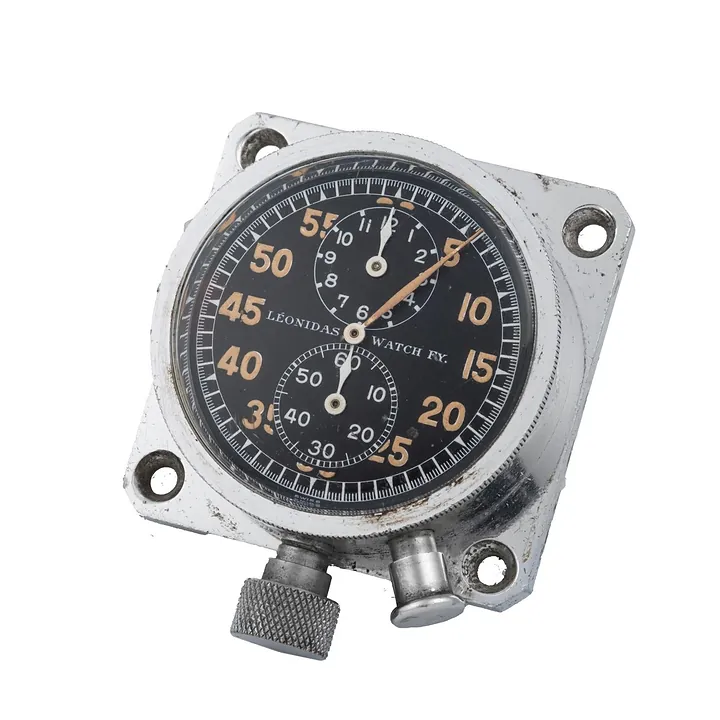
Leonidas clock, ref. 68901, c. 1950s
Antiquorum auction archive, Geneva
Wristwatches · c. 1940s
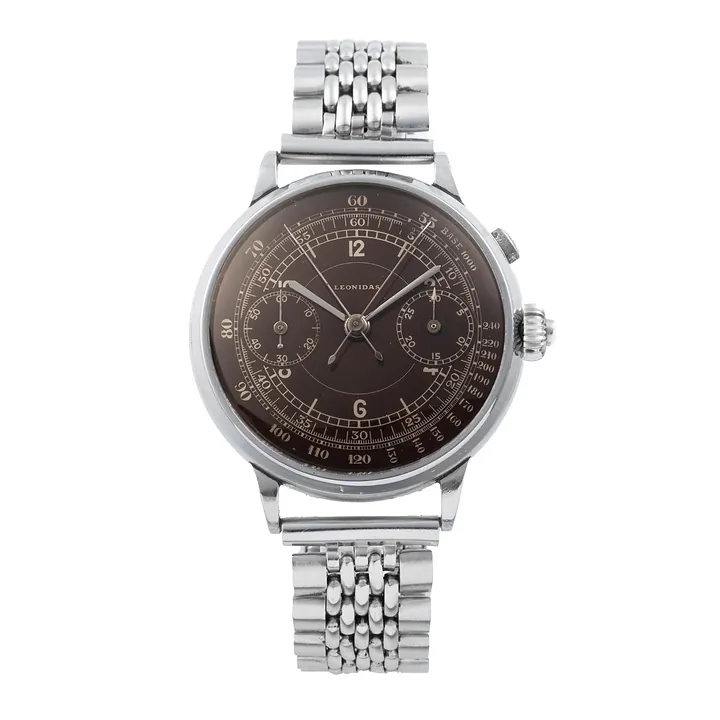
Leonidas wristwatch, c. 1940s
Antiquorum auction archive, Geneva
Wristwatches · c. 1960s
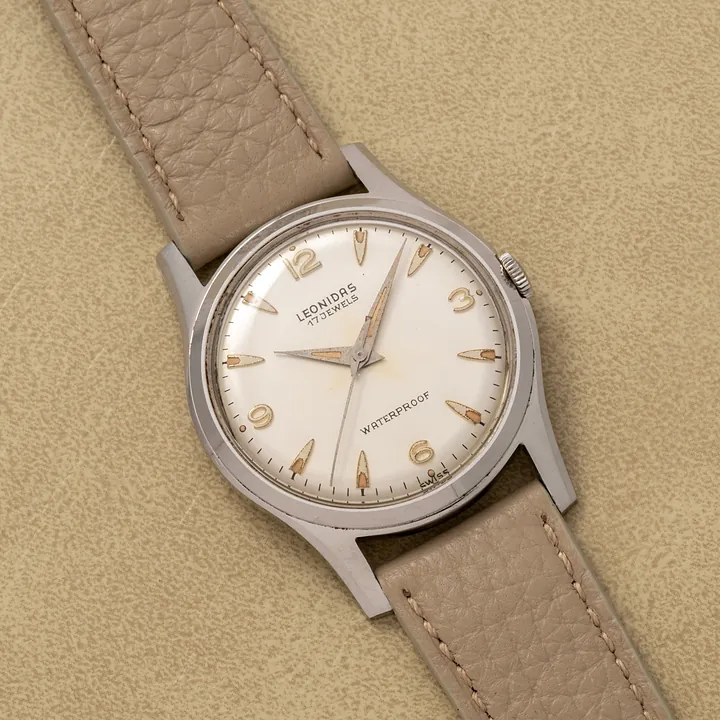
Leonidas 'Explorer' Field Watch, c. 1960s
Analog/Shift (dealer), New York
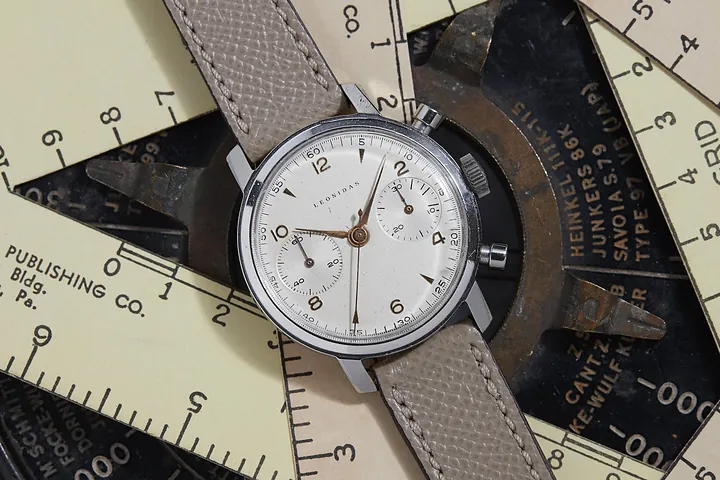
Wristwatches · c. 1950s
Leonidas Two-Register Chronograph, c. 1950s
Analog/Shift (dealer), New York
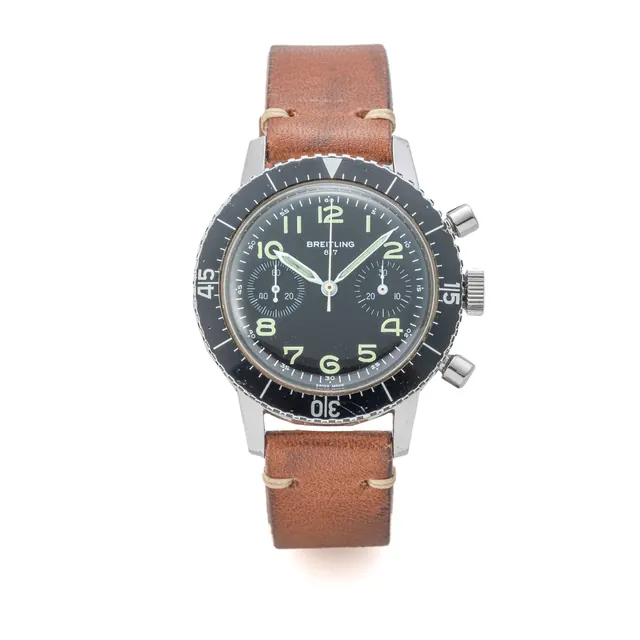
Wristwatches · c. 1955
Breitling wristwatch, ref. 817, Italian Military Chronograph, circa 1955
Antiquorum auction archive, Geneva
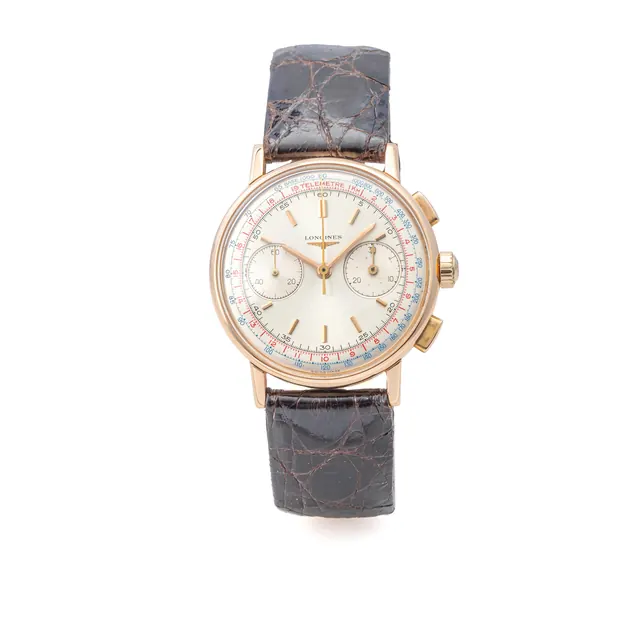
Wristwatches · Sold in August 1966 to Binda, agent for Italy
Longines wristwatch, ref. 7414, Flyback Chronograph 30Ch, Sold in August 1966 to Binda, agent for Italy
Antiquorum auction archive, Geneva
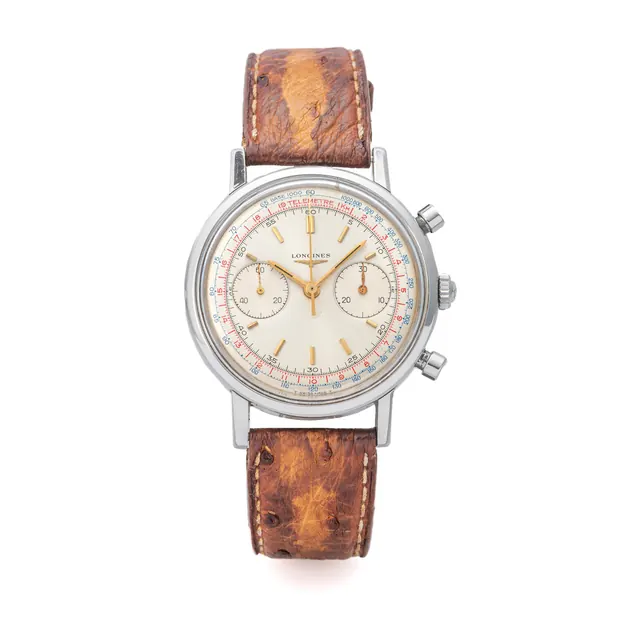
Wristwatches · Sold in January 1966 to Binda, agent for Italy
Longines wristwatch, ref. 7413, 30Ch Flyback Chronograph, Sold in January 1966 to Binda, agent for Italy
Antiquorum auction archive, Geneva
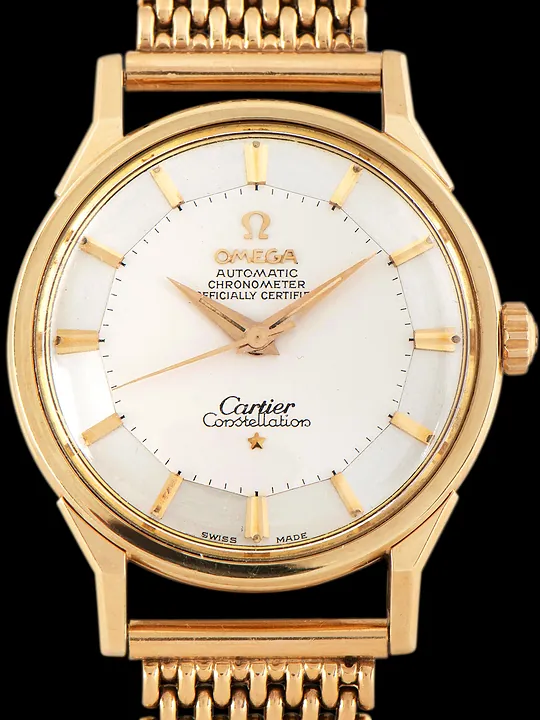
Wristwatches · 1962
Omega Constellation 14K YG (Ref. 14900SC) Silver "Cartier Cosigned" Pie-Pan Dial W/ Cartier Milanese Bracelet, 1962
Craft & Tailored (dealer), Los Angeles