
Wristwatches · Wristwatch
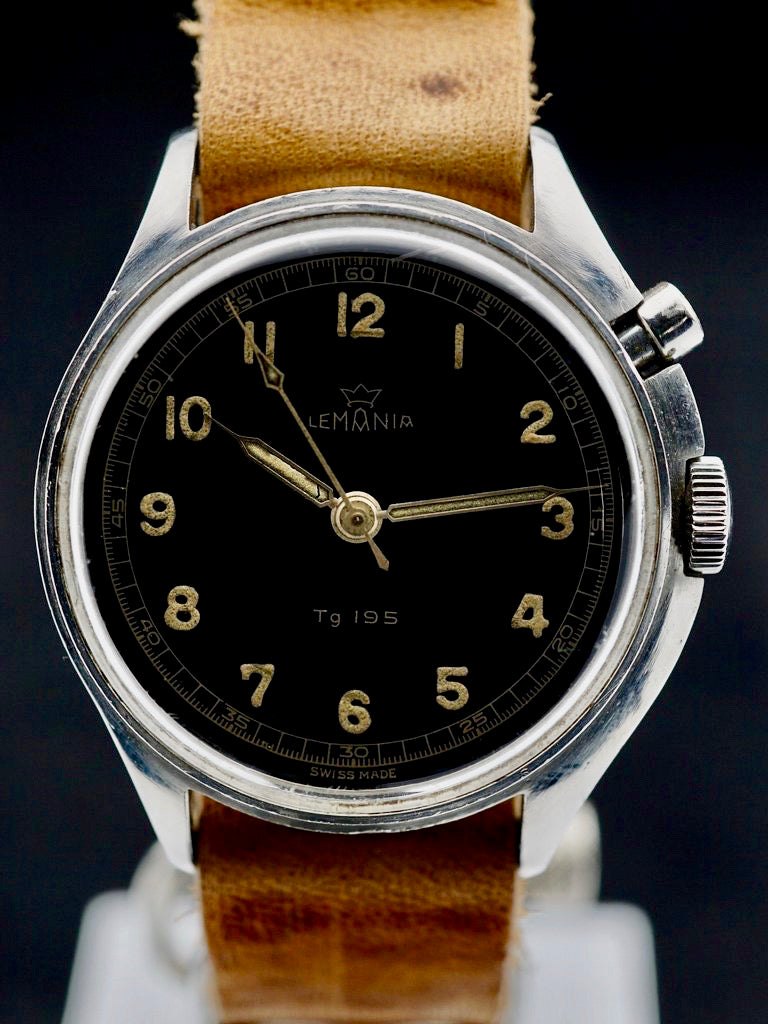
Lemania Tg 195 Swedish Military, 1957
- Maker / attribution
- Unrecorded in source
- Date
- 1957
- Historical period
- Modern Mechanical Horology (1945 – 1969)
- Country of origin
- Sweden
- Object type
- Wristwatch
- Dimensions
- Case 40 mm
- Stock no.
- LMPC1954
- Credit line
- Dealer listing, Craft & Tailored (LMPC1954)
- Catalogue title (original)
- 1957 Lemania Tg 195 Swedish Military (English)
View the source record (dealer listing) ↗ (opens another website in a new tab)Suggest a correction
Record summary
Catalogued by Craft & Tailored (dealer), Los Angeles (stock number LMPC1954), this is a wristwatch, made in Sweden, dated 1957. The Atlas places it in the Modern Mechanical Horology period (1945 – 1969) of its Wristwatches collection. Recorded dimensions: Case 40 mm. The record is illustrated with 6 photographs.
Assembled from the source record's structured fields. Dates and attributions are given as the source states them; where a field is missing the Atlas leaves it blank rather than estimating.
Catalogue description
Dealer description — Craft & Tailored
Besides being a very handsome and well-executed military watch, this particular model by Lemania features a distinctive control: the button above the crown is depressed and immediately the movement stops, the seconds-hand is rotated back to 12 o'clock (flyback function), and the crown is extended for the setting of the watch. While many military watches will stop the hands when the crown is pulled (hacking), the flyback creates the optimum condition to set an exact time or to synchronize several watches precisely. In the 1950’s, Lemania began producing timer watches such as the Tg 195 for the Swedish Military bomb squad. These watches featured a pusher at the 2 o’clock position on the case above the crown, and when pushed the crown extends t and the seconds hand would jump to 12 o’clock. In this position, the wearer could set the time and when the crown is pushed in the second's hand begins to run to synchronize a number of watches before a military mission. Lemania continued to supply watches to the Swedish Military through the mid-1980’s. The watches for the Swedish Military are recognizable by several traits – the “Tg195” designation on the dial and three crowns engraved on the case back, known as “tre kronor” which is the Swedish coat of arms. The earliest examples produced to the military did not have the “Tg” marking and had smaller crowns engraved. Later examples featured larger crowns engraved on the back and “Tg195” was added to the dial with a capital “T” and lowercase “g”, finally evolving to have all capital letters – “TG195”. Tg stands for “giving time”, or in Swedish, “Tid Givare”. Close examination reveals that this is a very high-quality watch. The asymmetric case is heavy stainless steel, usefully and beautifully brushed, and 40mm across, exclusive of the crown. The right side's subtly wider shoulder below the bezel allows the crown to be partially recessed and provides some protection for the pusher. The dial is glossy black, with proper luminous Arabic numerals and hands, and some of the finest and crispest printing I have seen on a vintage watch. The whole package is simple and functional, and also attractive and pleasant to wear. SPECS Stock # LMPC1954 Brand Lemania Style Military Model Flyback TG 195 Serial N/A Size Men's Material SS Dial Glossy Black "Gilt" Millimeters 40mm Bracelet Leather Nato "Honey Blonde" CASE & BRACELET The beautiful asymmetrical case is in unpolished original condition with military fixed spring bars and sweeps seconds flyback pusher. Watch comes supplied on NATO Strap of customers choice. (Honey Blonde Shown) The 3 crowns designating military provenance are slightly visible on the case back. DIAL & HANDS The glossy gilt dial is in beautiful condition with no blemishing or markings on the dial. The lume remains in very good condition for the age of the piece and has taken on an eye catching golden patina. Under U.V. light the lume in the hands and on the dial shows no visible degradation. ACCESSORIES None. The watch is running at spec and is in perfect working condition.
Historical context
Modern Mechanical Horology (1945 – 1969)
Tool watches for divers, pilots and astronauts; electric watches anticipate the electronic age.
The classic era of the mechanical wristwatch: dive watches, chronographs for motor racing and space flight, GMT watches for jet travel, slim dress watches, automatic calendars, and the rise of Japanese manufacturers alongside Swiss, American, German and Soviet industries.
Read the period in the timelineMore wristwatches from this periodEarlier: Golden Age of Mechanical Watchmaking
Atlas type guide
Military, pilot and travel watches
The wristwatch owes much of its adoption by men to warfare and aviation. Wristlets — small pocket watches soldered with lugs and worn on a strap — were used in colonial campaigns and became standard equipment in the First World War, with protective grilles over the crystal ('shrapnel guards'). Louis Cartier's Santos (1904), designed for the aviator Alberto Santos-Dumont, is often cited as an early purpose-made pilot's watch.
In the Second World War governments specified watches in detail: the German B-Uhr observation watches, the American A-11, and the British 'W.W.W.' (the 'Dirty Dozen' set of 1945). After the war, jet travel brought GMT and world-time watches, which show two or more time zones at once — Louis Cottier's world-time mechanism and the Rolex GMT-Master (1955) are examples.
What to look for
- Military markings on the case back: broad arrow, issue numbers, 'W.W.W.', 'A.T.P.'
- High-legibility black dials with luminous Arabic numerals; oversized crowns for gloved hands.
- 24-hour hands and rotating 24-hour bezels or city rings on GMT/world-time watches.
- Wire lugs on early wristlets converted from pocket watches.
Dating clues
- Wire-lug wristlets: c. 1900–1925.
- Military specifications of the Second World War: 1939–1945.
- GMT and world-time wristwatches: mainly after 1950.
General guidance written by the Atlas editors about this kind of object. It is not a statement about this particular piece; for that, rely on the source record above and on physical examination.
Related records
Wristwatches · 1960–1962
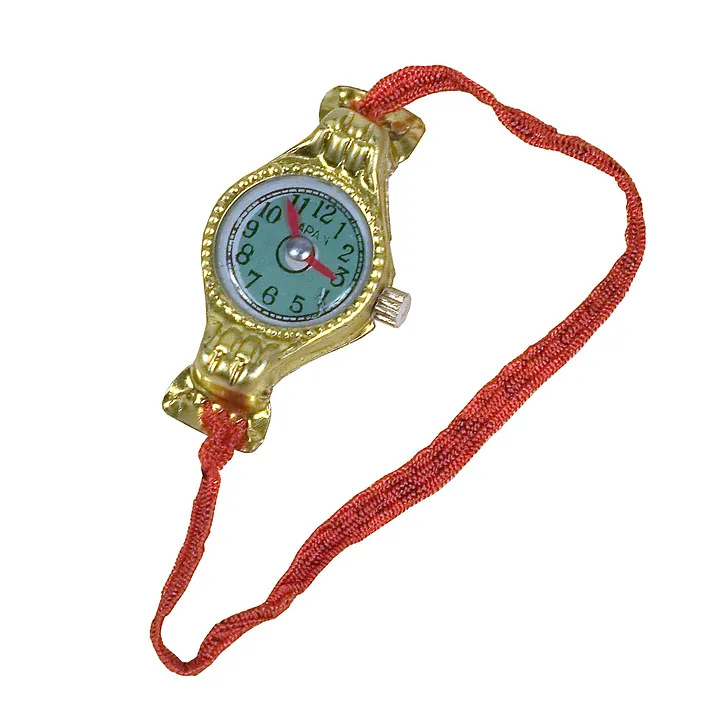
Wristwatch, Sweden, 1960–1962
Skelleftea museum
Wristwatches · 1965
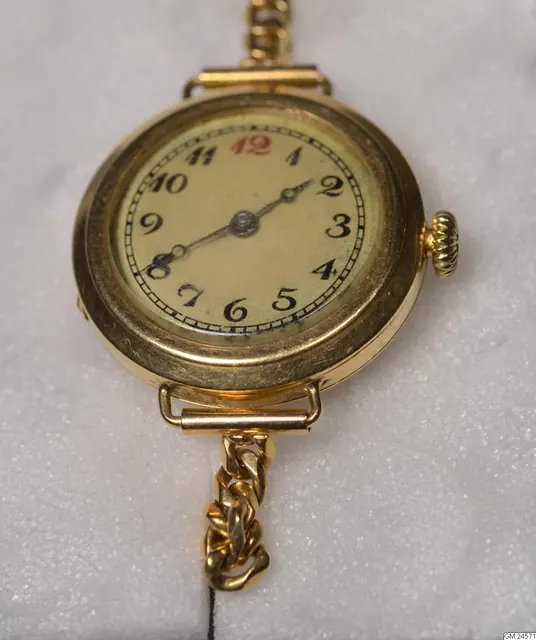
Wristwatch, Sweden, 1965
Museum of Gothenburg
Wristwatches · Sold in May 1959 to Sweden
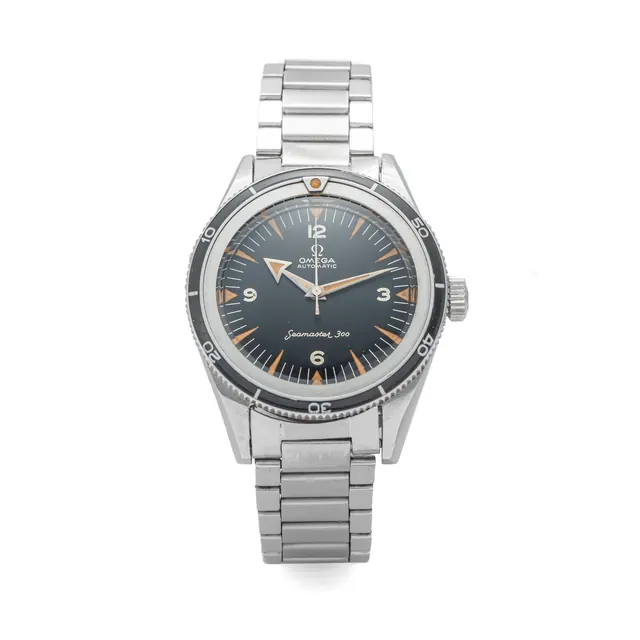
Omega wristwatch, ref. Ck, Seamaster 300, Sold in May 1959 to Sweden
Antiquorum auction archive, Geneva
Wristwatches · c. 1964
Bulova Accutron Spaceview 214 Tuning Fork Men’s Wristwatch, 1964, Fluco Suede Strap
LiveAuctioneers auction archive
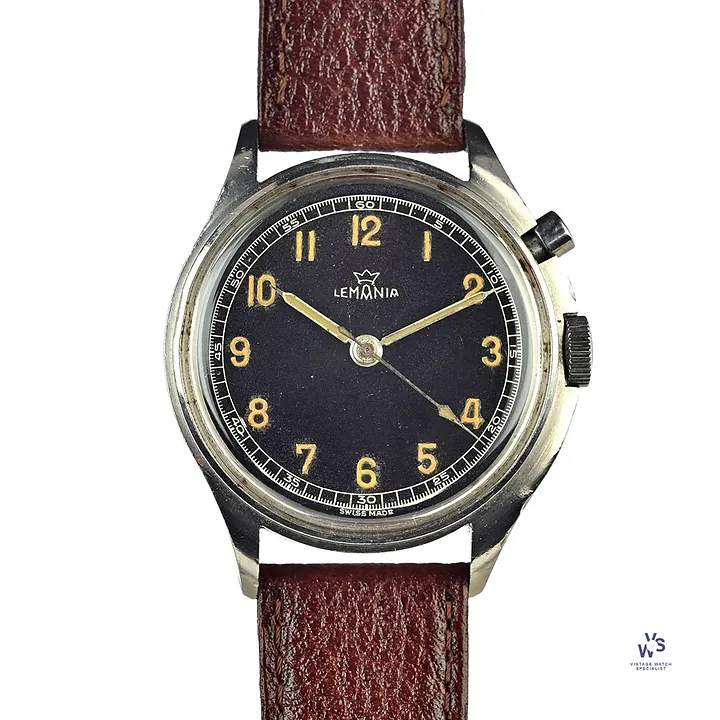
Wristwatches · c. 1954
Lemania TG 195 Swedish Military Issued, Single Pusher Hack Watch, Caseback ref. 54-1027, circa 1954
Vintage Watch Specialist (dealer), United Kingdom
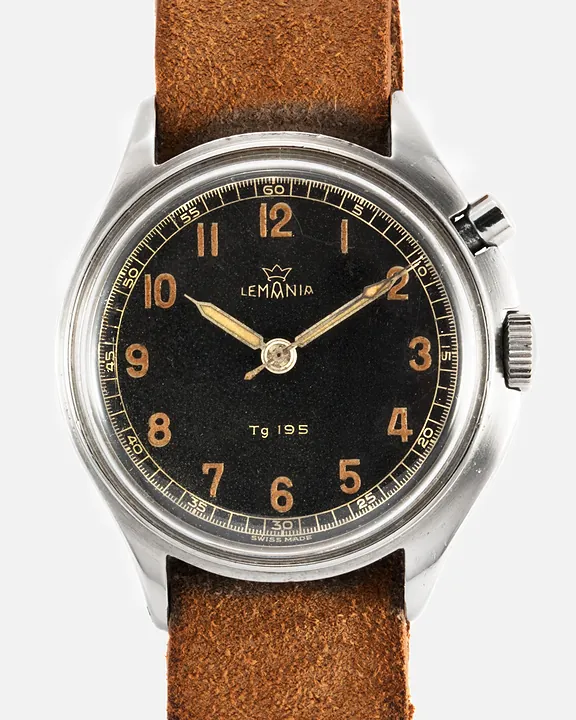
Wristwatches · 1954
Lemania TG 195 Swedish Military, 1954
S.Song Watches (dealer), Seattle
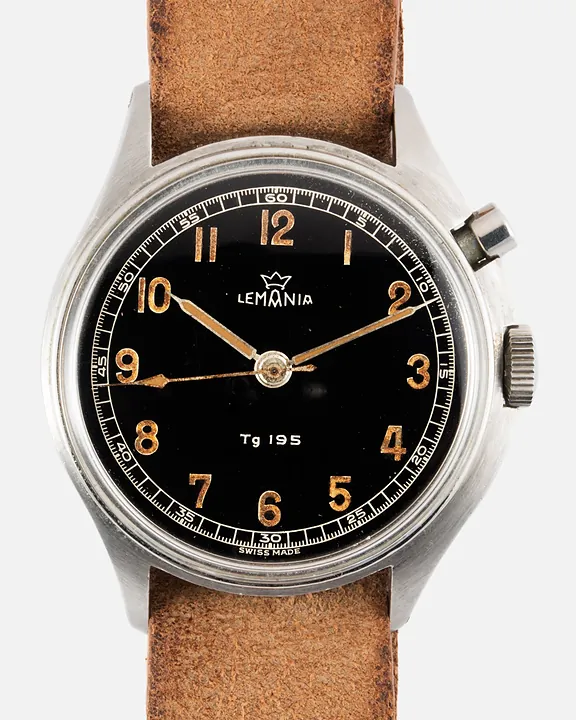
Wristwatches · 1957
Lemania TG 195 Swedish Military, 1957
S.Song Watches (dealer), Seattle
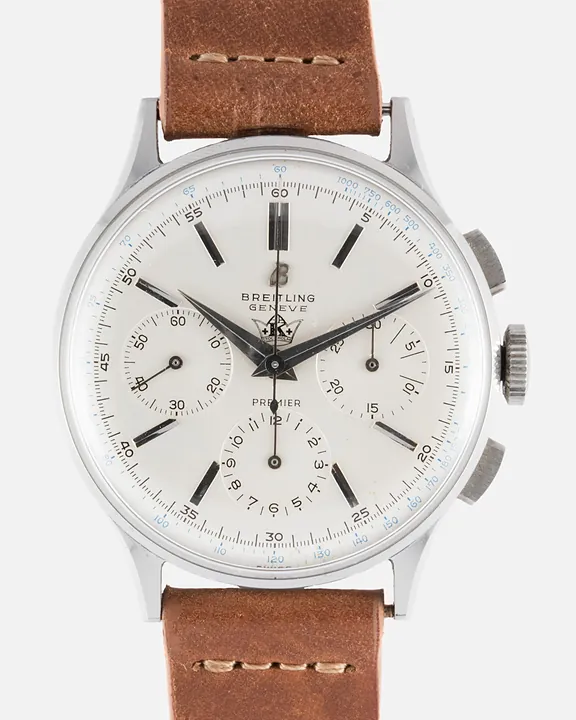
Wristwatches · 1950s
Breitling 'Kronometer Stockholm' Premier Ref. 734, 1950s
S.Song Watches (dealer), Seattle