
Wristwatches · Wristwatch
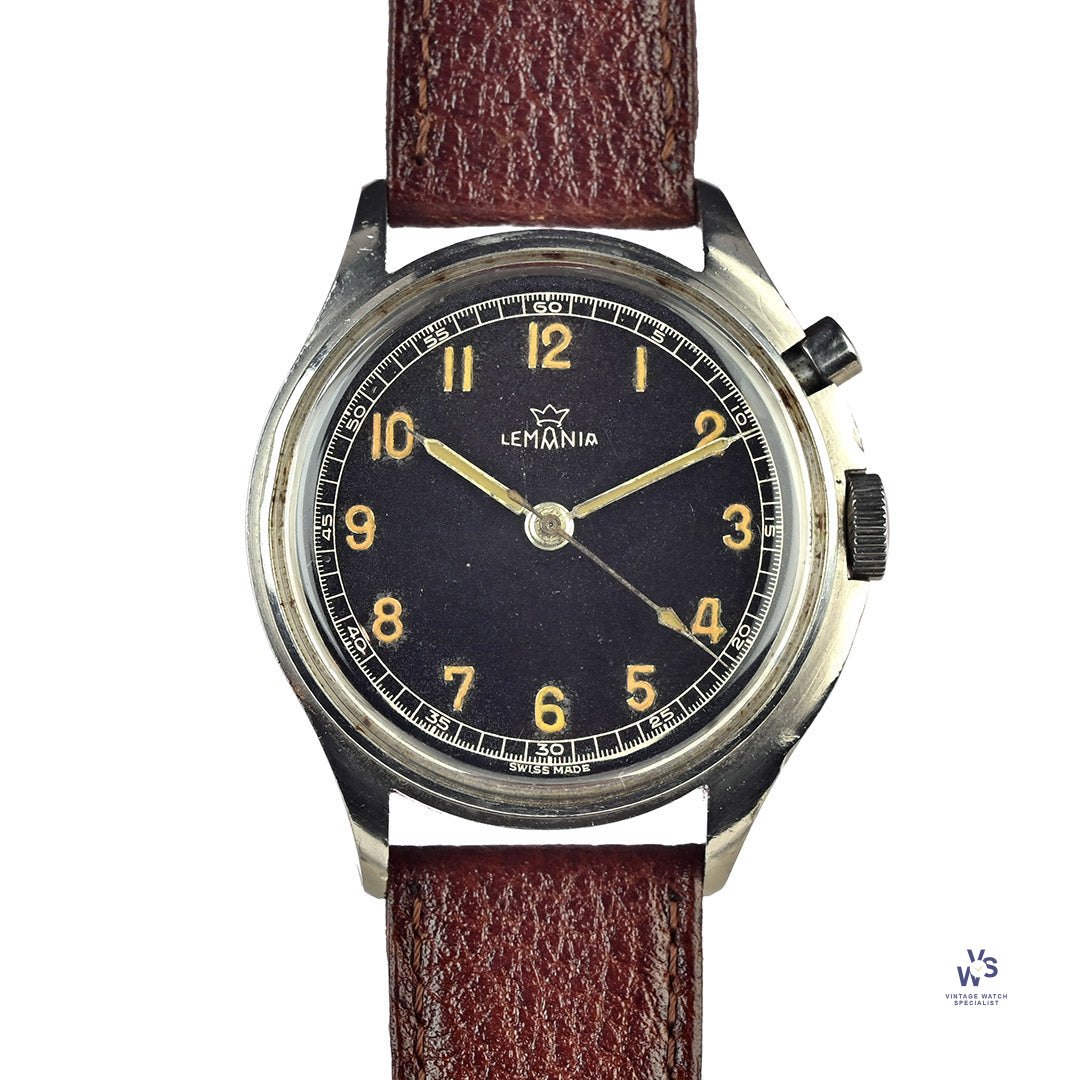
Lemania TG 195 Swedish Military Issued, Single Pusher Hack Watch, Caseback ref. 54-1027, circa 1954
- Maker / attribution
- Lemania (maker)
- Date
- c. 1954
- Historical period
- Modern Mechanical Horology (1945 – 1969)
- Country of origin
- Sweden
- Object type
- Wristwatch
- Stock no.
- VWS3252
- Credit line
- Dealer listing, Vintage Watch Specialist (VWS3252)
- Catalogue title (original)
- Lemania - TG 195 Swedish Military Issued - Single Pusher Hack Watch - Caseback Reference 54-1027 - c.1954 (English)
View the source record (dealer listing) ↗ (opens another website in a new tab)Suggest a correction
Record summary
Catalogued by Vintage Watch Specialist (dealer), United Kingdom (stock number VWS3252), this is a wristwatch by Lemania, made in Sweden, dated c. 1954. The Atlas places it in the Modern Mechanical Horology period (1945 – 1969) of its Wristwatches collection. The record is illustrated with 6 photographs.
Assembled from the source record's structured fields. Dates and attributions are given as the source states them; where a field is missing the Atlas leaves it blank rather than estimating.
Catalogue description
Dealer description — Vintage Watch Specialist
A Superb Example of the Enigmatic Lemania TG 195 in Excellent Vintage Condition With a Beautiful Gilt Gloss Dial and Original Military Markings, 1954 The Lemania TG 195 is a renowned "Hacking" watch, specifically designed for the Swedish military yet it does remain somewhat of a mystery with inconclusive evidence to prove what TG 195 actually means, however, we do know the Lemania TG 195s were delivered to the Swedish military in the 1950s, this example in 1954 as denoted by its caseback markings. Powered by the reliable Lemania 2225 movement, the TG 195 offers exceptional accuracy and reliability. The hack function allows precise timekeeping essential for coordinated military operations and timing tasks. Its minimalist yet functional design reflects Scandinavian efficiency and practicality. Over the years, the Lemania TG 195 has garnered respect not only within military circles but also among watch enthusiasts and collectors. What's on Offer The uniqueness and mystery surrounding this watch possibly contribute to its collectibility. The gilt gloss dial is beautiful and has been wonderfully well preserved. This example is in superb condition. The Lemania TG 195 is unique in that it is not a chronograph as can observed from the time-only dial. While it may look like a mono-pusher chronograph the Calibre 2225 movement in this watch is a hacking seconds with a special synchronisation function. Pressing the chronograph-style pusher pops the crown out and resets the second hand to zero. Only by pushing the crown back in, the watch start again - a useful function for synchronising watches on missions where accuracy was imperative! We are pleased to offer this rare and enigmatic timepiece for sale in such fantastic condition, any military collector would be overjoyed with this addition. Very rare to find and a first for us too!
Historical context
Modern Mechanical Horology (1945 – 1969)
Tool watches for divers, pilots and astronauts; electric watches anticipate the electronic age.
The classic era of the mechanical wristwatch: dive watches, chronographs for motor racing and space flight, GMT watches for jet travel, slim dress watches, automatic calendars, and the rise of Japanese manufacturers alongside Swiss, American, German and Soviet industries.
Read the period in the timelineMore wristwatches from this periodEarlier: Golden Age of Mechanical Watchmaking
Atlas type guide
Military, pilot and travel watches
The wristwatch owes much of its adoption by men to warfare and aviation. Wristlets — small pocket watches soldered with lugs and worn on a strap — were used in colonial campaigns and became standard equipment in the First World War, with protective grilles over the crystal ('shrapnel guards'). Louis Cartier's Santos (1904), designed for the aviator Alberto Santos-Dumont, is often cited as an early purpose-made pilot's watch.
In the Second World War governments specified watches in detail: the German B-Uhr observation watches, the American A-11, and the British 'W.W.W.' (the 'Dirty Dozen' set of 1945). After the war, jet travel brought GMT and world-time watches, which show two or more time zones at once — Louis Cottier's world-time mechanism and the Rolex GMT-Master (1955) are examples.
What to look for
- Military markings on the case back: broad arrow, issue numbers, 'W.W.W.', 'A.T.P.'
- High-legibility black dials with luminous Arabic numerals; oversized crowns for gloved hands.
- 24-hour hands and rotating 24-hour bezels or city rings on GMT/world-time watches.
- Wire lugs on early wristlets converted from pocket watches.
Dating clues
- Wire-lug wristlets: c. 1900–1925.
- Military specifications of the Second World War: 1939–1945.
- GMT and world-time wristwatches: mainly after 1950.
General guidance written by the Atlas editors about this kind of object. It is not a statement about this particular piece; for that, rely on the source record above and on physical examination.
Related records
Instruments · 1950–1970
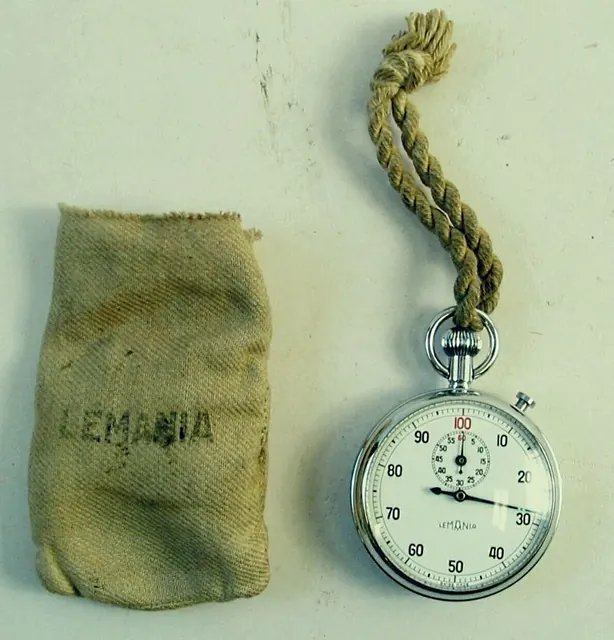
Stopwatch by Lemania, Switzerland, 1950–1970
Museokeskus Vapriikki
Wristwatches · c. 1970s
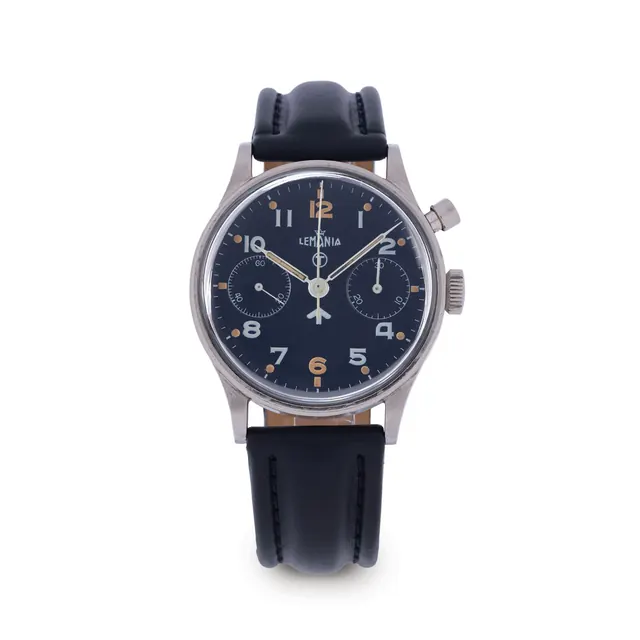
Lemania wristwatch, Series 2 Monopusher Chronograph, circa 1970s
Antiquorum auction archive, Geneva
Wristwatches · c. 1960s-1980s
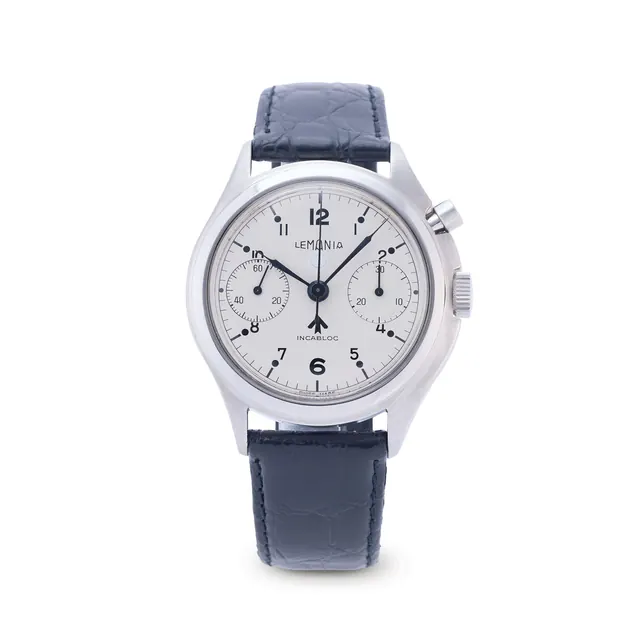
Lemania wristwatch, ref. 35-64, Series 3 Monopusher Chronograph, circa 1960s-1980s
Antiquorum auction archive, Geneva
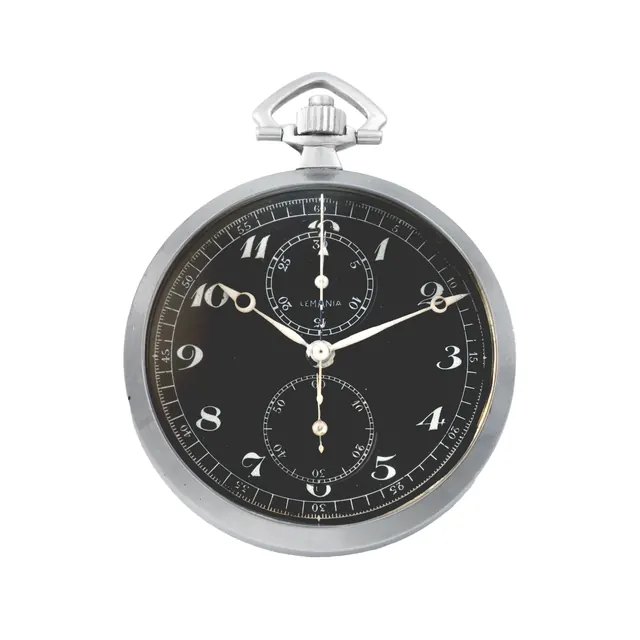
Pocket Watches · c. 1940
Lemania pocket watch, Single Button Chronograph, circa 1940
Antiquorum auction archive, Geneva
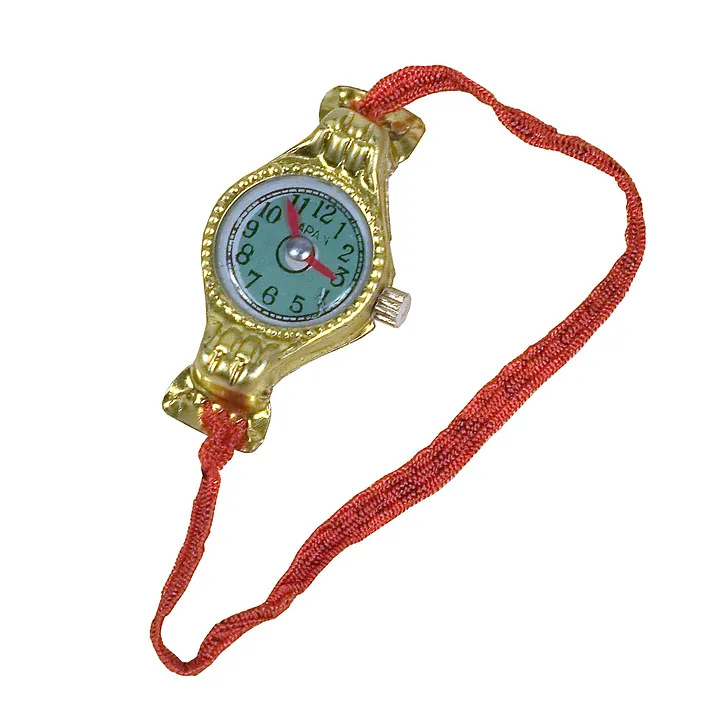
Wristwatches · 1960–1962
Wristwatch, Sweden, 1960–1962
Skelleftea museum
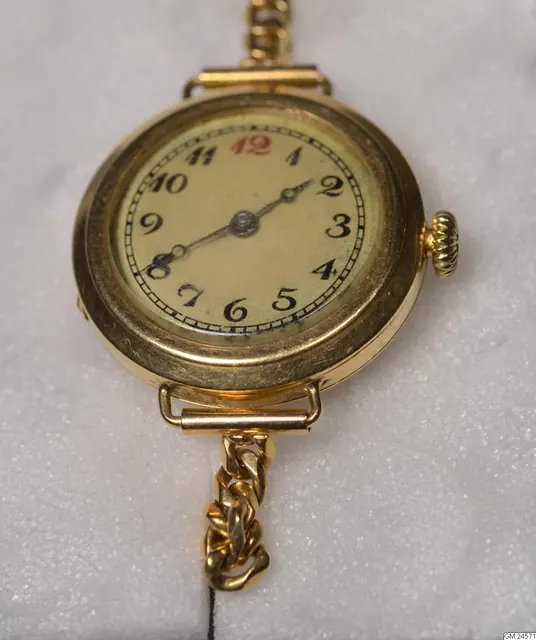
Wristwatches · 1965
Wristwatch, Sweden, 1965
Museum of Gothenburg
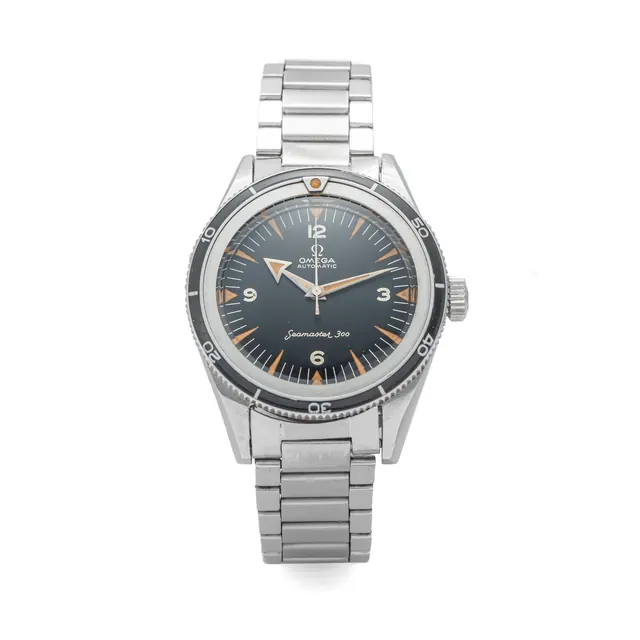
Wristwatches · Sold in May 1959 to Sweden
Omega wristwatch, ref. Ck, Seamaster 300, Sold in May 1959 to Sweden
Antiquorum auction archive, Geneva
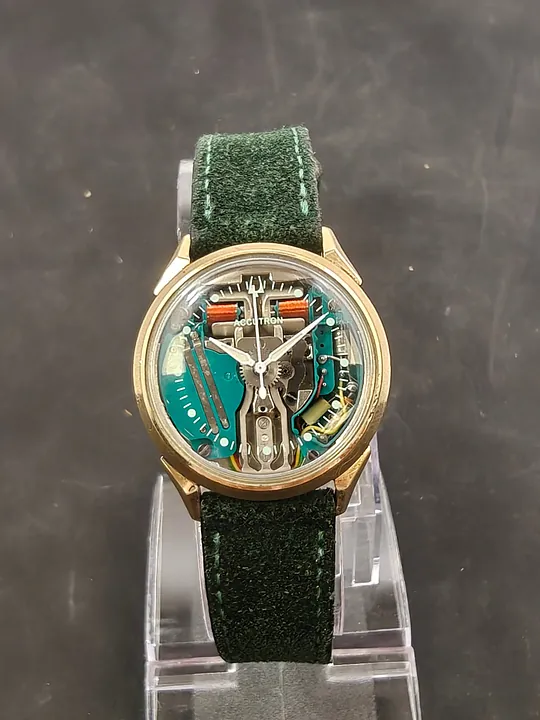
Wristwatches · c. 1964
Bulova Accutron Spaceview 214 Tuning Fork Men’s Wristwatch, 1964, Fluco Suede Strap
LiveAuctioneers auction archive