
Wristwatches · Wristwatch
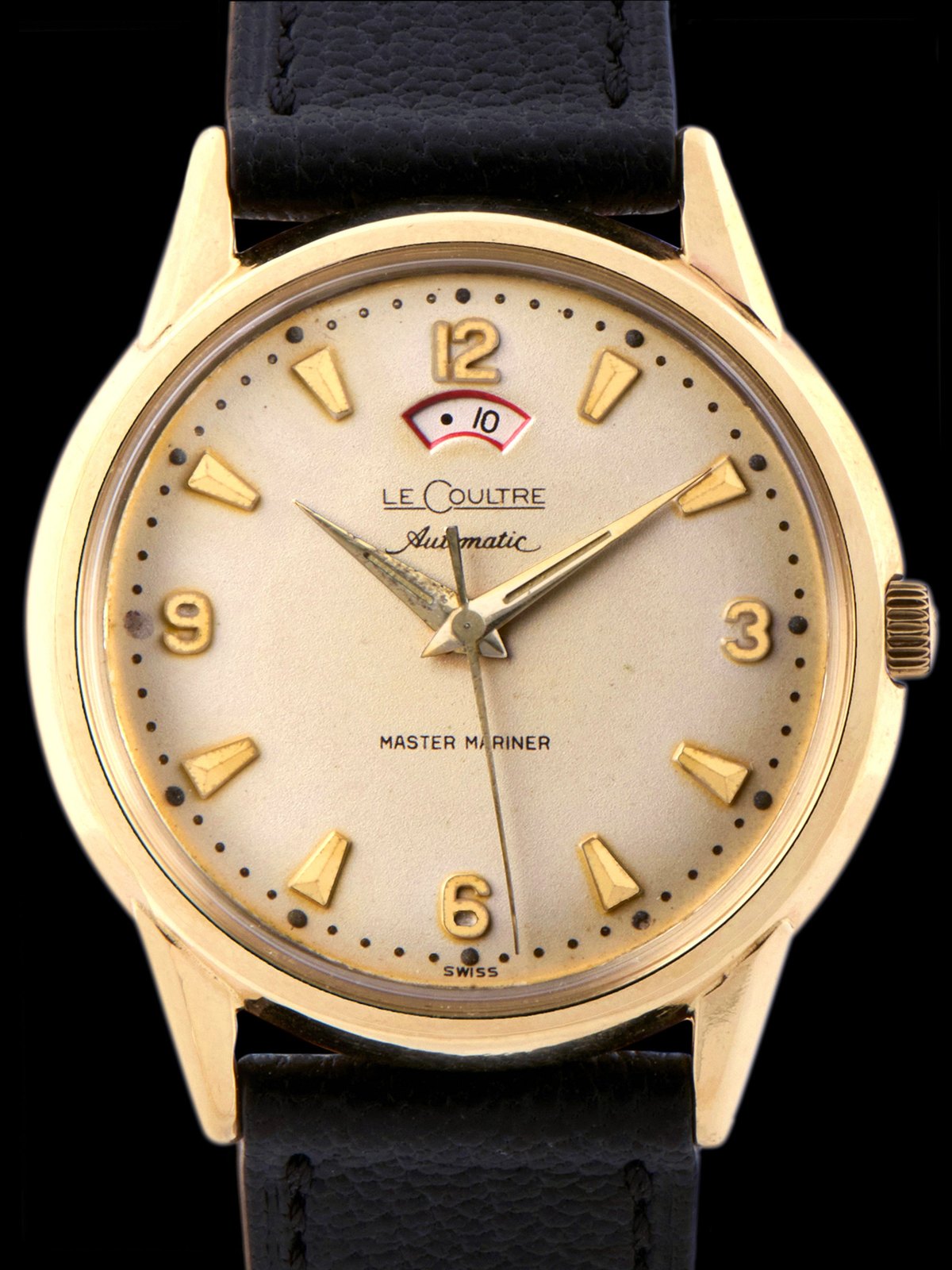
LeCoultre Master Mariner Powermatic Gold-Filled (Ref. 2295) 'Cal. 481', 1950s
- Maker / attribution
- Jaeger-LeCoultre (maker)
- Date
- 1950s
- Historical period
- Modern Mechanical Horology (1945 – 1969)
- Country of origin
- Switzerland
- Object type
- Wristwatch
- Materials / technique
- gold-filled
- Stock no.
- JLCPM481-3
- Credit line
- Dealer listing, Craft & Tailored (JLCPM481-3)
- Catalogue title (original)
- 1950s LeCoultre Master Mariner Powermatic Gold-Filled (Ref. 2295) 'Cal. 481' (English)
View the source record (dealer listing) ↗ (opens another website in a new tab)Suggest a correction
Record summary
Catalogued by Craft & Tailored (dealer), Los Angeles (stock number JLCPM481-3), this is a wristwatch by Jaeger-LeCoultre, made in Switzerland, dated 1950s. The Atlas places it in the Modern Mechanical Horology period (1945 – 1969) of its Wristwatches collection. Materials and techniques recorded by the source: gold-filled. The record is illustrated with 6 photographs.
Assembled from the source record's structured fields. Dates and attributions are given as the source states them; where a field is missing the Atlas leaves it blank rather than estimating.
Catalogue description
Dealer description — Craft & Tailored
Founded in 1833 by Antoine LeCoultre, the LeCoultre manufacture established itself as one of Switzerland’s most influential movement makers, supplying sophisticated calibers to some of the industry's most prestigious watchmaking houses. Its longstanding partnership with French watchmaker Edmond Jaeger ultimately led to the formation of Jaeger-LeCoultre in 1937, although watches destined for the American market continued to carry the LeCoultre signature for several decades. Among the manufacturer’s many horological achievements, the introduction of the Powermatic in 1948 stands as a particularly significant milestone. Powered by the innovative cal. 481 bumper automatic movement, the Powermatic became the first commercially produced self-winding wristwatch to incorporate a power-reserve indicator, displaying its approximately 40-hour reserve through a distinctive red-and-white aperture positioned just beneath 12 o’clock. Beyond its technical significance, this charming complication adds an unexpected element of character to an otherwise understated and classically styled timepiece. This 1950s LeCoultre Automatic "Master Mariner" ref. 2295 is a wonderful example of this pioneering design, featuring a warm silver dial with applied gold Arabic numerals and faceted hour markers, an elegant dauphine handset, and a handsome 10K gold-filled case. Combining quintessential mid-century aesthetics with a genuinely important piece of watchmaking innovation, this example offers an intriguing and historically significant addition to any vintage watch collection. SPECS Stock # JLCPM481-3 Brand LeCoultre Style Master Mariner Powermatic 'Cal. 481' Model 2295 Serial 88XXXXXX Size Men's Material 10K Gold Filled Dial Satin Silver "Aged" Millimeters 35 Strap 2pc Leather Strap CASE & BRACELET The impressive 10k gold-filled case features straight lugs that show minimal wear and light evidence of prior polishing. The "LEC" signed crown is believed to be original to the watch. The case back is in excellent condition with almost no wear present. The watch comes supplied on a 2pc handmade leather strap. DIAL & HANDS The original satin silver dial remains in excellent overall vintage condition, exhibiting an attractive, evenly developed warm patina throughout, with no notable damage or wear marks present. The distinctive power-reserve indicator positioned at 12 o’clock remains fully legible, transitioning from white when fully wound to red as the movement's power reserve approaches depletion. The original radium lume plots have aged to a deep brown patina, with the plot at 9 o’clock missing under UV inspection, while the remaining plots exhibit only nominal degradation. The original dauphine hands feature tan-colored luminous material that appears to have been professionally restored with tritium at some point. ACCESSORIES None. The watch is keeping time, but the service history is unknown. A movement service can be provided upon request.
Historical context
Modern Mechanical Horology (1945 – 1969)
Tool watches for divers, pilots and astronauts; electric watches anticipate the electronic age.
The classic era of the mechanical wristwatch: dive watches, chronographs for motor racing and space flight, GMT watches for jet travel, slim dress watches, automatic calendars, and the rise of Japanese manufacturers alongside Swiss, American, German and Soviet industries.
Read the period in the timelineMore wristwatches from this periodEarlier: Golden Age of Mechanical Watchmaking
Atlas type guide
Dive and water-resistant watches
Keeping water and dust out of a wristwatch was a long-standing challenge. Rolex's screw-down Oyster case (1926) and Omega's Marine (1932) were landmarks; in the early 1950s Blancpain's Fifty Fathoms and Rolex's Submariner defined the professional dive watch with rotating bezels for timing dives, luminous dials and high water resistance. The ISO 6425 standard (1982) later codified what a 'diver's watch' must do.
Dive watches became icons of post-war design and exploration, and their evolution — helium escape valves, ceramic bezels, saturation-diving depth ratings — records the history of underwater work.
What to look for
- Unidirectional or bidirectional rotating bezel with minute markings.
- Screw-down crown and case back; depth rating printed on the dial.
- Luminous hands and markers (radium before c. 1960, tritium c. 1960–1998, then Super-LumiNova).
- Reference numbers on the case between the lugs or inside the back.
Dating clues
- Screw-down Oyster cases: from 1926.
- Professional dive watches: from 1953.
- Tritium 'T' marks on dials: c. 1960–1998.
General guidance written by the Atlas editors about this kind of object. It is not a statement about this particular piece; for that, rely on the source record above and on physical examination.
Related records
Clocks · 1937–1938
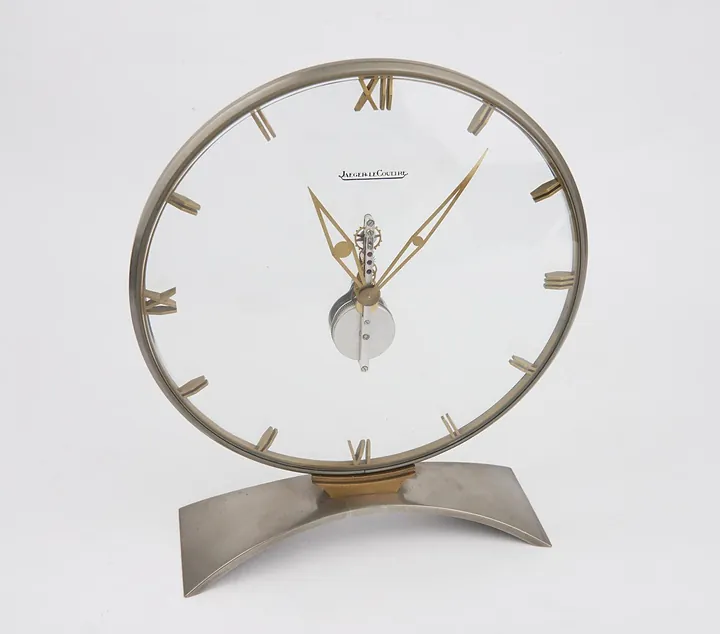
Skeleton clock by Jaeger-LeCoultre, Switzerland, 1937–1938
Science Museum Group, London
Movements & Components · 1953
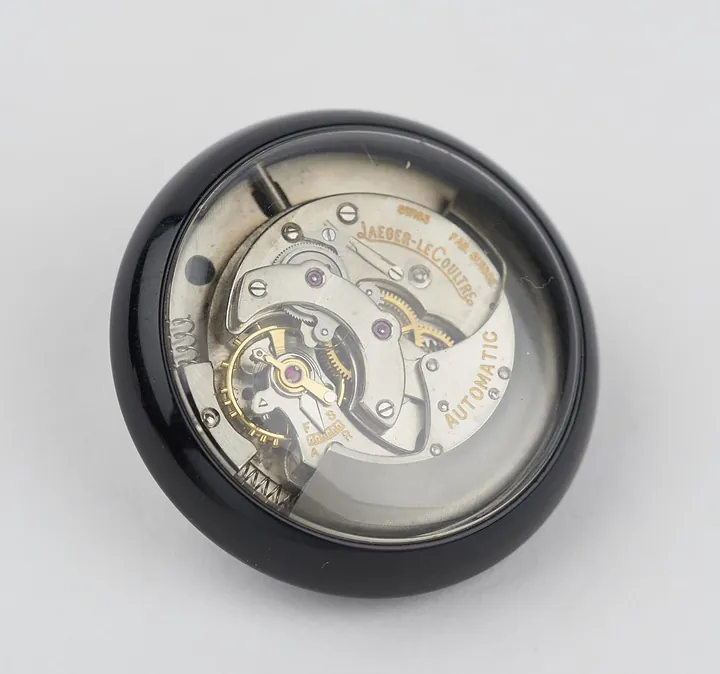
Automatic watch movement, Jaeger-LeCoultre, 1953, Geneva, Switzerland, showing self-winding mechanism
Science Museum Group, London
Wristwatches · 1953
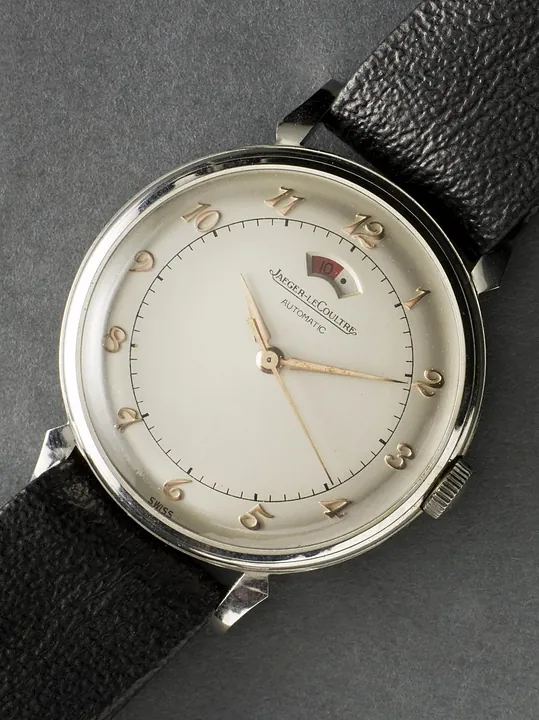
Automatic Wrist-watch, Jaeger-LeCoultre, Geneva, Switzerland, with reserve power indicator complete in steel case, 1953. Back numbered 564556.
Science Museum Group, London
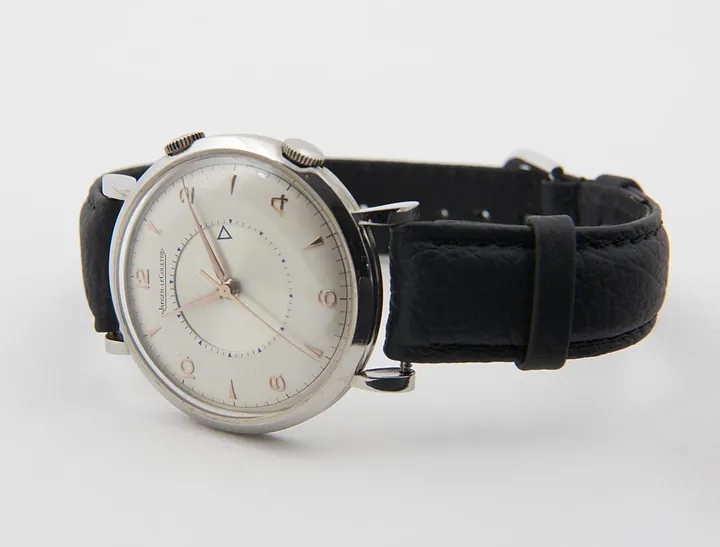
Wristwatches · 1953
Wrist-watch, 'Memovox' alarm, Jaeger-LeCoultre, Geneva, Switzerland, complete in steel case, 1953.
Science Museum Group, London

Wristwatches · 1945
Wristwatch by Eterna, 1945
Museum Rotterdam

Wristwatches · c. 1945
Breitling Premier, ref. 790, c. 1945
Antiquorum auction archive, Geneva

Wristwatches · c. 1945
Universal Genève Uni-Compax, ref. 22492, c. 1945
Antiquorum auction archive, Geneva

Wristwatches · c. 1950s
Baume & Mercier wristwatch, c. 1950s
Antiquorum auction archive, Geneva