
Wristwatches · Wristwatch
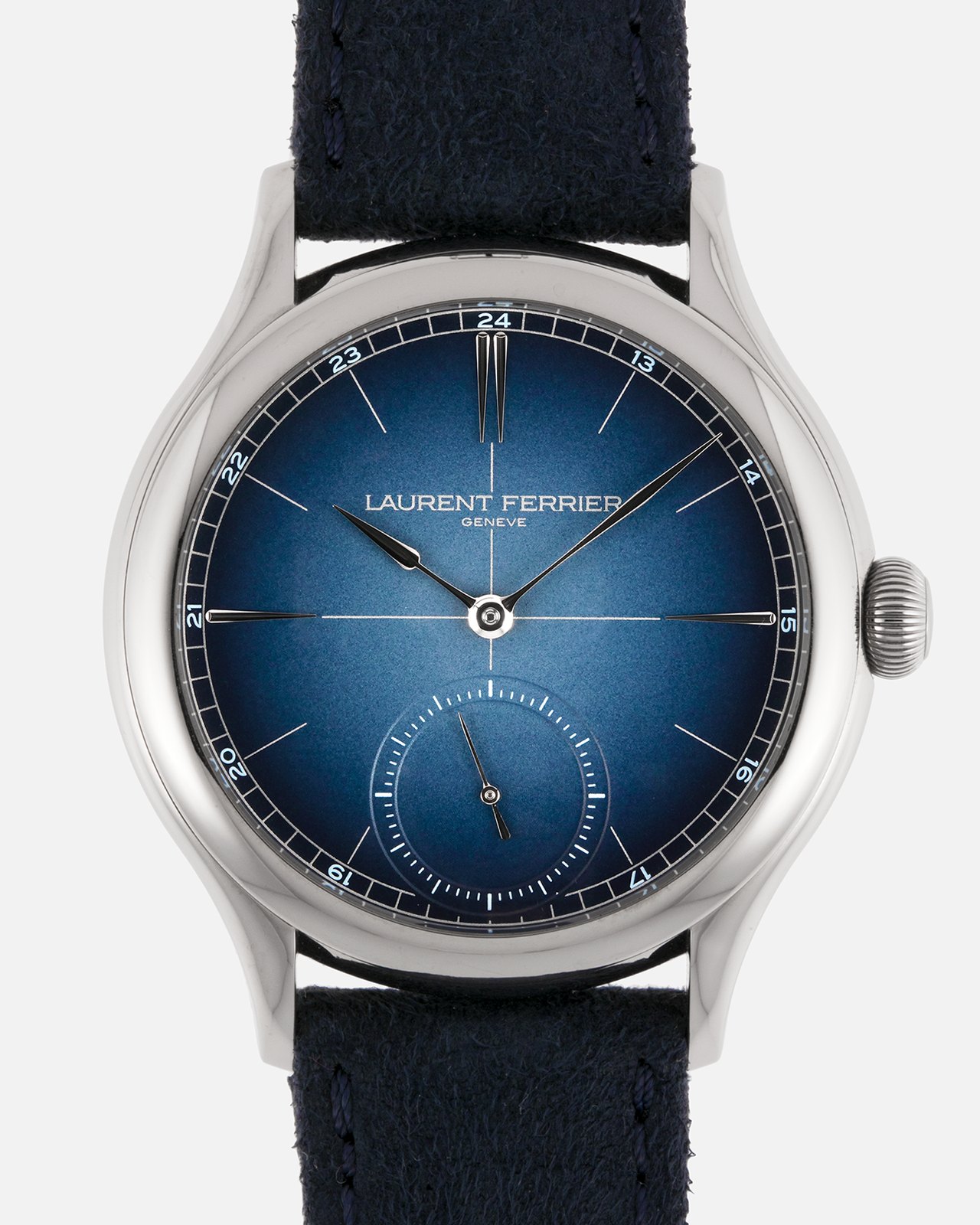
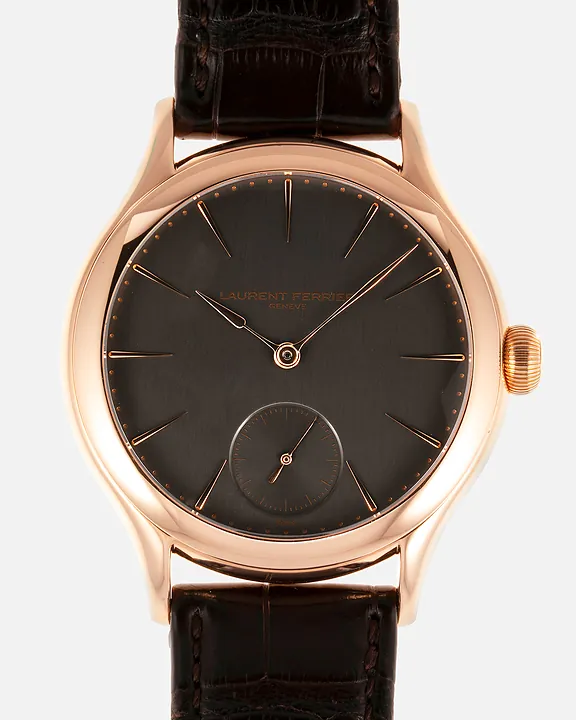
Laurent Ferrier Classic Origin Blue Titanium, 2024
- Maker / attribution
- Laurent Ferrier (maker)
- Date
- 2024
- Historical period
- Contemporary Horology (2010 – Present)
- Country of origin
- Switzerland
- Object type
- Wristwatch
- Materials / technique
- titanium
- Dimensions
- Case 40 mm
- Stock no.
- Product 7834259128407
- Credit line
- Dealer listing, S.Song Watches (product 7834259128407)
- Catalogue title (original)
- Laurent Ferrier Classic Origin Blue Titanium (English)
View the source record (dealer listing) ↗ (opens another website in a new tab)Suggest a correction
Record summary
Catalogued by S.Song Watches (dealer), Seattle (stock number Product 7834259128407), this is a wristwatch by Laurent Ferrier, made in Switzerland, dated 2024. The Atlas places it in the Contemporary Horology period (2010 – Present) of its Wristwatches collection. Materials and techniques recorded by the source: titanium. Recorded dimensions: Case 40 mm. The record is illustrated with 6 photographs.
Assembled from the source record's structured fields. Dates and attributions are given as the source states them; where a field is missing the Atlas leaves it blank rather than estimating.
Catalogue description
Dealer description — S.Song Watches
Founded in 2009 by Laurent Ferrier and his son Christian, Laurent Ferrier has established itself as one of the most respected names in contemporary independent watchmaking. Having spent 37 years at Patek Philippe, where he was involved in the development of some of the manufacture's most important complicated watches, Laurent Ferrier eventually departed to establish his own brand, bringing with him a distinctly classical approach to watchmaking. His philosophy has always centred around understated elegance, traditional movement architecture and exceptional finishing, drawing inspiration from the great Swiss watchmakers of the past while incorporating subtle contemporary elements. The brand made its debut in 2010 with the Classic Tourbillon Double Spiral, a watch that immediately established Laurent Ferrier's design language with its pebble-shaped case, distinctive Assegai hands and beautifully finished movement. The watch would go on to win the Men's Watch Prize at the Grand Prix d'Horlogerie de Genève that same year, an extraordinary achievement for a newly established independent manufacture. Over the following decade, Laurent Ferrier expanded its collection to include the Galet Micro-Rotor, Traveller and Annual Calendar, each retaining the same restrained aesthetic that has become synonymous with the brand. Introduced in 2020 to commemorate the manufacture's tenth anniversary, the Classic Origin represented a return to the fundamentals of traditional watchmaking. Unlike the more technically elaborate Micro-Rotor and Tourbillon models, the Classic Origin was conceived as a relatively straightforward manually wound time-only watch, allowing the quality of its design and movement finishing to take centre stage. It was also significant for introducing Grade 5 titanium to the brand's classical collection, offering a considerably lighter and more contemporary interpretation of the familiar Laurent Ferrier case. Here, we have the Classic Origin Blue, reference LCF036.T1.CG, introduced at Watches and Wonders in 2022. Housed in a 40mm Grade 5 titanium case measuring just 11.1mm in thickness, it retains the wonderfully rounded, pebble-like proportions of the original Classic Tourbillon. The highly polished case features a smooth, uninterrupted bezel, gently curved lugs and the distinctive ball-shaped crown inspired by nineteenth-century pocket watches. Despite its relatively substantial diameter for a classical dress watch, the absence of sharp edges and the flowing transitions between the case and lugs lend it an elegant, almost organic appearance. The dial is undoubtedly one of the most attractive aspects of this particular reference. Finished in a beautiful gradient blue opaline, it transitions from a relatively bright blue at the centre to a considerably deeper navy towards the periphery. Rather than employing a conventional sunburst finish, the finely textured opaline surface gives the dial a softer, more understated appearance, allowing the varying shades of blue to reveal themselves under different lighting conditions. Surrounding the dial is a powder-grey railway minute track punctuated by light blue numerals, with a delicate crosshair dividing the central portion into four quadrants. Four applied white gold drop-shaped indices provide a subtle contrast against the blue surface, while the brand's signature Assegai-shaped hands, also crafted from white gold, introduce a wonderfully elegant and distinctive element. At 6 o'clock sits a recessed, snailed subsidiary seconds dial with matching light blue markings, completing an exceptionally balanced and symmetrical composition. Turning the watch over reveals the manually wound calibre LF116.01, developed specifically for the Classic Origin. Comprising 150 components and operating at 21,600 vibrations per hour, the movement features a traditional Swiss lever escapement, a free-sprung balance with adjustment screws and a Breguet overcoil hairspring, offering an impressive power reserve of approximately 80 hours. Of particular note is Laurent Ferrier's distinctive long-blade ratchet pawl, a beautifully polished component that produces a remarkably satisfying tactile and audible sensation when winding the watch. Despite being one of the manufacture's more straightforward movements, the LF116.01 is finished to an exceptionally high standard. Its broad bridges feature a fine microbeaded surface with black rhodium treatment, contrasted against beautifully polished bevels, mirror-finished screw heads and carefully executed interior angles. The relatively open movement architecture also allows these finishing techniques to be appreciated without the visual complexity of a more elaborate complication. What I find particularly appealing about the Classic Origin Blue is how successfully Laurent Ferrier has combined the traditional codes of classical Swiss watchmaking with a distinctly contemporary colour palette and material. Unlike many contemporary independent watches that rely on increasingly elaborate complications or unconventional designs to distinguish themselves, the Classic Origin demonstrates how much can be achieved through careful proportions, restrained detailing and exceptional finishing. It is a particularly compelling expression of Laurent Ferrier's philosophy, and one of the more understated examples of modern independent watchmaking.
Historical context
Contemporary Horology (2010 – Present)
Silicon components, connected watches, optical-lattice research clocks and a thriving independent scene.
Smartwatches became the world's best-selling watches, while mechanical watchmaking focuses on craft, innovation (silicon components, new escapements) and independent makers.
Read the period in the timelineMore wristwatches from this periodEarlier: Mechanical Renaissance
Atlas type guide
Wristwatches
Bracelet watches were worn by women from the early nineteenth century — Breguet made one for Caroline Murat, Queen of Naples, in 1810–12 — but the wristwatch only became a man's instrument with military use and aviation in the early twentieth century. Between the World Wars it overtook the pocket watch; the 1920s and 1930s brought rectangular Art Deco cases, water-resistant cases and the first automatic winding systems.
After 1945 the wristwatch became a carrier of identity — dress watches, sports and dive watches, chronographs, calendars — produced by Swiss, American, Japanese, German, Soviet and Chinese industries. The quartz revolution after 1969 and the mechanical renaissance since the 1990s, including the rise of independent watchmakers, complete the story.
What to look for
- The reference number (between the lugs or inside the case back) and serial number, the starting point for dating.
- The calibre: its maker and number are often stamped under the dial or on the bridge.
- Originality of dial, hands and crown — refinished ('redial') dials are common.
- Case material marks: 18K/750, 14K/585, stainless steel, gold-filled, plated.
Dating clues
- Wire-lug cases: before c. 1925.
- Water-resistant screw-down cases: from 1926.
- Quartz movements: from 1969; sapphire crystals widespread after c. 1980.
General guidance written by the Atlas editors about this kind of object. It is not a statement about this particular piece; for that, rely on the source record above and on physical examination.
Read next:Identification Centre
Related records
Wristwatches · 2024
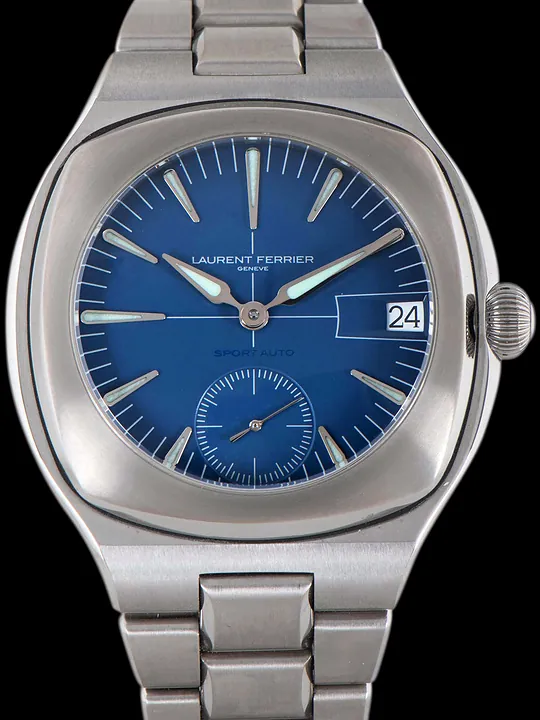
Laurent Ferrier Sport Auto Titanium (Ref. LF270.01) Blue Dial, 2024
Craft & Tailored (dealer), Los Angeles
Wristwatches · 2021
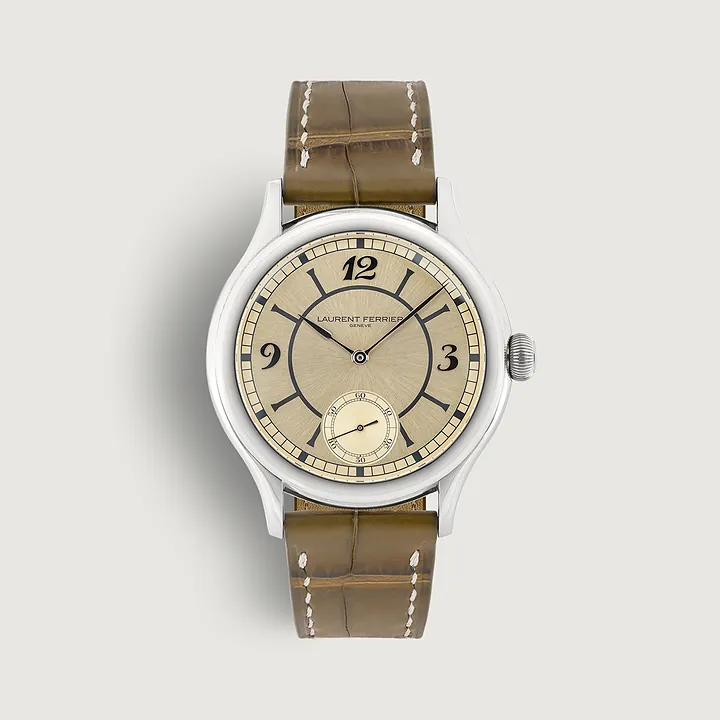
Laurent Ferrier Classic Origin Revolution x The Rake, 2021
Watches of Knightsbridge (dealer), London
Wristwatches · 2015
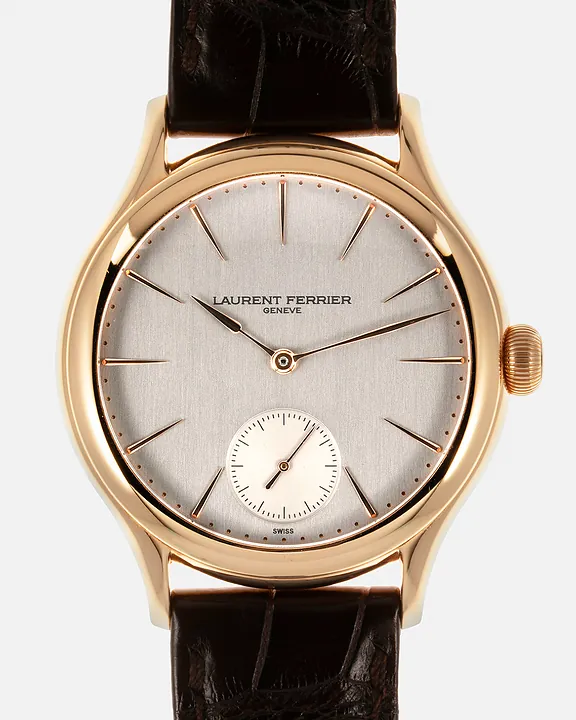
Laurent Ferrier Galet Classic Microrotor, 2015
S.Song Watches (dealer), Seattle
Wristwatches · 2012
Laurent Ferrier Galet Classic Microrotor "Early Number 2X", 2012
S.Song Watches (dealer), Seattle

Wristwatches · c. 2010s
Breguet Type XXI, ref. 3810, c. 2010s (Antiquorum Lot 381-24)
Antiquorum auction archive, Geneva

Wristwatches · c. 2010s
Breguet Type XXI, ref. 3810, c. 2010s (Antiquorum Lot 386-229)
Antiquorum auction archive, Geneva

Wristwatches · Sold in September 2010
Breitling Cosmonaute, ref. A 22322, Sold in September 2010
Antiquorum auction archive, Geneva

Wristwatches · c. 2010
Corum Bubble Chrono, ref. 396.150.20, c. 2010
Antiquorum auction archive, Geneva