
Clocks · Bracket clock
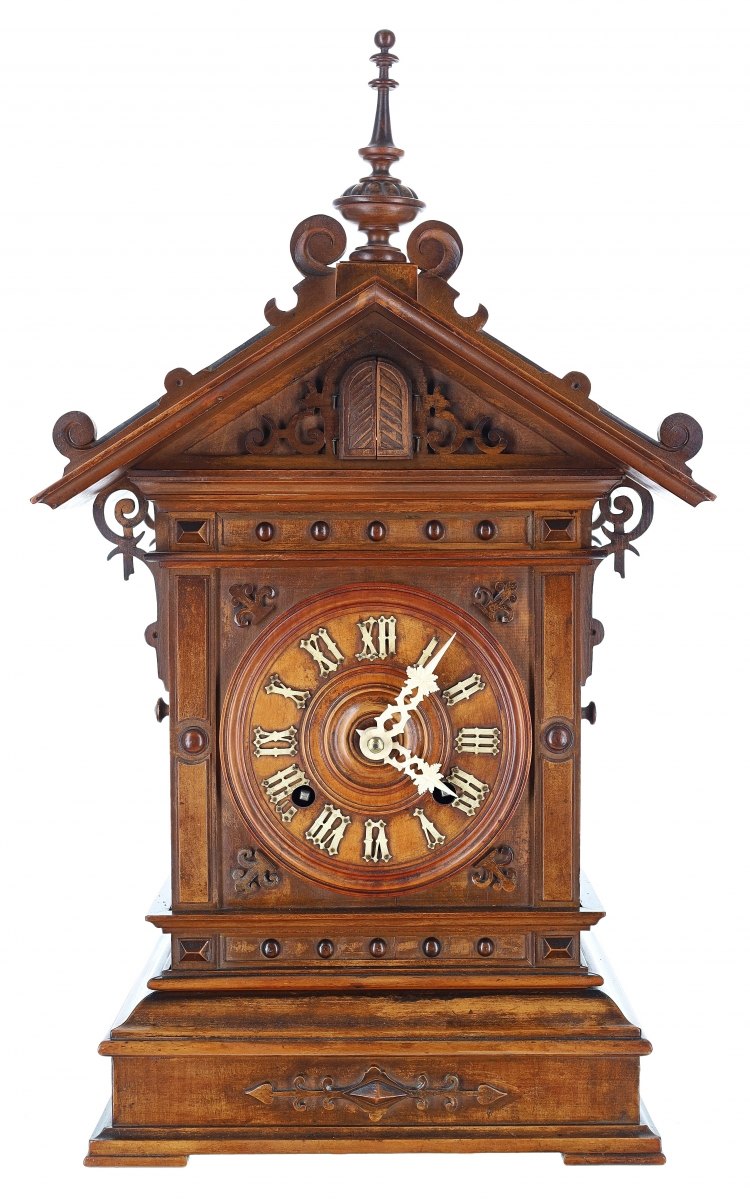
Late 19th century German Black Forest twin fusee cuckoo mantel clock attributed to Johann by Camerer Kuss & Co
- Maker / attribution
- Camerer Kuss & Co (maker)
- Date
- Late 19th century
- Historical period
- Industrial Revolution (1850 – 1900)
- Country of origin
- Germany
- Object type
- Bracket clock
- Dimensions
- Height 20.25 in (51 cm)
- Auction house
- Gardiner Houlgate (auction house), Corsham
- Lot
- Sale 42, lot 1259
- Credit line
- Auction lot record: lot 1259, Fine Clocks & Related Items, Gardiner Houlgate (22nd October 2026)
- Catalogue title (original)
- Late 19th century German Black Forest twin fusee cuckoo mantel clock attributed to Johann Baptist Beha and retailed by Camerer Kuss & Co, 5.5" turned dial with applied Roman numerals and ornate carved (English)
View the source record (auction lot) ↗ (opens another website in a new tab)Suggest a correction
Record summary
Catalogued by Gardiner Houlgate (auction house), Corsham (lot Sale 42, lot 1259), this is a bracket clock by Camerer Kuss & Co, made in Germany, dated Late 19th century. The Atlas places it in the Industrial Revolution period (1850 – 1900) of its Clocks collection. Recorded dimensions: Height 20.25 in (51 cm). The record is illustrated with 1 photograph.
Assembled from the source record's structured fields. Dates and attributions are given as the source states them; where a field is missing the Atlas leaves it blank rather than estimating.
Catalogue description
Lot description — Gardiner Houlgate
Late 19th century German Black Forest twin fusee cuckoo mantel clock attributed to Johann Baptist Beha and retailed by Camerer Kuss & Co, 5.5" turned dial with applied Roman numerals and ornate carved bone hands, eight day wood plate twin fusee movement, the hour strike train with outside countwheel and linkages to two bellows and a cuckoo automaton which appears from behind the door above the dial to announce the hour with a two-note call alternating with a hammer sounding on a gong fitted to the inside of the rear case panel, within a walnut chalet form case surmounted with a turned finial over side doors, 20.25" high (with pendulum and key) ** The George Hollis Collection ** Johann Baptist Beha was born in Oberbränd in 1815. He trained in his father's Vinzenz (1784-1868) workshop, but in 1845 at the age of thirty left to set up on his own in Eisenbach
Historical context
Industrial Revolution (1850 – 1900)
American interchangeable-parts manufacture; railroad time standards; Swiss and German factory systems.
Factory production transformed the clock into an everyday object. American makers (Seth Thomas, Ansonia, Waterbury) and German factories (Junghans, Gustav Becker, Lenzkirch) sold millions of shelf, wall and alarm clocks worldwide; France produced standardised Paris movements and carriage clocks; electric time distribution began.
Read the period in the timelineMore clocks from this periodEarlier: Precision & Scientific Horology
Atlas type guide
Bracket, table and spring-driven clocks
Spring-driven clocks freed timekeeping from the hanging weight. The coiled mainspring, documented from the fifteenth century, made portable table clocks possible; to even out its declining force, makers used the fusee, a conical pulley connected to the barrel by a gut line or chain. Renaissance table clocks from Augsburg and Nuremberg — drum-shaped, square or tower-shaped in gilt brass — were luxury scientific objects, often with astronomical dials and alarms.
After the pendulum, English makers developed the bracket clock: a wooden case with a carrying handle, a short pendulum with a verge escapement, and often repeating work to sound the hours on demand at night. Later examples use the anchor escapement. In the nineteenth century, 'table clock' became a broad term for spring clocks of every nationality.
What to look for
- A fusee in the movement (cone-shaped pulley) and the type of line — gut or chain.
- Verge escapement with a short bob pendulum, often with a decoratively engraved backplate.
- Repeat cords or buttons that make the clock strike again on demand.
- Gilt-brass engraved cases and horizontal dials on Renaissance pieces.
- Case shapes: inverted bell, bell top, break-arch, lancet or balloon.
Dating clues
- Drum and tower table clocks: c. 1520–1650.
- Ebony veneered English bracket clocks with verge escapements: c. 1670–1800.
- Engraved backplates were usual on English clocks until c. 1800, then generally plain.
General guidance written by the Atlas editors about this kind of object. It is not a statement about this particular piece; for that, rely on the source record above and on physical examination.
Related records
Clocks · c. 1850
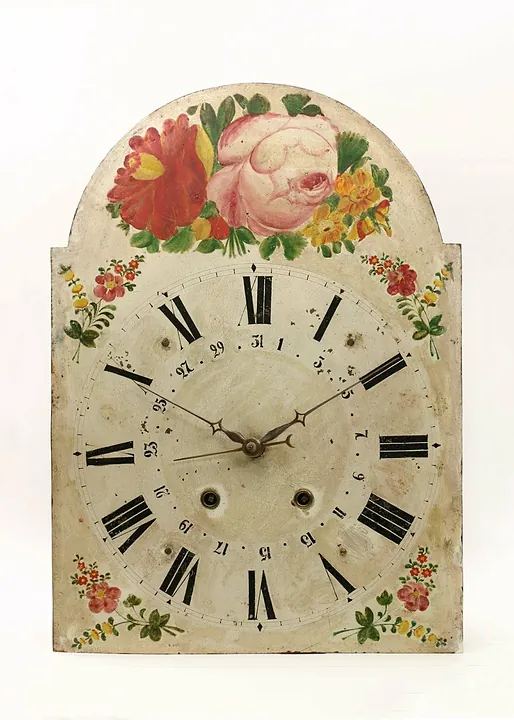
Cuckoo / black forest clock, Germany, c. 1850
German Clock Museum
Clocks · 1850
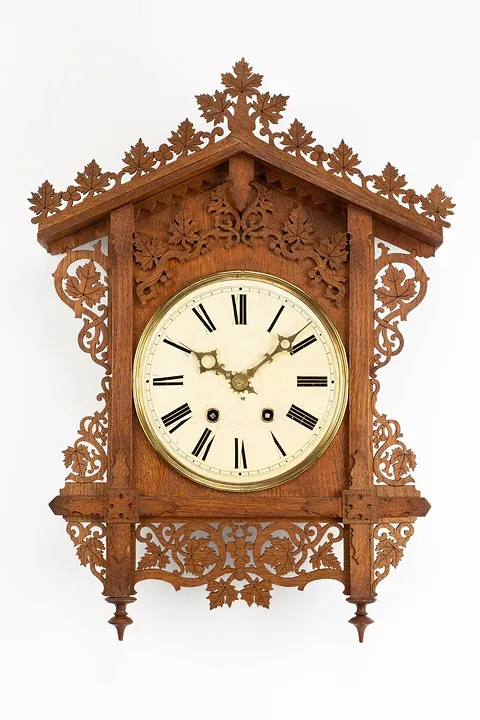
Wall clock by Glatz und Co. Kreuzer, Germany, 1850
German Clock Museum
Clocks · 1858
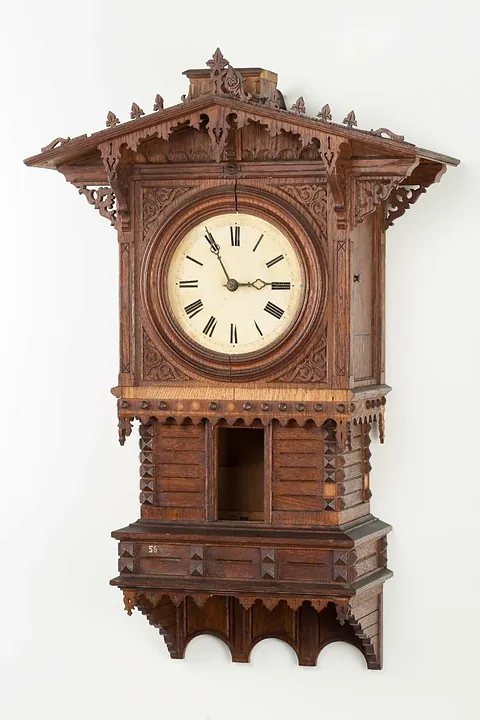
Clock by Jacob Bäuerle, Germany, 1858
German Clock Museum
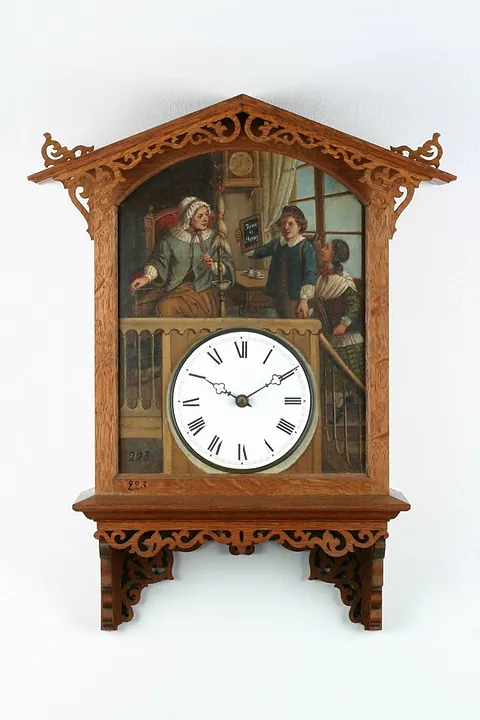
Clocks · 1860
Clock by August Tritschler, Germany, 1860
German Clock Museum
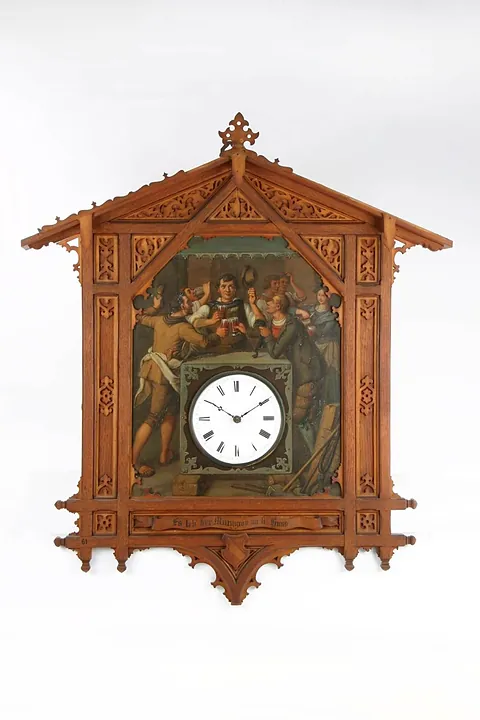
Clocks · 1860
Clock by Großherzoglich Badische Uhrmacherschule, Germany, 1860
German Clock Museum
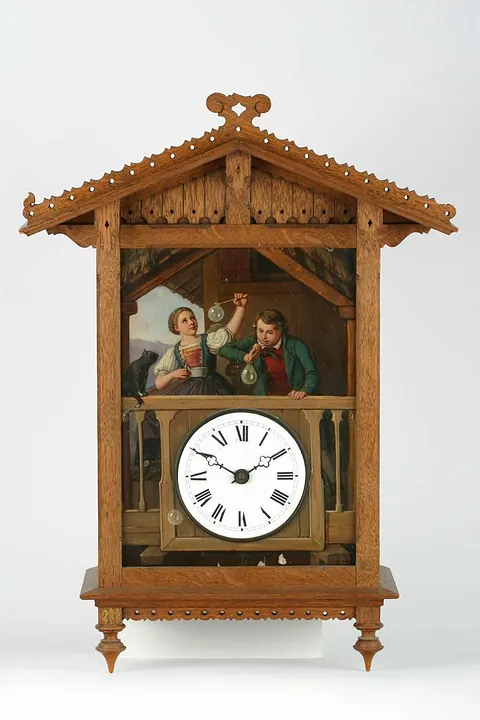
Clocks · c. 1860
Clock by Heinrich Frank, Germany, c. 1860
German Clock Museum
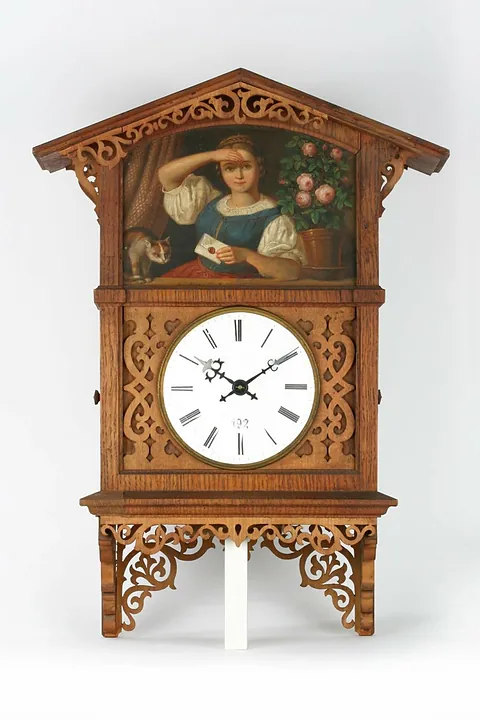
Clocks · c. 1860
Clock by M. Schuhmacher, Germany, c. 1860
German Clock Museum

Clocks · c. 1860
Clock by Martens und Cie., Germany, c. 1860 (no. 57930)
German Clock Museum