
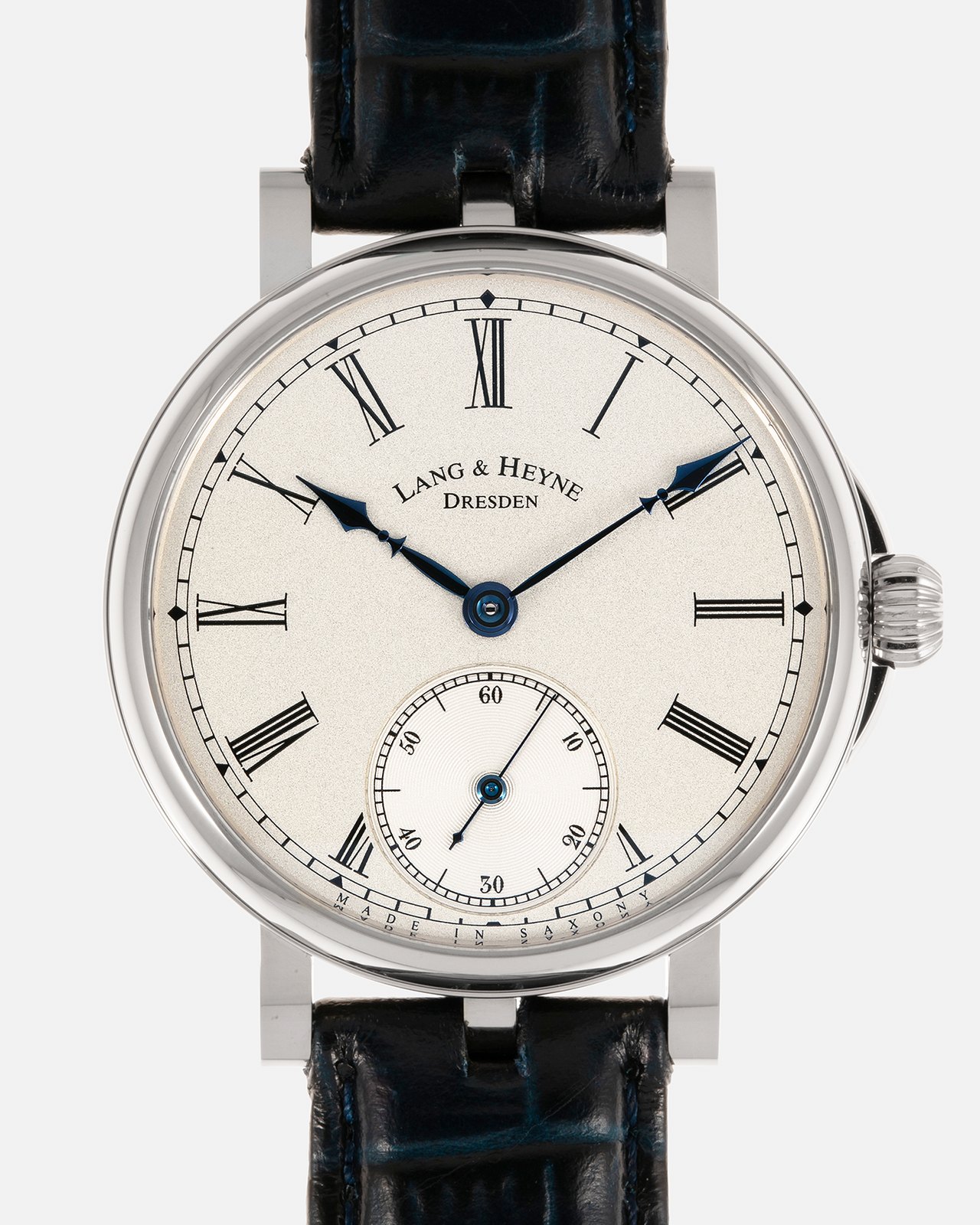
Wristwatches · Wristwatch
Lang & Heyne Friedrich III White Gold, 2023
- Maker / attribution
- Lang & Heyne (maker)
- Date
- 2023
- Historical period
- Contemporary Horology (2010 – Present)
- Country of origin
- Unrecorded in source
- Object type
- Wristwatch
- Materials / technique
- white gold
- Dimensions
- Case 39.2 mm
- Stock no.
- Product 7184840949847
- Credit line
- Dealer listing, S.Song Watches (product 7184840949847)
- Catalogue title (original)
- Lang & Heyne Friedrich III White Gold (English)
View the source record (dealer listing) ↗ (opens another website in a new tab)Suggest a correction
Record summary
Catalogued by S.Song Watches (dealer), Seattle (stock number Product 7184840949847), this is a wristwatch by Lang & Heyne, dated 2023. The Atlas places it in the Contemporary Horology period (2010 – Present) of its Wristwatches collection. Materials and techniques recorded by the source: white gold. Recorded dimensions: Case 39.2 mm. The record is illustrated with 6 photographs.
Assembled from the source record's structured fields. Dates and attributions are given as the source states them; where a field is missing the Atlas leaves it blank rather than estimating.
Catalogue description
Dealer description — S.Song Watches
Established in 2001 by Marco Lang and Mirko Heyne, Lang & Heyne, headquartered in Dresden, is a distinguished German independent watchmaker that redefines traditional watchmaking standards. Renowned for their remarkable movement finishing and attention to detail, Lang & Heyne timepieces are among the finest available in the market today. Released in 2013 at Baselworld, the Friedrich III was inspired by the forward-thinking of Friedrich III when, in 1349, he took over the regions of Thuringia and Meissen from his father (Friedrich II). He would then go on to improve Wettin’s (later Saxony, Germany) political reach and wealth by developing public administration systems and internal policies. Taking this approach and putting it into the Friedrich III, it is a classically themed timepiece that is bursting with an array of traditional aesthetics that speak to the timepiece’s inspiration. Here I have an 18-carat white gold Friedrich III that is perhaps the embodiment of a perfect modern dress watch (of German watchmaking origins). Aesthetically, the Friedrich III is understated, simple and elegant. Despite its traditionalist approach in its overall design language, the Friedrich III features a contemporarily-sized case measuring 39.2mm x 10.5mm. Encased within is a pure and stunning frosted silver dial adorned with slender and elongated black Roman numerals, a slightly recessed sub-seconds dial at 6:00, and a set of thermally-blued cathedral hands. In typical German fashion, all the elements on the dial are displayed with almost stereotypical efficiency, lending a sense of neatness and precision to its already simple design. Another noteworthy feature of the case is Lang and Heyne’s signature triple-lug design, which I thought was quite an intriguing design element as it helps eliminate the visual gap between the lugs, hence contributing to its overall visual balance. It is also easily recognizable for those in the know. Powering the Friedrich III from within is Lang & Heyne’s very own in-house, manual-winding Cal. VI with 55 hours of power reserve and a stunning trigonal bridge. Needless to say, the Friedrich III excites the senses when you turn it around and gaze upon what lies beneath its exhibition caseback. Constructed entirely of brass and featuring the traditional German frosting finishing technique alongside some stunning bevelling, a beautifully engraved balance cock, and the signature natural diamond atop the balance staff. In essence, the Friedrich III epitomizes independent watchmaking simplicity at its finest. Every element found on the watch, from the finishing to the overall design, is meticulously executed to a very high level. It embodies the quintessence of what makes the German approach to artisanal craftsmanship and independent horology so captivating. Ultimately, the Friedrich III is an exemplary work of art that showcases Lang & Heyne’s steadfast and unwavering dedication to the horological traditions within which they operate. For a small independent brand, that speaks volumes, particularly within discerning enthusiast circles.
Historical context
Contemporary Horology (2010 – Present)
Silicon components, connected watches, optical-lattice research clocks and a thriving independent scene.
Smartwatches became the world's best-selling watches, while mechanical watchmaking focuses on craft, innovation (silicon components, new escapements) and independent makers.
Read the period in the timelineMore wristwatches from this periodEarlier: Mechanical Renaissance
Atlas type guide
Wristwatches
Bracelet watches were worn by women from the early nineteenth century — Breguet made one for Caroline Murat, Queen of Naples, in 1810–12 — but the wristwatch only became a man's instrument with military use and aviation in the early twentieth century. Between the World Wars it overtook the pocket watch; the 1920s and 1930s brought rectangular Art Deco cases, water-resistant cases and the first automatic winding systems.
After 1945 the wristwatch became a carrier of identity — dress watches, sports and dive watches, chronographs, calendars — produced by Swiss, American, Japanese, German, Soviet and Chinese industries. The quartz revolution after 1969 and the mechanical renaissance since the 1990s, including the rise of independent watchmakers, complete the story.
What to look for
- The reference number (between the lugs or inside the case back) and serial number, the starting point for dating.
- The calibre: its maker and number are often stamped under the dial or on the bridge.
- Originality of dial, hands and crown — refinished ('redial') dials are common.
- Case material marks: 18K/750, 14K/585, stainless steel, gold-filled, plated.
Dating clues
- Wire-lug cases: before c. 1925.
- Water-resistant screw-down cases: from 1926.
- Quartz movements: from 1969; sapphire crystals widespread after c. 1980.
General guidance written by the Atlas editors about this kind of object. It is not a statement about this particular piece; for that, rely on the source record above and on physical examination.
Related records
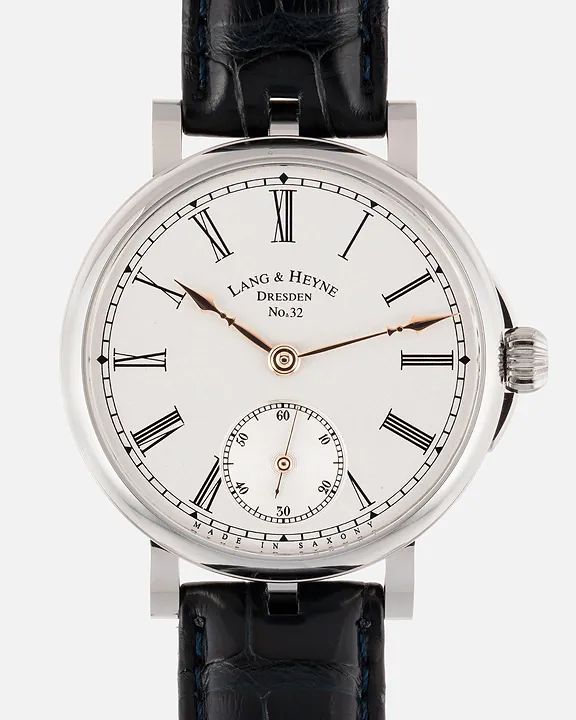
Wristwatches · 2018
Lang & Heyne Friedrich III Steel, 2018
S.Song Watches (dealer), Seattle
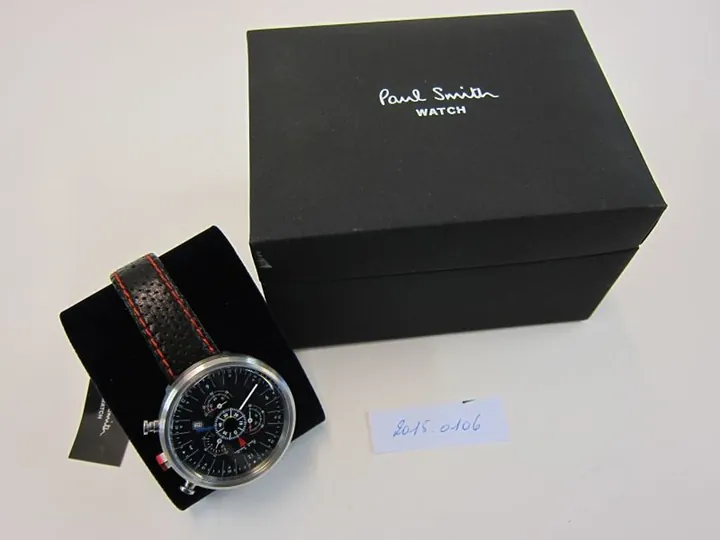
Wristwatches · 2010
Wristwatch, 2010
Modemuseum Hasselt
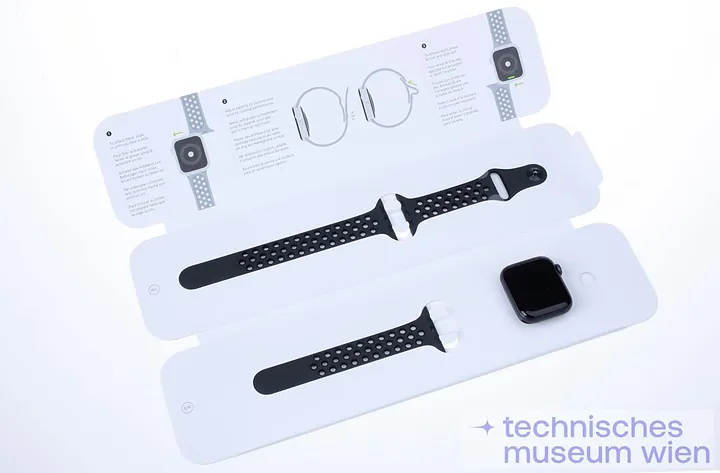
Wristwatches · 2018 (Series 4 released in September 2018; '1977' in the source is the model number A1977)
Apple Watch Series 4 (GPS, 40 mm, model A1977), 2018
Vienna Museum of Science and Technology
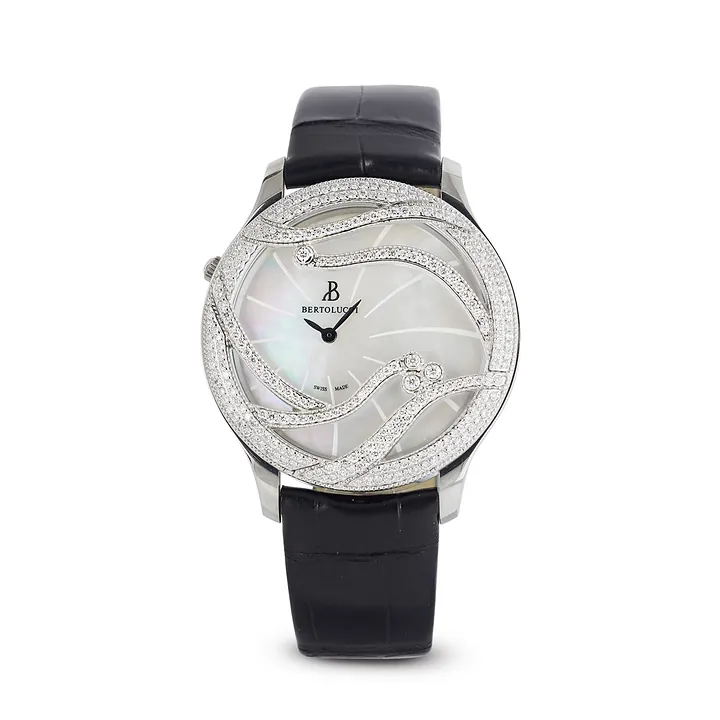
Wristwatches · c. 2010s
Bertolucci Stria III, ref. 11513.50.45.B88.6C1.501, c. 2010s
Antiquorum auction archive, Geneva
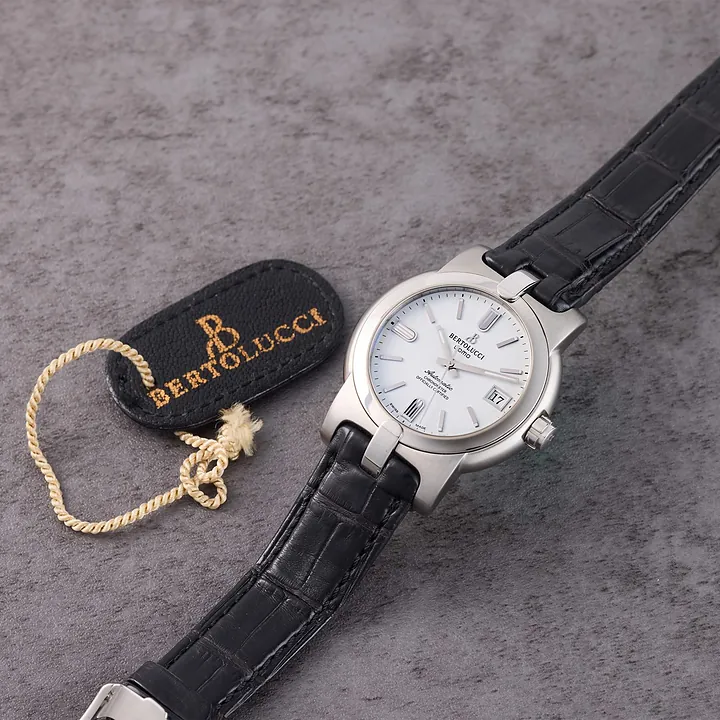
Wristwatches · c. 2010s
Bertolucci Uoma, ref. 824.51.41.10B, c. 2010s
Antiquorum auction archive, Geneva

Wristwatches · c. 2010s
Breguet Type XXI, ref. 3810, c. 2010s (Antiquorum Lot 381-24)
Antiquorum auction archive, Geneva

Wristwatches · c. 2010s
Breguet Type XXI, ref. 3810, c. 2010s (Antiquorum Lot 386-229)
Antiquorum auction archive, Geneva

Wristwatches · Sold in September 2010
Breitling Cosmonaute, ref. A 22322, Sold in September 2010
Antiquorum auction archive, Geneva