
Wristwatches · Wristwatch
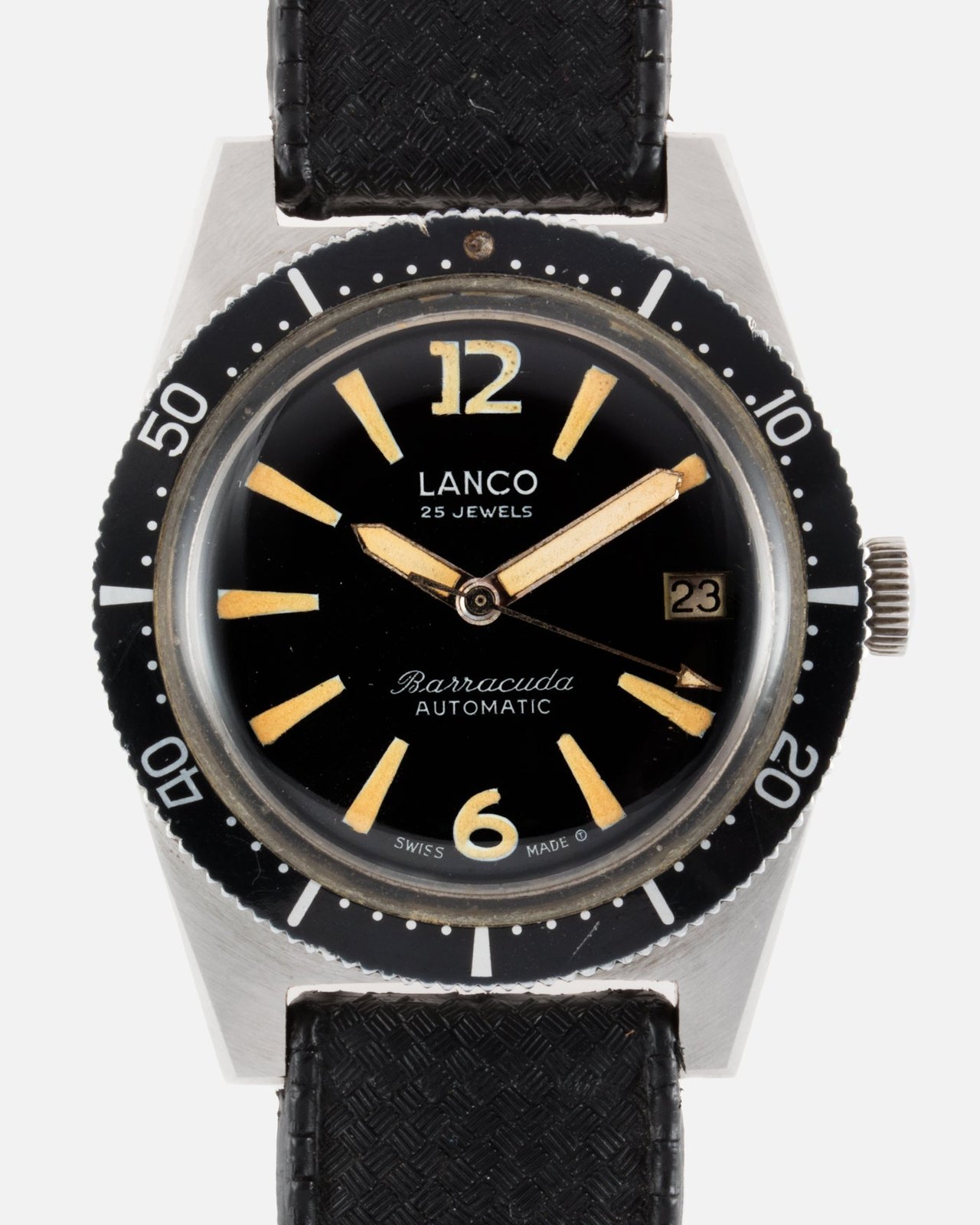
Lanco Barracuda Diver, 1960s
- Maker / attribution
- Lanco (maker)
- Date
- 1960s
- Historical period
- Modern Mechanical Horology (1945 – 1969)
- Country of origin
- Unrecorded in source
- Object type
- Wristwatch
- Dimensions
- Case 38 mm
- Stock no.
- Product 771420913751
- Credit line
- Dealer listing, S.Song Watches (product 771420913751)
- Catalogue title (original)
- Lanco Barracuda Diver (English)
View the source record (dealer listing) ↗ (opens another website in a new tab)Suggest a correction
Record summary
Catalogued by S.Song Watches (dealer), Seattle (stock number Product 771420913751), this is a wristwatch by Lanco, dated 1960s. The Atlas places it in the Modern Mechanical Horology period (1945 – 1969) of its Wristwatches collection. Recorded dimensions: Case 38 mm. The record is illustrated with 6 photographs.
Assembled from the source record's structured fields. Dates and attributions are given as the source states them; where a field is missing the Atlas leaves it blank rather than estimating.
Catalogue description
Dealer description — S.Song Watches
This Lanco Barracuda is one of the nicest skin divers ever made in my opinion and it has everything to do with design. Lanco is not a very well known brand, but what it lacks in recognition, it makes up for in this stunning Barracuda. Immediately, what you are drawn to is its dial. The deep glossy black dial is flawless and I find myself constantly staring at it. The hour markers and stylised 12 and 6 Arabic numerals are huge and filled with lume, complementing the extra thick stick hands. In this example, the luminous material has aged and developed a stunning orange/yellow patina that works with the dial very well. Furthermore, the choice of font for the text is excellent. The standard sans-serif ‘Lanco’ logo is nice, but it is the ‘Barracuda’ script font at the bottom of the dial that compliments this and works so well. Overall, it is the simplicity of the dial that makes it so beautiful, as you may have noticed that there are no minute markers at all. While this might not be the most legible, from a purely aesthetic point of view it is a very unique and attractive look. The 38mm stainless steel case is quite a common one used in skin divers in that era, but this example is made much better by the fact that is it unpolished. This Lanco Barracuda retains its original finish and the bevels on the case are so sharp it can cut. Flip the watch around and you are greeted with a beautiful self-winding Cal. 1145/56 movement that is copper coloured and signed with Lanco’s beautiful logo. As you can see, this watch is all about aesthetics and I have to say that Lanco really knocked it out of the park with this beautiful Barracuda. Oh, and one more thing, did I mention that they are incredibly rare? You won’t find many, especially not in this condition.
Historical context
Modern Mechanical Horology (1945 – 1969)
Tool watches for divers, pilots and astronauts; electric watches anticipate the electronic age.
The classic era of the mechanical wristwatch: dive watches, chronographs for motor racing and space flight, GMT watches for jet travel, slim dress watches, automatic calendars, and the rise of Japanese manufacturers alongside Swiss, American, German and Soviet industries.
Read the period in the timelineMore wristwatches from this periodEarlier: Golden Age of Mechanical Watchmaking
Atlas type guide
Dive and water-resistant watches
Keeping water and dust out of a wristwatch was a long-standing challenge. Rolex's screw-down Oyster case (1926) and Omega's Marine (1932) were landmarks; in the early 1950s Blancpain's Fifty Fathoms and Rolex's Submariner defined the professional dive watch with rotating bezels for timing dives, luminous dials and high water resistance. The ISO 6425 standard (1982) later codified what a 'diver's watch' must do.
Dive watches became icons of post-war design and exploration, and their evolution — helium escape valves, ceramic bezels, saturation-diving depth ratings — records the history of underwater work.
What to look for
- Unidirectional or bidirectional rotating bezel with minute markings.
- Screw-down crown and case back; depth rating printed on the dial.
- Luminous hands and markers (radium before c. 1960, tritium c. 1960–1998, then Super-LumiNova).
- Reference numbers on the case between the lugs or inside the back.
Dating clues
- Screw-down Oyster cases: from 1926.
- Professional dive watches: from 1953.
- Tritium 'T' marks on dials: c. 1960–1998.
General guidance written by the Atlas editors about this kind of object. It is not a statement about this particular piece; for that, rely on the source record above and on physical examination.
Related records
Wristwatches · early 1960s
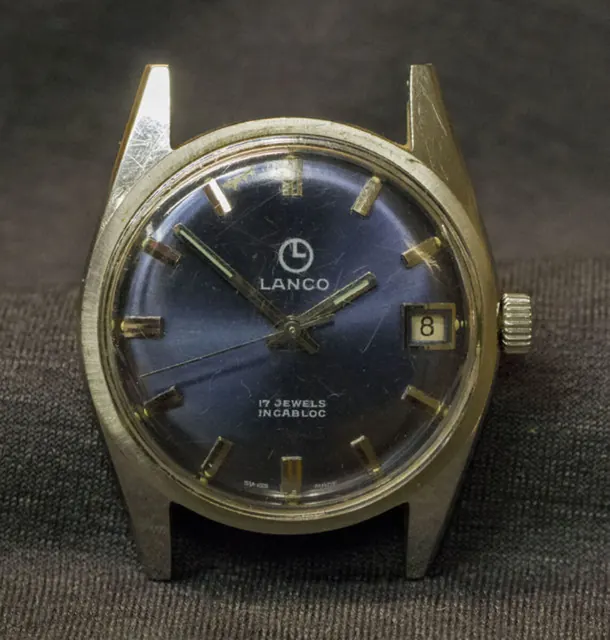
Wristwatch by Lanco, Switzerland, early 1960s
Satakunnan Museo
Wristwatches · c. 1960
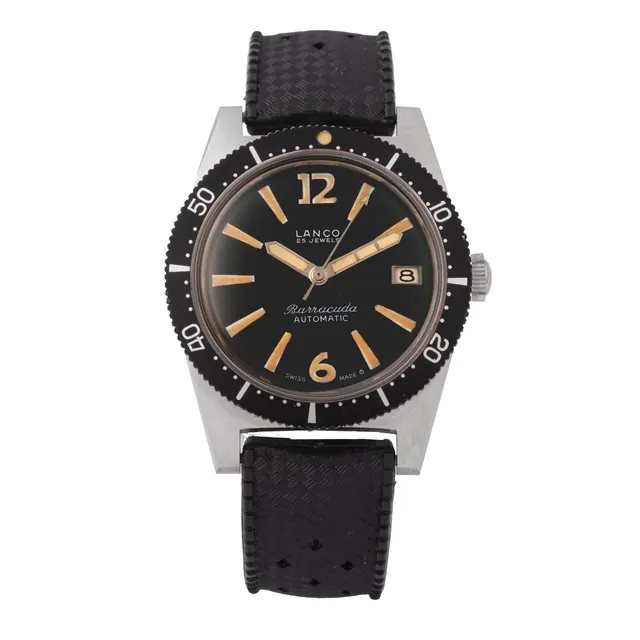
Lanco wristwatch, ref. 237, Barracuda, circa 1960
Antiquorum auction archive, Geneva

Wristwatches · 1945
Wristwatch by Eterna, 1945
Museum Rotterdam

Wristwatches · c. 1945
Breitling Premier, ref. 790, c. 1945
Antiquorum auction archive, Geneva

Wristwatches · c. 1945
Universal Genève Uni-Compax, ref. 22492, c. 1945
Antiquorum auction archive, Geneva
Wristwatches · c. 1950s
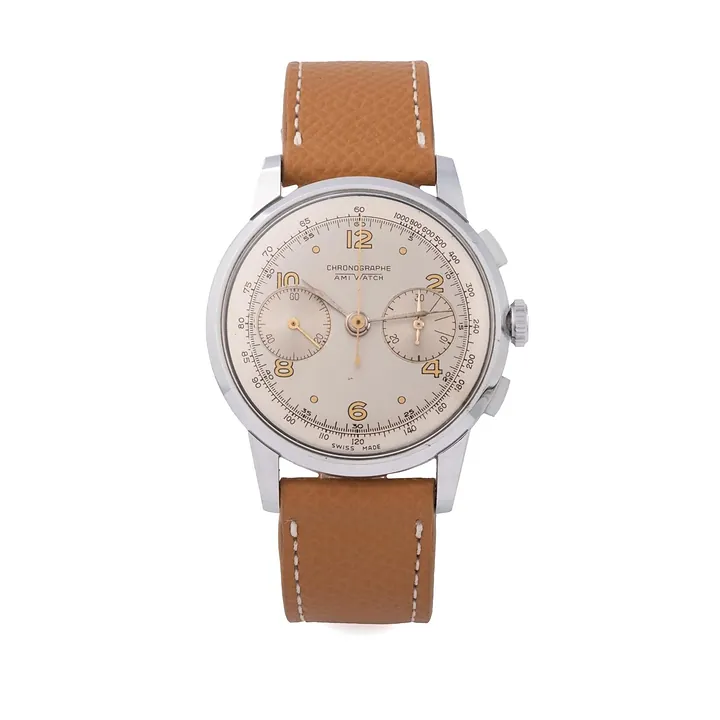
Ami Watch Chronographe, c. 1950s
Antiquorum auction archive, Geneva

Wristwatches · c. 1950s
Baume & Mercier wristwatch, c. 1950s
Antiquorum auction archive, Geneva
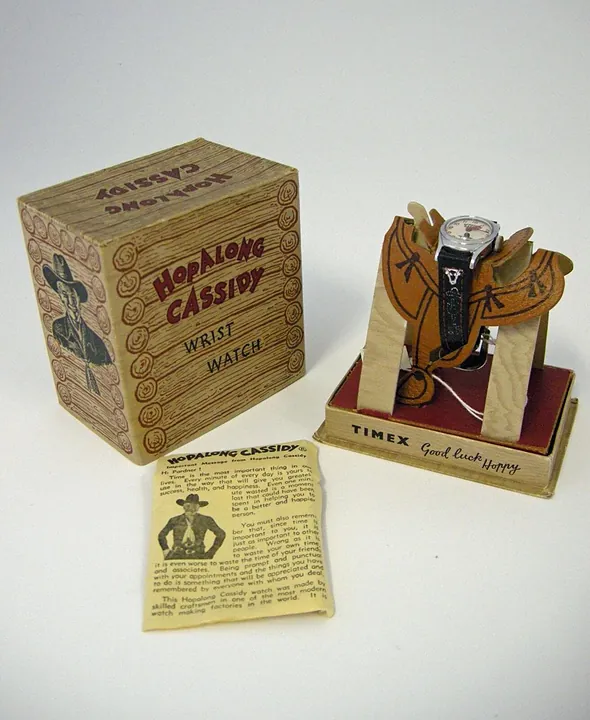
Wristwatches · c. 1955
Child's wrist watch by Timex, Dundee, c. 1955
Victoria and Albert Museum, London