
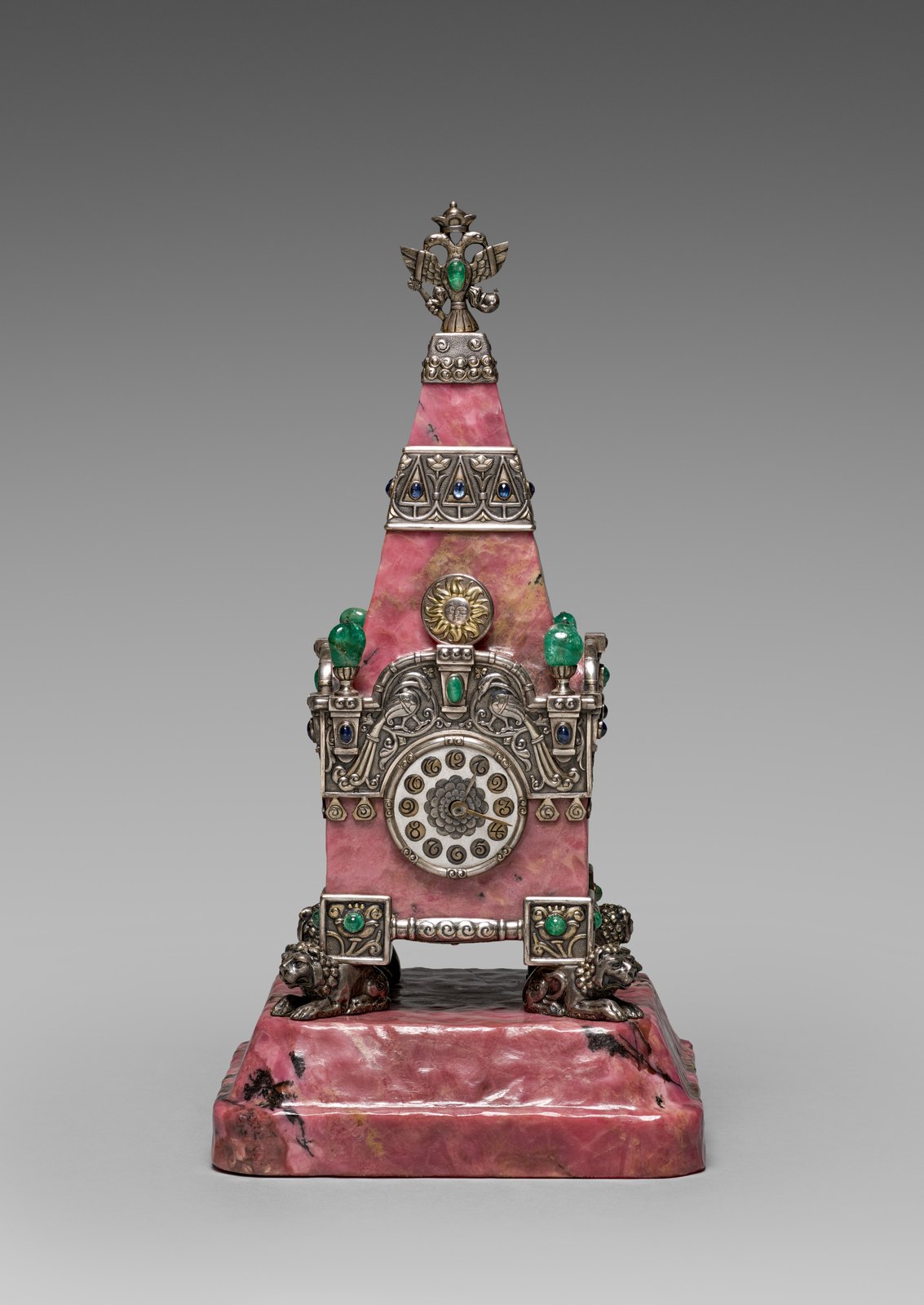
Clocks · Kremlin tower clock
Kremlin Tower Clock
- Maker / attribution
- House of Fabergé (maker)
- Date
- c. 1913
- Historical period
- Golden Age of Mechanical Watchmaking (1900 – 1945)
- Country of origin
- Russia
- Place
- Russia, St. Petersburg
- Object type
- Kremlin tower clock
- Materials / technique
- rhodonite, silver, enamel, emeralds, sapphires
- Dimensions
- Overall: 29 x 14.6 cm (11 7/16 x 5 3/4 in.)
- Holding institution
- Cleveland Museum of Art
- Accession / object no.
- 1966.477
- Credit line
- The India Early Minshall Collection
- Catalogue title (original)
- Kremlin Tower Clock (English)
View the source record ↗ (opens another website in a new tab)Suggest a correction
Record summary
Held and catalogued by Cleveland Museum of Art (object number 1966.477), this is a kremlin tower clock by House of Fabergé, made in Russia, St. Petersburg, dated c. 1913. The Atlas places it in the Golden Age of Mechanical Watchmaking period (1900 – 1945) of its Clocks collection. Materials and techniques recorded by the source: rhodonite, silver, enamel, emeralds, sapphires. Recorded dimensions: Overall: 29 x 14.6 cm (11 7/16 x 5 3/4 in.). The record is illustrated with 6 photographs.
Assembled from the source record's structured fields. Dates and attributions are given as the source states them; where a field is missing the Atlas leaves it blank rather than estimating.
Catalogue description
Description — Cleveland Museum of Art
The use of Russian hardstones in creating precious objects became a hallmark of design from the House of Fabergé. Easily carved, these minerals were sourced largely from the western region surrounding the Ural Mountains. Fabergé's workmasters used colorful stones such as agate, nephrite (jade), lapis lazuli, rock crystal, and rhodonite, seen here in this elaborate table or mantel clock, to create all manner of luxurious accessories. Bright pink rhodonite was among the rarest, and consequently most expensive, specimens used by the House of Fabergé. This clock resembles the Taynitskaya Tower, the middle tower on the south side of the Kremlin. The House of Fabergé created this work to commemorate the 300th anniversary of the Romanov dynasty, representing Fabergé's ability to balance the functionality of objects with intricate decorative design.
Inscriptions & marks
84, Kokoshnik, delta [assay mark for Moscow, 1908-26]; 91, Kokoshnik; 91; Kokoshnik; C. Fabergé (in Cyrillic); double-headed eagle [imperial warrant]; 16419 k? scratched.; Painted on clock face: Le Gruet (in script); strike, silence, set hand work (in English).
Provenance
India Early Minshall [1885–1965], Cleveland, OH, bequest to the Cleveland Museum of Art; The Cleveland Museum of Art
Historical context
Golden Age of Mechanical Watchmaking (1900 – 1945)
The wristwatch displaces the pocket watch; waterproof cases, self-winding and grand complications.
Between 1900 and 1945 clocks were electrified: master-clock systems ran factories and offices, synchronous mains clocks entered homes, and the Shortt free-pendulum clock set new standards of accuracy before the first quartz clocks (1927). Art Deco design reshaped mantel and table clocks.
Read the period in the timelineMore clocks from this periodEarlier: Industrial Revolution
Atlas type guide
Turret, tower and public clocks
The first mechanical clocks of the late thirteenth and fourteenth centuries were large iron striking clocks in towers, monasteries and cathedrals, driven by falling weights and controlled by a verge escapement with a foliot or wheel balance. They struck a bell rather than displaying the time, and only gradually acquired dials. Public clocks ordered civic life, regulating markets, work and worship.
From the seventeenth century the pendulum and then the anchor and pinwheel escapements made turret clocks far more accurate. In the nineteenth century firms such as Dent, Smith of Derby, Gillett & Johnston, J. F. Weule and Collin made cast-iron flatbed movements, and Edmund Beckett Denison's gravity escapement for the Great Clock of Westminster (1859) became the standard for accurate tower clocks.
What to look for
- Frame construction: early wrought-iron 'birdcage' or posted frames versus later cast-iron flatbed or plate-and-spacer frames.
- The escapement: verge and foliot, anchor, pinwheel or double three-legged gravity escapement.
- Striking and chiming trains with count wheels or rack striking.
- Maker's plates and dates cast or engraved on the frame.
Dating clues
- Wedged and riveted wrought-iron frames generally predate 1700.
- Flatbed cast-iron movements date from about 1840 onward.
- Electrical synchronisation and electric winding appear from about 1900.
General guidance written by the Atlas editors about this kind of object. It is not a statement about this particular piece; for that, rely on the source record above and on physical examination.
Related records
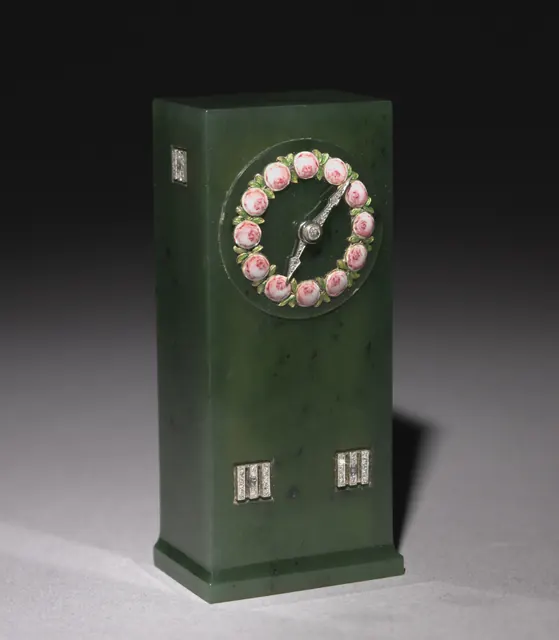
Clocks · 1908–17
Clock by Henrik Wigström, Russia, 1908–17
Cleveland Museum of Art
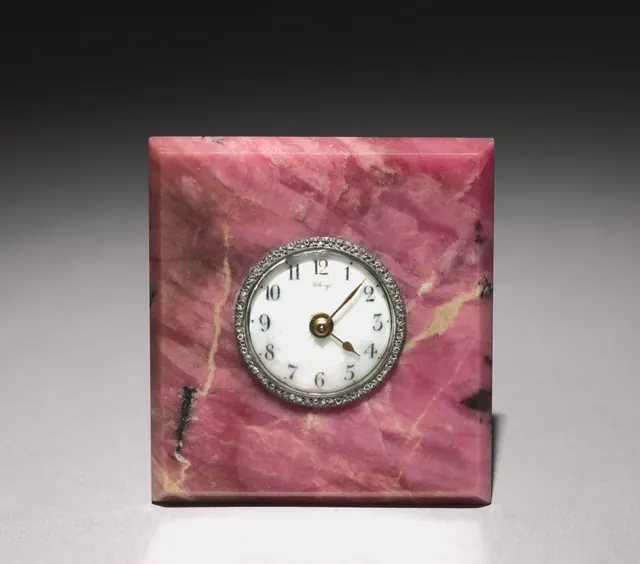
Clocks · c. 1905–15
Clock by Henrik Wigström, Russia, c. 1905–15
Cleveland Museum of Art
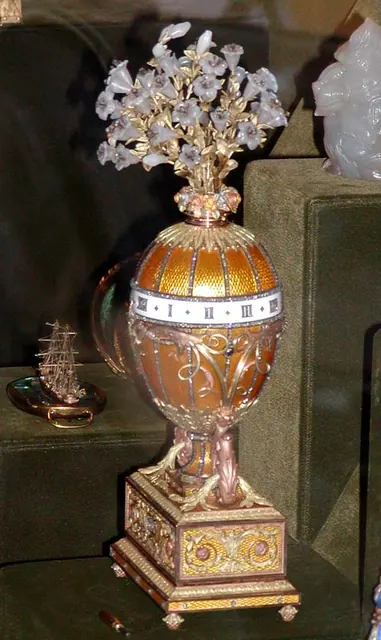
Clocks · 1899
Bouquet of Lilies Clock
Moscow Kremlin Museums
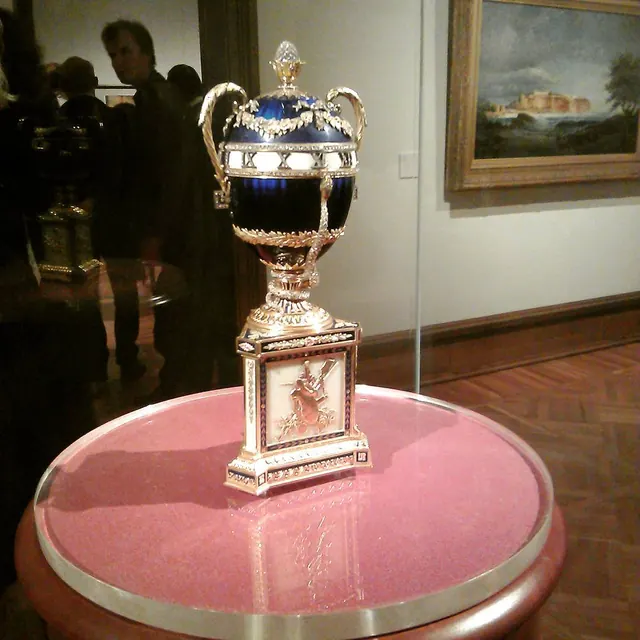
Clocks · 1895
Blue Serpent Clock
Art collection of the Prince
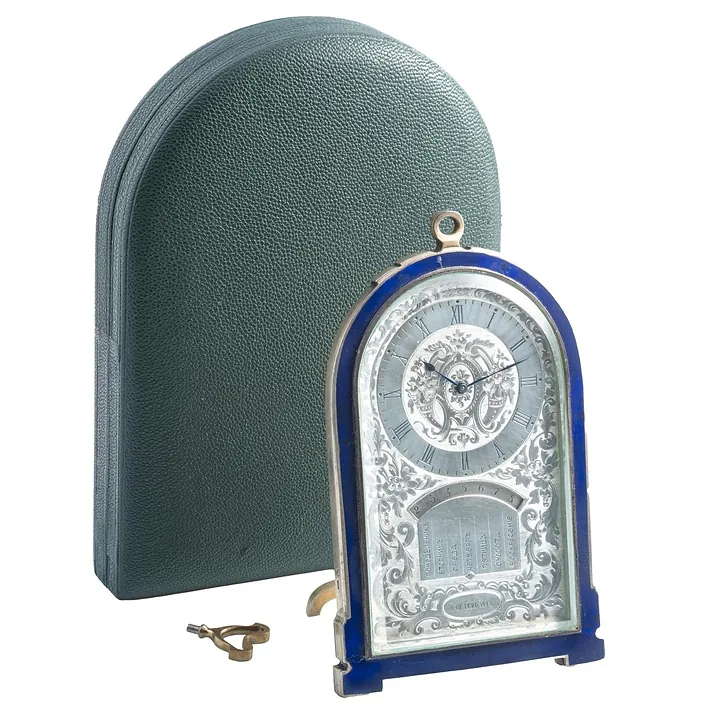
Clocks · c. 1915
Fabergé clock, c. 1915
Antiquorum auction archive, Geneva

Clocks · 1917
Constellation egg
Fersman Mineralogical Museum
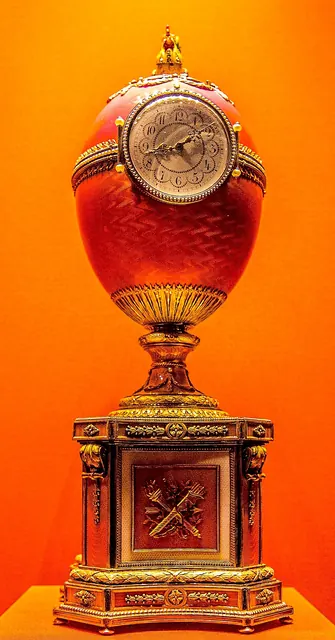
Clocks · 1902
Clock by Michael Perkhin, 1902
Hermitage Museum
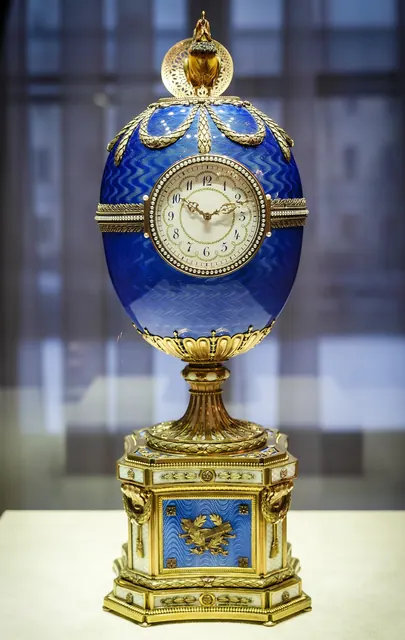
Clocks · 1904
Kelch Chanticleer
Fabergé museum in Saint Petersburg