
Clocks · Carriage clock
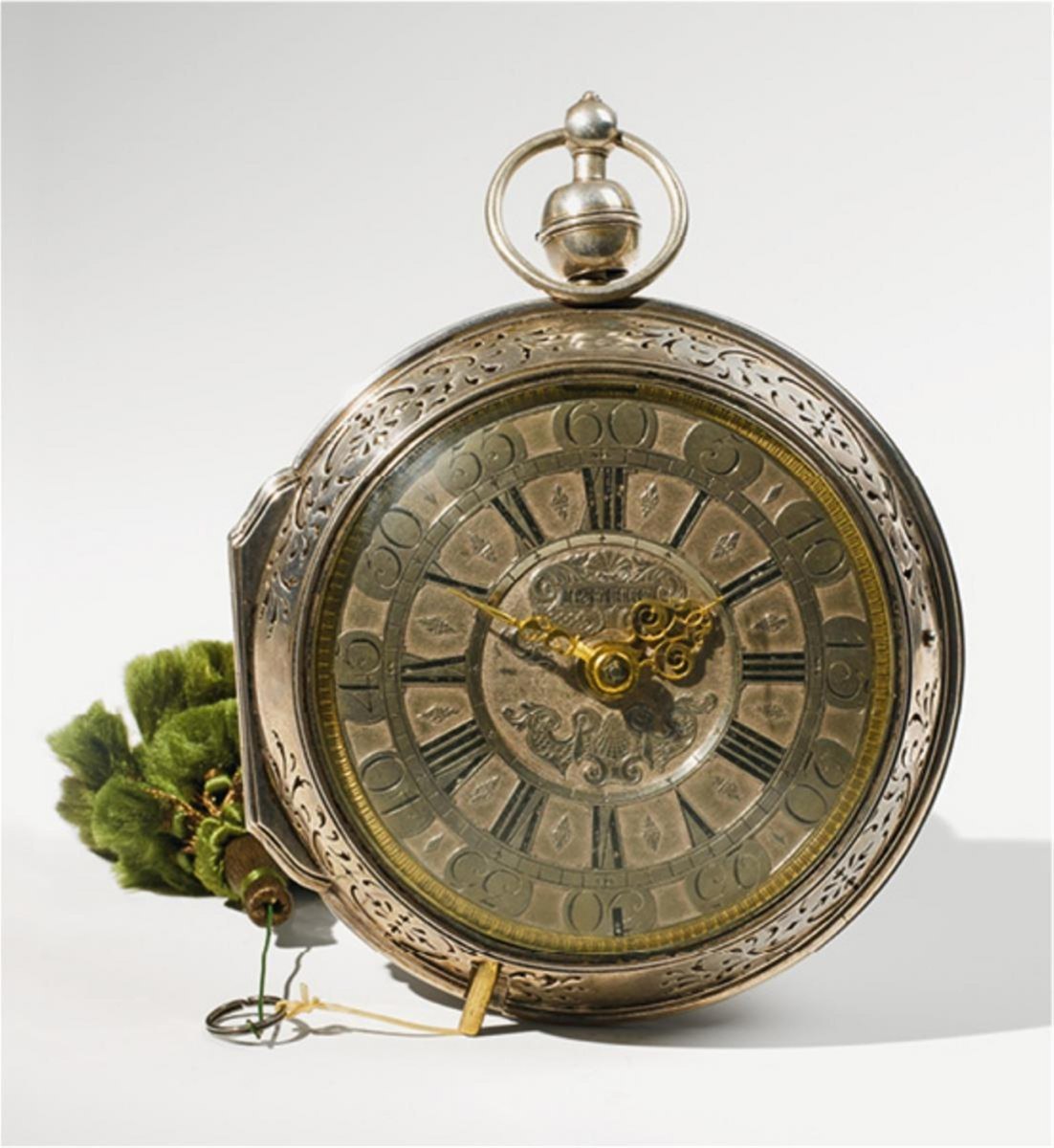
Johann Rehle silver carriage clock
- Maker / attribution
- Johann Rehle (source attribution)
- Date
- first quarter 18th century
- Historical period
- Early Modern Horology (1600 – 1750)
- Country of origin
- Germany
- Object type
- Carriage clock
- Holding institution
- Lempertz
- Accession / object no.
- 751
- Credit line
- Lempertz
- Catalogue title (original)
- An important silver carriage clock - Lot 751 (English)
View the source record ↗ (opens another website in a new tab)Suggest a correction
Record summary
Held and catalogued by Lempertz (object number 751), this is a carriage clock attributed to Johann Rehle, made in Germany, dated first quarter 18th century. The Atlas places it in the Early Modern Horology period (1600 – 1750) of its Clocks collection. The record is illustrated with 1 photograph.
Assembled from the source record's structured fields. Dates and attributions are given as the source states them; where a field is missing the Atlas leaves it blank rather than estimating.
Catalogue description
Original object description
Attributed to the Friedberg maker Johann Rehle and dated by the auction house to the first quarter of the eighteenth century, this silver carriage clock (Kutschenuhr) spans approximately 12.5 cm in diameter. Stylized as a large pocket watch, the silver housing is bordered by a leaf-engraved bezel and topped with a turned round finial carrying a hinged suspension loop. A green-tasseled pull cord projects from the rear. Engraved with 'IOHANN REHLE 185' within a cartouche, the silvered dial is incised with Roman hour numerals encircled by Arabic markers at five-minute intervals. The internal mechanism features verge escapement regulation alongside plates adorned with finely chased applied metalwork. An internal bell sounds both the quarter and half hours. Past conservation records indicate that three screws and the repeater cord have been replaced.
Inscriptions & marks
185
Historical context
Early Modern Horology (1600 – 1750)
Huygens' pendulum and balance spring transform accuracy; English makers develop the anchor and deadbeat escapements.
Huygens's pendulum (1656–57) improved clock accuracy from about a quarter of an hour to under a minute a day. The anchor escapement (c. 1670) and the long seconds pendulum created the longcase clock; London makers such as Fromanteel, Knibb, Tompion and Quare led European clockmaking, and French makers created the Boulle pendule.
Read the period in the timelineMore clocks from this periodEarlier: Renaissance Horology
Atlas type guide
Carriage and travel clocks
The carriage clock is a portable spring clock with a balance-wheel escapement and a brass case with glass panels and a carrying handle. Abraham-Louis Breguet made early examples around 1800, and from the 1830s Paul Garnier and other French makers industrialised production, with the small towns of Saint-Nicolas-d'Aliermont and the Franche-Comté supplying movements for retailers worldwide.
Typical features include a platform escapement mounted horizontally on top of the movement (usually a lever, sometimes cylinder or Garnier's chaff-cutter), striking or repeating work, and alarms. English carriage clocks, generally larger and with fusees, were made by firms such as Frodsham and Dent. Travel clocks in folding leather cases became popular in the twentieth century.
What to look for
- A platform escapement visible through the top glass.
- Case styles: corniche, gorge, anglaise, obis or engraved cases.
- Repeat buttons on top and strike/silent levers.
- Stamps of movement makers (e.g. Drocourt, Jacot, Margaine, Richard & Co.) on the backplate.
Dating clues
- Early carriage clocks with Breguet or Garnier features: c. 1800–1850.
- Mass-produced French carriage clocks: c. 1850–1914.
- Folding travel clocks and alarm travel clocks: mostly 1920–1970.
General guidance written by the Atlas editors about this kind of object. It is not a statement about this particular piece; for that, rely on the source record above and on physical examination.
Read next:Detached lever escapement
Related records
Clocks · 1600–1700
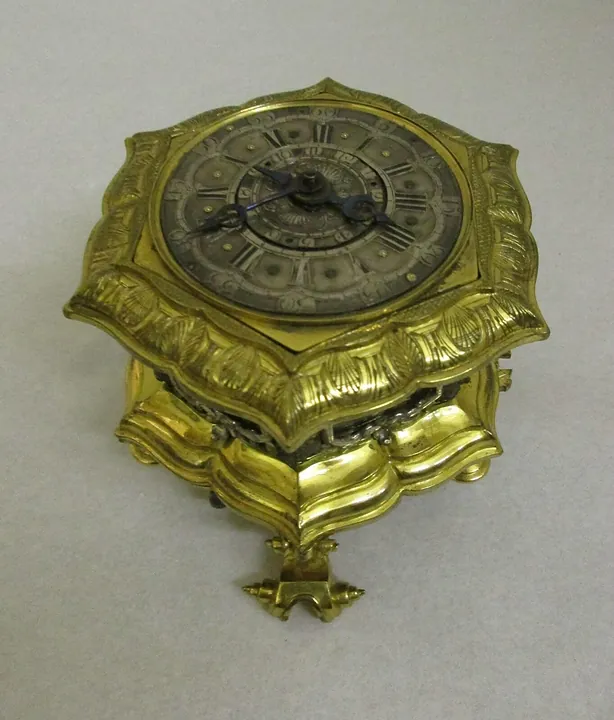
Clock, Germany, 1600–1700
Victoria and Albert Museum, London
Clocks · 1600–1699
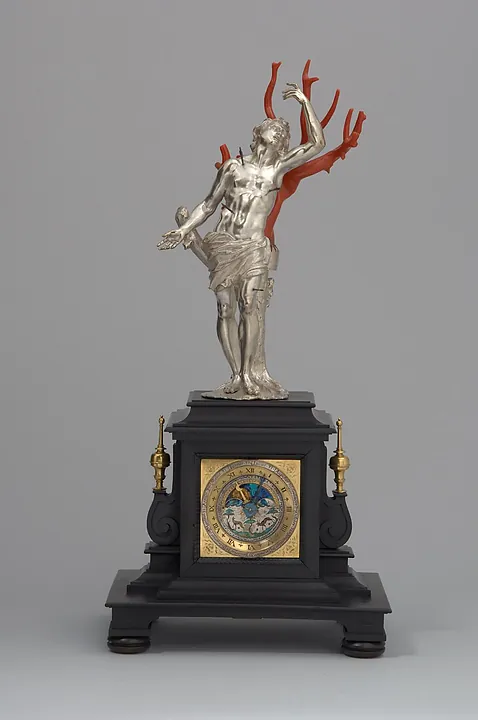
Table clock by Hans Christoph II. Fesenmair, Germany, 1600–1699
Fine Arts Museum Vienna
Clocks · 1600–1699
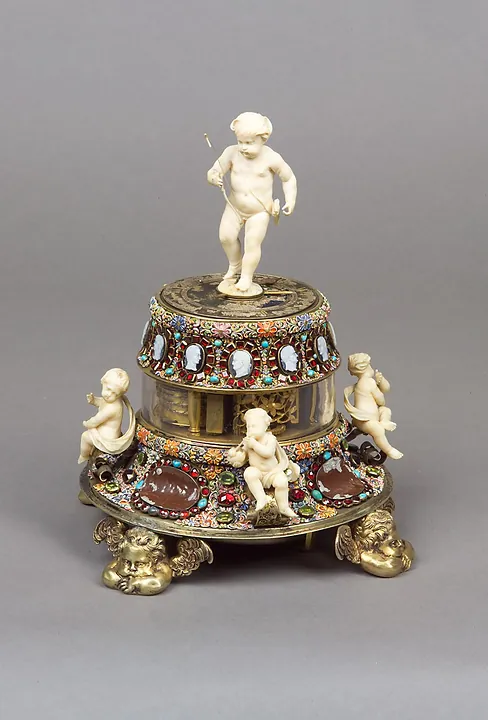
Table clock by Hans Jakob Mair, Germany, 1600–1699
Fine Arts Museum Vienna
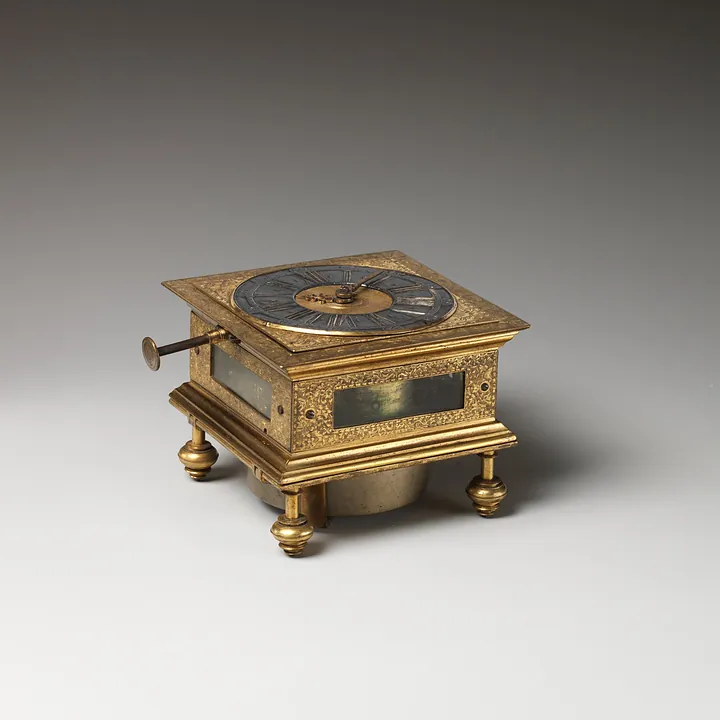
Clocks · 17th century
Table clock by Johann Heinrich Kleinschmidt, Germany, 17th century
The Metropolitan Museum of Art, New York
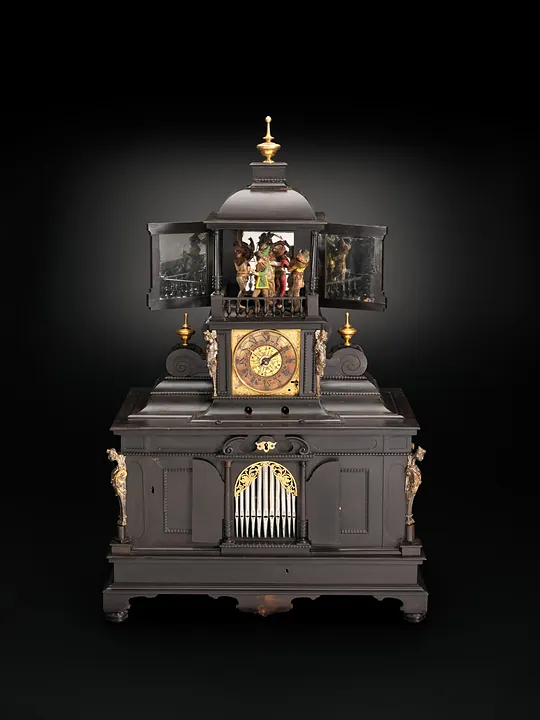
Clocks · c. 1625
Musical clock with spinet and organ by Veit Langenbucher, Germany, c. 1625
The Metropolitan Museum of Art, New York
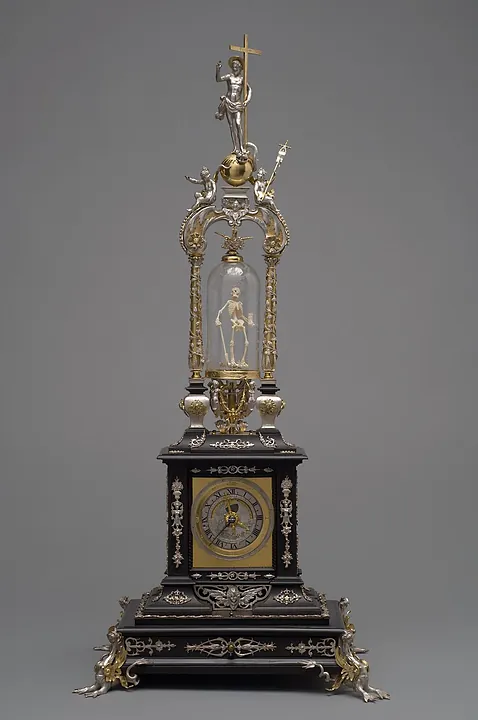
Clocks · 1624–1630
Table clock by Christoph Angermair, Germany, 1624–1630
Fine Arts Museum Vienna
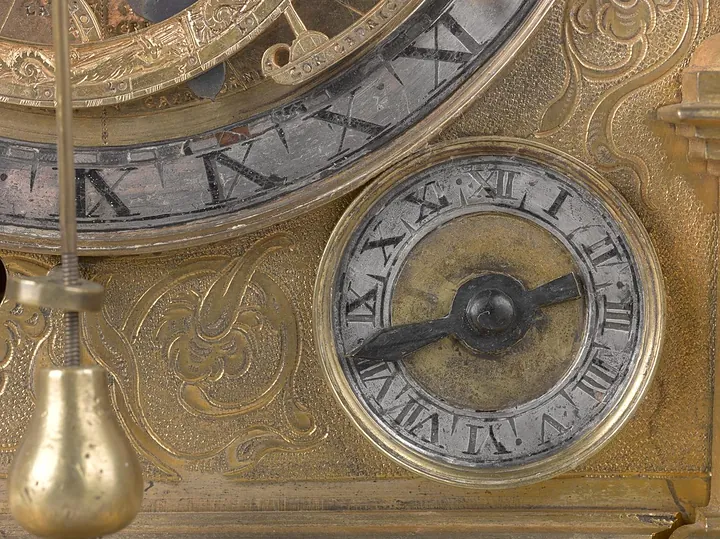
Clocks · 1625–1635
Upright table clock with winding key, by unknown maker, made in Augsburg, Germany, 1625–1635
Science Museum Group, London
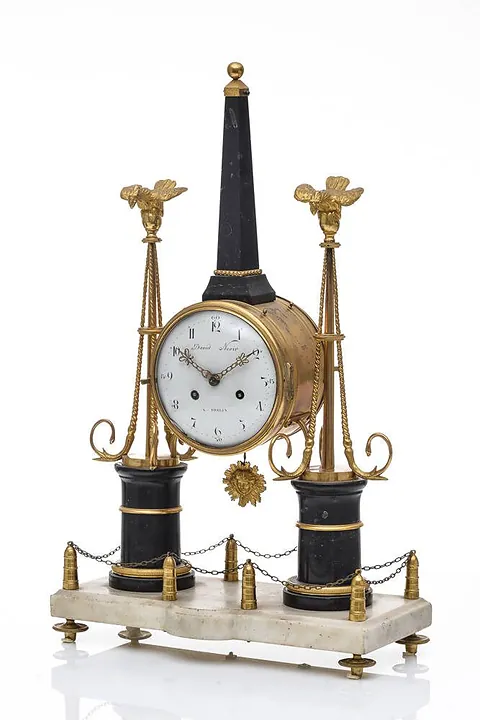
Clocks · 1700–1799
Mantel clock by David Nevir, Germany, 1700–1799
City Museum Berlin