
Wristwatches · Wristwatch
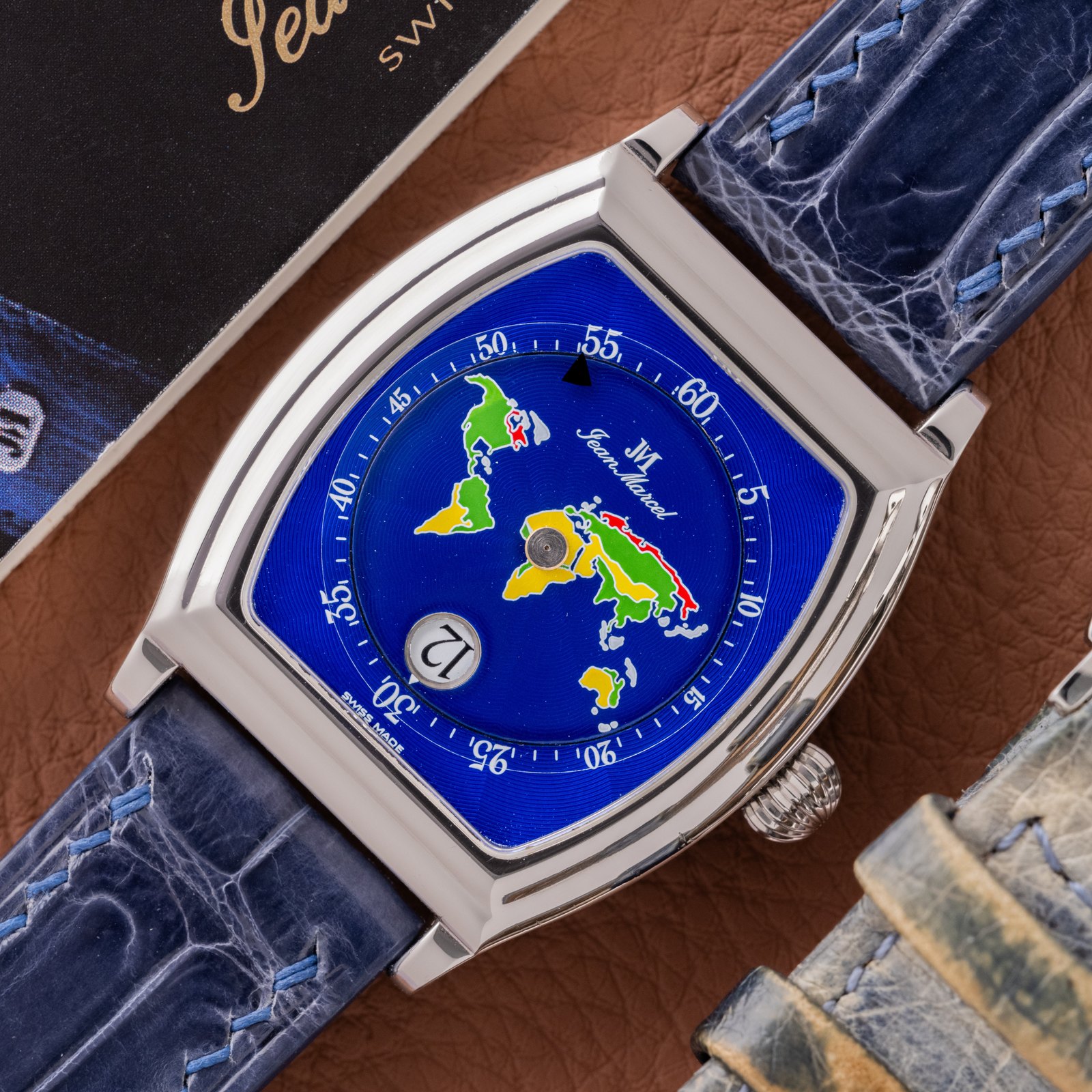
Jean Marcel Mystery Jump Hour World Map (Ref. 160.158), 1997
- Maker / attribution
- Jean Marcel (maker)
- Date
- 1997
- Historical period
- Mechanical Renaissance (1990 – 2010)
- Country of origin
- Italy
- Object type
- Wristwatch
- Dimensions
- Case 33 mm
- Stock no.
- Product 15932579119287
- Credit line
- Dealer listing, Huntington Company (product 15932579119287)
- Catalogue title (original)
- 1997 Jean Marcel Mystery Jump Hour World Map - Box and Papers (Ref. 160.158) (English)
Editor's note
The dealer's brand field named another maker; the dealer's own listing title identifies the watch as Jean Marcel.View the source record (dealer listing) ↗ (opens another website in a new tab)Suggest a correction
Record summary
Catalogued by Huntington Company (dealer) (stock number Product 15932579119287), this is a wristwatch by Jean Marcel, made in Italy, dated 1997. The Atlas places it in the Mechanical Renaissance period (1990 – 2010) of its Wristwatches collection. Recorded dimensions: Case 33 mm. The record is illustrated with 6 photographs.
Assembled from the source record's structured fields. Dates and attributions are given as the source states them; where a field is missing the Atlas leaves it blank rather than estimating.
Catalogue description
Dealer description — Huntington Company
History and Significance The jumping hour is one of the more unusual complications in mechanical watchmaking, offering an alternative to the traditional arrangement of centrally mounted hour and minute hands. Rather than displaying the hour through a continuously moving hand, a jumping hour mechanism advances a numbered disc at the completion of each hour. The concept dates back to the nineteenth century and became particularly popular during the Art Deco period, when watchmakers experimented with unconventional ways of displaying time. By the late twentieth century, jumping hour watches had become relatively uncommon, making the complication an interesting area of exploration for smaller manufacturers and independent watchmakers. Jean Marcel's Mystery collection emerged during a period of renewed interest in mechanical watchmaking and unusual complications. Throughout the 1990s, a number of smaller Swiss watch companies began exploring designs that differed considerably from the traditional offerings of established manufacturers. The Mystery Jump Hour was particularly distinctive, combining an unconventional time display with elaborate decorative dial work. The reference 160.158 is an especially interesting example, incorporating a colorful world map into a richly finished blue dial. Rather than treating the jumping hour as the sole attraction, the design makes the entire watch an exercise in decorative and mechanical creativity. The movement adds another layer of interest to the reference 160.158. Based on a Swiss ETA automatic caliber, the jumping hour mechanism was reconstructed by watchmaker Vincent Calabrese, whose career has been closely associated with inventive approaches to mechanical time displays. Calabrese became known for developing unusual complications and challenging conventional movement architecture, eventually becoming one of the founding members of the Académie Horlogère des Créateurs Indépendants. The association is particularly appropriate for a watch that approaches timekeeping in such an unconventional manner. Through the exhibition caseback, the movement's mechanical construction can be appreciated alongside the watch's distinctive dial. The dial itself deserves considerable attention. A deep blue guilloché surface provides the foundation for a colorful representation of the world, with the continents arranged across the center of the watch. The hour is displayed through an aperture at six o'clock, while the minutes are read using a pointer and a numbered scale around the perimeter. This arrangement allows the world map to remain the dominant visual element without sacrificing the ability to read the time. The combination of textured blue finishing, colorful enamel-style decoration, and an unusual mechanical display gives the watch a personality that is difficult to compare with more conventional wristwatches. Writer’s Thoughts The most appealing aspect of the reference 160.158 is the way the mechanical complication and decorative dial work together. Jumping hour watches can sometimes feel like exercises in mechanical novelty, but the Mystery has a much stronger visual identity. The world map immediately captures attention, while the rich blue guilloché and colorful detailing reveal considerably more complexity upon closer inspection. The jumping hour display becomes part of the overall composition rather than an isolated feature. The involvement of Vincent Calabrese makes the watch particularly interesting. His work has long been associated with unconventional mechanical solutions, and the reconstructed ETA movement gives the Mystery a connection to an important figure in independent watchmaking. Our Promise Every watch is thoroughly vetted, carefully described with complete transparency, and guaranteed authentic. Each piece is offered in honest condition, ensuring collectors receive a timepiece that reflects both originality and integrity. Specifications Brand: Jean Marcel Model: Mystery Jump Hour World Map Reference: 160.158 Year: 1997 Case Material: Stainless Steel Case Size: 33mm Dial: Blue Guilloché Dial with Colorful World Map, Jumping Hour Aperture, and Peripheral Minute Scale Movement: Automatic Swiss ETA-Based Jumping Hour Movement Reconstructed by Vincent Calabrese Strap/Buckle: New H.C. Blue Leather Strap; Original Blue Leather Strap Included Buckle/Clasp: Original Buckle Included Contents: Watch, Original Strap and Buckle, Box, and Papers Condition Case: Stainless steel case remains in good vintage condition with light surface wear consistent with age and use. Dial: Blue guilloché dial remains in excellent condition with well-preserved world map decoration, attractive color, and clear time indications. Hands: Minute pointer remains in excellent condition with well-preserved finishing. Crystal: Crystal remains in good condition with light signs of normal wear. Strap/Buckle: Newly fitted H.C. blue leather strap remains in excellent condition. Original blue leather strap is also included and shows wear consistent with age. Buckle/Clasp: Original buckle is included and remains in good vintage condition with normal surface wear.
Historical context
Mechanical Renaissance (1990 – 2010)
Mechanical watches return as cultural objects; independent watchmaking flourishes.
Mechanical watches returned as cultural and luxury objects. Complications, tourbillons and new materials proliferated; independent watchmakers such as George Daniels, F.P. Journe and Philippe Dufour revived artisanal watchmaking; collecting vintage watches became a major field.
Read the period in the timelineMore wristwatches from this periodEarlier: Quartz Revolution
Atlas type guide
Wristwatches
Bracelet watches were worn by women from the early nineteenth century — Breguet made one for Caroline Murat, Queen of Naples, in 1810–12 — but the wristwatch only became a man's instrument with military use and aviation in the early twentieth century. Between the World Wars it overtook the pocket watch; the 1920s and 1930s brought rectangular Art Deco cases, water-resistant cases and the first automatic winding systems.
After 1945 the wristwatch became a carrier of identity — dress watches, sports and dive watches, chronographs, calendars — produced by Swiss, American, Japanese, German, Soviet and Chinese industries. The quartz revolution after 1969 and the mechanical renaissance since the 1990s, including the rise of independent watchmakers, complete the story.
What to look for
- The reference number (between the lugs or inside the case back) and serial number, the starting point for dating.
- The calibre: its maker and number are often stamped under the dial or on the bridge.
- Originality of dial, hands and crown — refinished ('redial') dials are common.
- Case material marks: 18K/750, 14K/585, stainless steel, gold-filled, plated.
Dating clues
- Wire-lug cases: before c. 1925.
- Water-resistant screw-down cases: from 1926.
- Quartz movements: from 1969; sapphire crystals widespread after c. 1980.
General guidance written by the Atlas editors about this kind of object. It is not a statement about this particular piece; for that, rely on the source record above and on physical examination.
Related records
Wristwatches · c. 2007
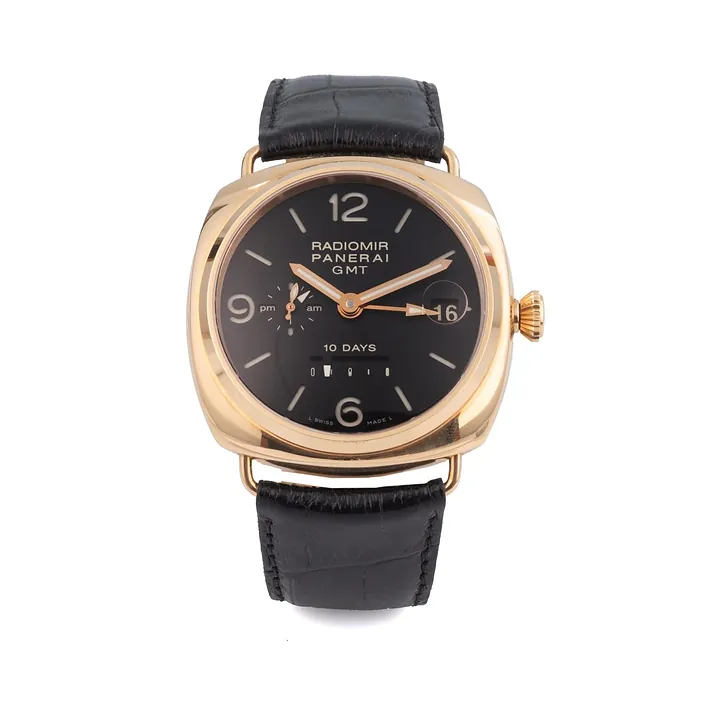
Officine Panerai Radiomir GMT, ref. 06706, c. 2007
Antiquorum auction archive, Geneva
Wristwatches · c. 2007
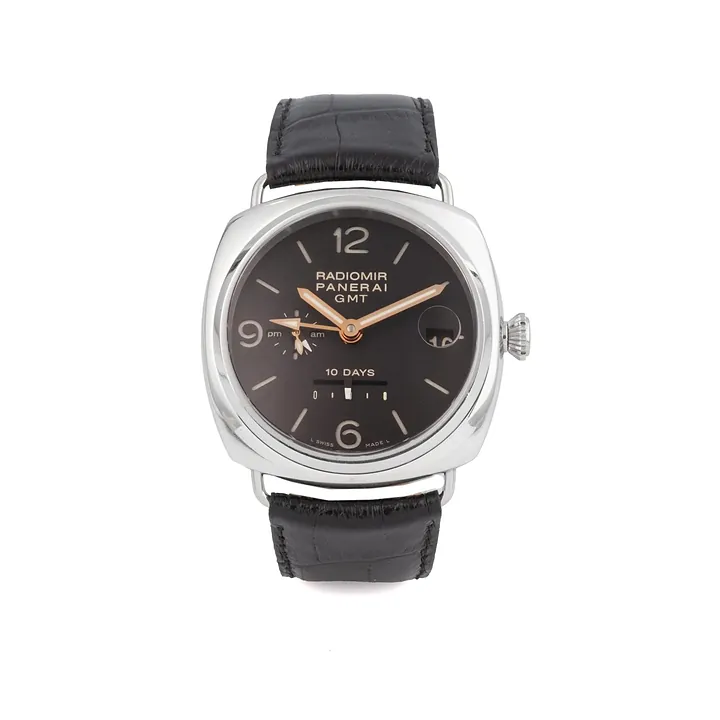
Officine Panerai Radiomir GMT, ref. PAAM00274, c. 2007
Antiquorum auction archive, Geneva
Wristwatches · Sold in Nov 2006
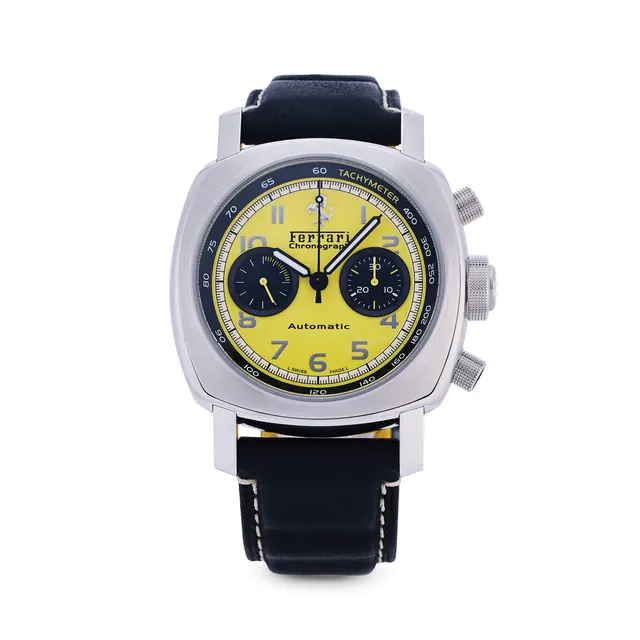
Panerai wristwatch, ref. FER00011, Ferrari Granturismo Chronograph Limited 169/700, Sold in Nov 2006
Antiquorum auction archive, Geneva
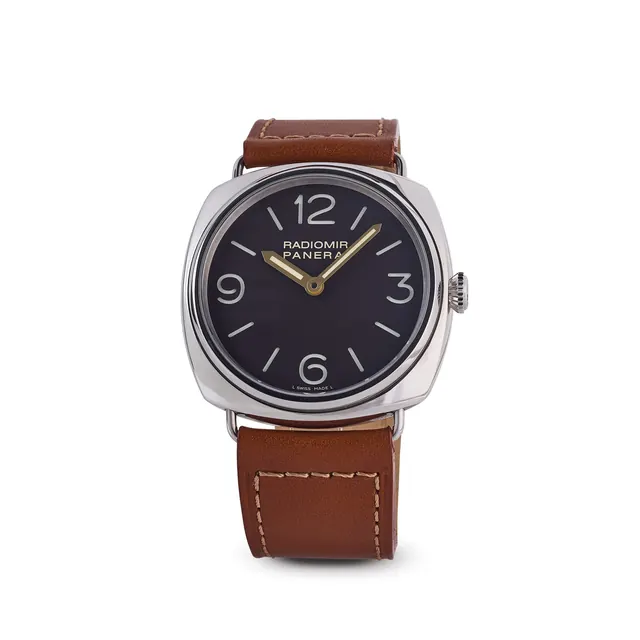
Wristwatches · originally sold in October 2007 (per the lot record)
Panerai wristwatch, ref. PAM, Radiomir 1938 New Old Stock, originally sold in October 2007
Antiquorum auction archive, Geneva
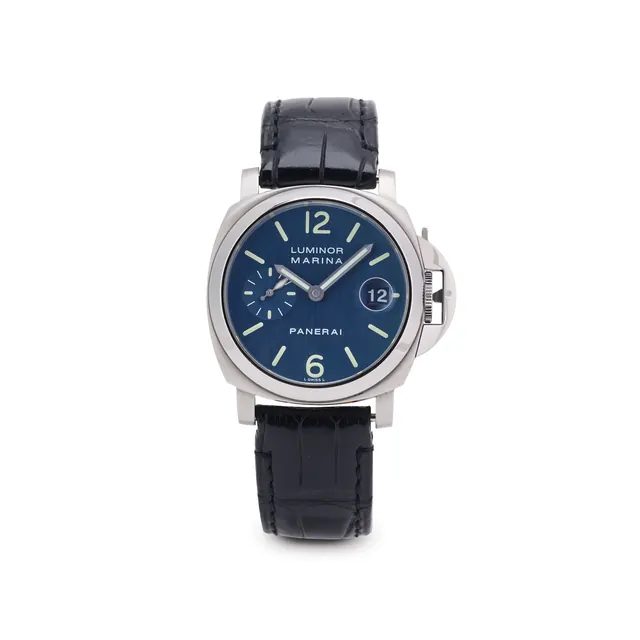
Wristwatches · c. 2002-2006
Panerai wristwatch, ref. PAM, Lumior Marina, circa 2002-2006
Antiquorum auction archive, Geneva
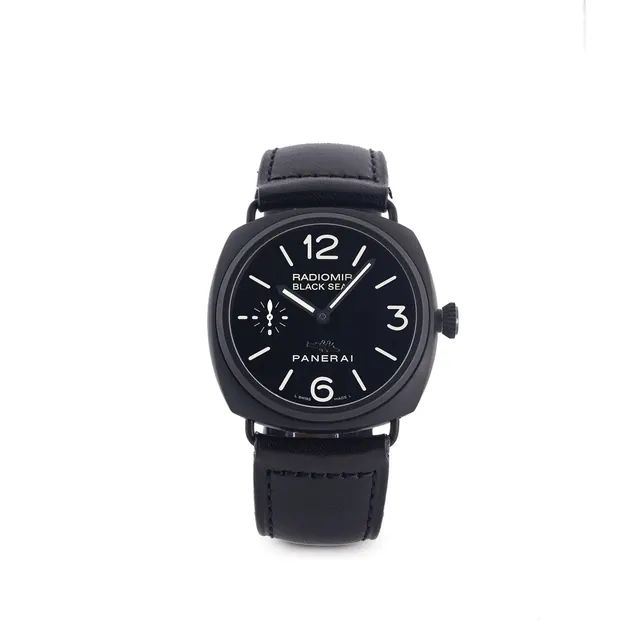
Wristwatches · c. 2009
Panerai wristwatch, ref. PAM00292, Radiomir Black Seal Limited Edition of 1000 Pieces, circa 2009
Antiquorum auction archive, Geneva
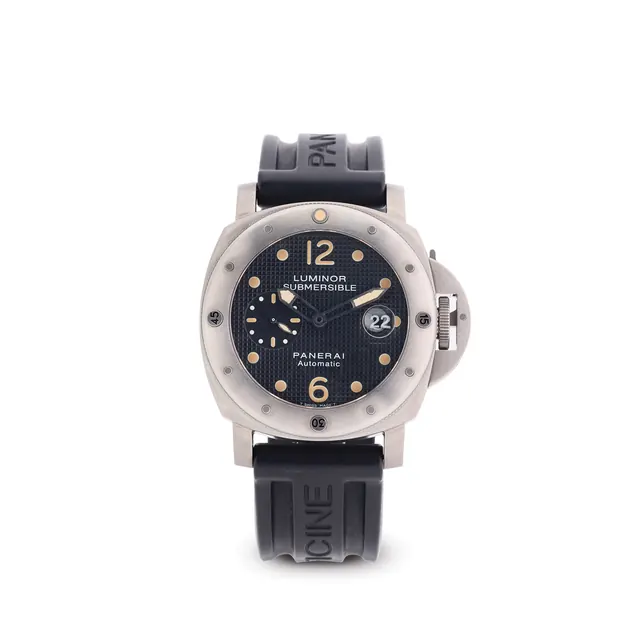
Wristwatches · c. Jun 1998
Panerai wristwatch, ref. PAM025/OP6507, Luminor Submersible, circa Jun 1998
Antiquorum auction archive, Geneva
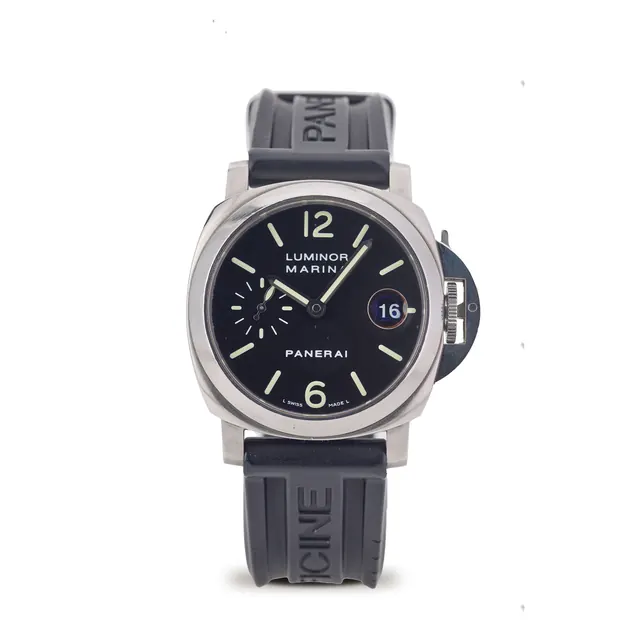
Wristwatches · originally sold in 2006 (per the lot record)
Panerai wristwatch, ref. PAM0048, Luminor Marina, originally sold in 2006
Antiquorum auction archive, Geneva