
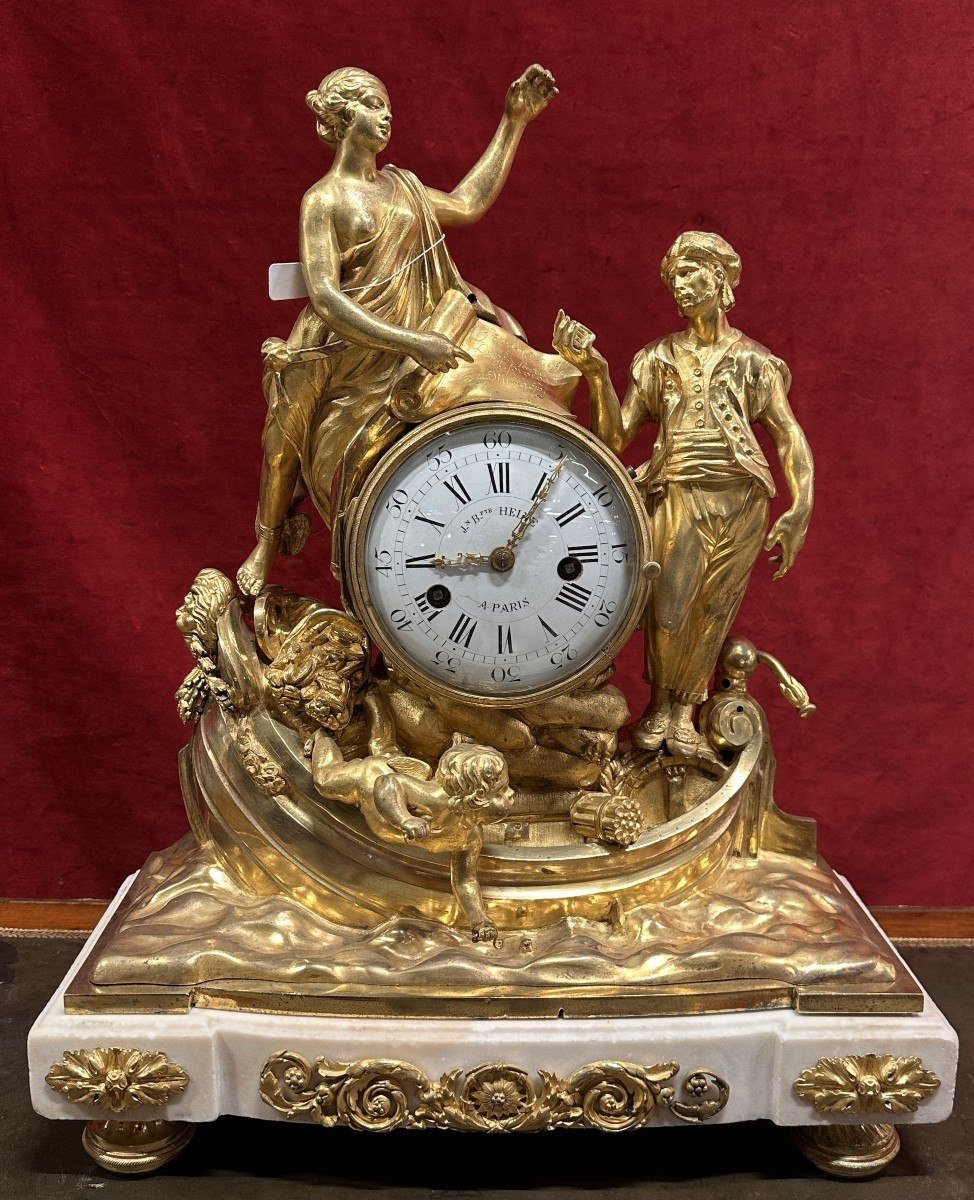
Clocks · Mantel clock
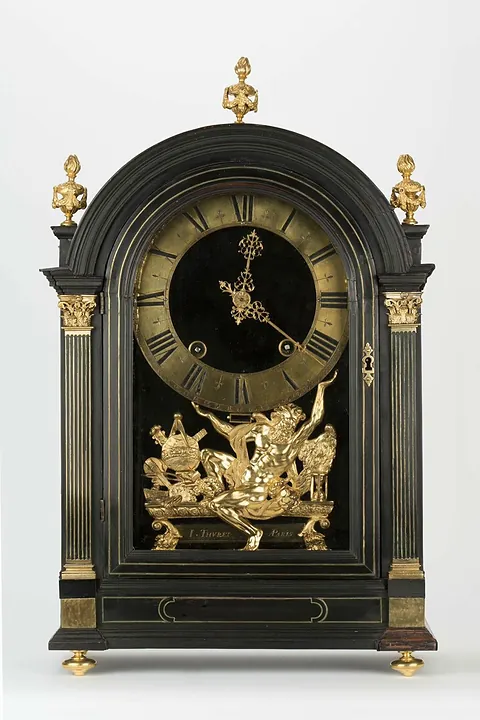
Jean-Baptiste Helye Louis XVI 'Allegory of Maritime Commerce' mantel clock
- Maker / attribution
- Jean-Baptiste Helye (source attribution)
- Date
- 18th century
- Historical period
- Early Modern Horology (1600 – 1750)
- Country of origin
- France
- Object type
- Mantel clock
- Dimensions
- 48 cm x 40 cm x 19 cm
- Holding institution
- Your Antiques / Proantic
- Accession / object no.
- jean-baptiste-helye-louis-xvi-allegory-of-maritime-commerce-mantel-clock-8bb59a2
- Credit line
- Your Antiques / Proantic
- Catalogue title (original)
- Proantic: Clock \"allegory Of Maritime Commerce\" Signed Jn Bᵗᵉ Helye, P (English)
View the source record ↗ (opens another website in a new tab)Suggest a correction
Record summary
Held and catalogued by Your Antiques / Proantic (object number jean-baptiste-helye-louis-xvi-allegory-of-maritime-commerce-mantel-clock-8bb59a2), this is a mantel clock attributed to Jean-Baptiste Helye, made in France, dated 18th century. The Atlas places it in the Early Modern Horology period (1600 – 1750) of its Clocks collection. Recorded dimensions: 48 cm x 40 cm x 19 cm. The record is illustrated with 1 photograph.
Assembled from the source record's structured fields. Dates and attributions are given as the source states them; where a field is missing the Atlas leaves it blank rather than estimating.
Catalogue description
Original object description
Dating to the Louis XVI era in Paris, this mantel clock combines mercury-gilt bronze sculpture with a white marble plinth adorned with gilt-bronze foliage swags, rosettes, and scrolls. The figurative setting portrays an allegory of maritime trade as a ship afloat on waves; near the bow, a winged putto pulls an anchor amidst freight consisting of bales and casks. The central dial is flanked by two monumental figures: an antique-draped goddess on the left, identified in literature as probable personifications of Abundance or Fortune, and a turbaned merchant in Levantine attire on the right, representing Middle Eastern commerce. The white enamel dial exhibits dual winding arbors, Roman numerals for the hours, outer Arabic minute divisions, and the maker's mark 'JN B.TE HELYE A PARIS' (also documented as 'Jn Bᵗᵉ Helye – à Paris'). Its interior houses a Parisian movement signed by Jean-Baptiste Helye, regulated by a silk-thread suspension and sounding the hours and half-hours on a bell. According to condition reports, the original gilding displays typical minor aging, and fine hairlines appear near the winding apertures; the rear plate and bell are unillustrated, and extended timekeeping accuracy is untested.
Historical context
Early Modern Horology (1600 – 1750)
Huygens' pendulum and balance spring transform accuracy; English makers develop the anchor and deadbeat escapements.
Huygens's pendulum (1656–57) improved clock accuracy from about a quarter of an hour to under a minute a day. The anchor escapement (c. 1670) and the long seconds pendulum created the longcase clock; London makers such as Fromanteel, Knibb, Tompion and Quare led European clockmaking, and French makers created the Boulle pendule.
Read the period in the timelineMore clocks from this periodEarlier: Renaissance Horology
Atlas type guide
Mantel and French pendule clocks
The mantel clock — the French pendule de cheminée — is as much decorative art as timekeeper. From the late seventeenth century Parisian clockmakers worked with cabinet-makers, bronze founders and gilders (ciseleurs-doreurs) to create cases in Boulle marquetry, gilt bronze and marble, while the movements were often supplied by specialist makers. Clocks of the Louis XIV, Louis XV and Louis XVI periods, and Empire clocks with allegorical figures, set fashions copied across Europe.
The nineteenth century industrialised the type. The 'Paris movement', a standardised round movement with silk-thread or Brocot suspension and count-wheel striking, was made in huge numbers by firms such as Japy and Vincenti, and fitted into cases of every style and material.
What to look for
- Round 'Paris' movements with makers' stamps (e.g. Japy Frères, Vincenti, S. Marti) and medal marks from exhibitions.
- Suspension type: silk thread (earlier) or Brocot adjustable suspension (after c. 1840).
- Visible Brocot escapement on the dial in later clocks.
- Fire-gilt (mercury) gilding on bronzes versus later electro-gilding.
- Signed dials naming a retailer rather than the movement maker.
Dating clues
- Silk-suspension Paris movements: c. 1800–1850.
- Brocot suspension and visible escapements: after c. 1840.
- Exhibition medal stamps on movements give dates after the medal year.
General guidance written by the Atlas editors about this kind of object. It is not a statement about this particular piece; for that, rely on the source record above and on physical examination.
Read next:Anchor (recoil) escapement
Related records
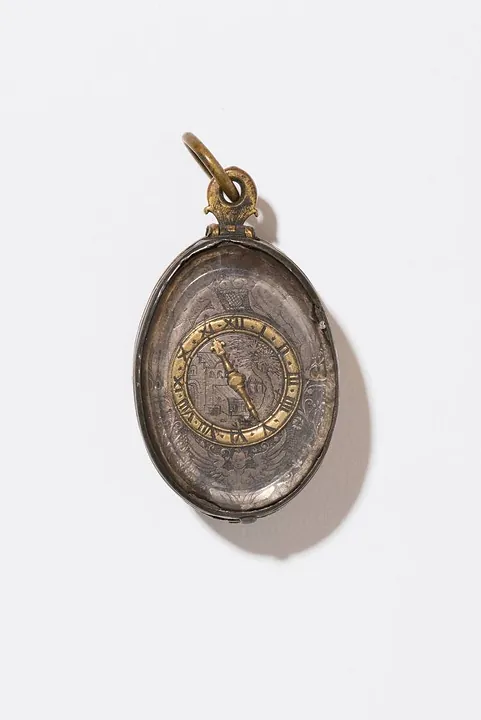
Clocks · 1590–1610
Clock, France, 1590–1610
MAK – Museum of Applied Arts
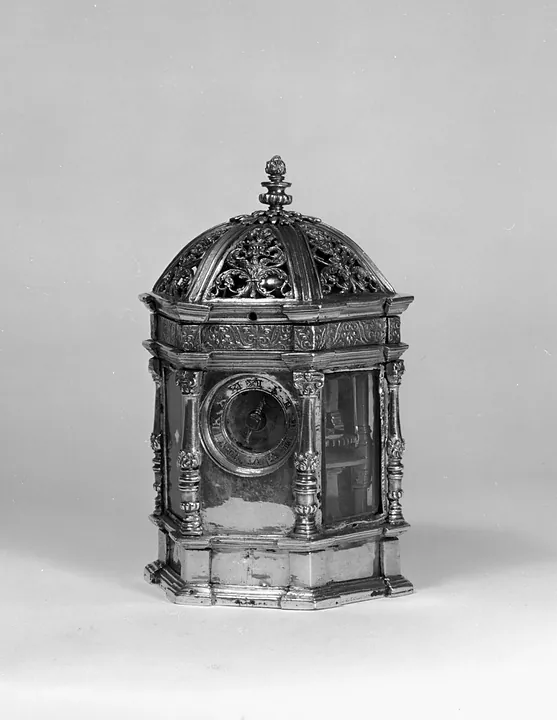
Clocks · c. 1600
Table Clock, sheet brass, engraved, pierced and gilt, Paris, ca.1600, signed 'B(?) Pichard, à Paris'
Victoria and Albert Museum, London
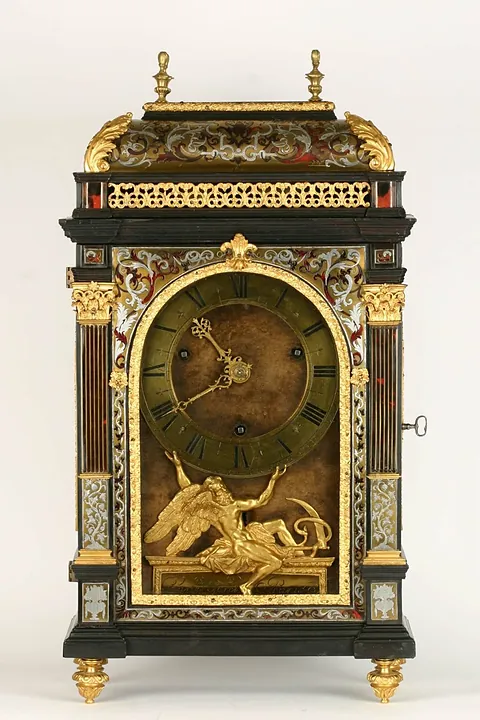
Clocks · 1600–1699
Table clock by Charles Goret, France, 1600–1699
German Clock Museum
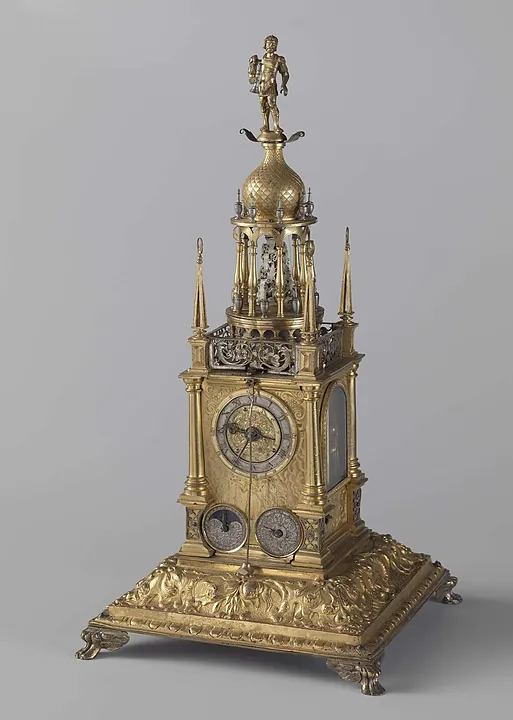
Clocks · 1640
Table clock, France, 1640
Rijksmuseum
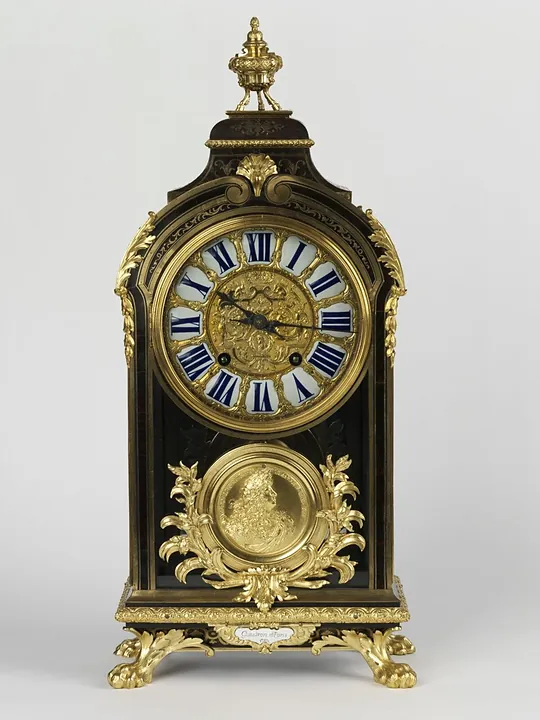
Clocks · late 17th century
Clock with case of tortoiseshell inlaid with brass, Paris, late 17th century
Victoria and Albert Museum, London
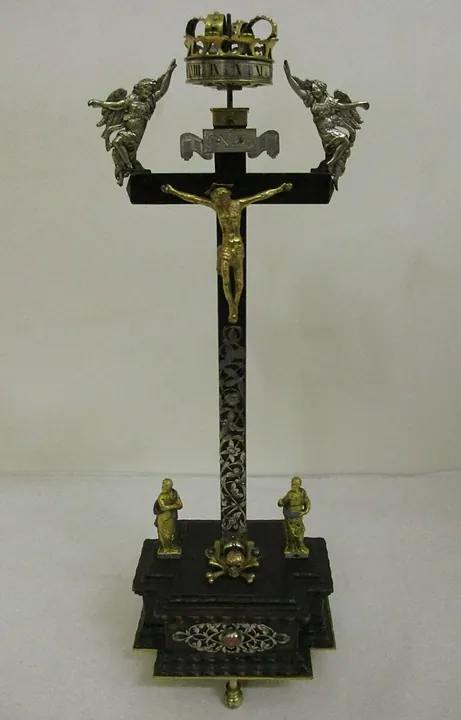
Clocks · 1650
Crucifix Clock, signed W. H. Arnstad, mid- 17th century.
Victoria and Albert Museum, London
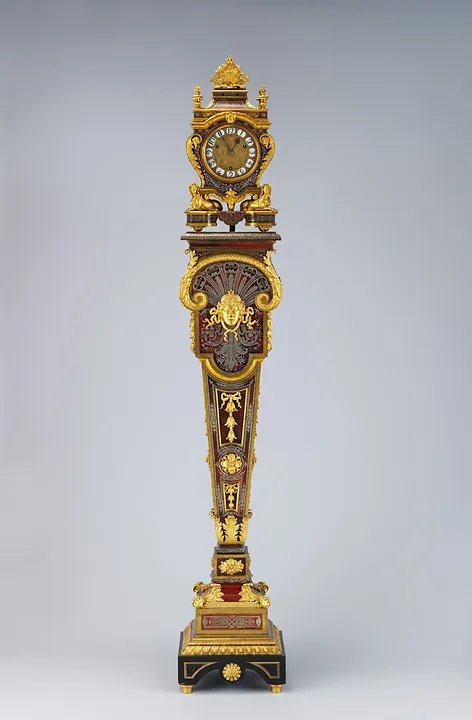
Clocks · c. 1690
Clock with pedestal, case attributed to André Charles Boulle, France, c. 1690
The Metropolitan Museum of Art, New York
Clocks · c. 1690
Table clock by Marc Boucher, France, c. 1690
German Clock Museum