
Wristwatches · Wristwatch
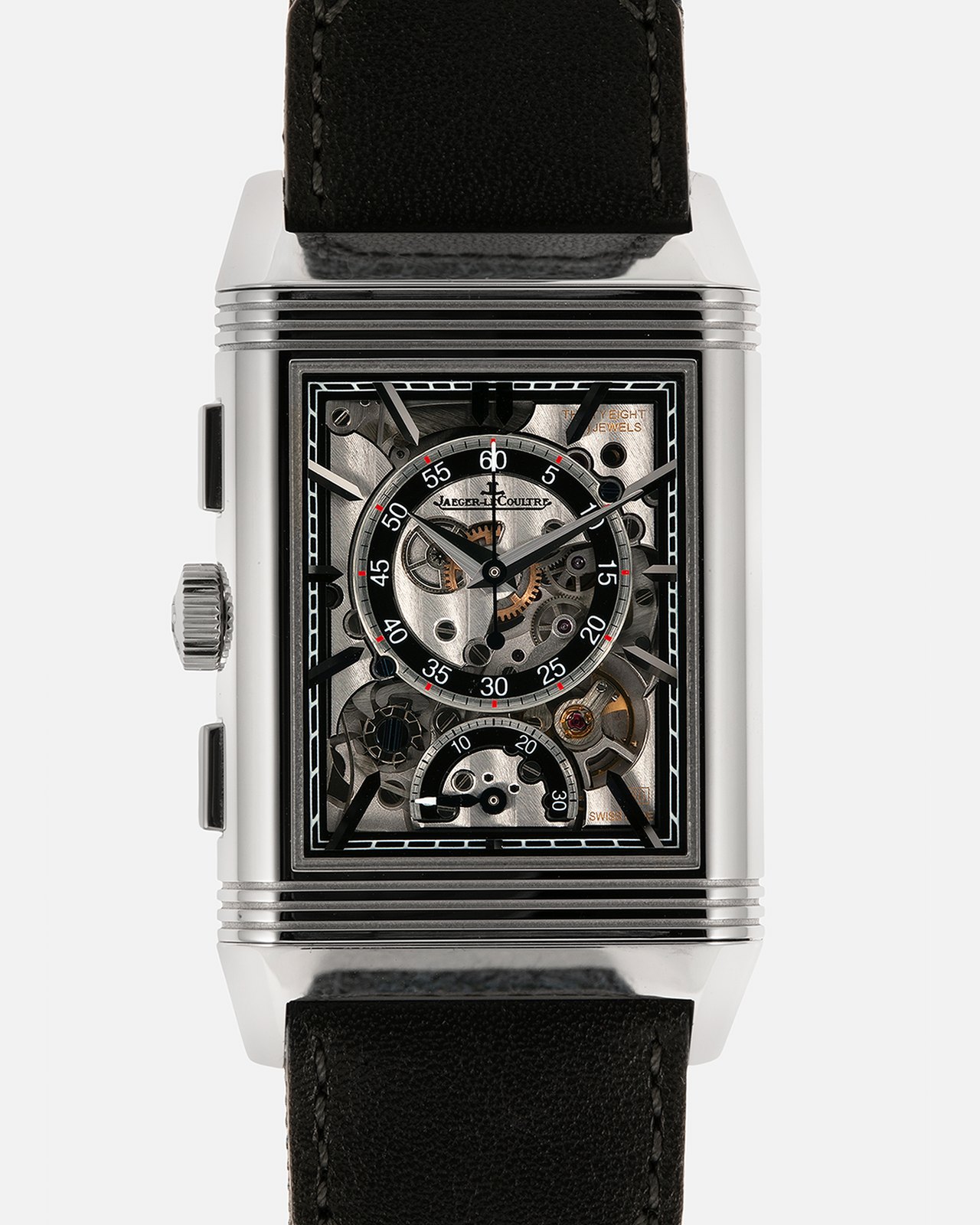
Jaeger-LeCoultre Reverso Tribute Chronograph 216.8.S0, 2024
- Maker / attribution
- Jaeger-LeCoultre (maker)
- Date
- 2024
- Historical period
- Contemporary Horology (2010 – Present)
- Country of origin
- Switzerland
- Object type
- Wristwatch
- Dimensions
- Case 49.9 mm
- Stock no.
- Product 7414994567255
- Credit line
- Dealer listing, S.Song Watches (product 7414994567255)
- Catalogue title (original)
- Jaeger-LeCoultre Reverso Tribute Chronograph 216.8.S0 (English)
View the source record (dealer listing) ↗ (opens another website in a new tab)Suggest a correction
Record summary
Catalogued by S.Song Watches (dealer), Seattle (stock number Product 7414994567255), this is a wristwatch by Jaeger-LeCoultre, made in Switzerland, dated 2024. The Atlas places it in the Contemporary Horology period (2010 – Present) of its Wristwatches collection. Recorded dimensions: Case 49.9 mm. The record is illustrated with 6 photographs.
Assembled from the source record's structured fields. Dates and attributions are given as the source states them; where a field is missing the Atlas leaves it blank rather than estimating.
Catalogue description
Dealer description — S.Song Watches
Created by Jacques-David LeCoultre in 1931, the Reverso was initially conceived to withstand the harsh beating a watch would endure during a game of polo. With the need for the watch to be more durable, the Reverso's genius reveals itself through its eponymous design–a reversible case. With its case able to be turned around on itself, the Reverso's dial can be protected while playing sports and returned to its natural position with a quick flick and slide. Thanks to its iconic heritage, the Reverso has evolved into one of Jaeger LeCoultre's most important design vehicles to date, with a healthy number of contemporary variations to suit the palate of modern enthusiasts and connoisseurs alike. While there have been many complications put into the Reverso over the years, one that was sorely lacking was a chronograph. Only made once in 1996 in a limited edition, my feeling is that the resources required to make a square, in-house chronograph was too great to justify. Avid followers will know that we are huge fans of the original reference, so when Jaeger-LeCoultre announced that they will be finally releasing a Reverso chronograph in 2023, we were over the moon. Unveiled in yellow gold and stainless steel, what we have here today is the latter- the Reverso Tribute Chronograph 216.8.S0. Beginning with a stainless steel case measuring 49.9mm x 29.9mm x 11.14mm, this tribute chronograph features a striking dual-faced configuration. Much like the design language of the iconic Duoface, the design capitalises on its reversible mechanism by incorporating a second dial. The front tells the time, and the reverse side features the chronograph counter. Despite having two faces with two sets of hands, they are synced and not a dual time function. This is so that when the user wants to use the chronograph and flips the watch over, they can still tell what time it is. The original from 1996 lacked this and it is a welcome piece of functionality. On the front, the watch features a simple yet stunning grey-blue sunburst dial that interacts beautifully with light from different angles. Flip it over, and you're treated to a view of the openworked in-house, manual-winding Cal. 860, distinguished by its captivating finishing and intricate design. The movement offers a power reserve of up to 52 hours when fully wound. Floating above the exposed inner mechanics are applied hour markers, a minute track, a 30-minute counter at 6:00, and a pair of elegant dauphine hands, complemented by blued accents that add a much-needed touch of contrast and visual flair. Much like the Duoface, the true beauty of this timepiece lies in its duality: a refined, understated dial on one side, and a highly intricate, visually captivating movement on the other. It’s quite literally two watches in one. The Reverso Tribute Chronograph is an exceptionally versatile piece, offering the wearer two distinct faces to match their outfit, mood, or occasion. I've always believed that Jaeger-LeCoultre Reversos occupy a category entirely their own. It's fascinating to consider that while they were originally designed for polo players—and once regarded as true sports watches—they are now widely seen as refined dress pieces. This unique blend of characteristics gives the Reverso a hybrid quality that enhances its wearability and appeal. It’s a testament to the model’s versatility: equally at home in the boardroom as it is on the polo field. Ultimately, the Reverso stands as a brilliant example of a design that not only solved a practical, real-world challenge in its time but has since become an enduring icon in the world of high-end watchmaking. With this contemporary Reverso Chronograph, Jaeger-LeCoultre has finally addressed the missing piece to their list of complicated Reversos.
Historical context
Contemporary Horology (2010 – Present)
Silicon components, connected watches, optical-lattice research clocks and a thriving independent scene.
Smartwatches became the world's best-selling watches, while mechanical watchmaking focuses on craft, innovation (silicon components, new escapements) and independent makers.
Read the period in the timelineMore wristwatches from this periodEarlier: Mechanical Renaissance
Atlas type guide
Chronographs and split-seconds watches
A chronograph is a watch with an additional seconds hand that can be started, stopped and returned to zero independently of the timekeeping. Louis Moinet built an early example in 1816 and Nicolas Rieussec a recording 'chronographe' in 1821; Adolphe Nicole's heart-shaped reset cam (patented 1862) made the modern return-to-zero possible. Split-seconds (rattrapante) chronographs add a second hand that can be stopped for intermediate times; flyback chronographs restart instantly.
Chronographs were essential tools for doctors (pulsometer scales), artillery (telemeter), engineers and sport. In wristwatches, Valjoux, Venus, Lemania and later the automatic chronographs of 1969 (Zenith El Primero, the Chronomatic Calibre 11 group and Seiko 6139) are milestones.
What to look for
- Push-pieces on the case band or a single button in the crown (monopusher).
- Subsidiary registers for minutes and hours; tachymeter, telemeter or pulsometer scales.
- Column wheel versus cam control visible in the movement.
- Calibre markings of specialist makers (Valjoux, Lemania, Venus, Landeron).
Dating clues
- Pocket chronographs with heart cam reset: after 1862.
- Wrist chronographs: from c. 1910; two-button designs from the 1930s.
- Automatic chronographs: from 1969.
General guidance written by the Atlas editors about this kind of object. It is not a statement about this particular piece; for that, rely on the source record above and on physical examination.
Read next:Flyback chronographChronograph
Related records
Clocks · 1937–1938
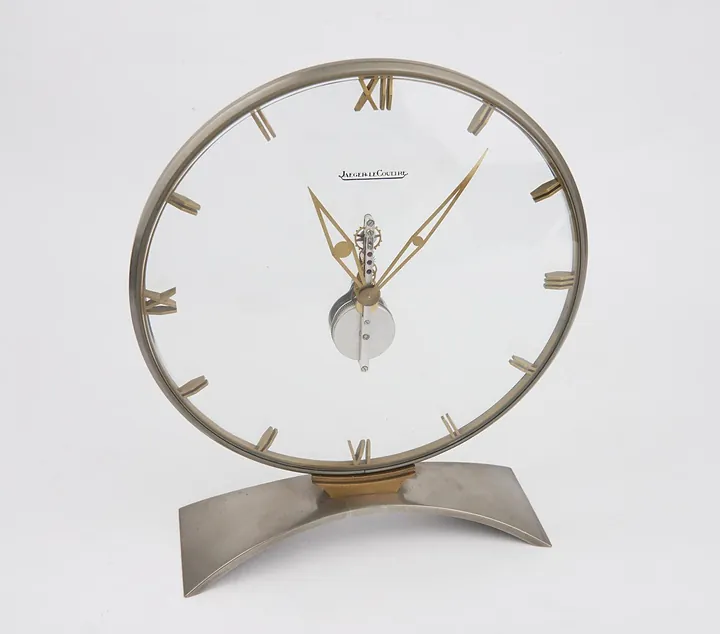
Skeleton clock by Jaeger-LeCoultre, Switzerland, 1937–1938
Science Museum Group, London
Movements & Components · 1953
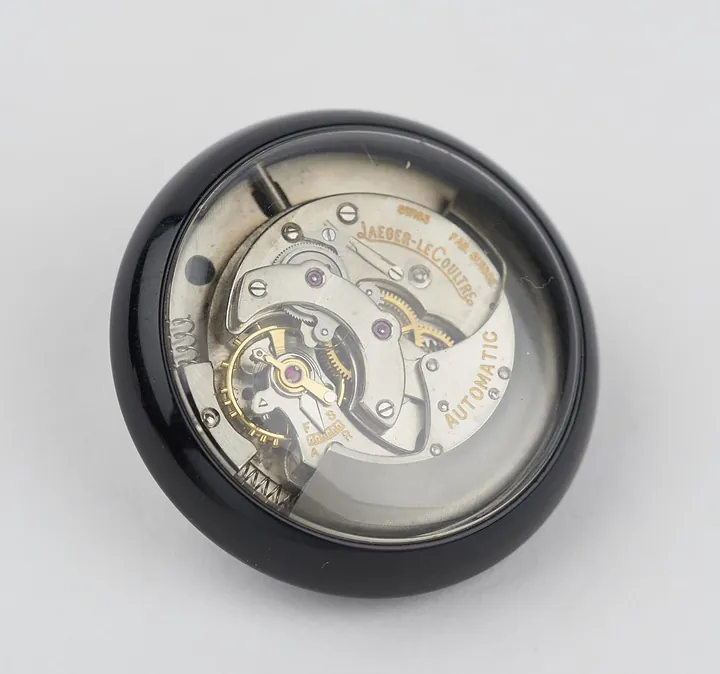
Automatic watch movement, Jaeger-LeCoultre, 1953, Geneva, Switzerland, showing self-winding mechanism
Science Museum Group, London
Wristwatches · 1953
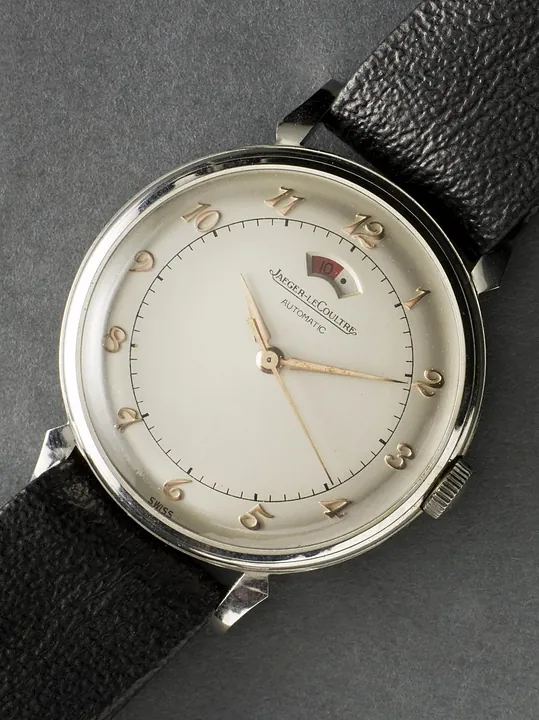
Automatic Wrist-watch, Jaeger-LeCoultre, Geneva, Switzerland, with reserve power indicator complete in steel case, 1953. Back numbered 564556.
Science Museum Group, London
Wristwatches · 1953
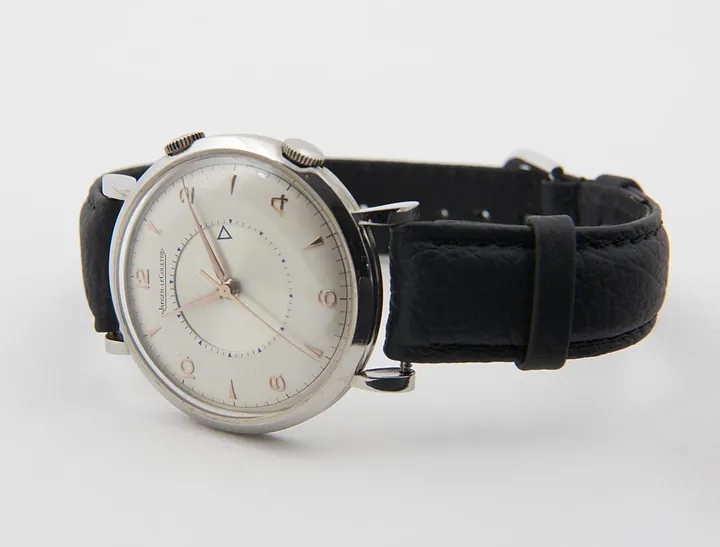
Wrist-watch, 'Memovox' alarm, Jaeger-LeCoultre, Geneva, Switzerland, complete in steel case, 1953.
Science Museum Group, London

Wristwatches · c. 2010s
Breguet Type XXI, ref. 3810, c. 2010s (Antiquorum Lot 381-24)
Antiquorum auction archive, Geneva

Wristwatches · c. 2010s
Breguet Type XXI, ref. 3810, c. 2010s (Antiquorum Lot 386-229)
Antiquorum auction archive, Geneva

Wristwatches · Sold in September 2010
Breitling Cosmonaute, ref. A 22322, Sold in September 2010
Antiquorum auction archive, Geneva

Wristwatches · c. 2010
Corum Bubble Chrono, ref. 396.150.20, c. 2010
Antiquorum auction archive, Geneva