
Wristwatches · Wristwatch
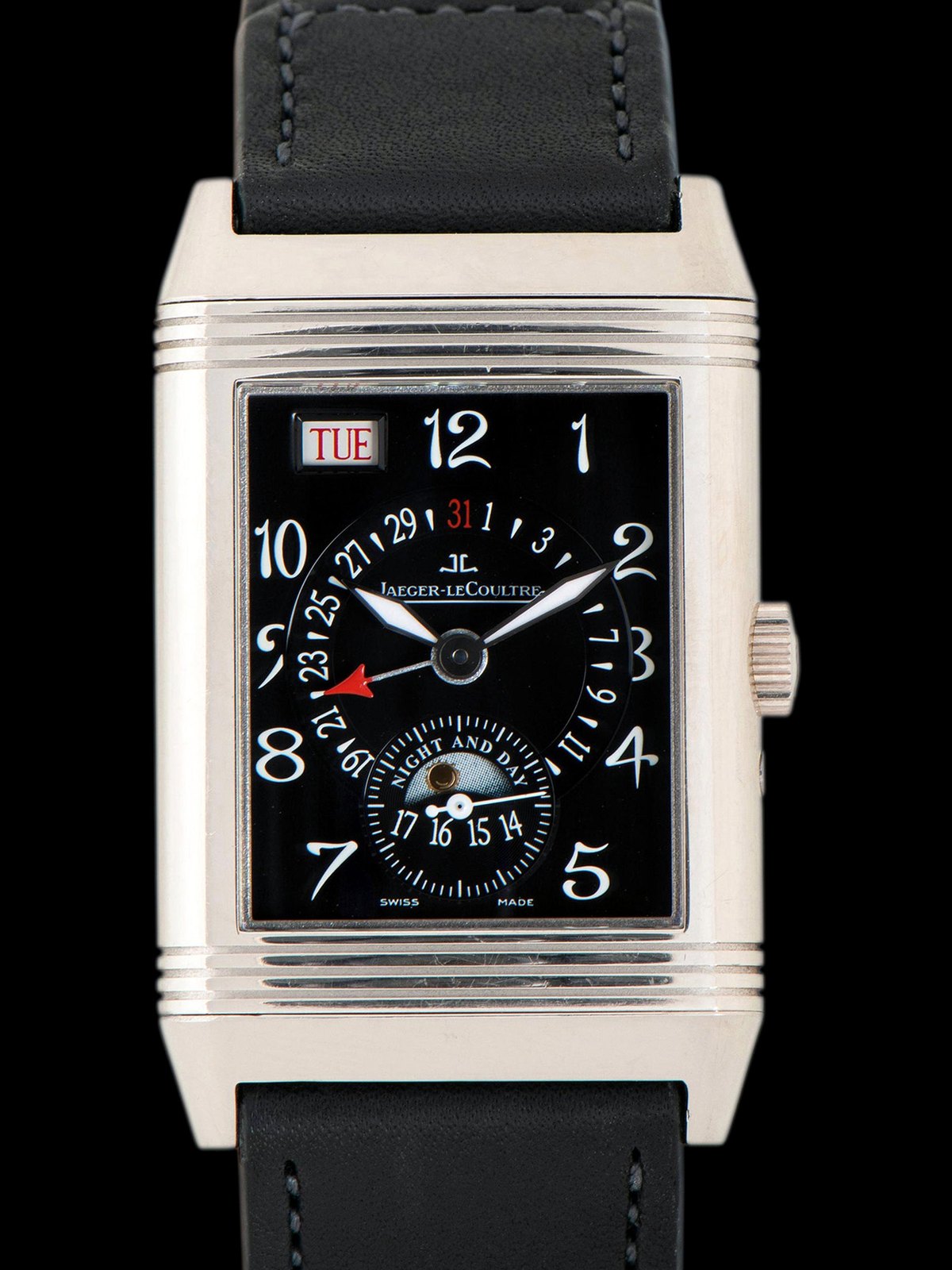
Jaeger-LeCoultre Reverso Calendar (Ref. 270.3.36) 18K WG, 2000s
- Maker / attribution
- Jaeger-LeCoultre (maker)
- Date
- 2000s
- Historical period
- Mechanical Renaissance (1990 – 2010)
- Country of origin
- Switzerland
- Object type
- Wristwatch
- Stock no.
- JLCREV270336
- Credit line
- Dealer listing, Craft & Tailored (JLCREV270336)
- Catalogue title (original)
- 2000s Jaeger-LeCoultre Reverso Calendar (Ref. 270.3.36) 18K WG (English)
View the source record (dealer listing) ↗ (opens another website in a new tab)Suggest a correction
Record summary
Catalogued by Craft & Tailored (dealer), Los Angeles (stock number JLCREV270336), this is a wristwatch by Jaeger-LeCoultre, made in Switzerland, dated 2000s. The Atlas places it in the Mechanical Renaissance period (1990 – 2010) of its Wristwatches collection. The record is illustrated with 6 photographs.
Assembled from the source record's structured fields. Dates and attributions are given as the source states them; where a field is missing the Atlas leaves it blank rather than estimating.
Catalogue description
Dealer description — Craft & Tailored
Sophisticated and rugged are two words not commonly seen together, but when describing the sport of Polo, or the players of the sport, no two words are better suited. However, this combination didn't bode well for the polo player's watches, which saw constant abuse due to most watches featuring an exposed crystal. So after a conversation with a Polo player who just broke their crystal while playing a match in India, Swiss businessman César de Trey brought the idea of a watch that could survive the harsh conditions of a Polo match to Jacques-David LeCoultre, who was the owner of JLC. Jacques-David took this concept to his head designer at the time, René-Alfred Chauvot, who quickly designed and patented the sophisticated and rugged Reverso design. The Jaeger-LeCoultre Reverso on its own is a stunning dress piece, however, its ability to flip over on its case to protect its finer watchmaking components was nothing short of revolutionary at the time of its conception. Since 1931, JLC has introduced numerous variants of this iconic timepiece including, GMTs, tourbillions, dual face variants, moon phases, and calendars like the example presented here. SPECS Stock # JLCREV270336 Brand Jaeger-LeCoultre Style Reverso Calendar Model 270.3.36 Serial 21XXXXX Size Men's Material 18K White Gold Dial Black Millimeters 26x36 Strap JLC Black Leather Strap W/ Stainless Steel JLC Deployant Clasp CASE & BRACELET The beautiful 18K white gold case exhibits gentle signs of use and no evidence of previous polishing present. The case retains its original Jaeger-LeCoultre crown. The case back retains crisp finishing with the original factory markings in excellent condition. The black JLC leather strap is a replacement and comes with a stainless steel JLC deployant clasp that matches the white gold case nicely. DIAL & HANDS The original black dial is flawless, showing no damage or age. The dial features a day window at 11 o'clock, with the date at the center of the dial, and at 6 o'clock is a day/night indicator along with the running second's hand. The hands are in perfect condition as well. ACCESSORIES None. The watch is keeping time, but the service history is unknown. A movement service can be provided upon request.
Historical context
Mechanical Renaissance (1990 – 2010)
Mechanical watches return as cultural objects; independent watchmaking flourishes.
Mechanical watches returned as cultural and luxury objects. Complications, tourbillons and new materials proliferated; independent watchmakers such as George Daniels, F.P. Journe and Philippe Dufour revived artisanal watchmaking; collecting vintage watches became a major field.
Read the period in the timelineMore wristwatches from this periodEarlier: Quartz Revolution
Atlas type guide
Calendar, moon-phase and perpetual calendar watches
Calendar complications range from a simple date to the perpetual calendar, which automatically allows for months of different lengths and leap years until 2100. Pocket watches with perpetual calendars were made in the eighteenth and nineteenth centuries; Patek Philippe made the first perpetual calendar wristwatch in 1925, and series production followed in 1941. The annual calendar (Patek Philippe, 1996) needs correction only once a year.
Moon-phase displays use a disc with two moons and 59 teeth advanced daily, approximating the 29.5-day lunation; more precise trains reduce the error to one day in over a century.
What to look for
- Apertures or subsidiary dials for day, date, month and leap year.
- Moon disc under a 'bosom' shaped aperture.
- Recessed correctors on the case band for setting the calendar.
Dating clues
- Triple-date wristwatches: popular c. 1940–1955.
- Perpetual calendar wristwatches: from 1925 (unique) and 1941 (series).
General guidance written by the Atlas editors about this kind of object. It is not a statement about this particular piece; for that, rely on the source record above and on physical examination.
Related records
Clocks · 1937–1938
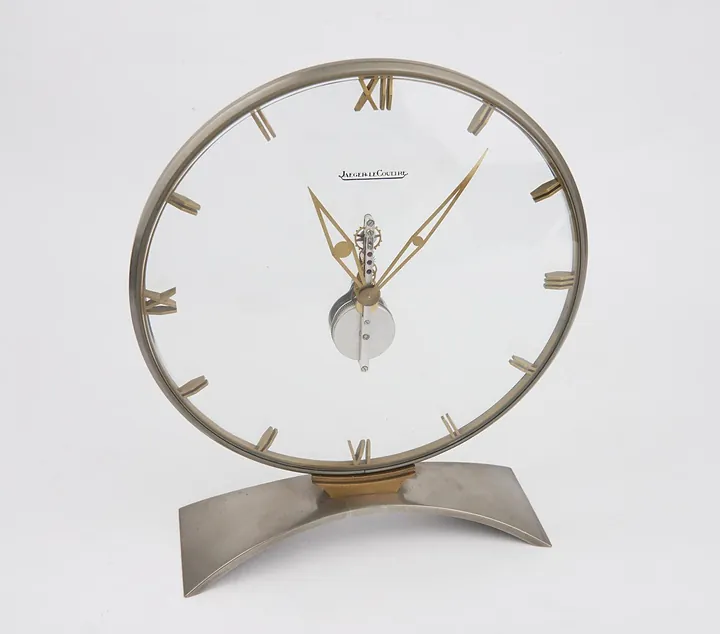
Skeleton clock by Jaeger-LeCoultre, Switzerland, 1937–1938
Science Museum Group, London
Movements & Components · 1953
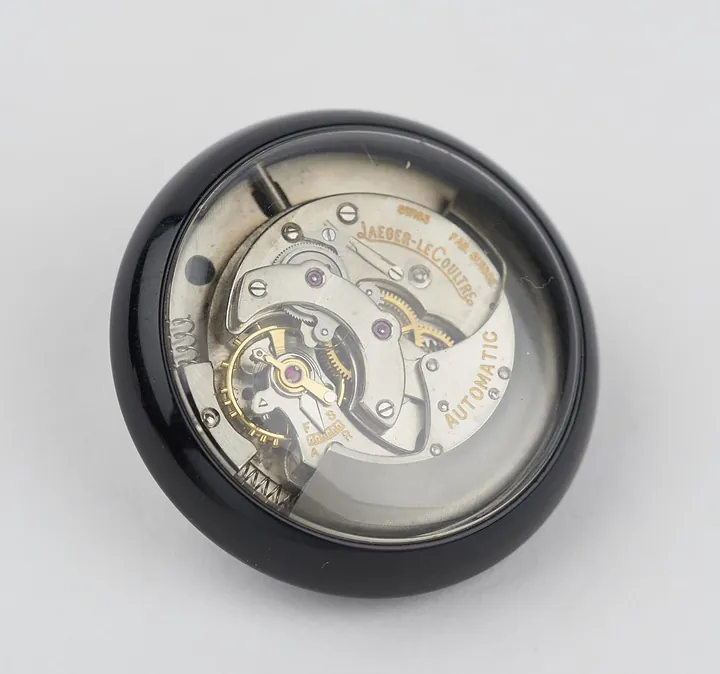
Automatic watch movement, Jaeger-LeCoultre, 1953, Geneva, Switzerland, showing self-winding mechanism
Science Museum Group, London
Wristwatches · 1953
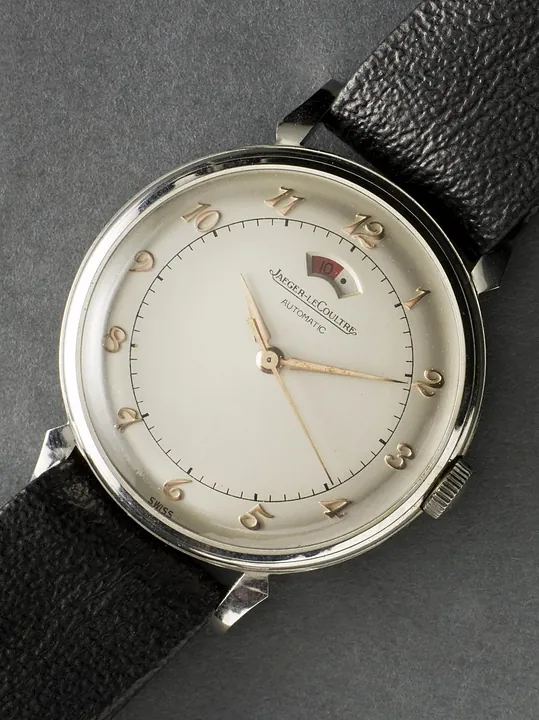
Automatic Wrist-watch, Jaeger-LeCoultre, Geneva, Switzerland, with reserve power indicator complete in steel case, 1953. Back numbered 564556.
Science Museum Group, London
Wristwatches · 1953
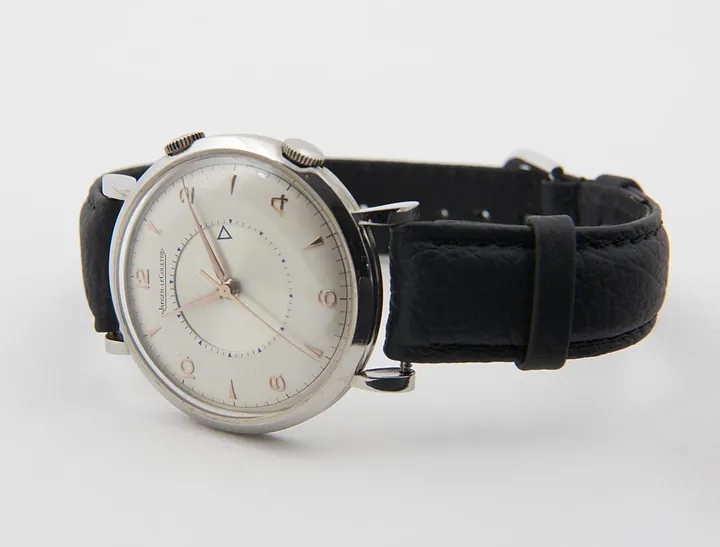
Wrist-watch, 'Memovox' alarm, Jaeger-LeCoultre, Geneva, Switzerland, complete in steel case, 1953.
Science Museum Group, London

Wristwatches · 2008
Wristwatch by Breitling?, 2008
Museum Rotterdam

Wristwatches · c. 1990s
Audemars Piguet Bamboo, c. 1990s
Antiquorum auction archive, Geneva

Wristwatches · c. 1990
Audemars Piguet Huitieme Perpetual Calendar, ref. 25696PT, c. 1990
Antiquorum auction archive, Geneva

Wristwatches · c. 1990
Breitling Chronomat, ref. b13050.1, c. 1990
Antiquorum auction archive, Geneva