
Wristwatches · Wristwatch
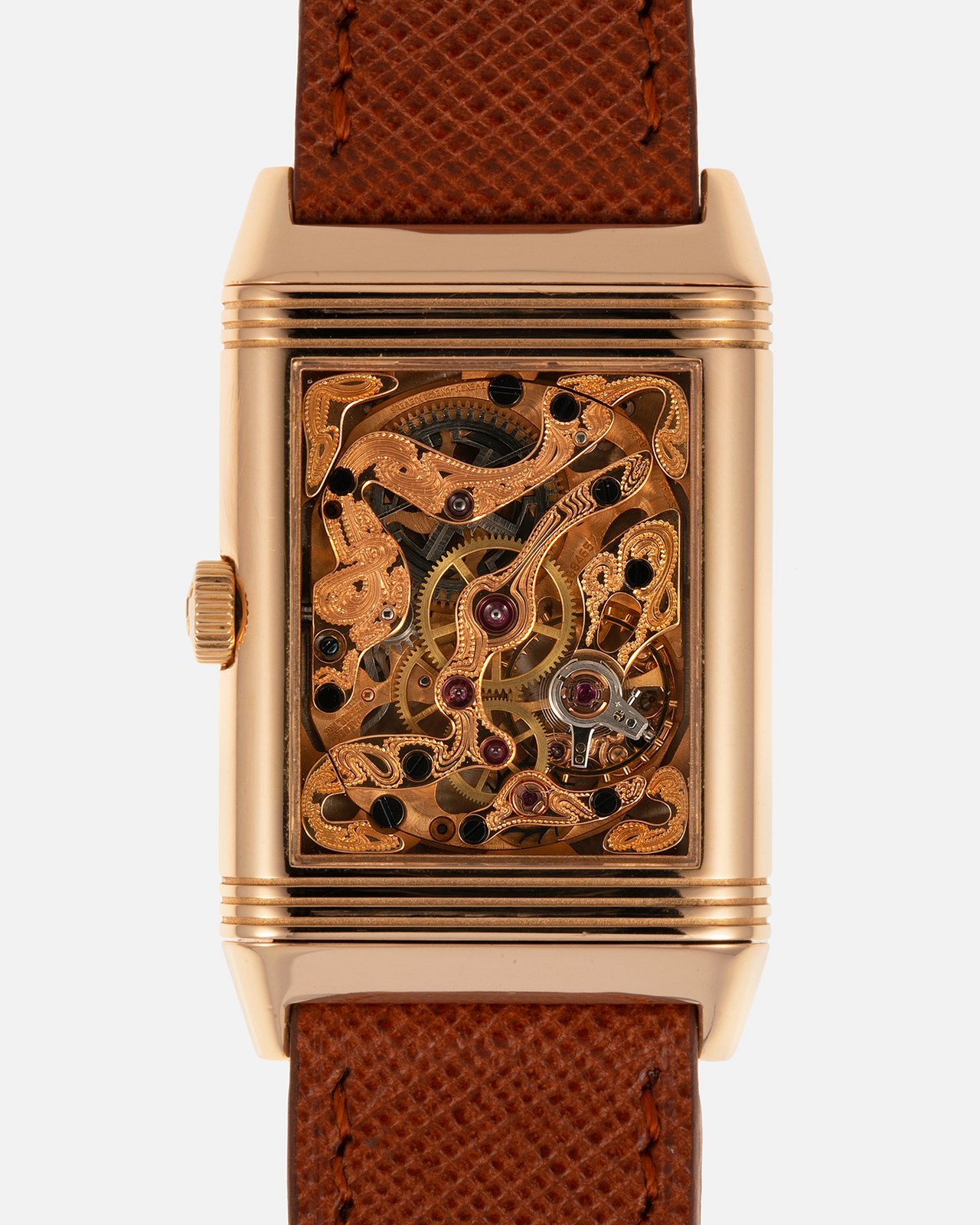
Jaeger-LeCoultre Reverso Art Deco Skeleton 270.2.62, 1990s
- Maker / attribution
- Jaeger-LeCoultre (maker)
- Date
- 1990s
- Historical period
- Mechanical Renaissance (1990 – 2010)
- Country of origin
- Switzerland
- Object type
- Wristwatch
- Dimensions
- Case 42 mm
- Stock no.
- Product 7320295440471
- Credit line
- Dealer listing, S.Song Watches (product 7320295440471)
- Catalogue title (original)
- Jaeger-LeCoultre Reverso Art Deco Skeleton 270.2.62 (English)
View the source record (dealer listing) ↗ (opens another website in a new tab)Suggest a correction
Record summary
Catalogued by S.Song Watches (dealer), Seattle (stock number Product 7320295440471), this is a wristwatch by Jaeger-LeCoultre, made in Switzerland, dated 1990s. The Atlas places it in the Mechanical Renaissance period (1990 – 2010) of its Wristwatches collection. Recorded dimensions: Case 42 mm. The record is illustrated with 6 photographs.
Assembled from the source record's structured fields. Dates and attributions are given as the source states them; where a field is missing the Atlas leaves it blank rather than estimating.
Catalogue description
Dealer description — S.Song Watches
Created by Jacques-David LeCoultre in 1931, the Reverso was initially conceived to withstand the harsh beating a watch would endure during a game of polo. With the need for the watch to be more durable, the Reverso's genius reveals itself through its eponymous design–a reversible case. With its case able to be turned around on itself, the Reverso's dial can be protected while playing sports and returned to its natural position with a quick flick and slide. Thanks to its iconic heritage, the Reverso has evolved into one of Jaeger LeCoultre's most important design vehicles to date, with a healthy number of contemporary variations to suit the palate of modern enthusiasts and connoisseurs alike. Offered here today is an uncommon Reverso Art Deco Ref. 270.2.62 in 18-carat rose gold. For context, this particular Reverso variant was produced for around 10 years, from 1992 to 2002, with only 900 pieces made in rose gold and 200 in white gold in that time period. Aesthetically, this Reverso is stunning, showcasing one of the most beautifully crafted and decorated movements I've encountered within a Reverso ‘Grand Taille’ case. For those in the know, Reverso cases are often more technically sophisticated than their specifications on paper would suggest. In this instance, the Grand Taille case is a design signature of the esteemed Maison which was first introduced in 1991 for the groundbreaking Reverso Soixantième. The case features squared lugs with a conical profile, complemented by rounded, barrel-like flanks on each side. It measures 42mm (including lugs) x 26mm and is designed according to the golden ratio, approximately 1.618. Also known as the divine proportion, this ratio is generally regarded as something naturally pleasing to the human eye. Like many Reverso models, the case is fully polished and exhibits a beautiful perlage along with its hallmarks on the inner chassis. When examining a Reverso of this caliber, the saying "God is in the details" certainly applies. Starting with its beautifully finished dial, which embodies a distinct art deco aesthetic, the silver surface may initially appear plain from afar. However, a closer look reveals its complexity, featuring a plethora of intricate details. The outer section showcases a vertically brushed texture that sets the tone for what follows, complemented by a dimpled periphery that serves as the minutes track. At 6:00, you’ll find a charming small seconds display gracefully recessed between the ‘5’ and ‘7’ hour markers, framed by a contrasting railroad track on the outer section and a guilloché mid-section. Finally, the circular center hosts a captivating billowing rose lathe guilloché portion, all enhanced by beautifully applied rose gold markers around the dial and a set of elegant dauphine hands. Moving on to the business end of this Ref. 270.2.62, the movement powering this mechanical masterpiece is the Jaeger-LeCoultre Cal. 822AD, which stands for ‘Art Deco’ and is essentially a skeletonized version of the Cal. 822. When fully wound, it boasts an impressive 45-hour power reserve, especially when considering its compact size. However, as impressive as that is, I believe the most remarkable aspect of this reference is its stunningly engraved and decorated movement. I think it’s important to note that while the front of the dial embodies Art Deco in its truest form—with its tasteful juxtaposition of various textures, lines, and curves conveying artistic extravagance—the movement side of the watch leans more towards art nouveau. This style emphasizes fluidity, asymmetry, and organic forms, which are all beautifully expressed in the construction and embellishment of the Cal. 822AD. Meticulously engraved, skeletonized, and adorned with vibrant thermally-blued screws and striking red rubies, the movement is a true spectacle of horological artistry. It flaunts a pronounced sense of liquidity and biomorphism, all while also demonstrating a fine visual balance that allows all elements to come together harmoniously. While the time-telling side of this Reverso is the one that should obviously face you while on the wrist, I found myself frequently flipping it over to admire the stunning movement. Undoubtedly, this is the most captivating aspect of the Ref. 270.2.62. The level of detail on this side is simply astounding, with every element painstakingly executed by hand, showcasing the artisan's impeccable skill and hand-eye coordination. The result is an exquisite visual appeal that translates beautifully even in photographs. When it comes to Jaeger-LeCoultre Reversos, I often tell people that there exists another realm filled with gems like this one. It's astonishing to consider the level of craftsmanship and intricacy concealed behind a seemingly plain dial face like that of the Ref. 270.2.62. Overall, this Reverso embodies the pinnacle of Jaeger-LeCoultre’s watchmaking excellence and stands as a testament to the Maison 's unwavering commitment to genuine artistry and versatility within the Reverso lineage. For the true connoisseur, this is a Reverso that simply cannot be overlooked.
Historical context
Mechanical Renaissance (1990 – 2010)
Mechanical watches return as cultural objects; independent watchmaking flourishes.
Mechanical watches returned as cultural and luxury objects. Complications, tourbillons and new materials proliferated; independent watchmakers such as George Daniels, F.P. Journe and Philippe Dufour revived artisanal watchmaking; collecting vintage watches became a major field.
Read the period in the timelineMore wristwatches from this periodEarlier: Quartz Revolution
Atlas type guide
Wristwatches
Bracelet watches were worn by women from the early nineteenth century — Breguet made one for Caroline Murat, Queen of Naples, in 1810–12 — but the wristwatch only became a man's instrument with military use and aviation in the early twentieth century. Between the World Wars it overtook the pocket watch; the 1920s and 1930s brought rectangular Art Deco cases, water-resistant cases and the first automatic winding systems.
After 1945 the wristwatch became a carrier of identity — dress watches, sports and dive watches, chronographs, calendars — produced by Swiss, American, Japanese, German, Soviet and Chinese industries. The quartz revolution after 1969 and the mechanical renaissance since the 1990s, including the rise of independent watchmakers, complete the story.
What to look for
- The reference number (between the lugs or inside the case back) and serial number, the starting point for dating.
- The calibre: its maker and number are often stamped under the dial or on the bridge.
- Originality of dial, hands and crown — refinished ('redial') dials are common.
- Case material marks: 18K/750, 14K/585, stainless steel, gold-filled, plated.
Dating clues
- Wire-lug cases: before c. 1925.
- Water-resistant screw-down cases: from 1926.
- Quartz movements: from 1969; sapphire crystals widespread after c. 1980.
General guidance written by the Atlas editors about this kind of object. It is not a statement about this particular piece; for that, rely on the source record above and on physical examination.
Related records
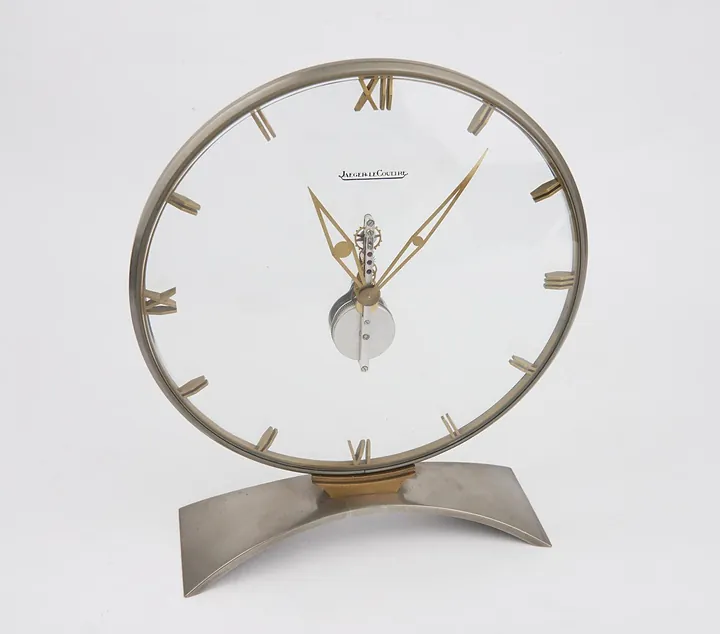
Clocks · 1937–1938
Skeleton clock by Jaeger-LeCoultre, Switzerland, 1937–1938
Science Museum Group, London
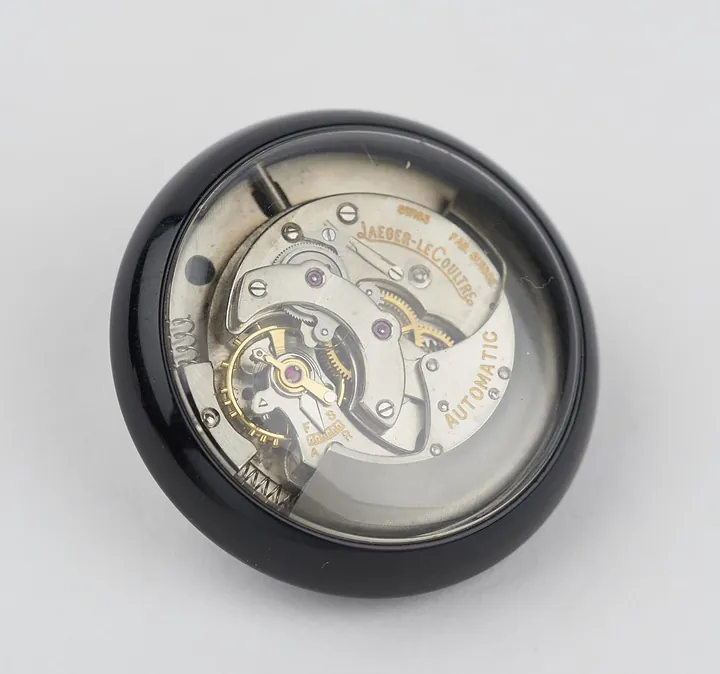
Movements & Components · 1953
Automatic watch movement, Jaeger-LeCoultre, 1953, Geneva, Switzerland, showing self-winding mechanism
Science Museum Group, London
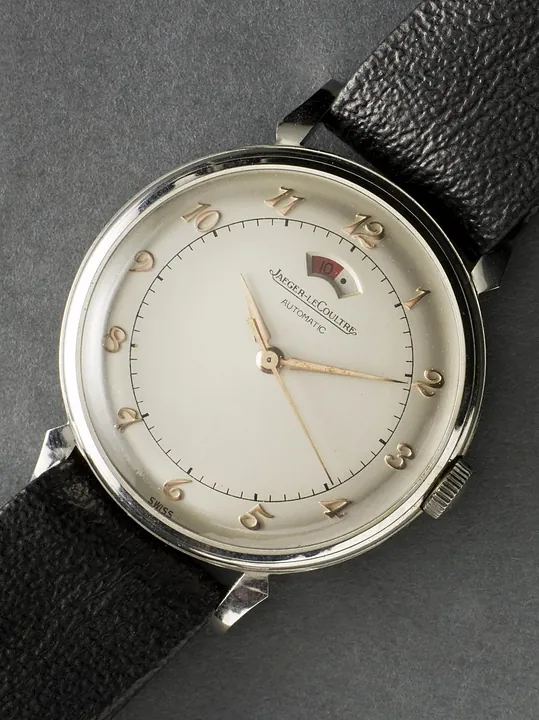
Wristwatches · 1953
Automatic Wrist-watch, Jaeger-LeCoultre, Geneva, Switzerland, with reserve power indicator complete in steel case, 1953. Back numbered 564556.
Science Museum Group, London
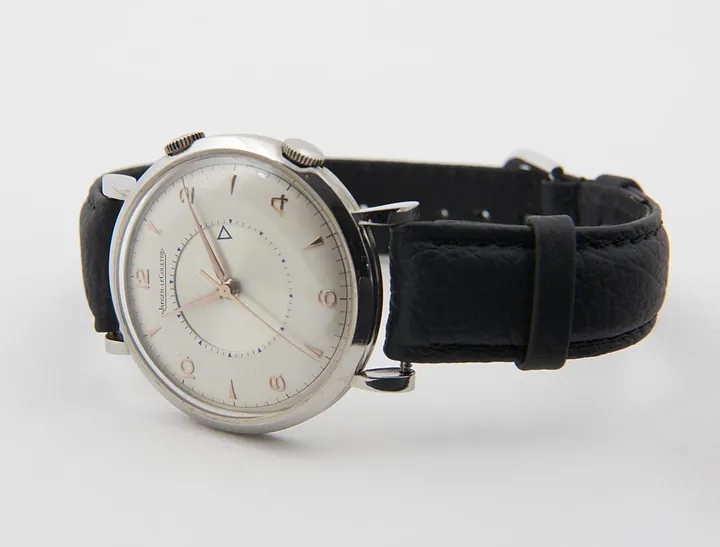
Wristwatches · 1953
Wrist-watch, 'Memovox' alarm, Jaeger-LeCoultre, Geneva, Switzerland, complete in steel case, 1953.
Science Museum Group, London

Wristwatches · 2008
Wristwatch by Breitling?, 2008
Museum Rotterdam

Wristwatches · c. 1990s
Audemars Piguet Bamboo, c. 1990s
Antiquorum auction archive, Geneva

Wristwatches · c. 1990
Audemars Piguet Huitieme Perpetual Calendar, ref. 25696PT, c. 1990
Antiquorum auction archive, Geneva

Wristwatches · c. 1990
Breitling Chronomat, ref. b13050.1, c. 1990
Antiquorum auction archive, Geneva