
Wristwatches · Wristwatch
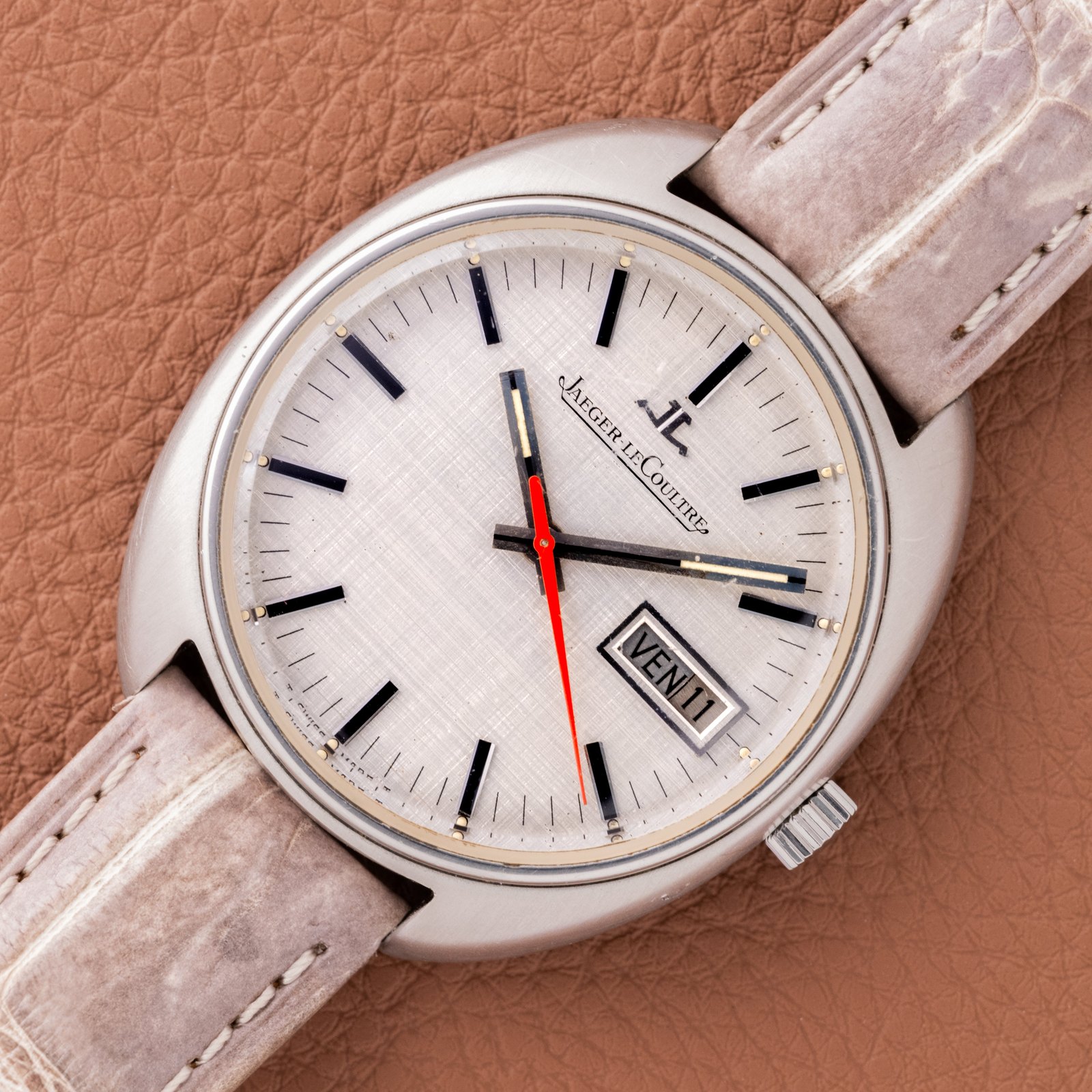
Jaeger-LeCoultre Master Mariner Chronometer - Prototype (Ref. 24002.42), 1970s
- Maker / attribution
- Jaeger-LeCoultre (maker)
- Date
- 1970s
- Historical period
- Quartz Revolution (1969 – 1990)
- Country of origin
- Switzerland
- Object type
- Wristwatch
- Dimensions
- Case 39 mm
- Stock no.
- Product 8817262821559
- Credit line
- Dealer listing, Huntington Company (product 8817262821559)
- Catalogue title (original)
- 1970s Jaeger-LeCoultre Master Mariner Chronometer - Prototype (Ref. 24002.42) (English)
View the source record (dealer listing) ↗ (opens another website in a new tab)Suggest a correction
Record summary
Catalogued by Huntington Company (dealer) (stock number Product 8817262821559), this is a wristwatch by Jaeger-LeCoultre, made in Switzerland, dated 1970s. The Atlas places it in the Quartz Revolution period (1969 – 1990) of its Wristwatches collection. Recorded dimensions: Case 39 mm. The record is illustrated with 6 photographs.
Assembled from the source record's structured fields. Dates and attributions are given as the source states them; where a field is missing the Atlas leaves it blank rather than estimating.
Catalogue description
Dealer description — Huntington Company
History and Significance The Master Mariner occupies an interesting corner of Jaeger-LeCoultre's 1970s catalog, a period when the manufacture was experimenting with larger cases and more contemporary designs while still relying on serious mechanical watchmaking underneath. The reference 2400X family belongs squarely to that era. Its broad case and restrained dial feel distinctly different from the smaller dress watches that defined much of Jaeger-LeCoultre's earlier output. At 39mm, the design was particularly substantial for the period. This example becomes considerably more interesting because it is believed to be a prototype. The automatic caliber 906 used throughout the reference 2400X Master Mariner family is generally associated with production around 1973 to 1975, while the movement number inside this watch corresponds with approximately 1972 to 1973. That chronology places the movement right at the beginning of the period associated with the model. Combined with the unusual reference 24002.42 configuration, the timing supports the possibility that this watch belongs to the developmental stage of the Master Mariner, although prototype status should be understood within the limits of the available information. The linen dial is particularly suited to the watch. Rather than relying on a flat surface, the fine texture changes subtly with the light and gives an otherwise restrained design considerably more depth. That texture works especially well inside the broad steel case, creating contrast without adding unnecessary color or decoration. It is a very period-specific detail that immediately gives the watch a 1970s identity. The caliber 906 is equally important to understanding the reference 24002.42. Jaeger-LeCoultre has historically been defined as much by movements as by external design, and the Master Mariner provides an interesting example of that philosophy applied to a more contemporary case. The automatic movement allowed the watch to remain practical while the exterior pushed toward the larger and more casual proportions becoming increasingly relevant during the decade. That combination makes the watch more than simply an unusual case design from the 1970s. Finally, there is something compelling about a watch that appears to sit near the beginning of a production story rather than comfortably within it. Prototypes and transitional pieces rarely provide every answer collectors would like to have, particularly when dealing with watches more than half a century old. The movement chronology, unusual configuration, and relationship to the later Master Mariner family provide meaningful clues without requiring the history to be overstated. The reference 24002.42 is interesting precisely because it invites further study. Writer’s Thoughts This is the kind of Jaeger-LeCoultre that demonstrates how much remains to be explored outside the manufacture's best-known watches. The possible prototype status gives the reference 24002.42 an immediate historical hook, but the watch would still be compelling without it. A 39mm 1970s Jaeger-LeCoultre with a textured linen dial and automatic caliber 906 already has plenty of personality. The unusual configuration simply makes the story considerably deeper. The proportions are especially appealing. Thirty-nine millimeters sounds completely ordinary today, but within the context of early 1970s Jaeger-LeCoultre it gives the Master Mariner an unexpectedly modern presence. The linen dial prevents the larger surface area from feeling empty, while the steel case keeps everything relatively understated. It feels like Jaeger-LeCoultre experimenting with what a more contemporary everyday watch could become. Most importantly, the evidence surrounding the watch is interesting without needing to turn assumptions into facts. The early movement number fits logically with the beginning of the caliber 906 Master Mariner period and makes the prototype theory worth taking seriously. At the same time, the uncertainty is part of what makes the reference 24002.42 fascinating. Watches like this create an opportunity to study the object itself rather than simply repeat an established reference-book description. Our Promise Every watch is thoroughly vetted, carefully described with complete transparency, and guaranteed authentic. Each piece is offered in honest condition, ensuring collectors receive a timepiece that reflects both originality and integrity. Specifications Brand: Jaeger-LeCoultre Model: Master Mariner Prototype Reference: 24002.42 Year: Circa 1970s Case Material: Stainless steel Case Size: 39mm Dial: Silver linen dial Movement: Automatic Jaeger-LeCoultre caliber 906 Strap/Buckle: Generic leather strap Buckle/Clasp: Generic buckle Contents: Watch only Condition Case: Stainless steel case presents attractively with surface wear and marks consistent with age and use. The distinctive broad 1970s case retains strong overall definition. Dial: Linen dial presents beautifully with its textured finish clearly preserved and even aging throughout. Hands: Hands present well with aging consistent with the dial and age of the watch. Crystal: Crystal presents well overall with light surface wear consistent with use. Strap/Buckle: Leather strap presents well and is suitable for continued wear. Buckle/Clasp: Generic buckle presents well with light signs of use.
Historical context
Quartz Revolution (1969 – 1990)
Seiko's Astron begins mass quartz timekeeping; traditional industries contract sharply.
Quartz and digital watches transformed the market after 1969. Swiss employment collapsed, Japanese and Hong Kong production soared, and the Swatch (1983) helped the Swiss industry recover; mechanical watches survived as luxury goods.
Read the period in the timelineMore wristwatches from this periodEarlier: Modern Mechanical Horology
Atlas type guide
Dive and water-resistant watches
Keeping water and dust out of a wristwatch was a long-standing challenge. Rolex's screw-down Oyster case (1926) and Omega's Marine (1932) were landmarks; in the early 1950s Blancpain's Fifty Fathoms and Rolex's Submariner defined the professional dive watch with rotating bezels for timing dives, luminous dials and high water resistance. The ISO 6425 standard (1982) later codified what a 'diver's watch' must do.
Dive watches became icons of post-war design and exploration, and their evolution — helium escape valves, ceramic bezels, saturation-diving depth ratings — records the history of underwater work.
What to look for
- Unidirectional or bidirectional rotating bezel with minute markings.
- Screw-down crown and case back; depth rating printed on the dial.
- Luminous hands and markers (radium before c. 1960, tritium c. 1960–1998, then Super-LumiNova).
- Reference numbers on the case between the lugs or inside the back.
Dating clues
- Screw-down Oyster cases: from 1926.
- Professional dive watches: from 1953.
- Tritium 'T' marks on dials: c. 1960–1998.
General guidance written by the Atlas editors about this kind of object. It is not a statement about this particular piece; for that, rely on the source record above and on physical examination.
Related records
Clocks · 1937–1938
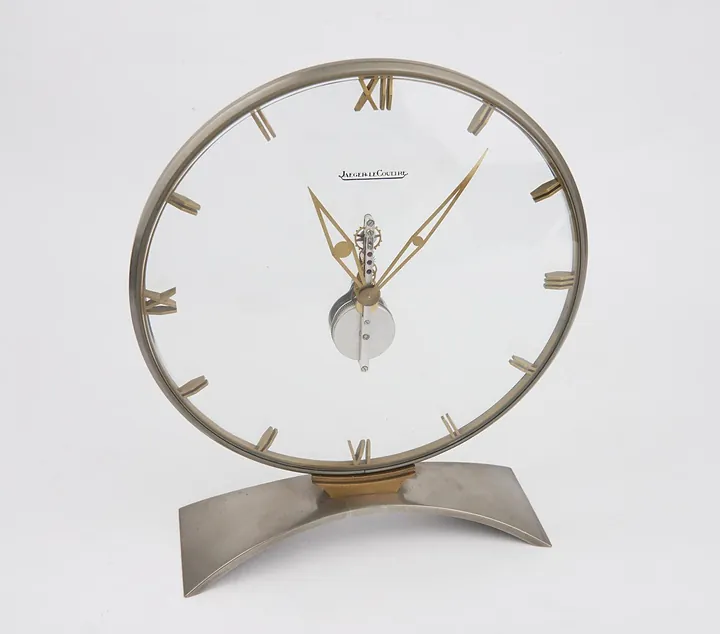
Skeleton clock by Jaeger-LeCoultre, Switzerland, 1937–1938
Science Museum Group, London
Movements & Components · 1953
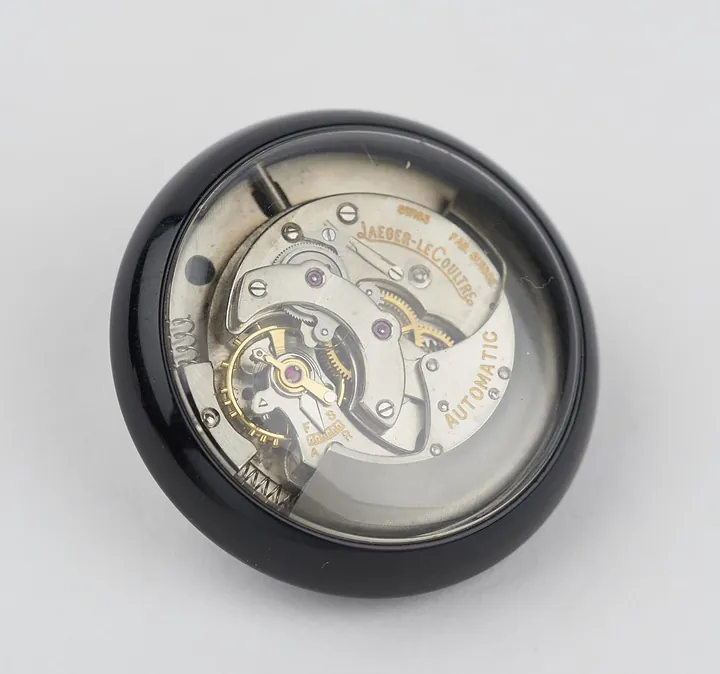
Automatic watch movement, Jaeger-LeCoultre, 1953, Geneva, Switzerland, showing self-winding mechanism
Science Museum Group, London
Wristwatches · 1953
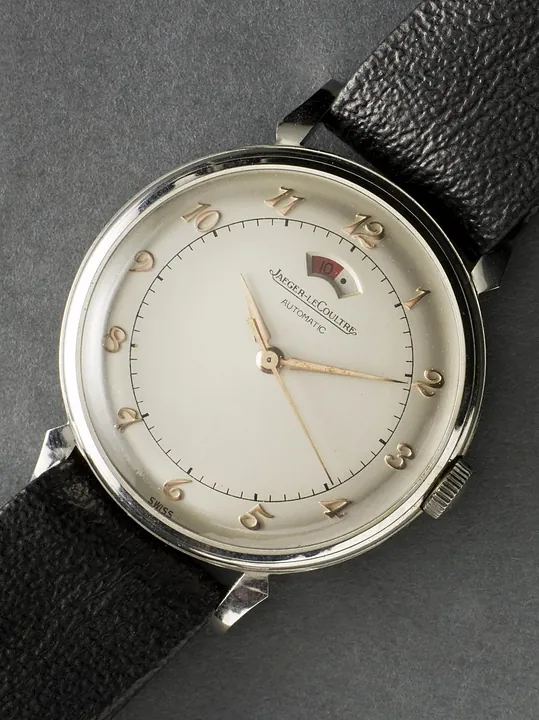
Automatic Wrist-watch, Jaeger-LeCoultre, Geneva, Switzerland, with reserve power indicator complete in steel case, 1953. Back numbered 564556.
Science Museum Group, London
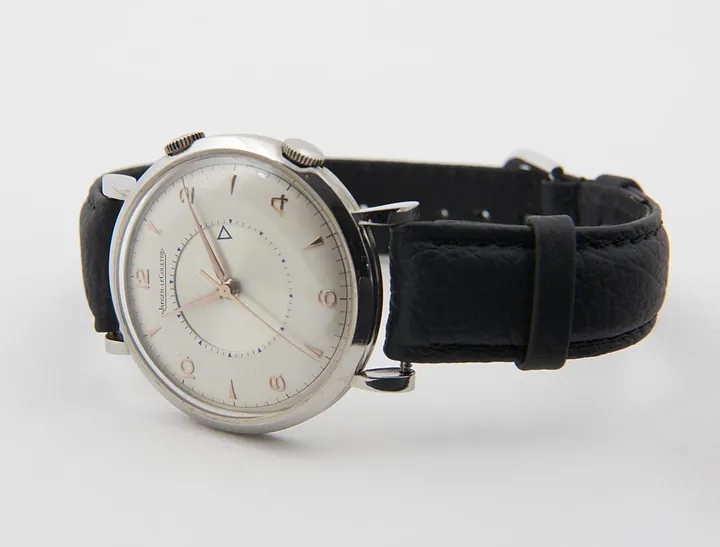
Wristwatches · 1953
Wrist-watch, 'Memovox' alarm, Jaeger-LeCoultre, Geneva, Switzerland, complete in steel case, 1953.
Science Museum Group, London

Wristwatches · 1970
Wristwatch by Heno, Switzerland, 1970
Museum Rotterdam

Wristwatches · 1960–1986
'Tri-Compax' calendar chronograph wristwatch in gold case, by Universal, Geneva, Switzerland, 1960–1986.
Science Museum Group, London

Wristwatches · 1969–1970
Beta 21 Quartz wristwatch movement, made in Switzerland, 1970.
Science Museum Group, London

Wristwatches · c. 1969
Omega Speedmaster Moonwatch, ref. 145022-69st, c. 1969
Antiquorum auction archive, Geneva