
Wristwatches · Wristwatch
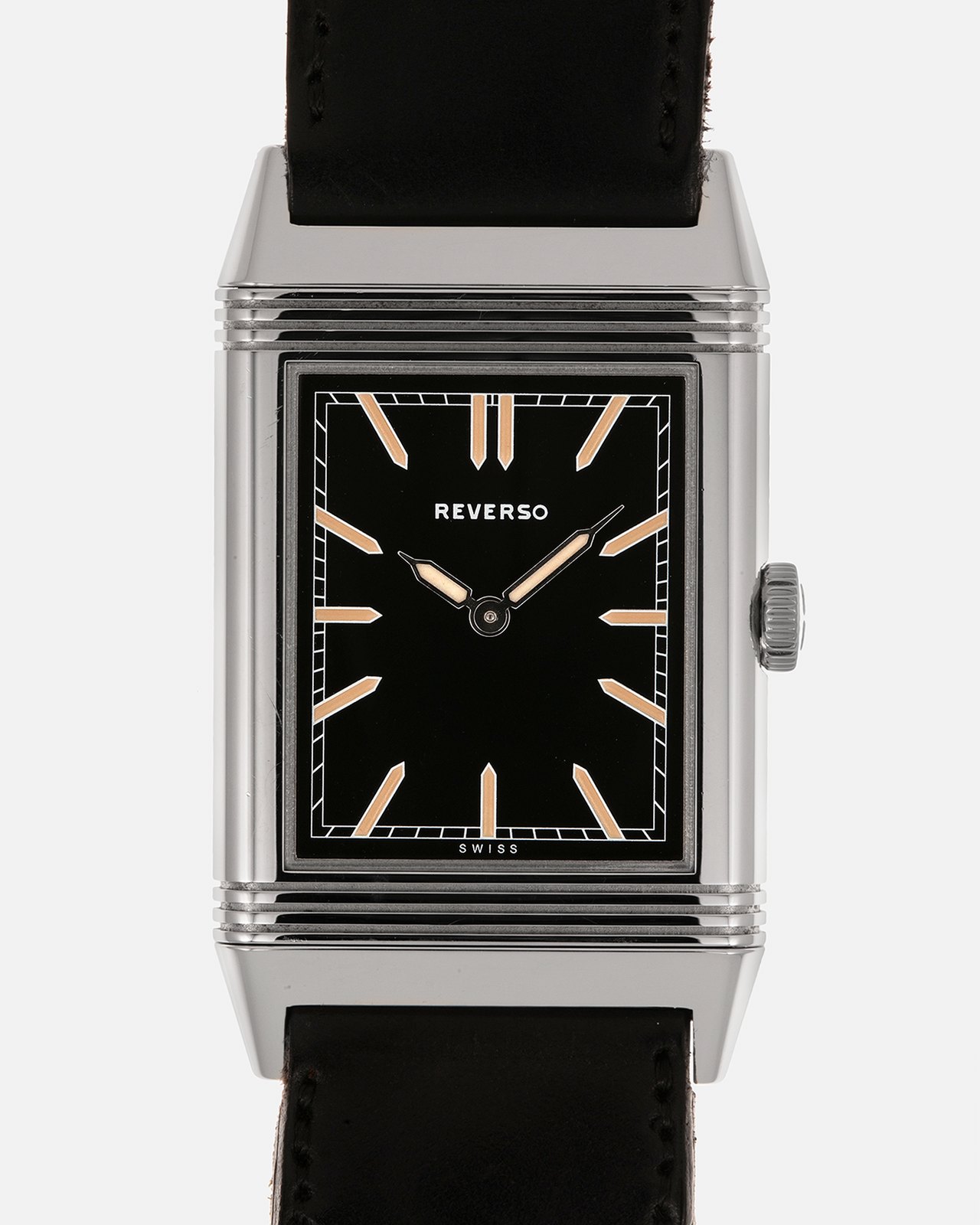
Jaeger-LeCoultre Grande Reverso Tribute to 1931 US Edition 'Syringe Hands' 277.8.62, 2011
- Maker / attribution
- Jaeger-LeCoultre (maker)
- Date
- 2011
- Historical period
- Contemporary Horology (2010 – Present)
- Country of origin
- Switzerland
- Object type
- Wristwatch
- Dimensions
- Case 46.8 mm
- Stock no.
- Product 7541874884695
- Credit line
- Dealer listing, S.Song Watches (product 7541874884695)
- Catalogue title (original)
- Jaeger-LeCoultre Grande Reverso Tribute to 1931 US Edition 'Syringe Hands' 277.8.62 (English)
View the source record (dealer listing) ↗ (opens another website in a new tab)Suggest a correction
Record summary
Catalogued by S.Song Watches (dealer), Seattle (stock number Product 7541874884695), this is a wristwatch by Jaeger-LeCoultre, made in Switzerland, dated 2011. The Atlas places it in the Contemporary Horology period (2010 – Present) of its Wristwatches collection. Recorded dimensions: Case 46.8 mm. The record is illustrated with 6 photographs.
Assembled from the source record's structured fields. Dates and attributions are given as the source states them; where a field is missing the Atlas leaves it blank rather than estimating.
Catalogue description
Dealer description — S.Song Watches
Created by Jacques-David LeCoultre in 1931, the Reverso was initially conceived to withstand the harsh beating a watch would endure during a game of polo. Today, it has evolved into a dress watch thanks to its now-classical aesthetic and graceful design. Unique in that its case can be opened, slid along a rail, flipped around on its vertical axis, and snapped back into place so that its caseback faces out with its dial against the wrist, the Reverso's eponymous function gave Jaeger-LeCoultre a powerful medium to experiment and develop. Offered here today is one of, I think, the brand’s most handsome modern interpretations: the Grande Reverso Ultra Thin Tribute to 1931, 277.8.62. Introduced to mark the Reverso’s 80th anniversary in 2011, Jaeger-LeCoultre released three commemorative variants—a rose-gold model with a white dial and two stainless-steel versions with black dials. This example is the US Edition of one of the stainless-steel offerings, limited to 200 pieces (100 pieces delivered in 2011, another 100 in 2012), created for the American market with a distinct dial and hand configuration, which we will get into shortly. Our example here hails from the 2011 batch, as indicated via the embossed text on the underside of its Casa Fagliano shell cordovan leather strap. Starting with its iconic case, the 277.8.62 captures the quintessential Grande Reverso profile. The 46.8mm x 27.4mm case is flanked by squared, slightly conical lugs and rounded, barrel-like sides that give the watch its familiar presence. The glossy black dial pairs perfectly with the understated stainless-steel case. For this US Edition, the dial features thirteen luminous baton hour markers (with two placed as a pair at 12:00) and a set of distinctive syringe hands. A railroad minute track is aligned along its periphery, and the crisp “REVERSO” signature at 12:00 completes the layout, echoing the spirit of the original in a way that feels both faithful and subtly elevated. Powering this watch from within is Jaeger-LeCoultre’s in-house, manual-winding Cal. 822. Featuring 21 jewels, this ultra-thin movement, at just 2.95mm thick, is widely regarded as one of the brand’s most reliable calibres. Beating at a frequency of 21,600 vph, the Cal. 822 also offers a power reserve of 45 hours when fully wound. Remarkably, the 277.8.62 demonstrates how a dial with such minimal design can evoke a strong emotional impact when executed well. Every detail lands exactly where it should: from the period-correct ‘REVERSO’ script that has been matched as closely as possible to the font on the original, its distinctive syringe hands and clean hour markers, all treated with a well-controlled amount of faux patina. While I am usually wary of artificial patina on contemporary dials, here it is applied with purpose and restraint, serving both as a respectful nod and as an anchor to the 1931 inspiration that shaped this edition’s identity. Adding to this, Jaeger-LeCoultre’s decision to omit its logo entirely only reinforces the Reverso’s stature—the blueprint is so distinctive that it requires no branding to assert itself. Despite being a modern release, the watch certainly carries a certain quiet old-world charm. have always believed that Jaeger-LeCoultre Reversos occupy a unique category of their own. Interestingly, although they were initially designed for polo matches and considered sports watches, they are now widely regarded as dress watches. This blend of characteristics gives them a distinctive hybrid quality that sets them apart in terms of wearability. The Reverso’s true versatility shines through in its effortless transition from the polo field to the boardroom. Ultimately, it stands as a prime example of a design that solved a practical challenge of its time and has since become an enduring icon in high-end watchmaking.
Historical context
Contemporary Horology (2010 – Present)
Silicon components, connected watches, optical-lattice research clocks and a thriving independent scene.
Smartwatches became the world's best-selling watches, while mechanical watchmaking focuses on craft, innovation (silicon components, new escapements) and independent makers.
Read the period in the timelineMore wristwatches from this periodEarlier: Mechanical Renaissance
Atlas type guide
Wristwatches
Bracelet watches were worn by women from the early nineteenth century — Breguet made one for Caroline Murat, Queen of Naples, in 1810–12 — but the wristwatch only became a man's instrument with military use and aviation in the early twentieth century. Between the World Wars it overtook the pocket watch; the 1920s and 1930s brought rectangular Art Deco cases, water-resistant cases and the first automatic winding systems.
After 1945 the wristwatch became a carrier of identity — dress watches, sports and dive watches, chronographs, calendars — produced by Swiss, American, Japanese, German, Soviet and Chinese industries. The quartz revolution after 1969 and the mechanical renaissance since the 1990s, including the rise of independent watchmakers, complete the story.
What to look for
- The reference number (between the lugs or inside the case back) and serial number, the starting point for dating.
- The calibre: its maker and number are often stamped under the dial or on the bridge.
- Originality of dial, hands and crown — refinished ('redial') dials are common.
- Case material marks: 18K/750, 14K/585, stainless steel, gold-filled, plated.
Dating clues
- Wire-lug cases: before c. 1925.
- Water-resistant screw-down cases: from 1926.
- Quartz movements: from 1969; sapphire crystals widespread after c. 1980.
General guidance written by the Atlas editors about this kind of object. It is not a statement about this particular piece; for that, rely on the source record above and on physical examination.
Related records
Clocks · 1937–1938
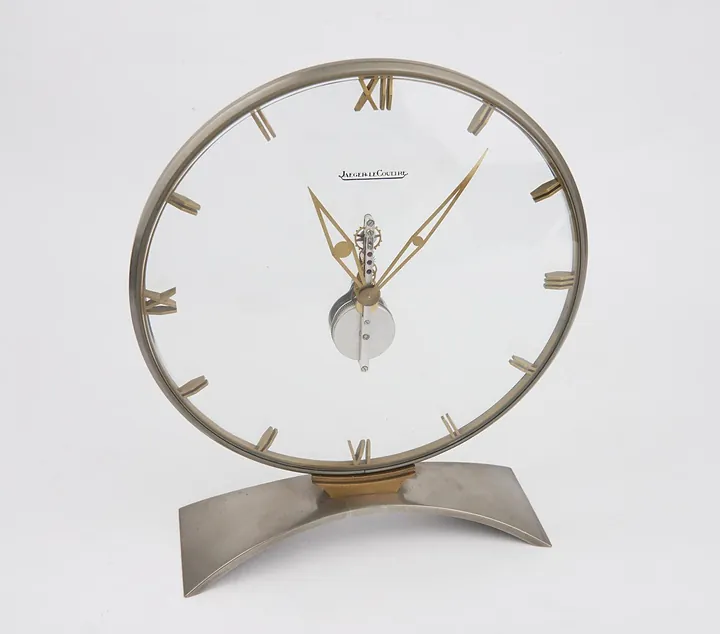
Skeleton clock by Jaeger-LeCoultre, Switzerland, 1937–1938
Science Museum Group, London
Movements & Components · 1953
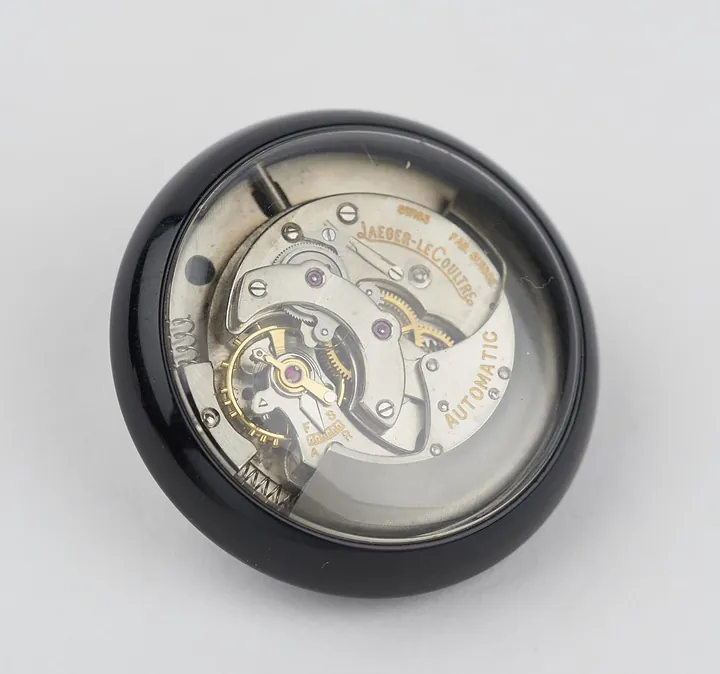
Automatic watch movement, Jaeger-LeCoultre, 1953, Geneva, Switzerland, showing self-winding mechanism
Science Museum Group, London
Wristwatches · 1953
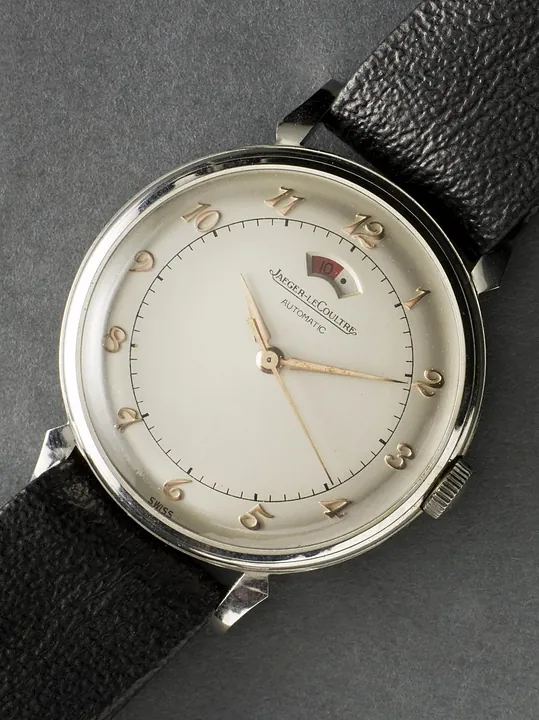
Automatic Wrist-watch, Jaeger-LeCoultre, Geneva, Switzerland, with reserve power indicator complete in steel case, 1953. Back numbered 564556.
Science Museum Group, London
Wristwatches · 1953
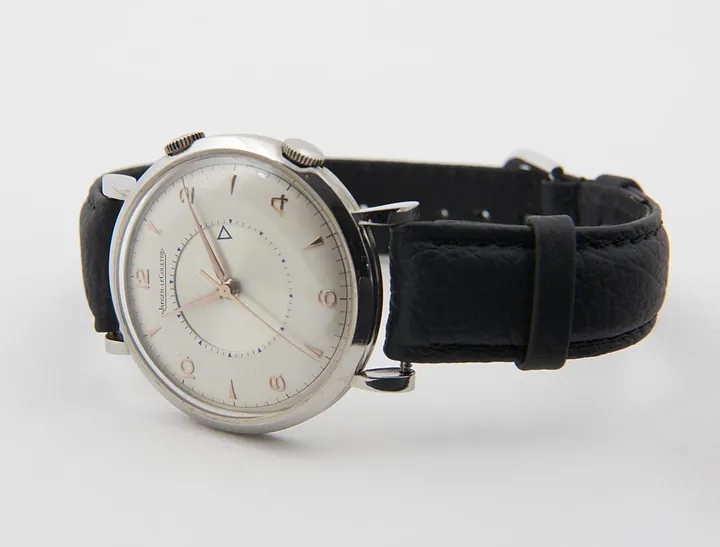
Wrist-watch, 'Memovox' alarm, Jaeger-LeCoultre, Geneva, Switzerland, complete in steel case, 1953.
Science Museum Group, London

Wristwatches · c. 2010s
Breguet Type XXI, ref. 3810, c. 2010s (Antiquorum Lot 381-24)
Antiquorum auction archive, Geneva

Wristwatches · c. 2010s
Breguet Type XXI, ref. 3810, c. 2010s (Antiquorum Lot 386-229)
Antiquorum auction archive, Geneva

Wristwatches · Sold in September 2010
Breitling Cosmonaute, ref. A 22322, Sold in September 2010
Antiquorum auction archive, Geneva

Wristwatches · c. 2010
Corum Bubble Chrono, ref. 396.150.20, c. 2010
Antiquorum auction archive, Geneva