
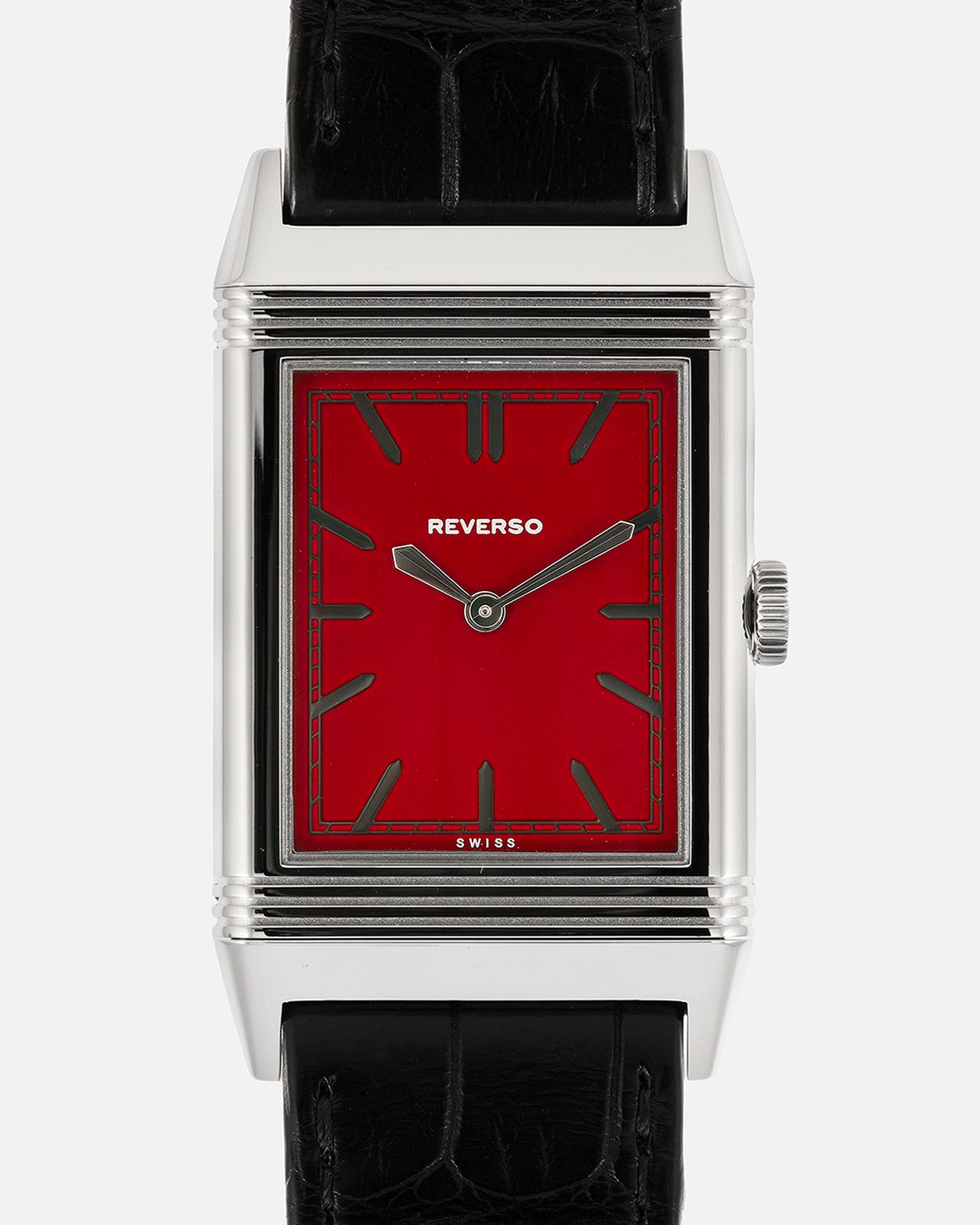
Wristwatches · Wristwatch
Jaeger-LeCoultre Grande Reverso Tribute to 1931 Edition Spéciale Rouge 277.8.62, 2014
- Maker / attribution
- Jaeger-LeCoultre (maker)
- Date
- 2014
- Historical period
- Contemporary Horology (2010 – Present)
- Country of origin
- Switzerland
- Object type
- Wristwatch
- Dimensions
- Case 46.8 mm
- Stock no.
- Product 7433040199767
- Credit line
- Dealer listing, S.Song Watches (product 7433040199767)
- Catalogue title (original)
- Jaeger-LeCoultre Grande Reverso Tribute to 1931 Edition Spéciale Rouge 277.8.62 (English)
View the source record (dealer listing) ↗ (opens another website in a new tab)Suggest a correction
Record summary
Catalogued by S.Song Watches (dealer), Seattle (stock number Product 7433040199767), this is a wristwatch by Jaeger-LeCoultre, made in Switzerland, dated 2014. The Atlas places it in the Contemporary Horology period (2010 – Present) of its Wristwatches collection. Recorded dimensions: Case 46.8 mm. The record is illustrated with 6 photographs.
Assembled from the source record's structured fields. Dates and attributions are given as the source states them; where a field is missing the Atlas leaves it blank rather than estimating.
Catalogue description
Dealer description — S.Song Watches
Created by Jacques-David LeCoultre in 1931, the Reverso was initially conceived to withstand the harsh beating a watch would endure during a game of polo. With the need for the watch to be more durable, the Reverso's genius reveals itself through its eponymous design—a reversible case. With its case able to be turned around on itself, the Reverso's dial can be protected while playing sports and returned to its original position with a quick flick and slide. Thanks to its iconic heritage, the Reverso has evolved into one of Jaeger LeCoultre's most important design vehicles to date, with a healthy number of contemporary variations to suit the palate of modern enthusiasts and connoisseurs alike. Offered here today is perhaps one of the most visually evocative variants of the Reverso I’ve ever come across: the Grande Reverso Tribute to 1931 Edition Spéciale ‘Rouge’ 277.8.62. Now, for some context on this unique Reverso: it was released as a limited boutique edition in late 2011 as a tribute to one of the earliest Reverso models. You see, during the 1930s, a period the French referred to as the Années folles or “Crazy Years”, Jaeger-LeCoultre produced several colourful Reverso variants alongside their more conservative offerings. This particular ‘Rouge’ edition has drawn inspiration from a rare red-dialled example from that spirited era. While much of its vintage charm has been faithfully retained, this modern reinterpretation introduced a few thoughtful updates. Most notably, the case size has been updated to better align with contemporary preferences. The dial, too, has undergone a subtle evolution—not in layout, but in tone. More on that shortly. Starting with its case, the 277.8.62 embodies the quintessential Grande Reverso aesthetic. It features a case measuring 46.8mm x 27.4mm, two pairs of squared lugs with conical profiles, and rounded, barrel-like flanks on either side. The dial presents a glossy, oxblood-red backdrop that complements the understated stainless steel case beautifully. As noted earlier, the overall design language remains largely faithful to the original, though this modern red-lacquered dial adopts a slightly more muted tonality. Personally, and I believe many would agree, this execution feels a touch more appealing. That’s not to diminish the charm of the 1930s version, which featured a brighter crimson dial accented by eggshell-colored luminous hour markers. Still, in this contemporary execution, the interplay between colour and material feels more balanced, refined, and intentional, giving the watch a stronger wrist presence without ever veering into ostentation. The dial is also adorned with thirteen silver baton-style hour markers, a crisp REVERSO logo signature just below the 12:00 markers, and a pair of slender, sword-shaped hands that echo the case’s steel finish—a restrained, elegant choice that lets the dial’s colour take centre stage. As someone with Malaysian-Chinese roots, the colour red holds deep cultural significance, symbolising auspiciousness, vitality, and good fortune. That said, red can be a challenging base colour for a watch dial. Its bold and polarizing nature often makes it difficult to integrate into everyday wear, and its tone is highly sensitive to light. It needs to be just right—too bright, and it risks appearing gaudy or over-the-top; too dark, and it may seem dull or lifeless. What makes this particular shade so compelling is the visual balance it strikes. It still manages to channel the vintage Art Deco charm of the early Reverso models, all while aligning seamlessly with contemporary design sensibilities. There’s no denying, it’s a bold choice for a watch dial, but one that somehow still feels tasteful and timeless. Just look at the up-close photos of that vibrant, dandy-esque dial; you can almost hear George Gershwin’s Rhapsody in Blue playing in the background (ironically, not in Red —but I digress). Powering this ‘Rouge’ Reverso is Jaeger-LeCoultre’s in-house, manual-winding Cal. 822. Featuring 21 jewels, this ultra-thin movement, at just 2.95mm thick, is widely regarded as one of the Maison’s most reliable calibres. Beating at a frequency of 21,600 vph, the Cal. 822 also boasts a power reserve of 45 hours when fully wound. I have always believed that Jaeger-LeCoultre Reversos occupy a unique category of their own. Interestingly, although they were originally designed for polo matches and considered sports watches, they are now widely regarded as dress watches. This blend of characteristics gives them a distinctive hybrid quality that sets them apart in terms of wearability. The Reverso’s true versatility shines through in its effortless transition from the polo field to the boardroom. Ultimately, it stands as a prime example of a design that solved a practical challenge of its time and has since become an enduring icon in high-end watchmaking.
Historical context
Contemporary Horology (2010 – Present)
Silicon components, connected watches, optical-lattice research clocks and a thriving independent scene.
Smartwatches became the world's best-selling watches, while mechanical watchmaking focuses on craft, innovation (silicon components, new escapements) and independent makers.
Read the period in the timelineMore wristwatches from this periodEarlier: Mechanical Renaissance
Atlas type guide
Wristwatches
Bracelet watches were worn by women from the early nineteenth century — Breguet made one for Caroline Murat, Queen of Naples, in 1810–12 — but the wristwatch only became a man's instrument with military use and aviation in the early twentieth century. Between the World Wars it overtook the pocket watch; the 1920s and 1930s brought rectangular Art Deco cases, water-resistant cases and the first automatic winding systems.
After 1945 the wristwatch became a carrier of identity — dress watches, sports and dive watches, chronographs, calendars — produced by Swiss, American, Japanese, German, Soviet and Chinese industries. The quartz revolution after 1969 and the mechanical renaissance since the 1990s, including the rise of independent watchmakers, complete the story.
What to look for
- The reference number (between the lugs or inside the case back) and serial number, the starting point for dating.
- The calibre: its maker and number are often stamped under the dial or on the bridge.
- Originality of dial, hands and crown — refinished ('redial') dials are common.
- Case material marks: 18K/750, 14K/585, stainless steel, gold-filled, plated.
Dating clues
- Wire-lug cases: before c. 1925.
- Water-resistant screw-down cases: from 1926.
- Quartz movements: from 1969; sapphire crystals widespread after c. 1980.
General guidance written by the Atlas editors about this kind of object. It is not a statement about this particular piece; for that, rely on the source record above and on physical examination.
Related records
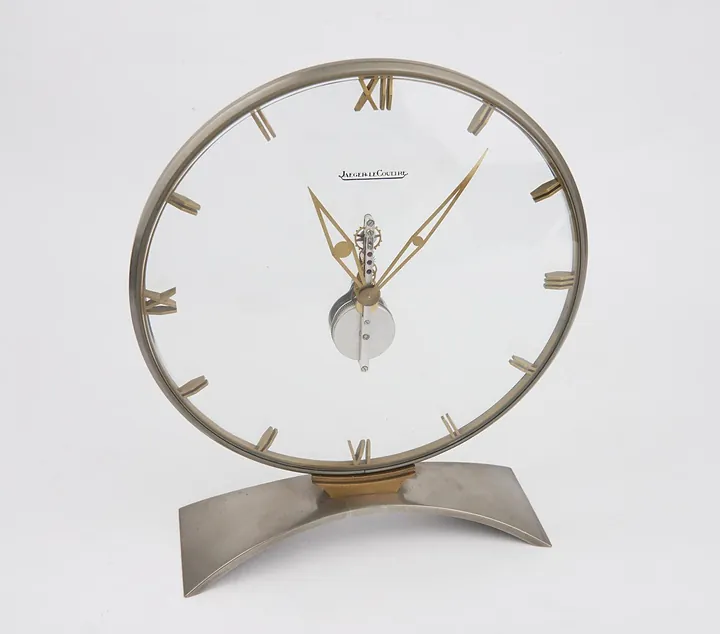
Clocks · 1937–1938
Skeleton clock by Jaeger-LeCoultre, Switzerland, 1937–1938
Science Museum Group, London
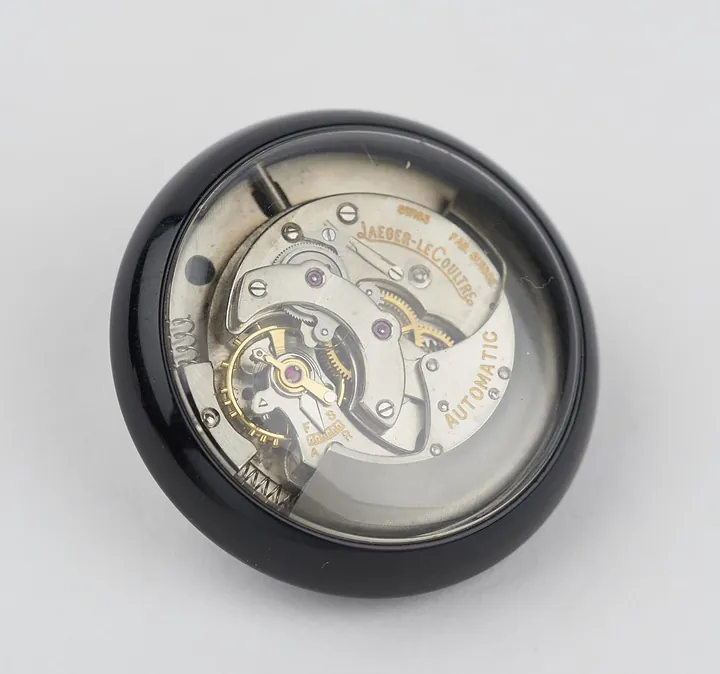
Movements & Components · 1953
Automatic watch movement, Jaeger-LeCoultre, 1953, Geneva, Switzerland, showing self-winding mechanism
Science Museum Group, London
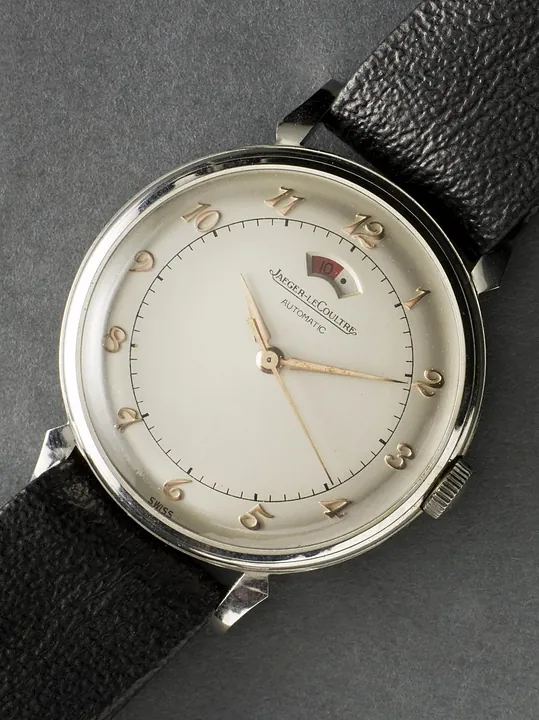
Wristwatches · 1953
Automatic Wrist-watch, Jaeger-LeCoultre, Geneva, Switzerland, with reserve power indicator complete in steel case, 1953. Back numbered 564556.
Science Museum Group, London
Wristwatches · 1953
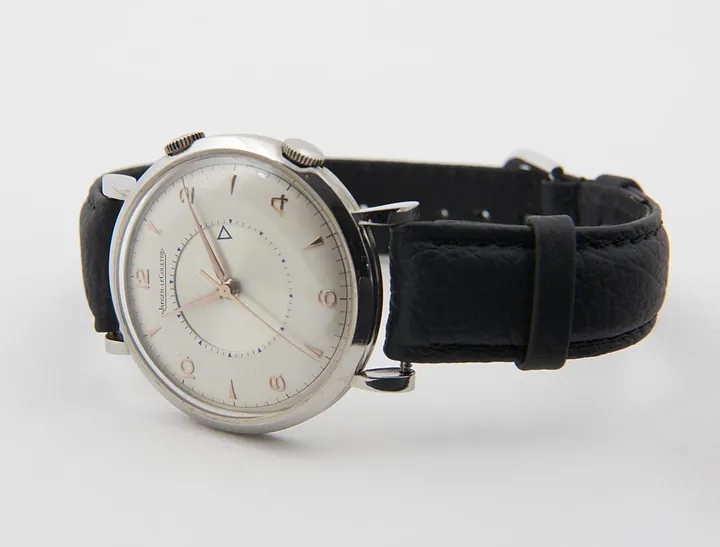
Wrist-watch, 'Memovox' alarm, Jaeger-LeCoultre, Geneva, Switzerland, complete in steel case, 1953.
Science Museum Group, London

Wristwatches · c. 2010s
Breguet Type XXI, ref. 3810, c. 2010s (Antiquorum Lot 381-24)
Antiquorum auction archive, Geneva

Wristwatches · c. 2010s
Breguet Type XXI, ref. 3810, c. 2010s (Antiquorum Lot 386-229)
Antiquorum auction archive, Geneva

Wristwatches · Sold in September 2010
Breitling Cosmonaute, ref. A 22322, Sold in September 2010
Antiquorum auction archive, Geneva

Wristwatches · c. 2010
Corum Bubble Chrono, ref. 396.150.20, c. 2010
Antiquorum auction archive, Geneva