
Wristwatches · Wristwatch
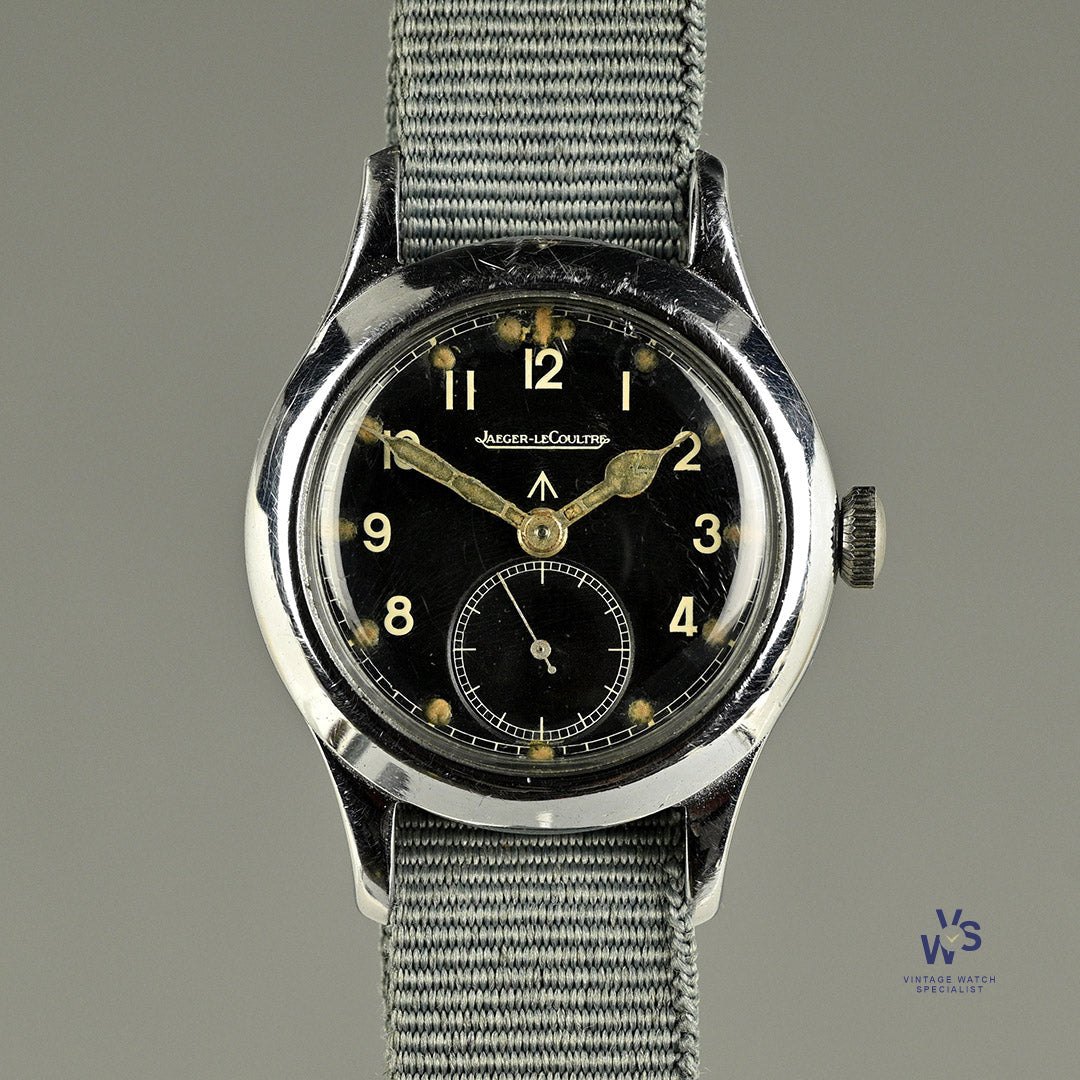
Jaeger LeCoultre, Dirty Dozen WW2 British Military Issued Watch, circa 1945
- Maker / attribution
- Jaeger-LeCoultre (maker)
- Date
- c. 1945
- Historical period
- Modern Mechanical Horology (1945 – 1969)
- Country of origin
- Switzerland
- Object type
- Wristwatch
- Dimensions
- Case 35 mm
- Stock no.
- vws4233
- Credit line
- Dealer listing, Vintage Watch Specialist (vws4233)
- Catalogue title (original)
- Jaeger LeCoultre - Dirty Dozen WW2 British Military Issued Watch - c.1945 (English)
View the source record (dealer listing) ↗ (opens another website in a new tab)Suggest a correction
Record summary
Catalogued by Vintage Watch Specialist (dealer), United Kingdom (stock number vws4233), this is a wristwatch by Jaeger-LeCoultre, made in Switzerland, dated c. 1945. The Atlas places it in the Modern Mechanical Horology period (1945 – 1969) of its Wristwatches collection. Recorded dimensions: Case 35 mm. The record is illustrated with 6 photographs.
Assembled from the source record's structured fields. Dates and attributions are given as the source states them; where a field is missing the Atlas leaves it blank rather than estimating.
Catalogue description
Dealer description — Vintage Watch Specialist
An evocative c.1945 Jaeger-LeCoultre WWW “Dirty Dozen” with surviving military markings, beautifully aged luminous details and the 16-jewel Calibre 479. The Jaeger-LeCoultre WWW belongs to the celebrated group of twelve military watches now known as the “Dirty Dozen”, produced to meet a demanding British military specification at the end of the Second World War. Built around clarity, reliability and durability, the JLC interpretation combined a highly legible black dial with its excellent hand-wound Calibre 479. Today, these purpose-built watches have become some of the most recognisable and desirable British military wristwatches of the period. What’s On Offer This is a wonderfully honest example of the Jaeger-LeCoultre WWW Dirty Dozen , retaining precisely the sort of age and character that makes an original military watch so compelling. The black dial follows the classic WWW layout, with bold Arabic numerals, an outer railway minute track and subsidiary seconds at six o’clock. The British military Broad Arrow remains clearly visible beneath the Jaeger-LeCoultre signature, immediately identifying the watch as government property rather than simply a civilian watch produced in a military style. Particularly appealing are the large cathedral-style hour and minute hands and the surviving luminous hour plots around the dial. Both have aged considerably, with the lume developing the wonderfully mottled, earthy appearance visible in the photographs. There is obvious deterioration in places, but on a watch of this nature we think that contributes enormously to its authenticity and character. The 35mm chrome-plated case displays plenty of evidence of its working life, with scratches, marks and wear throughout, yet presents extremely well for an approximately 80-year-old military watch. Its relatively long 45mm lug-to-lug measurement also gives it considerably more wrist presence than the 35mm diameter might initially suggest. Turn the watch over and its military origins become even more apparent. The stainless-steel caseback is clearly engraved with the Broad Arrow, W.W.W., F13250 and case number 283909 . The W.W.W. designation was used for watches produced to the British military specification, while the Broad Arrow denotes British government property. These surviving issue markings are an important part of the watch and its history. Inside is Jaeger-LeCoultre’s 16-jewel Calibre 479 , a manually wound mechanical movement developed for this military application and offering approximately 40 hours of power reserve. The movement is numbered 315399 . Finished on an adjustable grey NATO-style strap, this is not a pristine museum piece — nor would we particularly want it to be. This is an immensely characterful surviving example of one of the most important families of military watches ever produced, with the scars, ageing and military markings that tell you exactly what sort of watch it was built to be.
Historical context
Modern Mechanical Horology (1945 – 1969)
Tool watches for divers, pilots and astronauts; electric watches anticipate the electronic age.
The classic era of the mechanical wristwatch: dive watches, chronographs for motor racing and space flight, GMT watches for jet travel, slim dress watches, automatic calendars, and the rise of Japanese manufacturers alongside Swiss, American, German and Soviet industries.
Read the period in the timelineMore wristwatches from this periodEarlier: Golden Age of Mechanical Watchmaking
Atlas type guide
Military, pilot and travel watches
The wristwatch owes much of its adoption by men to warfare and aviation. Wristlets — small pocket watches soldered with lugs and worn on a strap — were used in colonial campaigns and became standard equipment in the First World War, with protective grilles over the crystal ('shrapnel guards'). Louis Cartier's Santos (1904), designed for the aviator Alberto Santos-Dumont, is often cited as an early purpose-made pilot's watch.
In the Second World War governments specified watches in detail: the German B-Uhr observation watches, the American A-11, and the British 'W.W.W.' (the 'Dirty Dozen' set of 1945). After the war, jet travel brought GMT and world-time watches, which show two or more time zones at once — Louis Cottier's world-time mechanism and the Rolex GMT-Master (1955) are examples.
What to look for
- Military markings on the case back: broad arrow, issue numbers, 'W.W.W.', 'A.T.P.'
- High-legibility black dials with luminous Arabic numerals; oversized crowns for gloved hands.
- 24-hour hands and rotating 24-hour bezels or city rings on GMT/world-time watches.
- Wire lugs on early wristlets converted from pocket watches.
Dating clues
- Wire-lug wristlets: c. 1900–1925.
- Military specifications of the Second World War: 1939–1945.
- GMT and world-time wristwatches: mainly after 1950.
General guidance written by the Atlas editors about this kind of object. It is not a statement about this particular piece; for that, rely on the source record above and on physical examination.
Related records
Clocks · 1937–1938
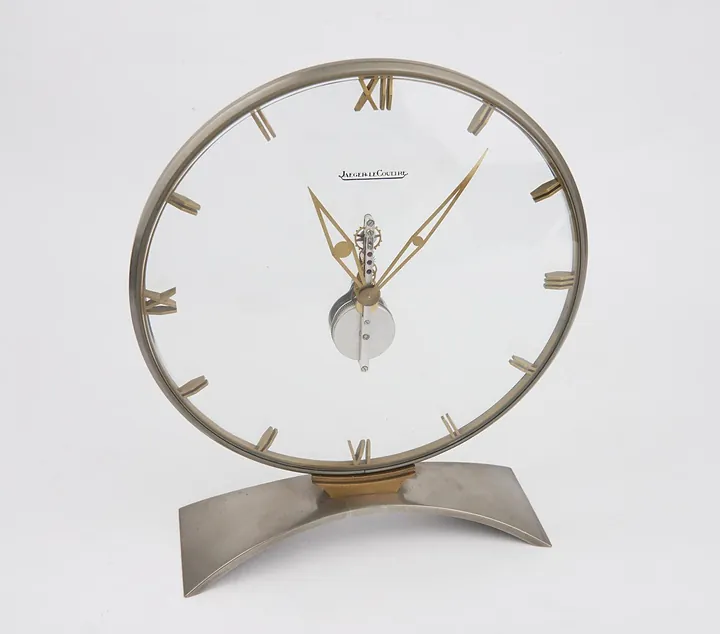
Skeleton clock by Jaeger-LeCoultre, Switzerland, 1937–1938
Science Museum Group, London
Movements & Components · 1953
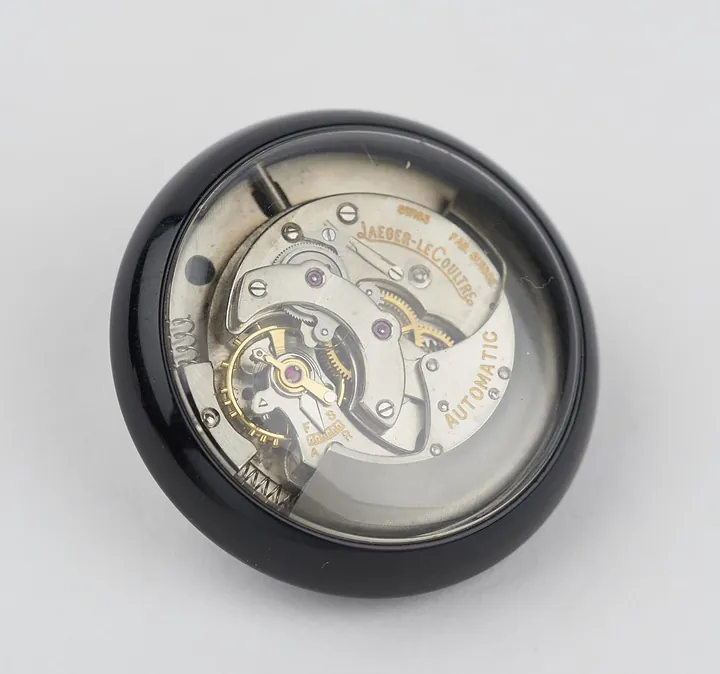
Automatic watch movement, Jaeger-LeCoultre, 1953, Geneva, Switzerland, showing self-winding mechanism
Science Museum Group, London
Wristwatches · 1953
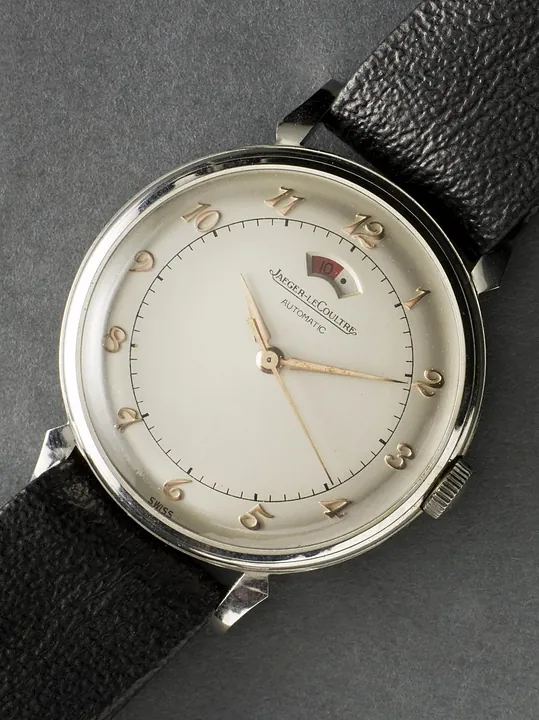
Automatic Wrist-watch, Jaeger-LeCoultre, Geneva, Switzerland, with reserve power indicator complete in steel case, 1953. Back numbered 564556.
Science Museum Group, London
Wristwatches · 1953
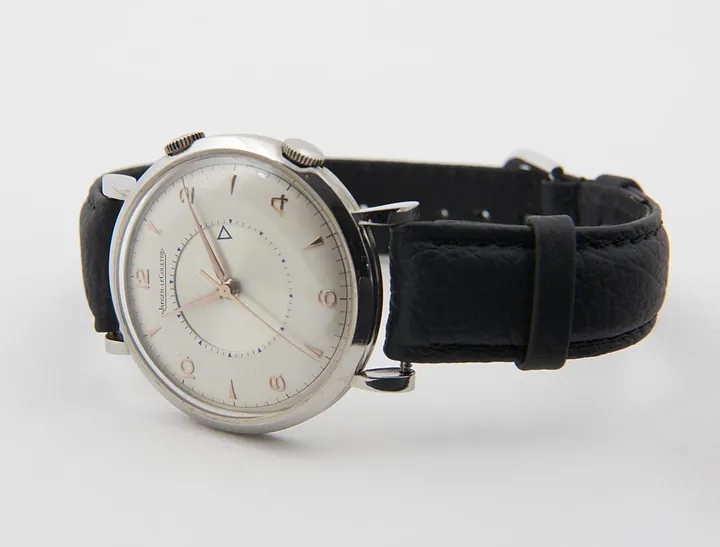
Wrist-watch, 'Memovox' alarm, Jaeger-LeCoultre, Geneva, Switzerland, complete in steel case, 1953.
Science Museum Group, London

Wristwatches · 1945
Wristwatch by Eterna, 1945
Museum Rotterdam

Wristwatches · c. 1945
Breitling Premier, ref. 790, c. 1945
Antiquorum auction archive, Geneva

Wristwatches · c. 1945
Universal Genève Uni-Compax, ref. 22492, c. 1945
Antiquorum auction archive, Geneva

Wristwatches · c. 1950s
Baume & Mercier wristwatch, c. 1950s
Antiquorum auction archive, Geneva