
Wristwatches · Wristwatch
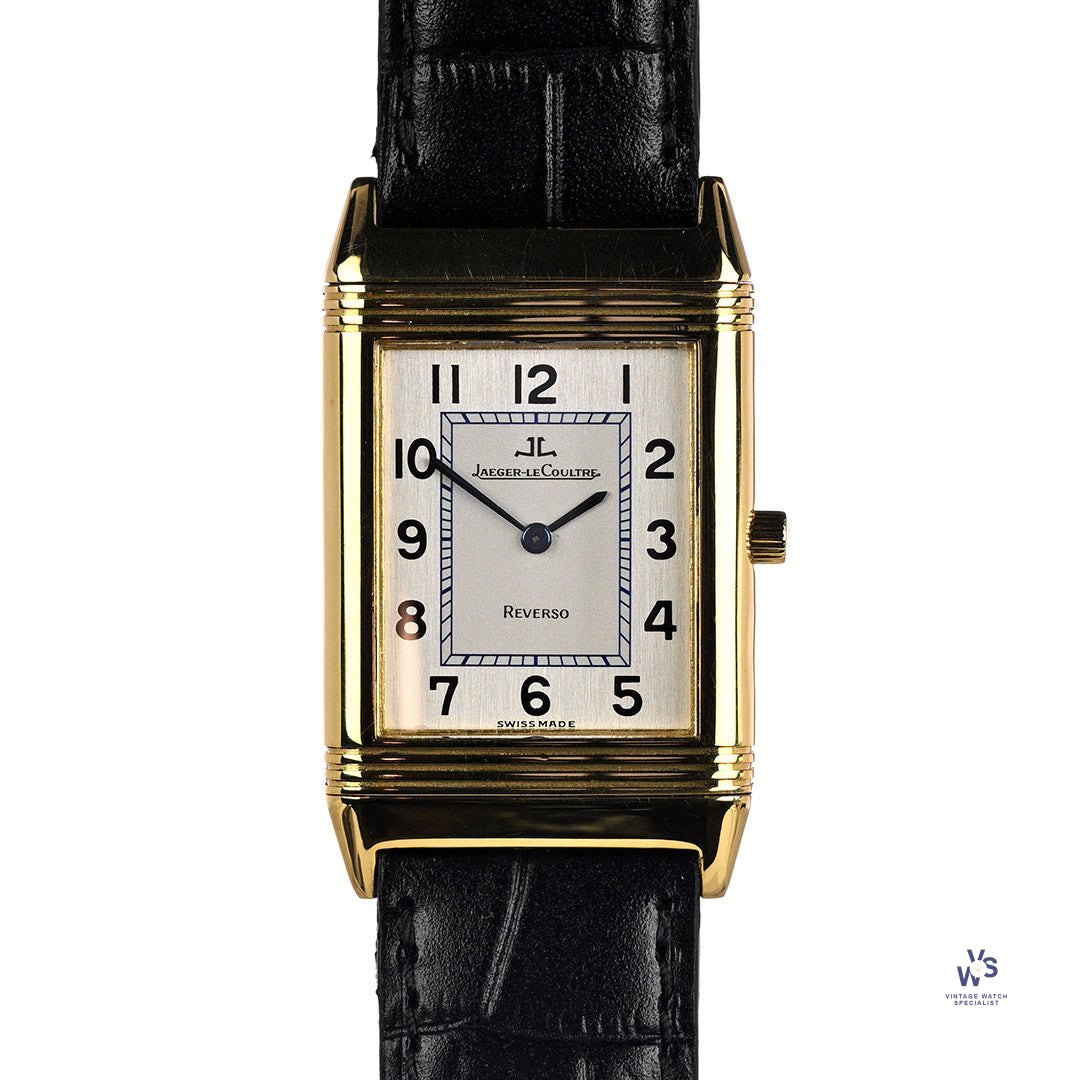
Jaegar LeCoultre Reverso Quartz 18K Gold, circa 1985
- Maker / attribution
- LeCoultre (maker)
- Date
- c. 1985
- Historical period
- Quartz Revolution (1969 – 1990)
- Country of origin
- Switzerland
- Object type
- Wristwatch
- Materials / technique
- gold
- Stock no.
- vws2056
- Credit line
- Dealer listing, Vintage Watch Specialist (vws2056)
- Catalogue title (original)
- Jaegar LeCoultre Reverso Quartz 18K Gold - c. 1985 (English)
View the source record (dealer listing) ↗ (opens another website in a new tab)Suggest a correction
Record summary
Catalogued by Vintage Watch Specialist (dealer), United Kingdom (stock number vws2056), this is a wristwatch by LeCoultre, made in Switzerland, dated c. 1985. The Atlas places it in the Quartz Revolution period (1969 – 1990) of its Wristwatches collection. Materials and techniques recorded by the source: gold. The record is illustrated with 6 photographs.
Assembled from the source record's structured fields. Dates and attributions are given as the source states them; where a field is missing the Atlas leaves it blank rather than estimating.
Catalogue description
Dealer description — Vintage Watch Specialist
A Charming Art Deco Style Quartz JLC Reverso in 18k Gold with a Beautiful Silver in Superb Preowned Condition, c.1985 The Reverso watch, introduced by luxury Swiss watchmaker Jaeger-LeCoultre in 1931, is an iconic timepiece celebrated for its unique and innovative reversible case design. Originally conceived for British Army officers playing polo in India, the Reverso's clever mechanism allows the watch's face to be flipped over, protecting the delicate crystal and dial from potential damage during intense polo matches. This distinctive feature not only offers practicality but also adds an element of sophistication and charm. Over the decades, the Reverso has evolved, maintaining its timeless Art Deco aesthetic while incorporating modern horological advancements. Its rectangular case and streamlined design appeal to both men and women, making it a versatile accessory for various occasions. There is no way for us to tell accurately what date this watch was produced, however, it is powered by the (JLC) calibre 608 which was produced from 1982 right through What's on Offer This is a charming Quartz Reverso watch from Jaeger LeCoultre crafted from solid 18k gold and in superb condition. The silver tank dial is exquisite with a very subtle texture and boasts simple Arabic numerals, an inner chapter ring and stylish blued steel hands. The watch is very Art Deco in style and bears very few signs of previous wear - the gold cases has been meticulously well taken care of and the Reverso function works well with a smooth transition. One can note the inside of the case is engraved with gold hallmarks and the JLC signature.
Historical context
Quartz Revolution (1969 – 1990)
Seiko's Astron begins mass quartz timekeeping; traditional industries contract sharply.
Quartz and digital watches transformed the market after 1969. Swiss employment collapsed, Japanese and Hong Kong production soared, and the Swatch (1983) helped the Swiss industry recover; mechanical watches survived as luxury goods.
Read the period in the timelineMore wristwatches from this periodEarlier: Modern Mechanical Horology
Atlas type guide
Quartz, digital and electronic watches
Electronic watches arrived in three steps. The Hamilton Electric 500 (1957) was the first battery-powered wristwatch, still with a balance; Bulova's Accutron (1960) used a tuning fork. On 25 December 1969 Seiko released the Astron 35SQ, the first quartz wristwatch, closely followed by the Swiss Beta 21 group. In 1972 Hamilton's Pulsar introduced the LED digital watch, and LCD displays soon made digital watches cheap.
The 'Quartz Crisis' that followed devastated the Swiss mechanical industry, which lost two-thirds of its workforce between 1970 and 1984 before recovering with the Swatch (1983) and the luxury mechanical revival. Solar, radio-controlled, kinetic and connected smartwatches continue the electronic line.
What to look for
- Battery hatch in the case back and calibre markings with 'Quartz' or a crystal frequency.
- Display technology: LED (red, push-button) versus LCD (always-on).
- Tuning-fork hum and a smoothly sweeping seconds hand on Accutrons.
- Model and reference numbers, often printed on the back.
Dating clues
- Electric balance watches: from 1957.
- Tuning-fork watches: 1960–c. 1977.
- Quartz analogue: from December 1969; LED digital: 1972–c. 1978; LCD from 1973.
General guidance written by the Atlas editors about this kind of object. It is not a statement about this particular piece; for that, rely on the source record above and on physical examination.
Read next:Seiko calibre 35A (Astron)
Related records
Wristwatches · c. 1960s
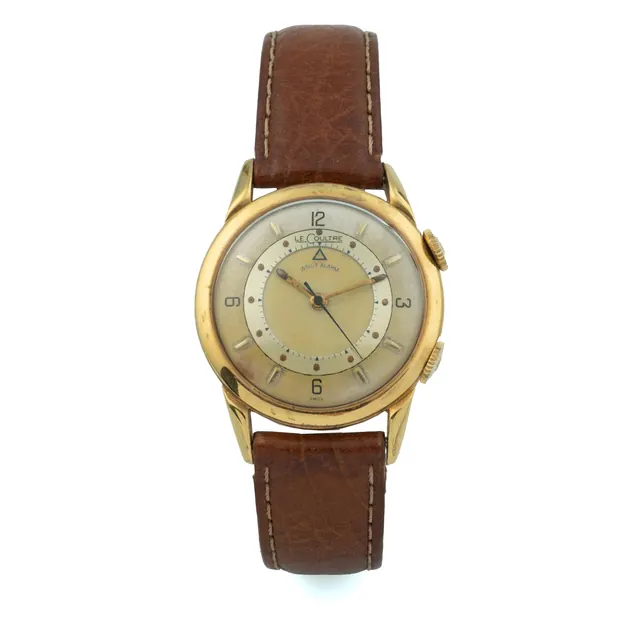
LeCoultre wristwatch, Memovox, circa 1960's
Antiquorum auction archive, Geneva
Wristwatches · c. 1960s
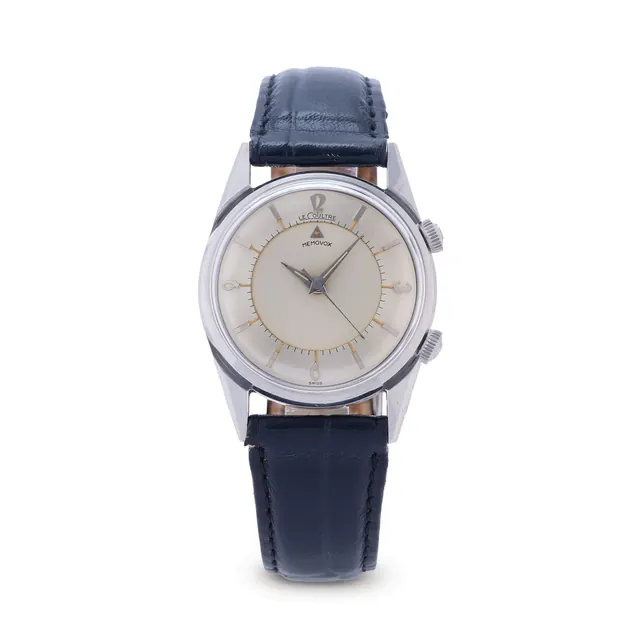
LeCoultre wristwatch, ref. 2404, Menovox Alarm, circa 1960’s
Antiquorum auction archive, Geneva
Clocks · c. 1960-1970s
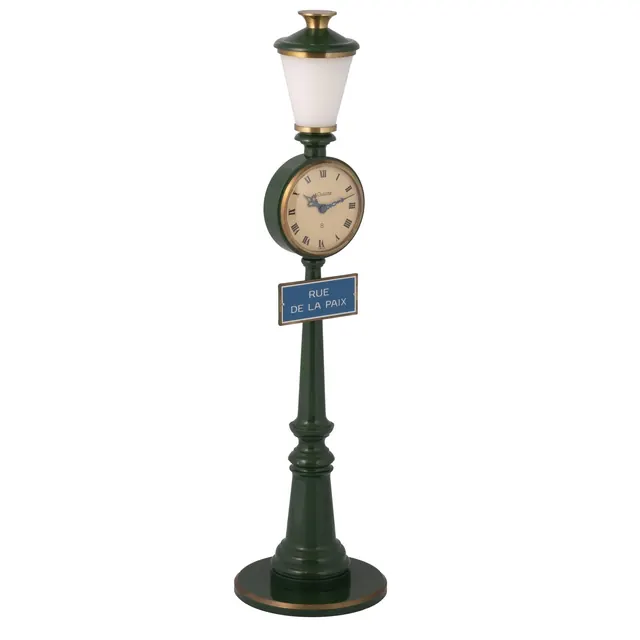
LeCoultre table clock, ref. 397, Rue de la Paix Gilt Brass, circa 1960-1970s
Antiquorum auction archive, Geneva
Wristwatches · c. 1956
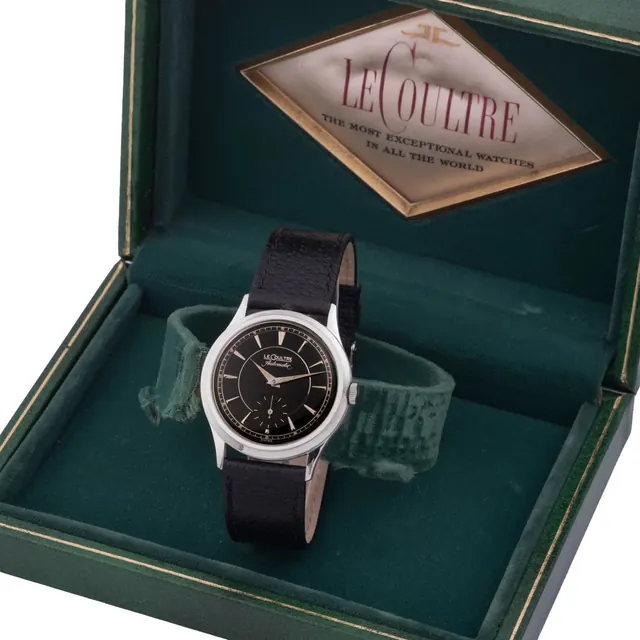
LeCoultre wristwatch, circa 1956
Antiquorum auction archive, Geneva

Wristwatches · 1970
Wristwatch by Heno, Switzerland, 1970
Museum Rotterdam

Wristwatches · 1960–1986
'Tri-Compax' calendar chronograph wristwatch in gold case, by Universal, Geneva, Switzerland, 1960–1986.
Science Museum Group, London

Wristwatches · 1969–1970
Beta 21 Quartz wristwatch movement, made in Switzerland, 1970.
Science Museum Group, London

Wristwatches · c. 1969
Omega Speedmaster Moonwatch, ref. 145022-69st, c. 1969
Antiquorum auction archive, Geneva