
Wristwatches · Wristwatch
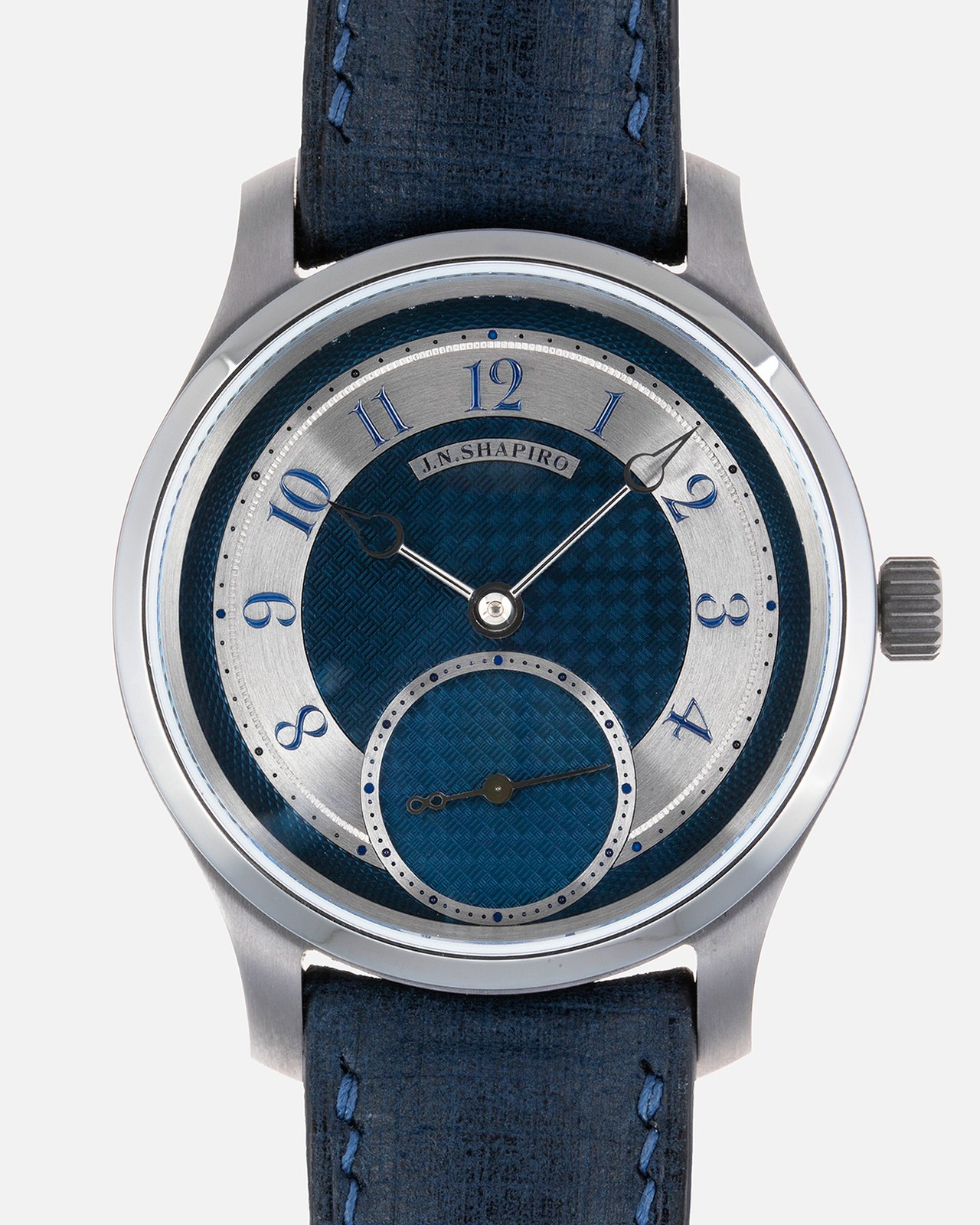
J.N. Shapiro Infinity Series Tantalum, 2021
- Maker / attribution
- J.N. Shapiro (maker)
- Date
- 2021
- Historical period
- Contemporary Horology (2010 – Present)
- Country of origin
- Unrecorded in source
- Object type
- Wristwatch
- Dimensions
- Case 40 mm
- Stock no.
- Product 6847199019095
- Credit line
- Dealer listing, S.Song Watches (product 6847199019095)
- Catalogue title (original)
- J.N. Shapiro Infinity Series Tantalum (English)
View the source record (dealer listing) ↗ (opens another website in a new tab)Suggest a correction
Record summary
Catalogued by S.Song Watches (dealer), Seattle (stock number Product 6847199019095), this is a wristwatch by J.N. Shapiro, dated 2021. The Atlas places it in the Contemporary Horology period (2010 – Present) of its Wristwatches collection. Recorded dimensions: Case 40 mm. The record is illustrated with 6 photographs.
Assembled from the source record's structured fields. Dates and attributions are given as the source states them; where a field is missing the Atlas leaves it blank rather than estimating.
Catalogue description
Dealer description — S.Song Watches
Joshua Shapiro grew up in a family of trained machinists and started working with his bare hands at a very young age. Even so, he pursued a traditional education route and eventually became an educator (read: school principal), but that all eventually changed when he became interested and picked up watchmaking along the way. Today, Joshua is famously known as a self-taught guillocheur who conceived an engine-turned motif of his own in 2013. In 2016, Joshua started to create engine-turned watch dials and became an apprentice to master clock and watchmaker David Walter. Fast forward to 2018, he proceeded to launch his own eponymous brand - J.N. Shapiro. His debut collection was the Infinity Series, named after the “Infinity Weave”, a proprietary guilloche pattern that he invented, which also serves as the foundation of the piece offered here today. Enter the J.N. Shapiro Infinity Tantalum Limited Edition, Joshua Shapiro’s latest creation - an exceptionally rare and special variant of the previous generation Infinity Series with tantalum incorporated into its construction. For context, tantalum is a special type of material we don’t see very often in the realm of watchmaking. It is essentially a grey-bluish metal with a slightly darker tone than steel, platinum, or white gold, and it is more prominent in medical and dental applications. It is corrosion-resistant, but also extremely arduous to machine, which is why we rarely see them being used in classic watchmaking. So far, there are only a few known examples of timepieces with tantalum incorporated into its construction, for example, the F.P. Journe Chronomètre Bleu, Omega Tri-Meter Seamaster, and a few Audemars Piguet Royal Oaks. Compared to its older Infinity sibling which measures 40mm, the Infinity Tantalum comes in at 39mm x 9.75mm. Its tantalum case features a selection of polished and brushed surfaces that contrast very nicely with the tantalum’s grey-bluish color tones. This allows the watch to take on a unique aesthetic and personality. It also gives the timepiece a very nice heft, which contributes to a pleasant tactile feel. According to Shapiro, this is actually the first time a case in tantalum is made entirely outside of Switzerland, and its usage is not solely confined to the case. If you take a closer look at the dial, you will also find that tantalum has been incorporated onto the chapter ring which bears Arabic numerals that are filled with lacquer, as well as the track outside the small-seconds sub-dial. The base of the dial is manufactured from solid palladium, and hosts, what I think, is the main highlight of this piece – J.N. Shapiro’s intricate engine-turned guilloche in three different forms. The periphery of the dial features a barleycorn motif whilst the minute track ring just above the numerals features a ratchet pattern and the basketweave in the middle section. Joshua had also created his very own pattern he calls the “Infinity weave” pattern as seen within the small-seconds counter at 6 o ‘clock, which he claims is a “basketweave inside of a basketweave” and was inspired after reading George Daniels’ book “Watchmaking”. As far as finishing is concerned, the guilloche on the Infinity Tantalum is exceedingly impressive and definitely on par with some of the best the watch industry could offer. In addition to the above, the Infinity Tantalum also uses uniquely shaped hour, minute, and sub-seconds hands. The hour and minute hands both have Breguet-style skeletonized tips, and the seconds hand has an infinity symbol as its counterweight. A very appropriate choice, if you ask me. Turn the watch over on its exhibition case back and you will find that the Infinity Tantalum is powered by a well-known movement produced in Germany – the manually-wound, UWD Cal. 33.1, a now-discontinued caliber produced by Uhren-Werke-Dresden, a sister company of Lang & Heyne. It should also be mentioned that all Shapiro timepieces that exist today will be the only ones that will ever house this movement. That aside, the UWD Cal. 33.1 is finely decorated with a contrasting combination of brushed and polished bevels, a hand-chamfered gold bridge medallion that denotes the serial number has also been added here to enhance visual appeal. J.N. Shapiro is definitely an independent brand on the rise and it’s no surprise that many collectors and connoisseurs alike are starting to flock toward this upcoming American watchmaker. Overall, the J.N. Shapiro Infinity Tantalum is an exceptional work of art and I cannot emphasize how rare it is to see one in the metal, let alone a tantalum example. It is as rare as it gets- not solely because it is a 26-piece limited edition (with a rough estimate of approximately 8 – 9 pieces made in this specific configuration), but due to the fact that many collectors who bought Shapiros are not selling, with only 2 pieces of any Shapiro example appearing on the market before this.
Historical context
Contemporary Horology (2010 – Present)
Silicon components, connected watches, optical-lattice research clocks and a thriving independent scene.
Smartwatches became the world's best-selling watches, while mechanical watchmaking focuses on craft, innovation (silicon components, new escapements) and independent makers.
Read the period in the timelineMore wristwatches from this periodEarlier: Mechanical Renaissance
Atlas type guide
Wristwatches
Bracelet watches were worn by women from the early nineteenth century — Breguet made one for Caroline Murat, Queen of Naples, in 1810–12 — but the wristwatch only became a man's instrument with military use and aviation in the early twentieth century. Between the World Wars it overtook the pocket watch; the 1920s and 1930s brought rectangular Art Deco cases, water-resistant cases and the first automatic winding systems.
After 1945 the wristwatch became a carrier of identity — dress watches, sports and dive watches, chronographs, calendars — produced by Swiss, American, Japanese, German, Soviet and Chinese industries. The quartz revolution after 1969 and the mechanical renaissance since the 1990s, including the rise of independent watchmakers, complete the story.
What to look for
- The reference number (between the lugs or inside the case back) and serial number, the starting point for dating.
- The calibre: its maker and number are often stamped under the dial or on the bridge.
- Originality of dial, hands and crown — refinished ('redial') dials are common.
- Case material marks: 18K/750, 14K/585, stainless steel, gold-filled, plated.
Dating clues
- Wire-lug cases: before c. 1925.
- Water-resistant screw-down cases: from 1926.
- Quartz movements: from 1969; sapphire crystals widespread after c. 1980.
General guidance written by the Atlas editors about this kind of object. It is not a statement about this particular piece; for that, rely on the source record above and on physical examination.
Related records
Wristwatches · 2023
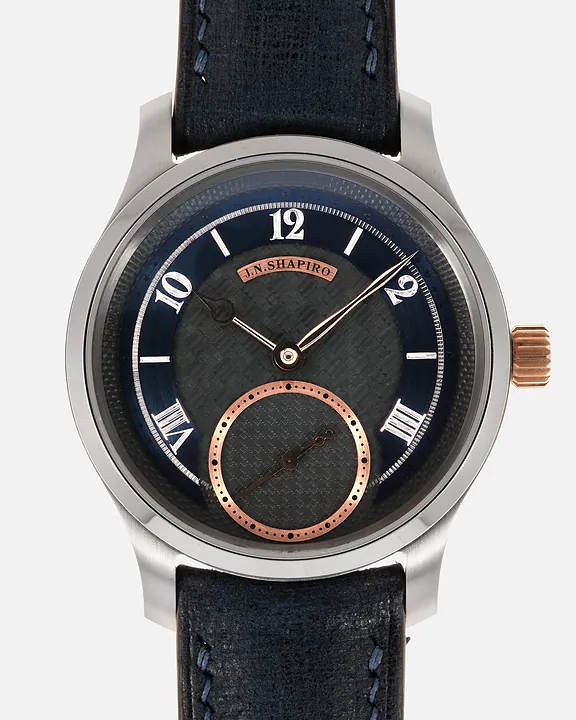
J.N. Shapiro Infinity Series '39mm' Steel, 2023
S.Song Watches (dealer), Seattle
Wristwatches · 2010
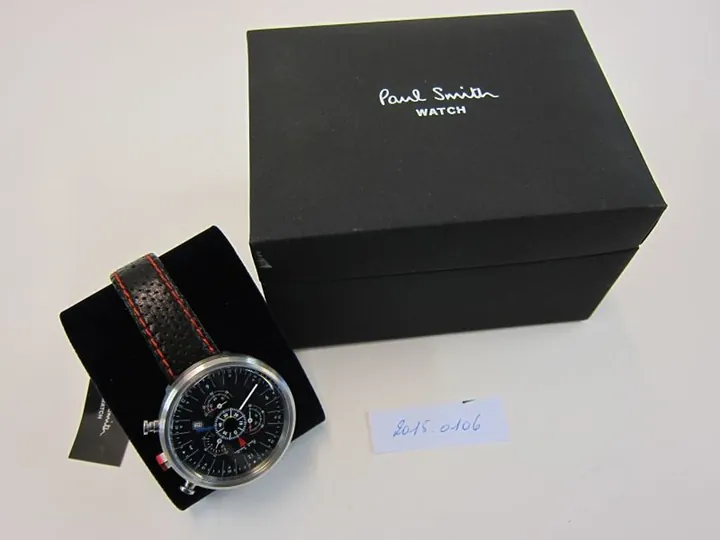
Wristwatch, 2010
Modemuseum Hasselt
Wristwatches · 2018 (Series 4 released in September 2018; '1977' in the source is the model number A1977)
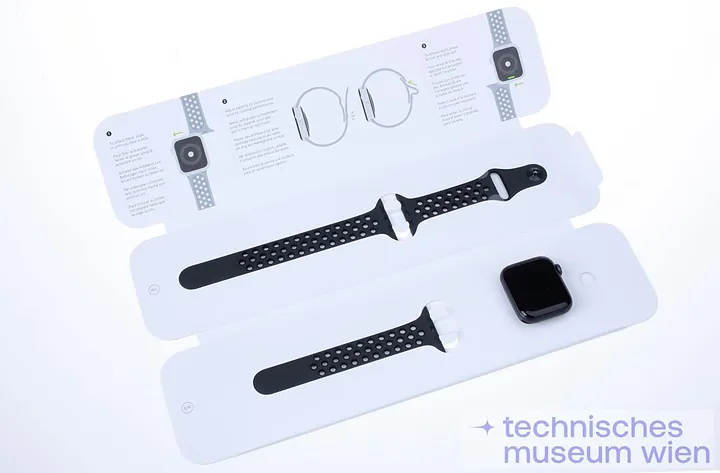
Apple Watch Series 4 (GPS, 40 mm, model A1977), 2018
Vienna Museum of Science and Technology
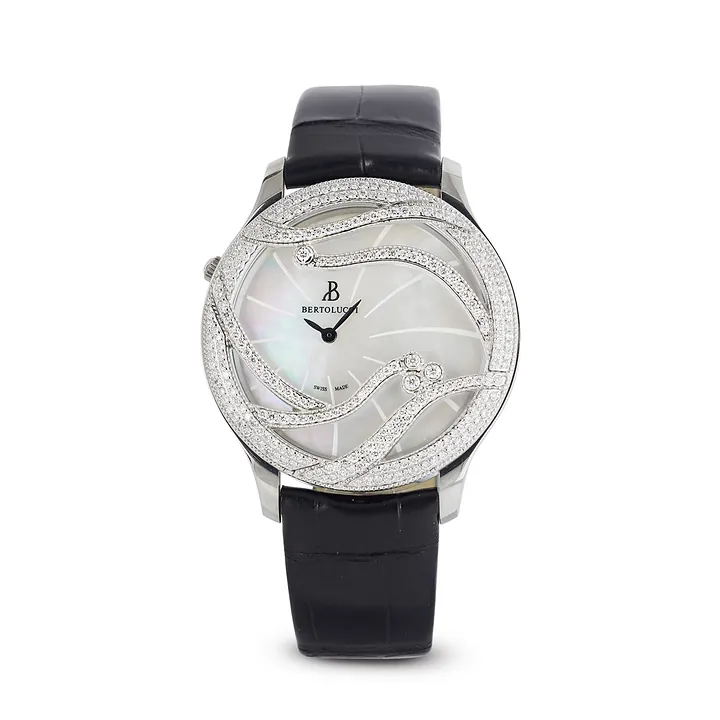
Wristwatches · c. 2010s
Bertolucci Stria III, ref. 11513.50.45.B88.6C1.501, c. 2010s
Antiquorum auction archive, Geneva
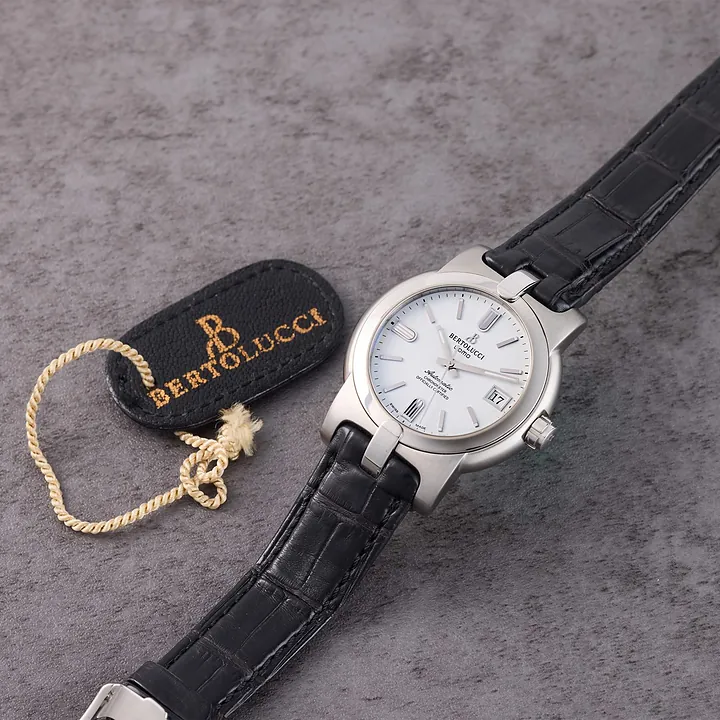
Wristwatches · c. 2010s
Bertolucci Uoma, ref. 824.51.41.10B, c. 2010s
Antiquorum auction archive, Geneva

Wristwatches · c. 2010s
Breguet Type XXI, ref. 3810, c. 2010s (Antiquorum Lot 381-24)
Antiquorum auction archive, Geneva

Wristwatches · c. 2010s
Breguet Type XXI, ref. 3810, c. 2010s (Antiquorum Lot 386-229)
Antiquorum auction archive, Geneva

Wristwatches · Sold in September 2010
Breitling Cosmonaute, ref. A 22322, Sold in September 2010
Antiquorum auction archive, Geneva