
Wristwatches · Wristwatch
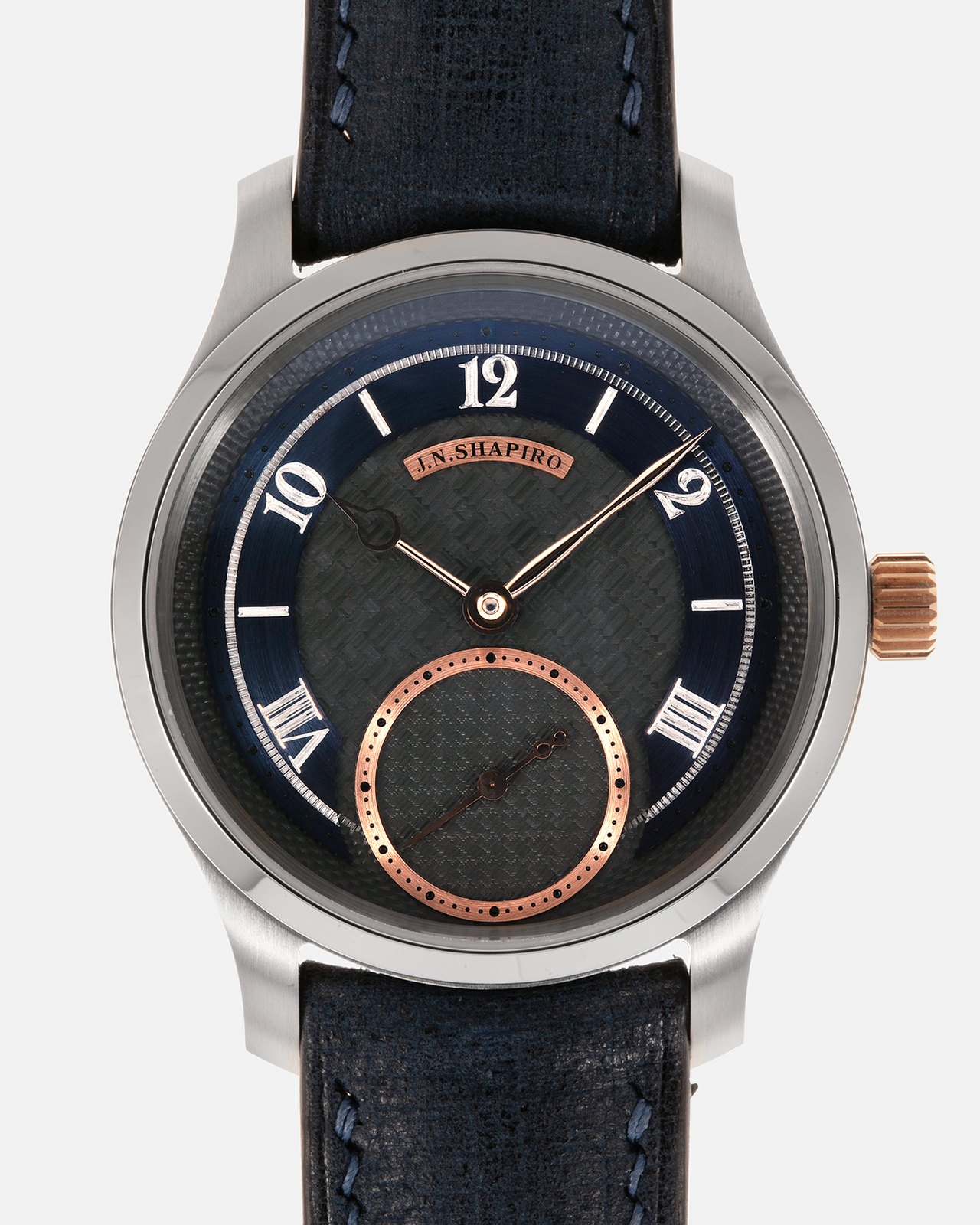
J.N. Shapiro Infinity Series '39mm' Steel, 2023
- Maker / attribution
- J.N. Shapiro (maker)
- Date
- 2023
- Historical period
- Contemporary Horology (2010 – Present)
- Country of origin
- Unrecorded in source
- Object type
- Wristwatch
- Materials / technique
- steel
- Dimensions
- Case 39 mm
- Stock no.
- Product 7301751308375
- Credit line
- Dealer listing, S.Song Watches (product 7301751308375)
- Catalogue title (original)
- J.N. Shapiro Infinity Series '39mm' Steel (English)
View the source record (dealer listing) ↗ (opens another website in a new tab)Suggest a correction
Record summary
Catalogued by S.Song Watches (dealer), Seattle (stock number Product 7301751308375), this is a wristwatch by J.N. Shapiro, dated 2023. The Atlas places it in the Contemporary Horology period (2010 – Present) of its Wristwatches collection. Materials and techniques recorded by the source: steel. Recorded dimensions: Case 39 mm. The record is illustrated with 6 photographs.
Assembled from the source record's structured fields. Dates and attributions are given as the source states them; where a field is missing the Atlas leaves it blank rather than estimating.
Catalogue description
Dealer description — S.Song Watches
Joshua Shapiro grew up in a family of trained machinists and started working with them at a very young age. Despite this, he pursued a traditional education route and eventually became a school principal. However, everything changed when he developed an interest in watchmaking. Today, Joshua is known as a self-taught guillocheur who conceived a unique engine-turned-motif in 2013. In 2016, he began creating engine-turned watch dials and apprenticed under the master clock and watchmaker David Walter. In 2018, Shapiro branched out on his own to launch his eponymous brand—J.N. Shapiro. His debut collection was the Infinity Series, named after the “Infinity Weave”—a proprietary guilloché pattern that he developed, which also serves as the foundation of the piece offered here today. Featured here today is the J.N. Shapiro Infinity Series 1.5 with a serial number ‘S.1’ (serial number 1), a finely crafted wristwatch presented within a contemporarily sized 39mm x 9.75mm stainless steel case. Visually, the watch seamlessly combines a multitude of polished and brushed surfaces, creating an eye-catching contrast against its stunning quadra-tone dial. Notably, while most Shapiro designs are typically 40mm or 42mm, this model is uniquely crafted at 39mm. Although it may seem like a minor detail, every millimeter impacts wearability, and we believe 39mm is the ideal size when it comes to Shapiro pieces. Additionally, this case also showcases Shapiro’s latest in-house case design, featuring two separate holes on each lug to accommodate either curved or straight spring bars, which is a significant plus point for those who enjoy changing up their watch straps from time to time. According to Joshua, the series is named the Infinity Series 1.5 because its striking black zirconium dial now hosts a newly designed chapter ring with a visual ‘break’, a detail visible around the periphery of the small seconds sub-dial between 4:00 and 7:00. This design change allows for a slightly larger central area to showcase his signature guilloché “Infinity Weave”—a design which he describes as a “basketweave inside of a basketweave” and as inspired by George Daniels’ book Watchmaking . Furthermore, Joshua also incorporated other guilloché techniques onto the dial: a barleycorn motif can be seen at the periphery, while the minute track above the Arabic numerals features a ratchet-like pattern. Elaborating on this newly added chapter ring, the hour markers used here consist of a combination of Roman numerals (III and VIII) and Arabic numerals (10, 12, and 2) in an alternating fashion. The overall dial design is completed with a set of hour, minute, and sub-second hands, all uniquely shaped and crafted from rose gold. The hour hand here features a Breguet-style skeletonized tip, while the small second hand is beautifully adorned with an infinity symbol as its counterweight—a particularly fitting detail given the name of the collection. True to Shapiro's style, the dial is tastefully packed with intricate finishing techniques and visually stimulating details that engage the senses. The overall finishing, presentation, and contrast between the various guilloché techniques employed here are truly impressive, and they stand strong alongside some of the finest within the industry. Turn the watch over to its exhibition case back, and you’ll find that it is powered by one of Germany’s finest—the UWD Cal. 33.1. It is a manually-wound caliber produced by Uhren-Werke-Dresden, a sister company of Lang & Heyne. It is also worth noting that the Infinity Series 1.5 was the final collection from Shapiro to house this particular caliber, as UWD has stopped selling them. When viewed up close, you’ll see that the UWD Cal. 33.1 is beautifully decorated with a blend of brushed and polished bevels, and it features a hand-chamfered gold bridge medallion that displays the serial number ‘S.1’. J.N. Shapiro is an independent brand on the rise, and it’s no surprise that many collectors and connoisseurs alike are starting to flock to this upcoming American watchmaker. Overall, the J.N. Shapiro Infinity Series 1.5 is an exceptional work of art, and I cannot emphasize how rare it is to even see one in person. Given the general scarcity of Shapiro pieces publicly available for sale today, and with most collectors holding onto theirs, the opportunity to offer one such example on the site is truly exciting.
Historical context
Contemporary Horology (2010 – Present)
Silicon components, connected watches, optical-lattice research clocks and a thriving independent scene.
Smartwatches became the world's best-selling watches, while mechanical watchmaking focuses on craft, innovation (silicon components, new escapements) and independent makers.
Read the period in the timelineMore wristwatches from this periodEarlier: Mechanical Renaissance
Atlas type guide
Wristwatches
Bracelet watches were worn by women from the early nineteenth century — Breguet made one for Caroline Murat, Queen of Naples, in 1810–12 — but the wristwatch only became a man's instrument with military use and aviation in the early twentieth century. Between the World Wars it overtook the pocket watch; the 1920s and 1930s brought rectangular Art Deco cases, water-resistant cases and the first automatic winding systems.
After 1945 the wristwatch became a carrier of identity — dress watches, sports and dive watches, chronographs, calendars — produced by Swiss, American, Japanese, German, Soviet and Chinese industries. The quartz revolution after 1969 and the mechanical renaissance since the 1990s, including the rise of independent watchmakers, complete the story.
What to look for
- The reference number (between the lugs or inside the case back) and serial number, the starting point for dating.
- The calibre: its maker and number are often stamped under the dial or on the bridge.
- Originality of dial, hands and crown — refinished ('redial') dials are common.
- Case material marks: 18K/750, 14K/585, stainless steel, gold-filled, plated.
Dating clues
- Wire-lug cases: before c. 1925.
- Water-resistant screw-down cases: from 1926.
- Quartz movements: from 1969; sapphire crystals widespread after c. 1980.
General guidance written by the Atlas editors about this kind of object. It is not a statement about this particular piece; for that, rely on the source record above and on physical examination.
Related records
Wristwatches · 2021
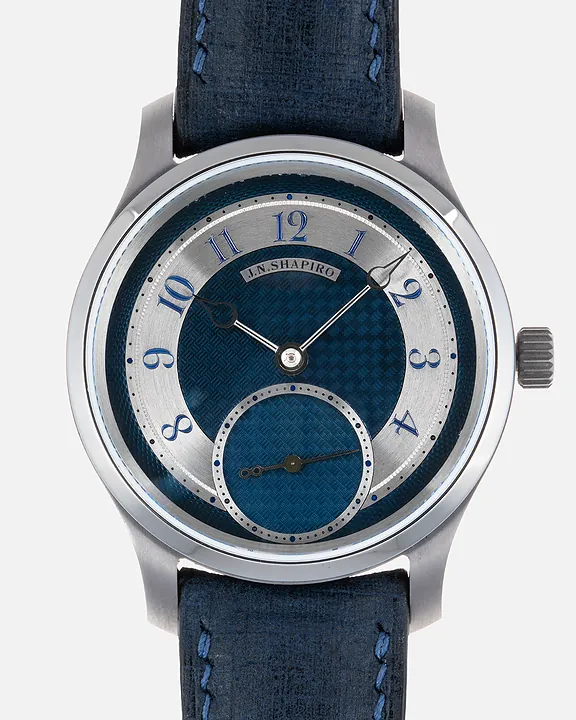
J.N. Shapiro Infinity Series Tantalum, 2021
S.Song Watches (dealer), Seattle
Wristwatches · 2010
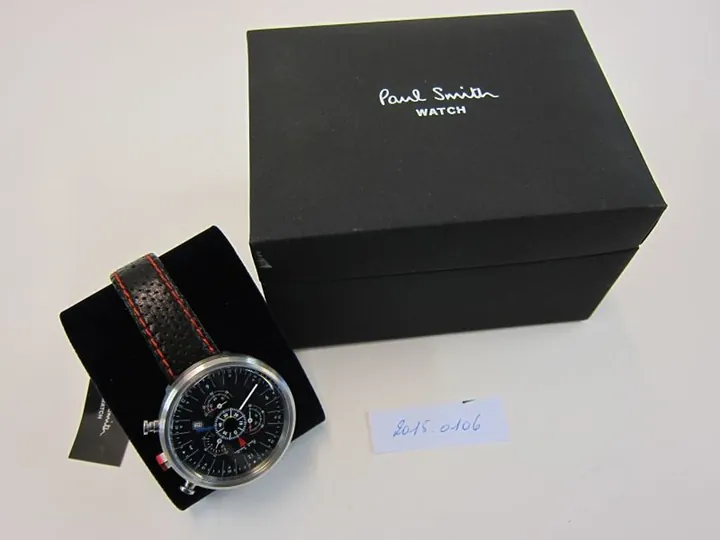
Wristwatch, 2010
Modemuseum Hasselt
Wristwatches · 2018 (Series 4 released in September 2018; '1977' in the source is the model number A1977)
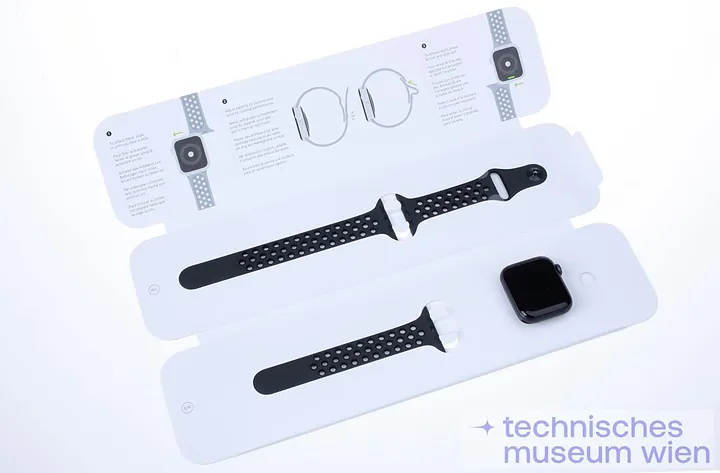
Apple Watch Series 4 (GPS, 40 mm, model A1977), 2018
Vienna Museum of Science and Technology
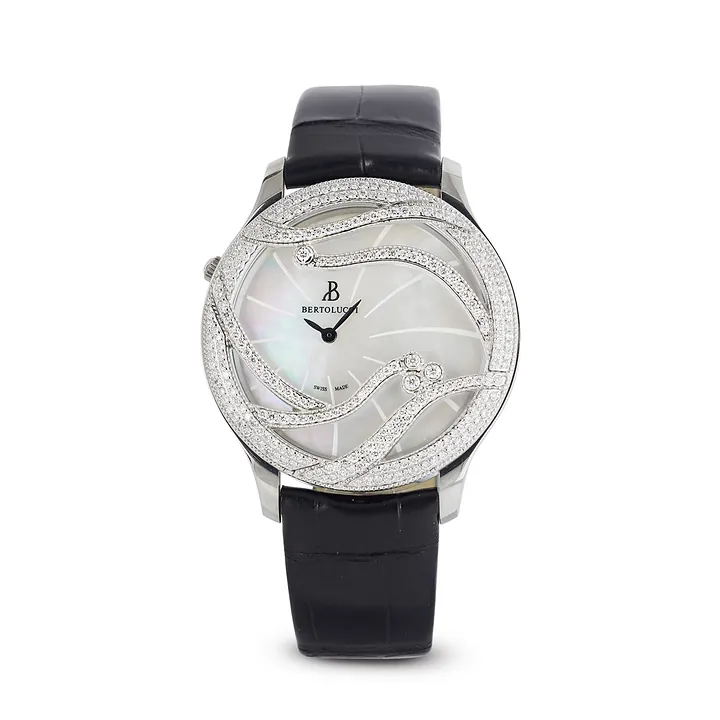
Wristwatches · c. 2010s
Bertolucci Stria III, ref. 11513.50.45.B88.6C1.501, c. 2010s
Antiquorum auction archive, Geneva
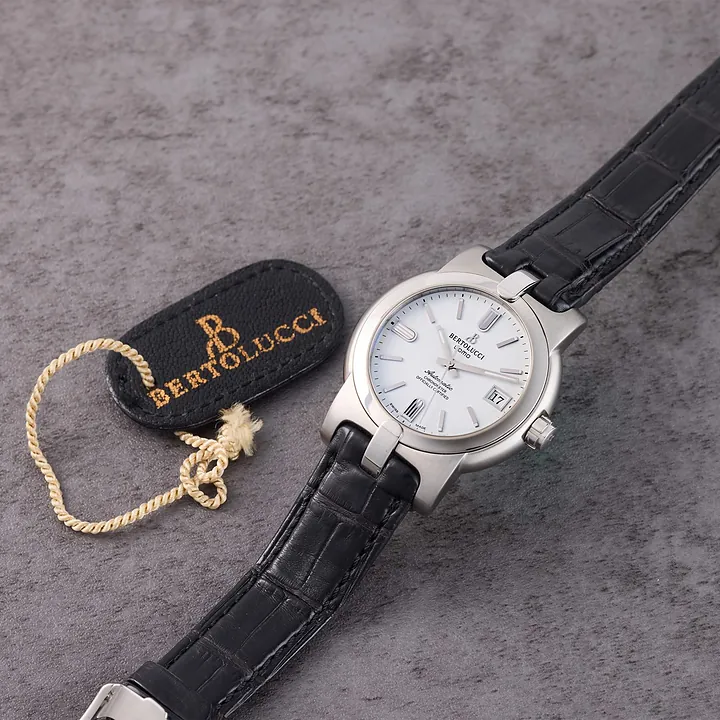
Wristwatches · c. 2010s
Bertolucci Uoma, ref. 824.51.41.10B, c. 2010s
Antiquorum auction archive, Geneva

Wristwatches · c. 2010s
Breguet Type XXI, ref. 3810, c. 2010s (Antiquorum Lot 381-24)
Antiquorum auction archive, Geneva

Wristwatches · c. 2010s
Breguet Type XXI, ref. 3810, c. 2010s (Antiquorum Lot 386-229)
Antiquorum auction archive, Geneva

Wristwatches · Sold in September 2010
Breitling Cosmonaute, ref. A 22322, Sold in September 2010
Antiquorum auction archive, Geneva