
Wristwatches · Wristwatch
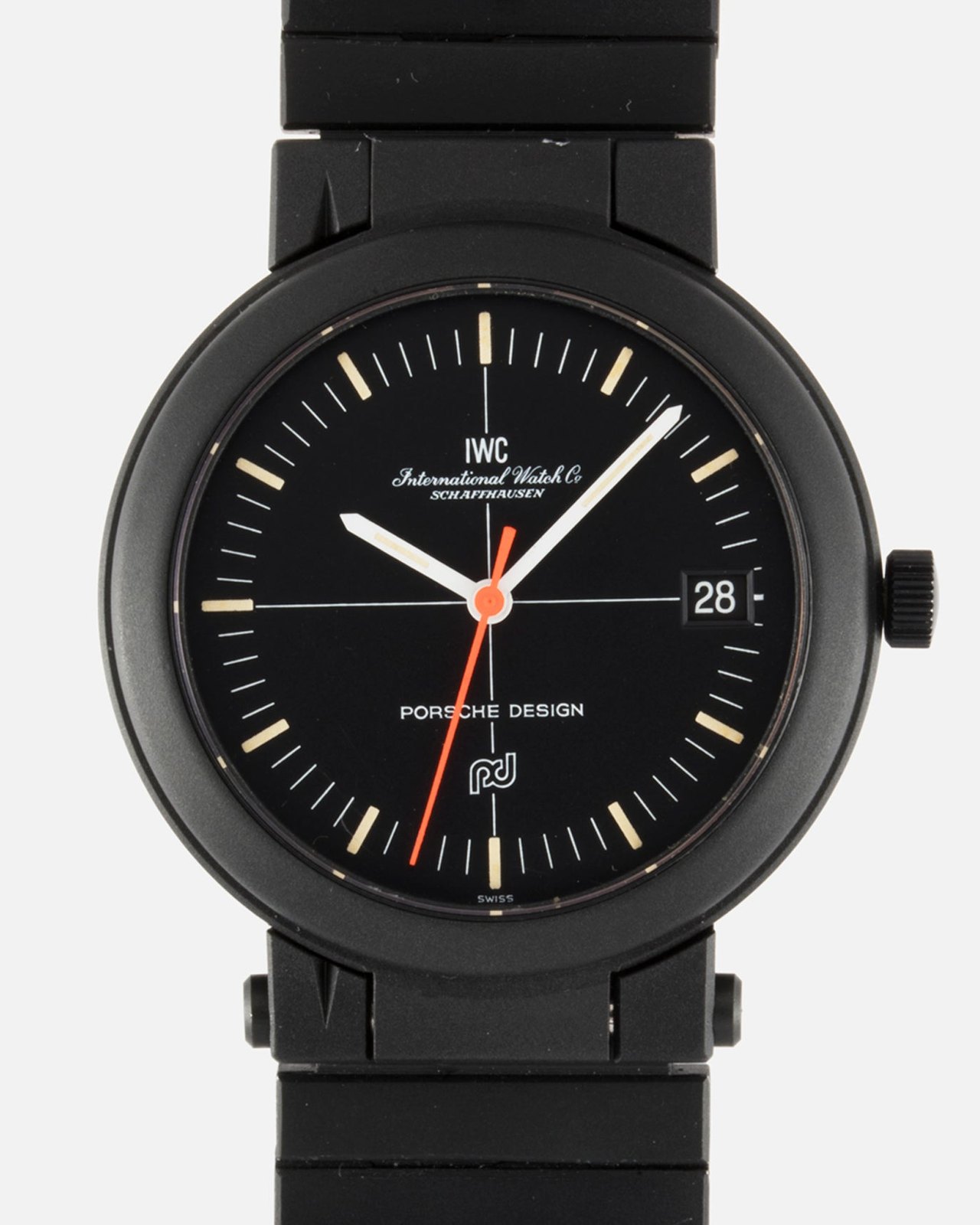
IWC Porsche Design Compass 3510, 1980s
- Maker / attribution
- IWC (maker)
- Date
- 1980s
- Historical period
- Quartz Revolution (1969 – 1990)
- Country of origin
- Switzerland
- Object type
- Wristwatch
- Stock no.
- Product 3960442617943
- Credit line
- Dealer listing, S.Song Watches (product 3960442617943)
- Catalogue title (original)
- IWC Porsche Design Compass 3510 (English)
View the source record (dealer listing) ↗ (opens another website in a new tab)Suggest a correction
Record summary
Catalogued by S.Song Watches (dealer), Seattle (stock number Product 3960442617943), this is a wristwatch by IWC, made in Switzerland, dated 1980s. The Atlas places it in the Quartz Revolution period (1969 – 1990) of its Wristwatches collection. The record is illustrated with 6 photographs.
Assembled from the source record's structured fields. Dates and attributions are given as the source states them; where a field is missing the Atlas leaves it blank rather than estimating.
Catalogue description
Dealer description — S.Song Watches
This is one of the coolest watches I’ve come across in a while and it goes to show that collecting watches doesn’t have to be extortionately expensive. I’ll admit that I did not know much about this watch when I first saw it and when I noticed it on the wrist of a fellow collector and friend I immediately offered to buy it. You’ll see why. The late ’70s as many will know was a pretty rough time for the Swiss watch industry. With the advent of quartz, many companies were going out of business and IWC was certainly heading in the same direction. They tried everything from pocket watches to jewellery watches and nothing worked, except their collaboration with Porsche Design. Ferdinand A. Porsche had left the eponymous brand his family had started and begun his own design studio, which still exists today and working together with IWC, the first watch they produced was this, the Compass Watch. I’m not even joking when I say that this is the watch that keeps surprising you. When I first saw this watch, I immediately fell for the clean minimalist design and the beautiful deep black dial. With a cross-hair design, long luminous markers that have aged to yellow, a red running seconds hand and the old-school International Watch Co. logo font, the design to me was perfect. Top that off with a PVD coated aluminium case, I was amazed at how light the case was and mind you, PVD wasn’t so trendy back then- this was revolutionary. By now I was already into the watch but what's amazing is that it has a hinged case! There are buttons on both sides of the bottom lugs that pop the case open to reveal, a compass! This might be a novelty, but what is unique is that mechanical movements do not like magnets at all and to have a compass right below the movement, I knew that the anti-magnetic properties of this watch had to be pretty good. Furthermore, the bracelet is a work of art. As compasses need to be laid down flat to properly navigate, there is a quick-release on the clasp that allows the watch to lie flat. Amazing! While I’ve dealt with far more expensive watches, I have to admit that this piece got me the most excited in quite a while!
Historical context
Quartz Revolution (1969 – 1990)
Seiko's Astron begins mass quartz timekeeping; traditional industries contract sharply.
Quartz and digital watches transformed the market after 1969. Swiss employment collapsed, Japanese and Hong Kong production soared, and the Swatch (1983) helped the Swiss industry recover; mechanical watches survived as luxury goods.
Read the period in the timelineMore wristwatches from this periodEarlier: Modern Mechanical Horology
Atlas type guide
Wristwatches
Bracelet watches were worn by women from the early nineteenth century — Breguet made one for Caroline Murat, Queen of Naples, in 1810–12 — but the wristwatch only became a man's instrument with military use and aviation in the early twentieth century. Between the World Wars it overtook the pocket watch; the 1920s and 1930s brought rectangular Art Deco cases, water-resistant cases and the first automatic winding systems.
After 1945 the wristwatch became a carrier of identity — dress watches, sports and dive watches, chronographs, calendars — produced by Swiss, American, Japanese, German, Soviet and Chinese industries. The quartz revolution after 1969 and the mechanical renaissance since the 1990s, including the rise of independent watchmakers, complete the story.
What to look for
- The reference number (between the lugs or inside the case back) and serial number, the starting point for dating.
- The calibre: its maker and number are often stamped under the dial or on the bridge.
- Originality of dial, hands and crown — refinished ('redial') dials are common.
- Case material marks: 18K/750, 14K/585, stainless steel, gold-filled, plated.
Dating clues
- Wire-lug cases: before c. 1925.
- Water-resistant screw-down cases: from 1926.
- Quartz movements: from 1969; sapphire crystals widespread after c. 1980.
General guidance written by the Atlas editors about this kind of object. It is not a statement about this particular piece; for that, rely on the source record above and on physical examination.
Related records
Pocket Watches · c. 1950
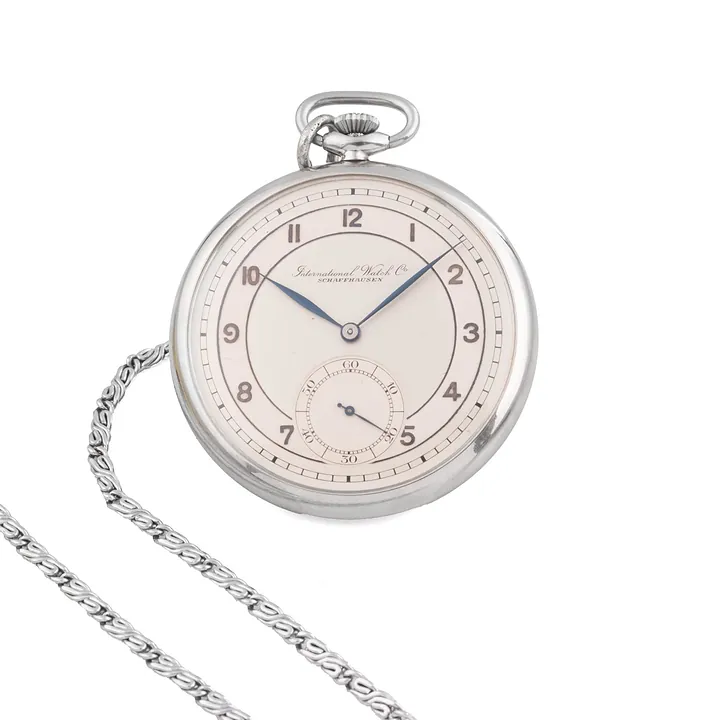
IWC Pocket Watch, c. 1950
Antiquorum auction archive, Geneva
Pocket Watches · c. 1980
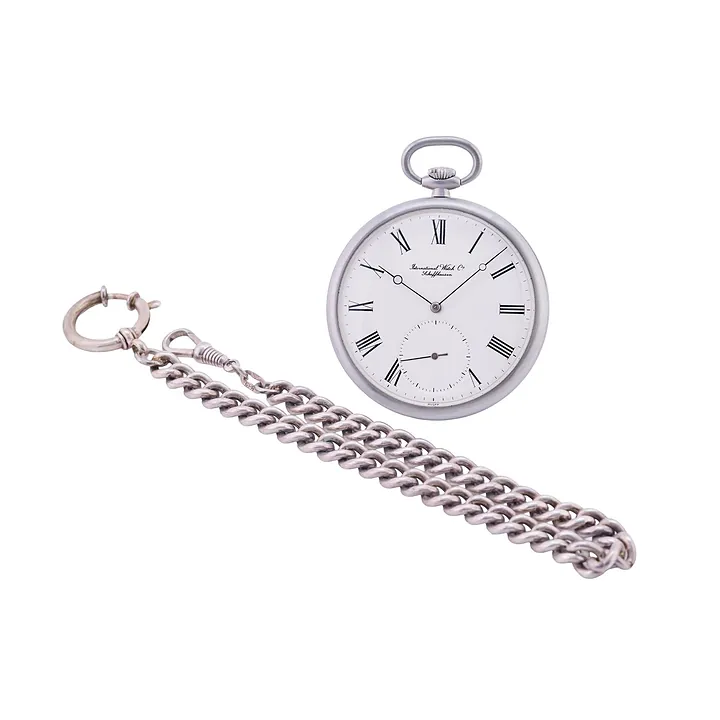
IWC pocket watch, ref. 5301, c. 1980
Antiquorum auction archive, Geneva
Wristwatches · originally sold in April 2016 (per the lot record)
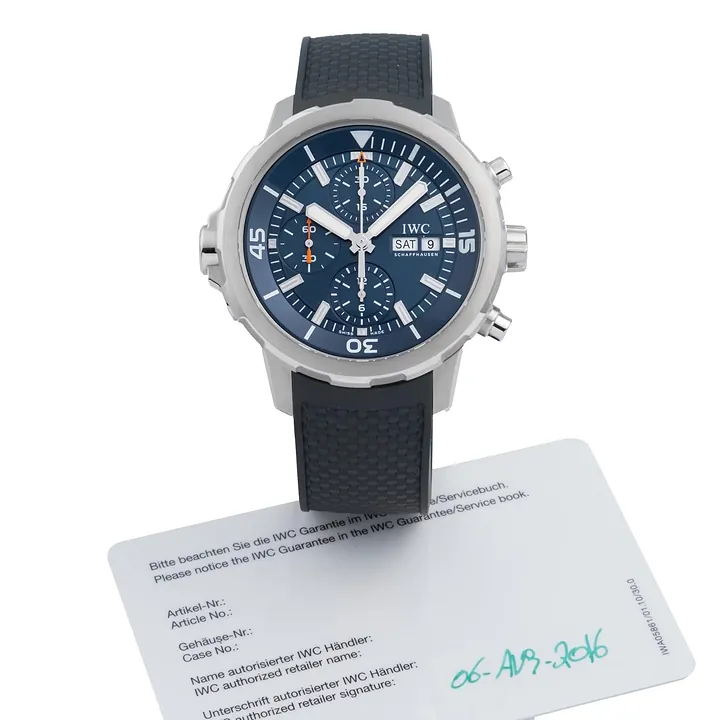
IWC Aquatimer Chronograph Cousteau, ref. IW3768, originally sold in April 2016
Antiquorum auction archive, Geneva
Wristwatches · c. 2010s
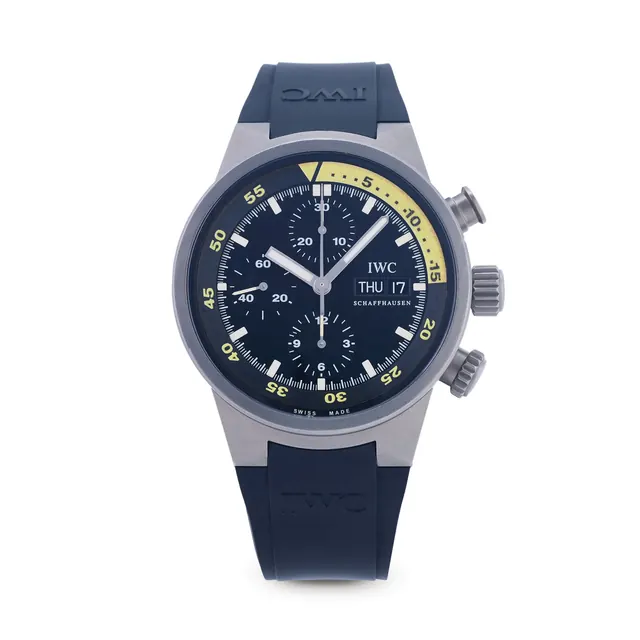
IWC wristwatch, ref. IW371918, Aquatimer, circa 2010s
Antiquorum auction archive, Geneva

Wristwatches · 1970
Wristwatch by Heno, Switzerland, 1970
Museum Rotterdam

Wristwatches · 1960–1986
'Tri-Compax' calendar chronograph wristwatch in gold case, by Universal, Geneva, Switzerland, 1960–1986.
Science Museum Group, London

Wristwatches · 1969–1970
Beta 21 Quartz wristwatch movement, made in Switzerland, 1970.
Science Museum Group, London

Wristwatches · c. 1969
Omega Speedmaster Moonwatch, ref. 145022-69st, c. 1969
Antiquorum auction archive, Geneva