
Wristwatches · Wristwatch
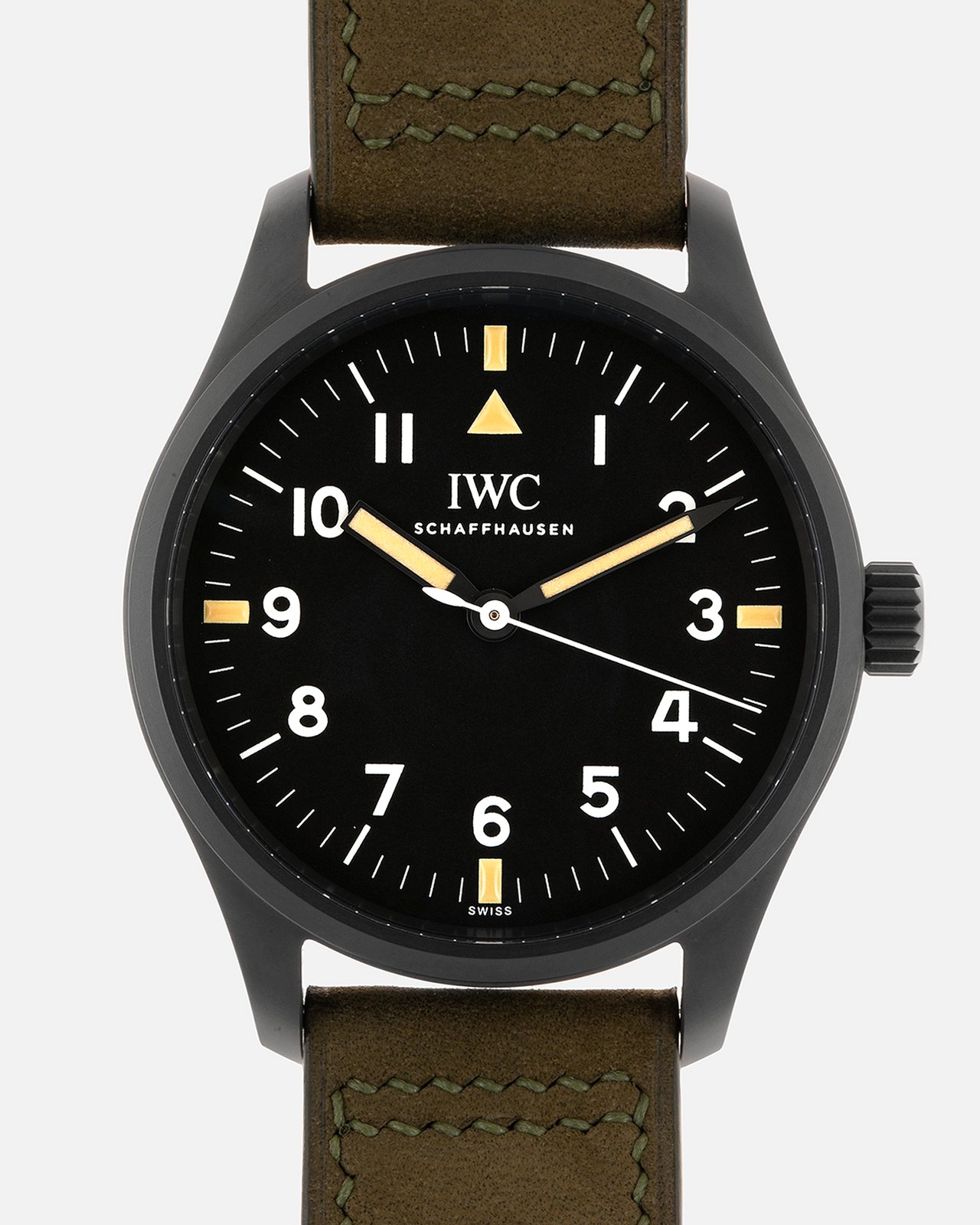
IWC Mark XVIII Hodinkee, 2019
- Maker / attribution
- IWC (maker)
- Date
- 2019
- Historical period
- Contemporary Horology (2010 – Present)
- Country of origin
- Switzerland
- Object type
- Wristwatch
- Dimensions
- Case 39 mm
- Stock no.
- Product 7135413370967
- Credit line
- Dealer listing, S.Song Watches (product 7135413370967)
- Catalogue title (original)
- IWC Mark XVIII Hodinkee (English)
View the source record (dealer listing) ↗ (opens another website in a new tab)Suggest a correction
Record summary
Catalogued by S.Song Watches (dealer), Seattle (stock number Product 7135413370967), this is a wristwatch by IWC, made in Switzerland, dated 2019. The Atlas places it in the Contemporary Horology period (2010 – Present) of its Wristwatches collection. Recorded dimensions: Case 39 mm. The record is illustrated with 6 photographs.
Assembled from the source record's structured fields. Dates and attributions are given as the source states them; where a field is missing the Atlas leaves it blank rather than estimating.
Catalogue description
Dealer description — S.Song Watches
While IWC is predominantly recognized for its pilot watches, there's a hidden gem nestled within the brand's lineup known as the Mark XVIII. For those who do not know, the IWC Mark XVIII is considered by many as one of the most aesthetically faithful and purest modern pilot watches ever produced by IWC. It also signifies IWC’s reversion to the pure, purpose-driven pilot watches of the years past. Offered here today isn't just any Mark XVIII though; this is the IWC Mark XVIII ‘Hodinkee’ edition which was introduced back in 2019 as part of a 500-piece limited edition. This example showcases a design that harkens back to one of IWC's most coveted military pilot watch designs - the Mark 11 from 1948. If you look closer, you’ll see that there are some striking resemblances evident here – clean case lines, a highly legible matte dial, and iconic baton hands with a squared-off hour hand. The watch also features a striking, blacked-out 39mm antimagnetic case crafted from a unique titanium alloy called Ceratanium - a proprietary blend, developed by IWC over 5 years, which offers the combination of the lightweight properties of titanium as well as the scratch resistance of ceramic. Visually, it complements the Mark XVIII exceptionally well, it gives the watch a stealthy and sleeker appearance that adds a whole lot of tactical flair to its traditional utilitarian design. Moving on to the dial of the Mark XVIII, akin to its predecessors, it embodies a simple yet purposeful design ethos, it offers all the essential elements you’ll ever need in a pilot’s watch, nothing more, nothing less. Just like the Mark 11, the black dial features a matte finish adorned with highly sober Arabic numerals and luminous hands. Placed at 12, 3, 6, and 9 o’clock are hour markers which are subtly treated with faux patina. Though I usually harbor reservations regarding the usage of faux patina on dials in general, the application seen on this limited edition is quite minimal and has been tastefully applied without overshadowing its original appeal. Powering the watch from beneath its specially engraved solid caseback is the self-winding IWC Cal. 35100, a no-date movement that beats methodically at 28,800 vph, and holds a power reserve of 42 hours when fully wound. Over the years, I've seen and handled many modern pilot watches from other brands but I find that there are only very few that possess the type of universal appeal typically seen in IWC pilot watches. This is one of those simple yet versatile watches that can effortlessly complement any style and remain timeless in design. It is also perfect for daily wear without attracting undue attention, should you prefer some level of discretion. That being said, whether you're an experienced collector or a rookie looking to start, the Mark XVIII is a failsafe choice, particularly in this Hodinkee limited edition.
Historical context
Contemporary Horology (2010 – Present)
Silicon components, connected watches, optical-lattice research clocks and a thriving independent scene.
Smartwatches became the world's best-selling watches, while mechanical watchmaking focuses on craft, innovation (silicon components, new escapements) and independent makers.
Read the period in the timelineMore wristwatches from this periodEarlier: Mechanical Renaissance
Atlas type guide
Wristwatches
Bracelet watches were worn by women from the early nineteenth century — Breguet made one for Caroline Murat, Queen of Naples, in 1810–12 — but the wristwatch only became a man's instrument with military use and aviation in the early twentieth century. Between the World Wars it overtook the pocket watch; the 1920s and 1930s brought rectangular Art Deco cases, water-resistant cases and the first automatic winding systems.
After 1945 the wristwatch became a carrier of identity — dress watches, sports and dive watches, chronographs, calendars — produced by Swiss, American, Japanese, German, Soviet and Chinese industries. The quartz revolution after 1969 and the mechanical renaissance since the 1990s, including the rise of independent watchmakers, complete the story.
What to look for
- The reference number (between the lugs or inside the case back) and serial number, the starting point for dating.
- The calibre: its maker and number are often stamped under the dial or on the bridge.
- Originality of dial, hands and crown — refinished ('redial') dials are common.
- Case material marks: 18K/750, 14K/585, stainless steel, gold-filled, plated.
Dating clues
- Wire-lug cases: before c. 1925.
- Water-resistant screw-down cases: from 1926.
- Quartz movements: from 1969; sapphire crystals widespread after c. 1980.
General guidance written by the Atlas editors about this kind of object. It is not a statement about this particular piece; for that, rely on the source record above and on physical examination.
Related records
Pocket Watches · c. 1950
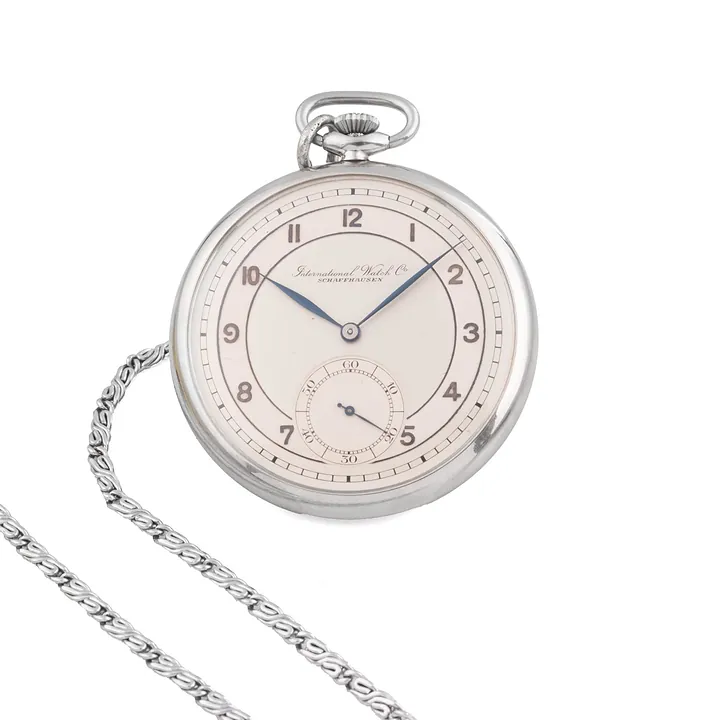
IWC Pocket Watch, c. 1950
Antiquorum auction archive, Geneva
Pocket Watches · c. 1980
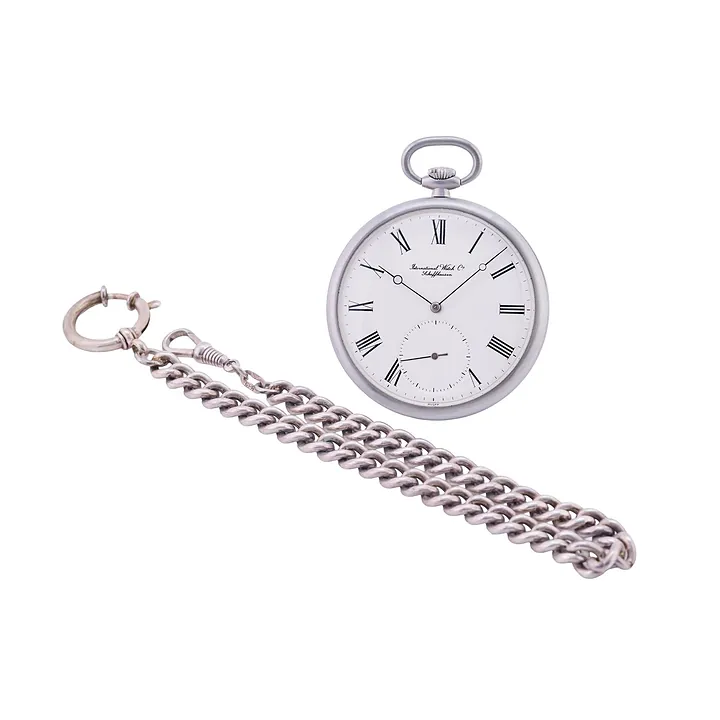
IWC pocket watch, ref. 5301, c. 1980
Antiquorum auction archive, Geneva
Wristwatches · originally sold in April 2016 (per the lot record)
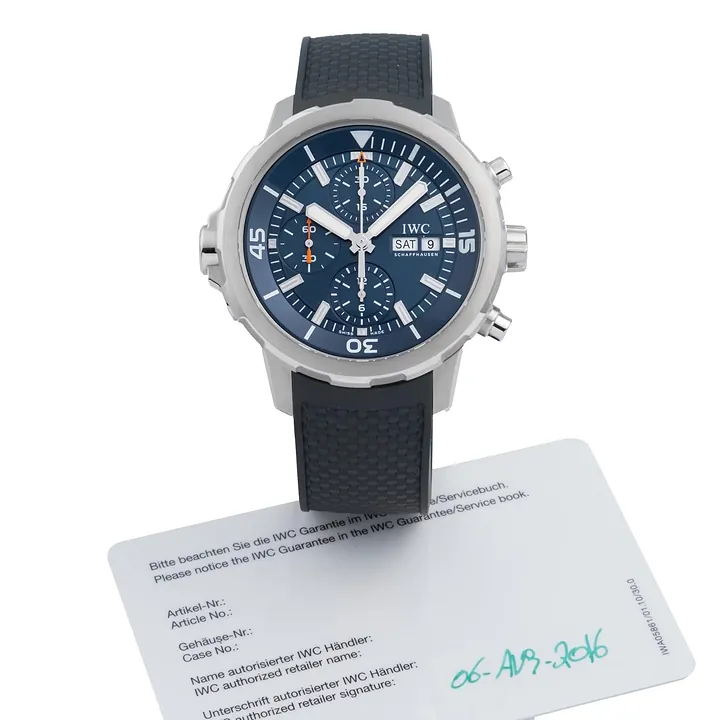
IWC Aquatimer Chronograph Cousteau, ref. IW3768, originally sold in April 2016
Antiquorum auction archive, Geneva
Wristwatches · c. 2010s
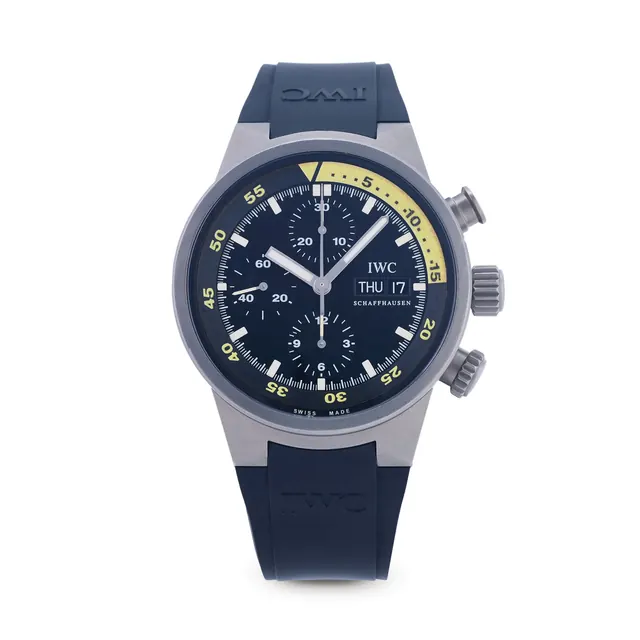
IWC wristwatch, ref. IW371918, Aquatimer, circa 2010s
Antiquorum auction archive, Geneva

Wristwatches · c. 2010s
Breguet Type XXI, ref. 3810, c. 2010s (Antiquorum Lot 381-24)
Antiquorum auction archive, Geneva

Wristwatches · c. 2010s
Breguet Type XXI, ref. 3810, c. 2010s (Antiquorum Lot 386-229)
Antiquorum auction archive, Geneva

Wristwatches · Sold in September 2010
Breitling Cosmonaute, ref. A 22322, Sold in September 2010
Antiquorum auction archive, Geneva

Wristwatches · c. 2010
Corum Bubble Chrono, ref. 396.150.20, c. 2010
Antiquorum auction archive, Geneva