
Wristwatches · Wristwatch
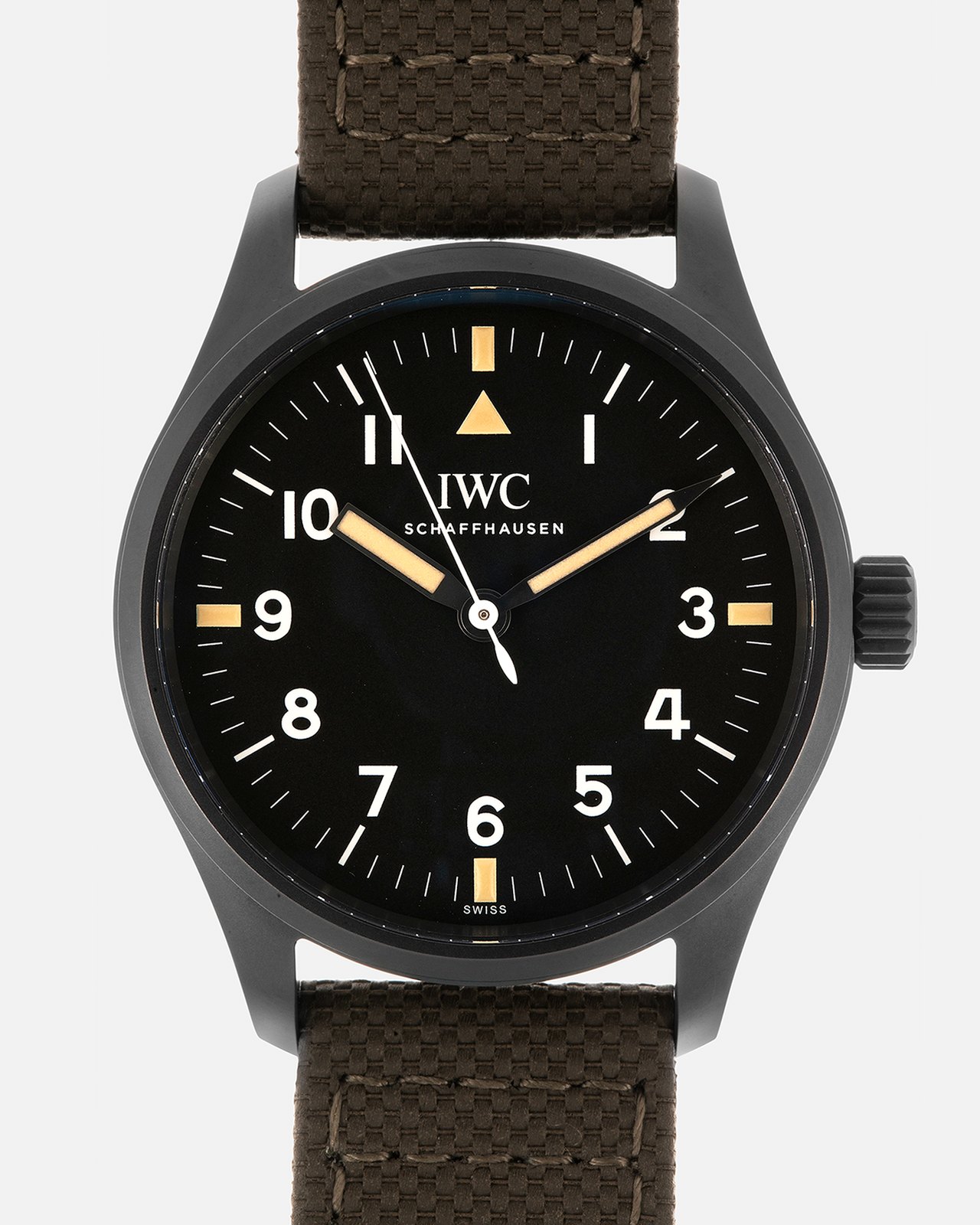
IWC Mark XVIII Hodinkee, 2019
- Maker / attribution
- IWC (maker)
- Date
- 2019
- Historical period
- Contemporary Horology (2010 – Present)
- Country of origin
- Switzerland
- Object type
- Wristwatch
- Dimensions
- Case 39 mm
- Stock no.
- Product 7679813353559
- Credit line
- Dealer listing, S.Song Watches (product 7679813353559)
- Catalogue title (original)
- IWC Mark XVIII Hodinkee (English)
View the source record (dealer listing) ↗ (opens another website in a new tab)Suggest a correction
Record summary
Catalogued by S.Song Watches (dealer), Seattle (stock number Product 7679813353559), this is a wristwatch by IWC, made in Switzerland, dated 2019. The Atlas places it in the Contemporary Horology period (2010 – Present) of its Wristwatches collection. Recorded dimensions: Case 39 mm. The record is illustrated with 6 photographs.
Assembled from the source record's structured fields. Dates and attributions are given as the source states them; where a field is missing the Atlas leaves it blank rather than estimating.
Catalogue description
Dealer description — S.Song Watches
While IWC is best known for its pilot’s watches, the Mark XVIII occupies a distinctive position within the collection. Widely regarded as one of the finest modern interpretations of IWC’s historic aviation watches, it represents a return to the clean, purpose-driven design language that defined the earliest generations of the line. The example offered here is not a standard Mark XVIII, but the Mark XVIII Hodinkee Edition, introduced in 2019 as a limited series of just 500 pieces. Conceived as a tribute to one of IWC’s most desirable military watches, the Mark XI of 1948, it captures much of the character that made the original such an enduring icon. The influence is immediately apparent in the restrained case profile, matte dial, and distinctive baton hands, including the squared-off hour hand synonymous with the Mark XI. That military-inspired approach extends beyond the design itself and into the construction of the watch. Housed in a 39mm Ceratanium case measuring just 10.6mm thick, the Hodinkee Edition feels every bit the modern tool watch. Developed by IWC over a five-year period, Ceratanium combines the lightness of titanium with the surface hardness and scratch resistance of ceramic. The matte black finish feels particularly appropriate here. Rather than pushing the watch into overtly modern territory, it reinforces the understated, utilitarian character that has long defined IWC’s best aviation watches. The dial follows the same philosophy. As with its predecessors, legibility remains the priority. A matte black surface is paired with clear Arabic numerals, luminous hands, and minimal text. At 12, 3, 6, and 9 o’clock, the hour markers feature a subtle faux-patina treatment. While faux patina can often feel contrived on modern watches, the execution here is restrained and serves as a tasteful nod to the Mark XI without becoming a distraction. Beneath the specially engraved solid caseback sits the self-winding IWC Calibre 35100. This robust no-date movement operates at 28,800 vibrations per hour and delivers approximately 42 hours of power reserve when fully wound. Having handled a wide range of modern pilot’s watches over the years, few strike the same balance of versatility and restraint as the Mark XVIII. It remains highly functional without feeling overly specialised, while its proportions make it remarkably easy to wear. What has always appealed to me about the Mark XVIII is its absence of excess. It delivers exactly what it needs to, without chasing vintage nostalgia or modern theatrics. In this Hodinkee Edition, those qualities are elevated further through the use of Ceratanium and a thoughtful tribute to the iconic Mark XI.
Historical context
Contemporary Horology (2010 – Present)
Silicon components, connected watches, optical-lattice research clocks and a thriving independent scene.
Smartwatches became the world's best-selling watches, while mechanical watchmaking focuses on craft, innovation (silicon components, new escapements) and independent makers.
Read the period in the timelineMore wristwatches from this periodEarlier: Mechanical Renaissance
Atlas type guide
Wristwatches
Bracelet watches were worn by women from the early nineteenth century — Breguet made one for Caroline Murat, Queen of Naples, in 1810–12 — but the wristwatch only became a man's instrument with military use and aviation in the early twentieth century. Between the World Wars it overtook the pocket watch; the 1920s and 1930s brought rectangular Art Deco cases, water-resistant cases and the first automatic winding systems.
After 1945 the wristwatch became a carrier of identity — dress watches, sports and dive watches, chronographs, calendars — produced by Swiss, American, Japanese, German, Soviet and Chinese industries. The quartz revolution after 1969 and the mechanical renaissance since the 1990s, including the rise of independent watchmakers, complete the story.
What to look for
- The reference number (between the lugs or inside the case back) and serial number, the starting point for dating.
- The calibre: its maker and number are often stamped under the dial or on the bridge.
- Originality of dial, hands and crown — refinished ('redial') dials are common.
- Case material marks: 18K/750, 14K/585, stainless steel, gold-filled, plated.
Dating clues
- Wire-lug cases: before c. 1925.
- Water-resistant screw-down cases: from 1926.
- Quartz movements: from 1969; sapphire crystals widespread after c. 1980.
General guidance written by the Atlas editors about this kind of object. It is not a statement about this particular piece; for that, rely on the source record above and on physical examination.
Related records
Pocket Watches · c. 1950
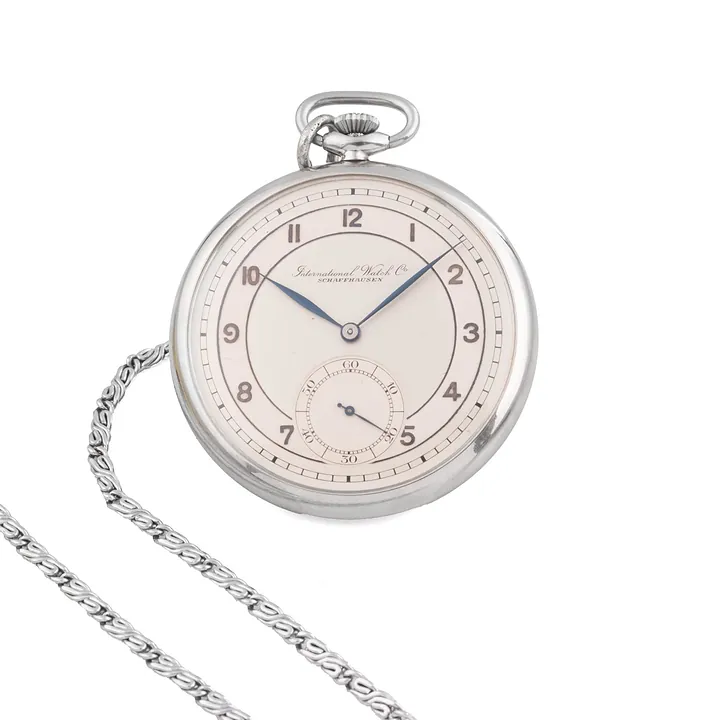
IWC Pocket Watch, c. 1950
Antiquorum auction archive, Geneva
Pocket Watches · c. 1980
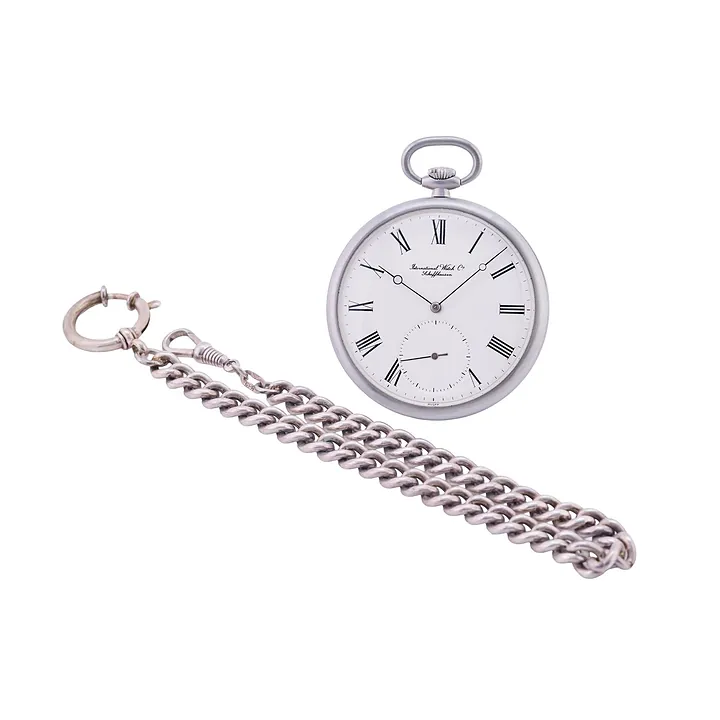
IWC pocket watch, ref. 5301, c. 1980
Antiquorum auction archive, Geneva
Wristwatches · originally sold in April 2016 (per the lot record)
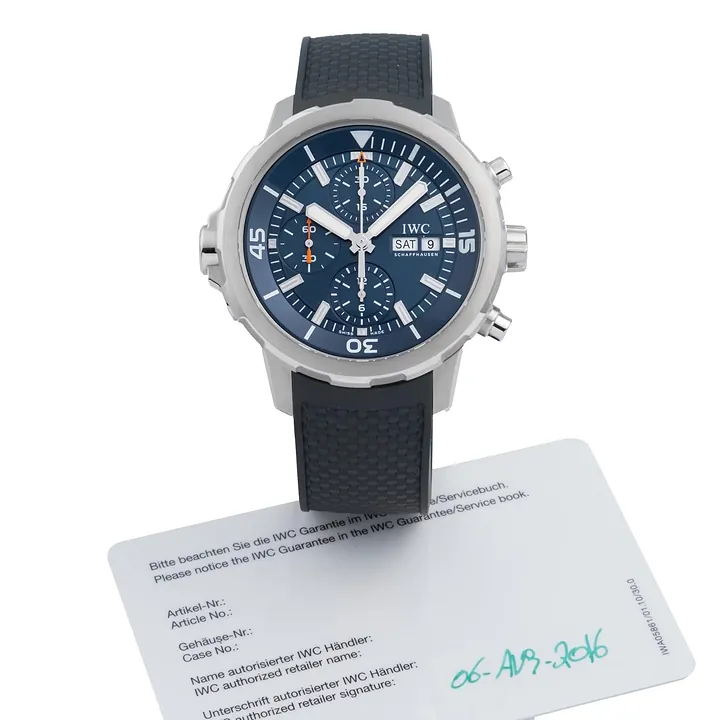
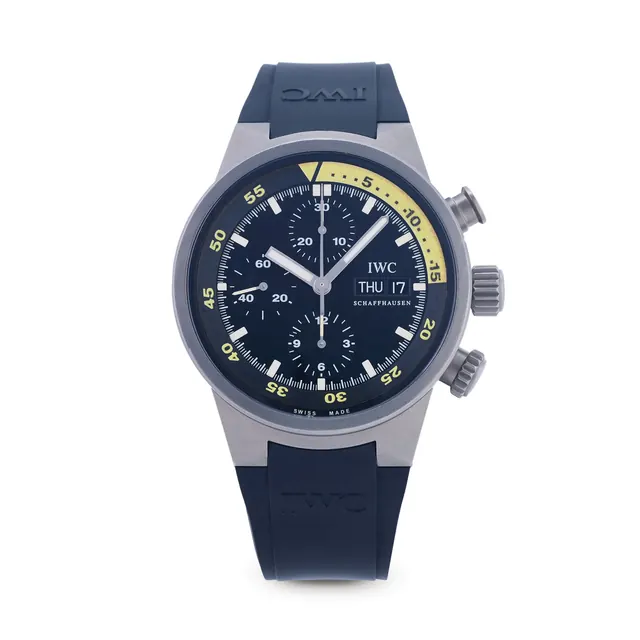
IWC Aquatimer Chronograph Cousteau, ref. IW3768, originally sold in April 2016
Antiquorum auction archive, Geneva
Wristwatches · c. 2010s
IWC wristwatch, ref. IW371918, Aquatimer, circa 2010s
Antiquorum auction archive, Geneva

Wristwatches · c. 2010s
Breguet Type XXI, ref. 3810, c. 2010s (Antiquorum Lot 381-24)
Antiquorum auction archive, Geneva

Wristwatches · c. 2010s
Breguet Type XXI, ref. 3810, c. 2010s (Antiquorum Lot 386-229)
Antiquorum auction archive, Geneva

Wristwatches · Sold in September 2010
Breitling Cosmonaute, ref. A 22322, Sold in September 2010
Antiquorum auction archive, Geneva

Wristwatches · c. 2010
Corum Bubble Chrono, ref. 396.150.20, c. 2010
Antiquorum auction archive, Geneva