
Wristwatches · Wristwatch
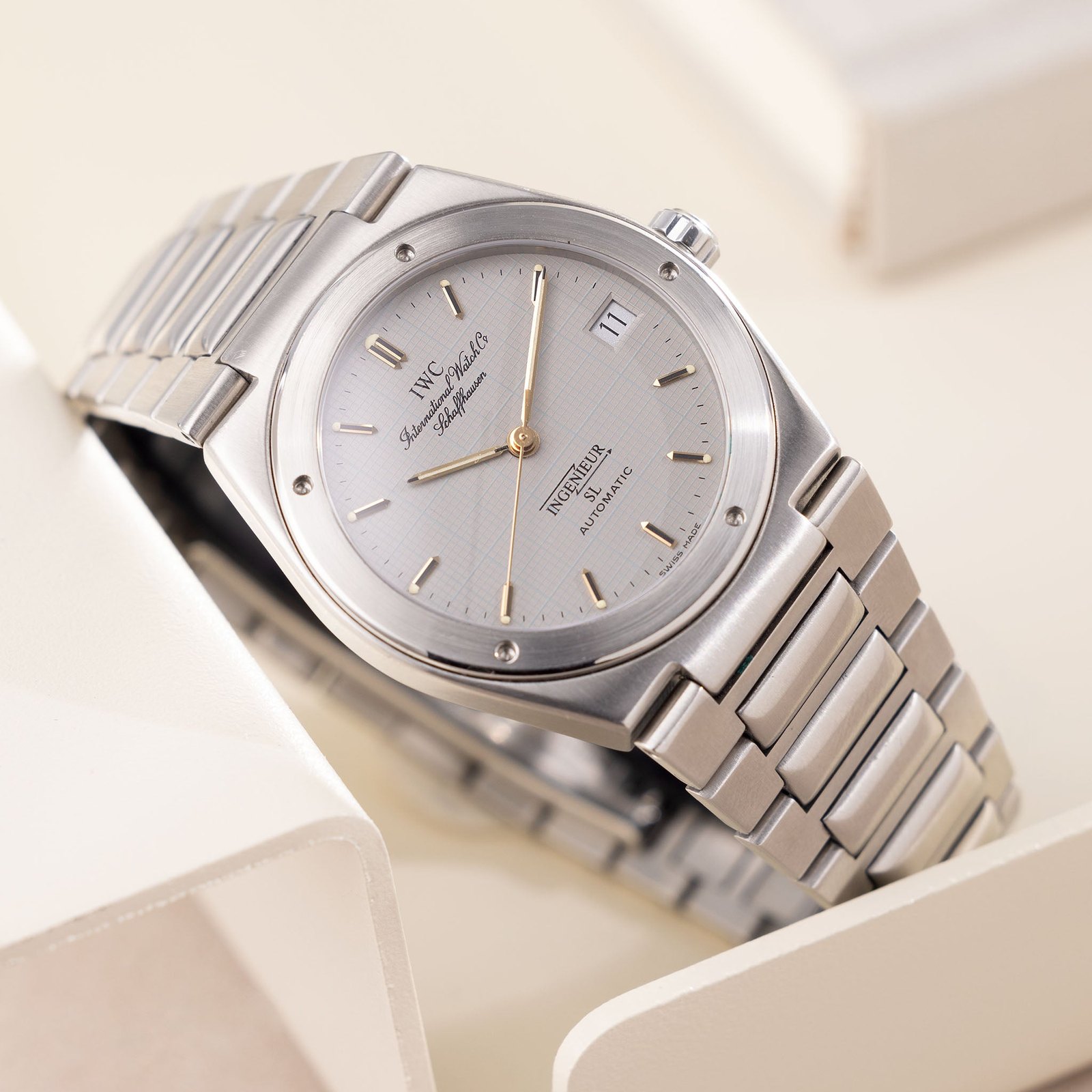
IWC Ingenieur SL Automatic Ref 3506 Grey "Graph Paper Dial", mid 1980s
- Maker / attribution
- IWC (maker)
- Date
- mid 1980s
- Historical period
- Quartz Revolution (1969 – 1990)
- Country of origin
- Switzerland
- Object type
- Wristwatch
- Dimensions
- Case 34 mm
- Stock no.
- W-3003
- Credit line
- Dealer listing, Bulang & Sons (W-3003)
- Catalogue title (original)
- IWC Ingenieur SL Automatic Ref 3506 Grey "Graph Paper Dial" (English)
View the source record (dealer listing) ↗ (opens another website in a new tab)Suggest a correction
Record summary
Catalogued by Bulang & Sons (dealer), Copenhagen (stock number W-3003), this is a wristwatch by IWC, made in Switzerland, dated mid 1980s. The Atlas places it in the Quartz Revolution period (1969 – 1990) of its Wristwatches collection. Recorded dimensions: Case 34 mm. The record is illustrated with 6 photographs.
Assembled from the source record's structured fields. Dates and attributions are given as the source states them; where a field is missing the Atlas leaves it blank rather than estimating.
Catalogue description
Dealer description — Bulang & Sons
In the mid-1970s, IWC decided to redesign the Ingenieur to give it a more "fashion-forward" look. With this new model, IWC aimed to emulate the success of one of its rivals. A few years earlier, Audemars Piguet had struck gold with the luxury steel sports watch, the "Royal Oak," designed by Gérald Genta. In response, IWC brought Genta on board (who also designed the steel Patek Philippe Nautilus) to redesign the Ingenieur, along with two other models: the Golf Club and Polo Club. These watches were part of what IWC called its Collection SL. IWC’s SL catalog from 1976/77 reveals that the SL designation originally stood for “Steel Line,” emphasizing the intention to create a luxury steel watch, inspired by the success of the Royal Oak. However, with the later inclusion of non-steel watches in the SL collection and the passage of time, the SL designation has come to be seen as meaning “Sports Line.” At hand, we have the reference 3506, where the "Jumbo" evolved into a "skinnier" version, with a 34mm case size and a cool, typical Genta-designed 3-row bracelet with a folding clasp that fits wrists up to 19cm. The showstopper here is the grey-ish "Graph Paper Dial" variant, featuring a date function and yellow tritium lume—so cool! The watch is powered by the automatic, gilted cal. 37521 movement, protected by a magnetic inner caseback. We think these variants of the Ingenieur are on the rise and currently a bit undervalued. Get in touch! Specifications: - IWC Ingenieur SL - Reference 3506 - Serial 239XXX dating to the mid-1980s - 34mm steel case - Grey “Graph Paper” dial - Tritium lume - Integrated bracelet - IWC calibre 37521 automatic movement - Fully checked by our watchmaker
Historical context
Quartz Revolution (1969 – 1990)
Seiko's Astron begins mass quartz timekeeping; traditional industries contract sharply.
Quartz and digital watches transformed the market after 1969. Swiss employment collapsed, Japanese and Hong Kong production soared, and the Swatch (1983) helped the Swiss industry recover; mechanical watches survived as luxury goods.
Read the period in the timelineMore wristwatches from this periodEarlier: Modern Mechanical Horology
Atlas type guide
Automatic (self-winding) watches
Self-winding watches use the wearer's motion to wind the mainspring. Abraham-Louis Perrelet and Breguet made 'perpétuelle' pocket watches with oscillating weights in the late eighteenth century, but the principle only became practical in the wristwatch. John Harwood patented a bumper automatic in 1923; Rolex's Perpetual rotor (1931) winding in one direction, and later bidirectional rotors (Eterna, Felsa Bidynator), established the modern form. Micro-rotors (Universal Genève, Buren) and peripheral rotors made automatic watches thinner.
What to look for
- A semicircular rotor turning 360° over the movement, or a 'bumper' weight that rebounds between springs.
- 'Automatic', 'Perpetual' or 'Self-winding' on the dial.
- A sealed screw-back case, since automatic watches are wound less often by the crown.
Dating clues
- Bumper automatics: 1923–c. 1955.
- Full rotors: from 1931 (Rolex); widespread after c. 1950.
- Micro-rotors: from 1954–1958.
General guidance written by the Atlas editors about this kind of object. It is not a statement about this particular piece; for that, rely on the source record above and on physical examination.
Related records
Pocket Watches · c. 1950
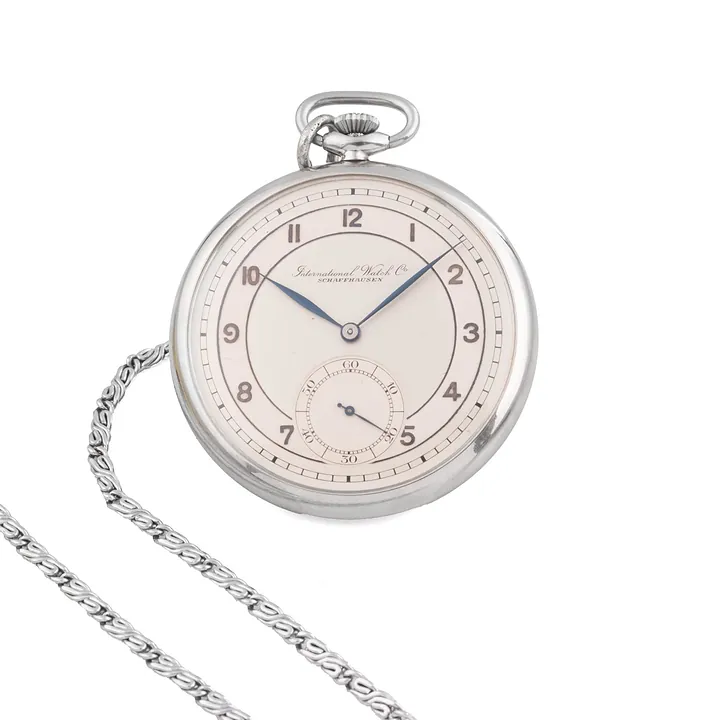
IWC Pocket Watch, c. 1950
Antiquorum auction archive, Geneva
Pocket Watches · c. 1980
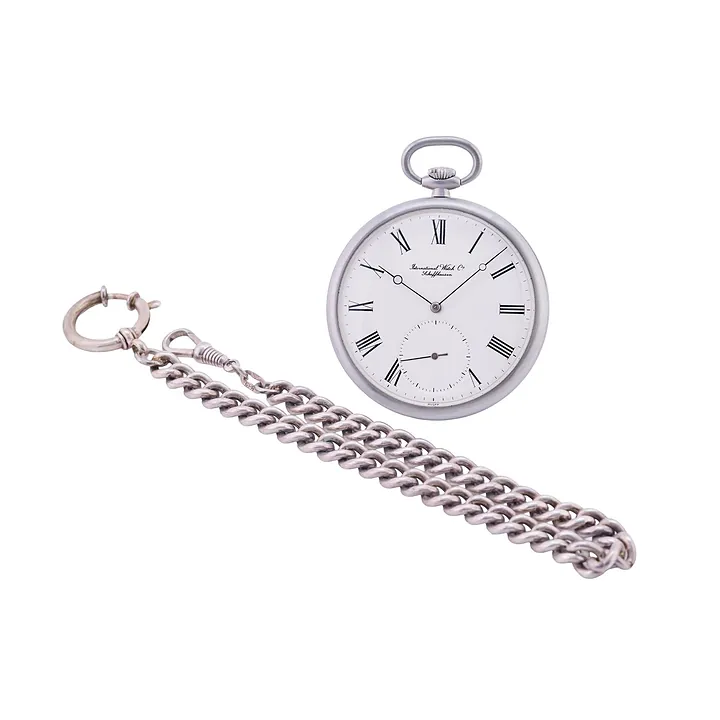
IWC pocket watch, ref. 5301, c. 1980
Antiquorum auction archive, Geneva
Wristwatches · originally sold in April 2016 (per the lot record)
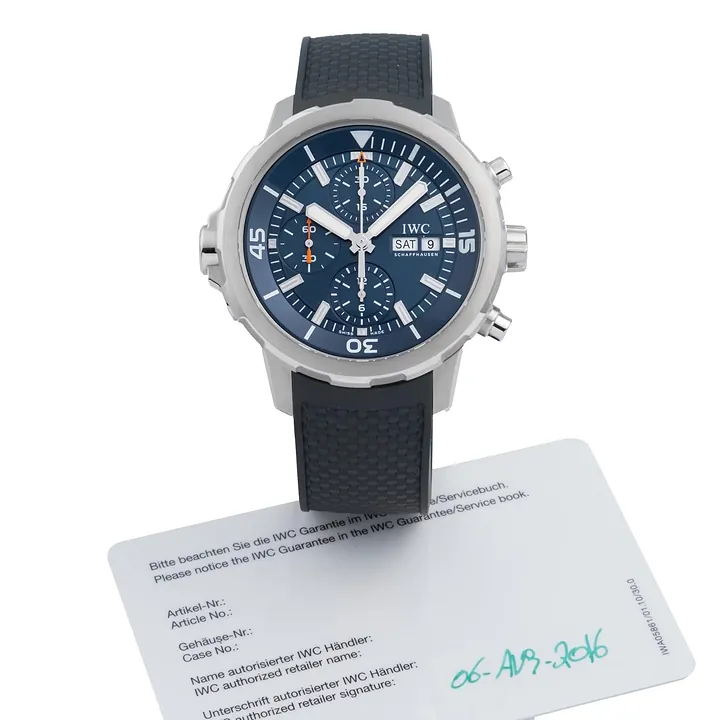
IWC Aquatimer Chronograph Cousteau, ref. IW3768, originally sold in April 2016
Antiquorum auction archive, Geneva
Wristwatches · c. 2010s
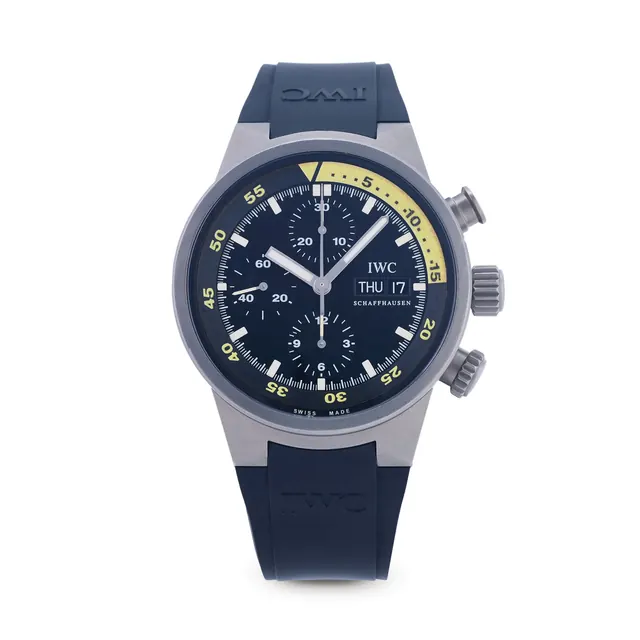
IWC wristwatch, ref. IW371918, Aquatimer, circa 2010s
Antiquorum auction archive, Geneva

Wristwatches · 1970
Wristwatch by Heno, Switzerland, 1970
Museum Rotterdam

Wristwatches · 1960–1986
'Tri-Compax' calendar chronograph wristwatch in gold case, by Universal, Geneva, Switzerland, 1960–1986.
Science Museum Group, London

Wristwatches · 1969–1970
Beta 21 Quartz wristwatch movement, made in Switzerland, 1970.
Science Museum Group, London

Wristwatches · c. 1969
Omega Speedmaster Moonwatch, ref. 145022-69st, c. 1969
Antiquorum auction archive, Geneva