
Wristwatches · Wristwatch
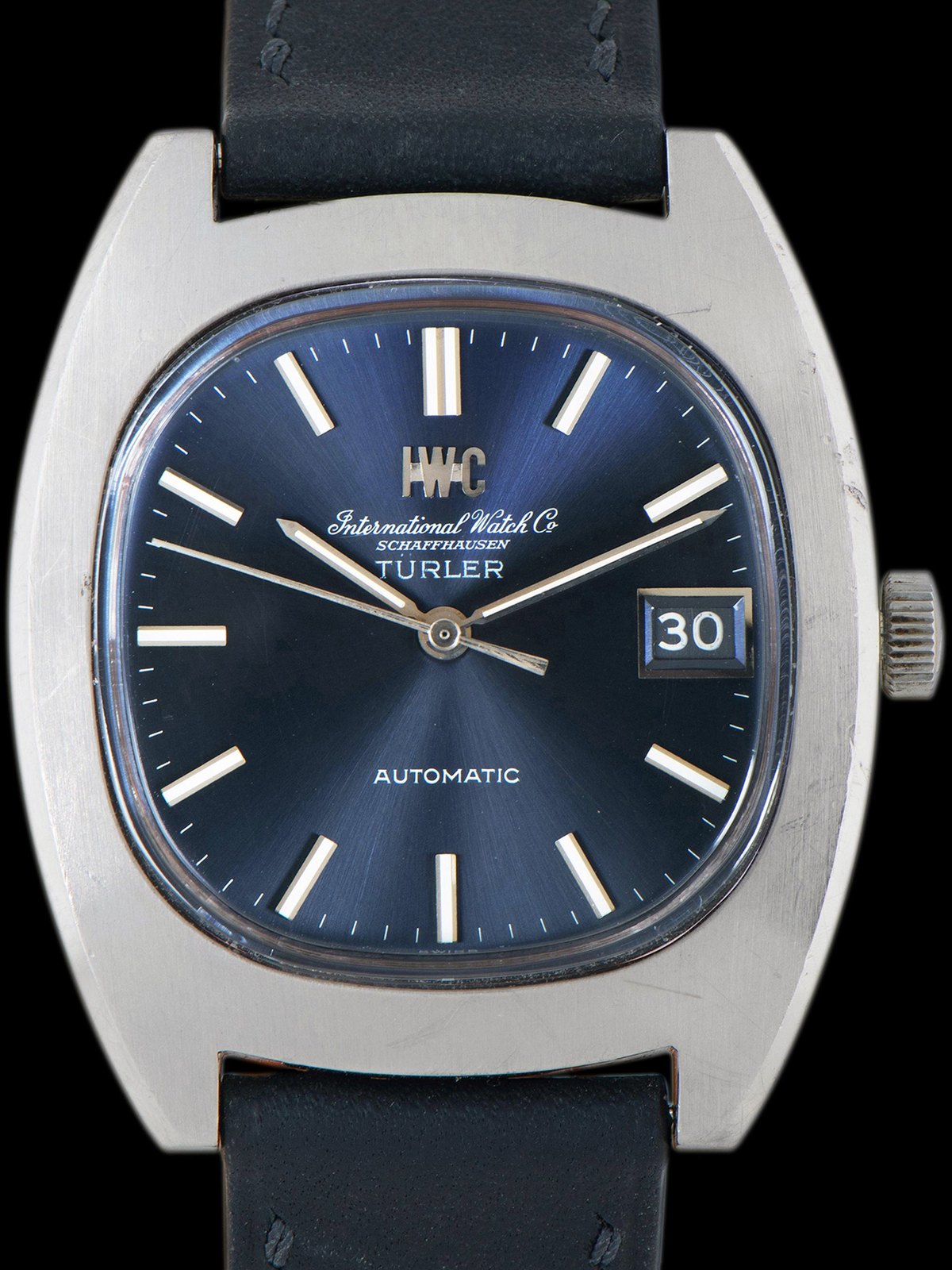
IWC Automatic 'Cal. 8541B' (Ref. 1872) Blue "Turler" Co-Signed Dial, 1970s
- Maker / attribution
- IWC (maker)
- Date
- 1970s
- Historical period
- Quartz Revolution (1969 – 1990)
- Country of origin
- Switzerland
- Object type
- Wristwatch
- Dimensions
- Case 36 mm
- Stock no.
- IWC1872T
- Credit line
- Dealer listing, Craft & Tailored (IWC1872T)
- Catalogue title (original)
- 1970s IWC Automatic 'Cal. 8541B' (Ref. 1872) Blue "Turler" Co-Signed Dial (English)
View the source record (dealer listing) ↗ (opens another website in a new tab)Suggest a correction
Record summary
Catalogued by Craft & Tailored (dealer), Los Angeles (stock number IWC1872T), this is a wristwatch by IWC, made in Switzerland, dated 1970s. The Atlas places it in the Quartz Revolution period (1969 – 1990) of its Wristwatches collection. Recorded dimensions: Case 36 mm. The record is illustrated with 6 photographs.
Assembled from the source record's structured fields. Dates and attributions are given as the source states them; where a field is missing the Atlas leaves it blank rather than estimating.
Catalogue description
Dealer description — Craft & Tailored
Founded more than 150 years ago, the International Watch Company has grown to become one of the most recognizable Swiss watch brands on the planet. And one of the things they're especially famous for is their caliber 85 movement, which is widely regarded as one of the finest watch movements ever made. The cal. 85 was introduced in the 1950s and was the second automatic movement the brand ever made – it was also their first automatic movement with central seconds. That movement went on to birth multiple subsequent versions, including the cal. 852, 853, 854, and finally the 8541B, which beats inside this ref. 1872. Featuring a stout 36mm tonneau-style case with a lightly brushed finish and a gorgeous steely blue dial that's also co-signed with Türler, this particular IWC Automatic is simply stunning with a no-nonsense design that makes for a highly reliable daily wearer. A quick note about Türler: they were a Swiss jeweler established in 1883 by two brothers, Jean Henri and César Alexander Türler. The brothers made a name for themselves by offering their customers the newest and most exclusive Swiss watch brands at the time, including Omega, Longines, IWC, Vacheron Constantin, and Blancpain. After establishing themselves as one of the top retailers in Zurich, Switzerland, and with the prestige the Türler name carried, they started to cosign the dials of some of the watches they offered, not unlike other well-respected retailers at the time. These 20th-century Türler-cosigned watches are now desired by collectors for their rarity and the provenance they carry. SPECS Stock # IWC1872T Brand IWC Style Automatic Model 1872 Serial 21XXXXX Size Men's Material Stainless Steel Dial Blue "Turler" Millimeters 36 Bracelet 2pc Leather Strap CASE & BRACELET The excellent cushion-shaped case is believed to remain unpolished, displaying crisp chamfers and factory finishing throughout with honest wear present. The case retains its original IWC "fish logo" crown. The case back shows some minor watchmaking marks but is otherwise clean, with the factory engraved serial number still highly legible. The watch comes supplied on a two-piece handmade leather strap. DIAL & HANDS The dark, steel-blue dial is simply gorgeous with almost no signs of wear or age. The lume-free hour markers feature white enamel inlays that pop beautifully off the dark dial. Likewise, the hands also have inlaid white enamel that matches the dial perfectly. The IWC logo is applied at 12 o'clock for a three-dimensional feel, and the Türler co-sign sits just below the rest of the dial type. ACCESSORIES
Historical context
Quartz Revolution (1969 – 1990)
Seiko's Astron begins mass quartz timekeeping; traditional industries contract sharply.
Quartz and digital watches transformed the market after 1969. Swiss employment collapsed, Japanese and Hong Kong production soared, and the Swatch (1983) helped the Swiss industry recover; mechanical watches survived as luxury goods.
Read the period in the timelineMore wristwatches from this periodEarlier: Modern Mechanical Horology
Atlas type guide
Automatic (self-winding) watches
Self-winding watches use the wearer's motion to wind the mainspring. Abraham-Louis Perrelet and Breguet made 'perpétuelle' pocket watches with oscillating weights in the late eighteenth century, but the principle only became practical in the wristwatch. John Harwood patented a bumper automatic in 1923; Rolex's Perpetual rotor (1931) winding in one direction, and later bidirectional rotors (Eterna, Felsa Bidynator), established the modern form. Micro-rotors (Universal Genève, Buren) and peripheral rotors made automatic watches thinner.
What to look for
- A semicircular rotor turning 360° over the movement, or a 'bumper' weight that rebounds between springs.
- 'Automatic', 'Perpetual' or 'Self-winding' on the dial.
- A sealed screw-back case, since automatic watches are wound less often by the crown.
Dating clues
- Bumper automatics: 1923–c. 1955.
- Full rotors: from 1931 (Rolex); widespread after c. 1950.
- Micro-rotors: from 1954–1958.
General guidance written by the Atlas editors about this kind of object. It is not a statement about this particular piece; for that, rely on the source record above and on physical examination.
Related records
Pocket Watches · c. 1950
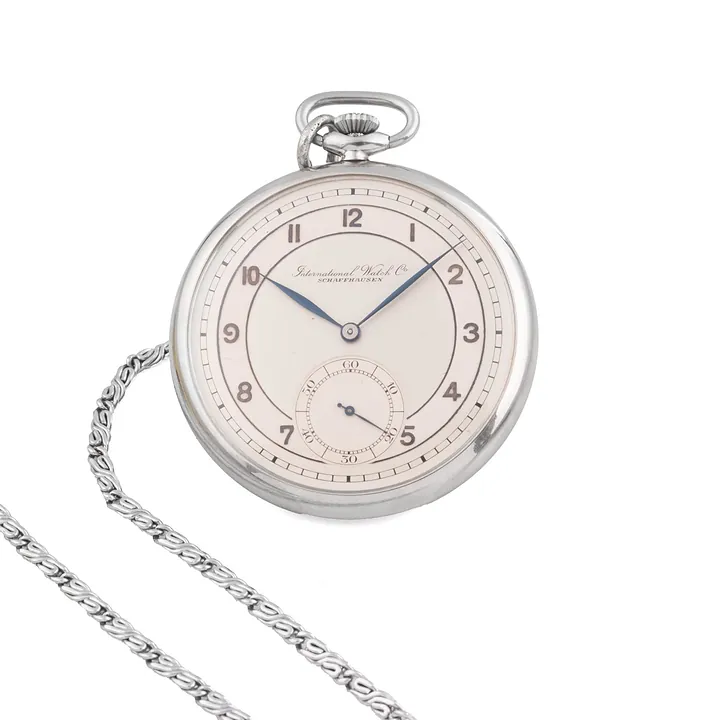
IWC Pocket Watch, c. 1950
Antiquorum auction archive, Geneva
Pocket Watches · c. 1980
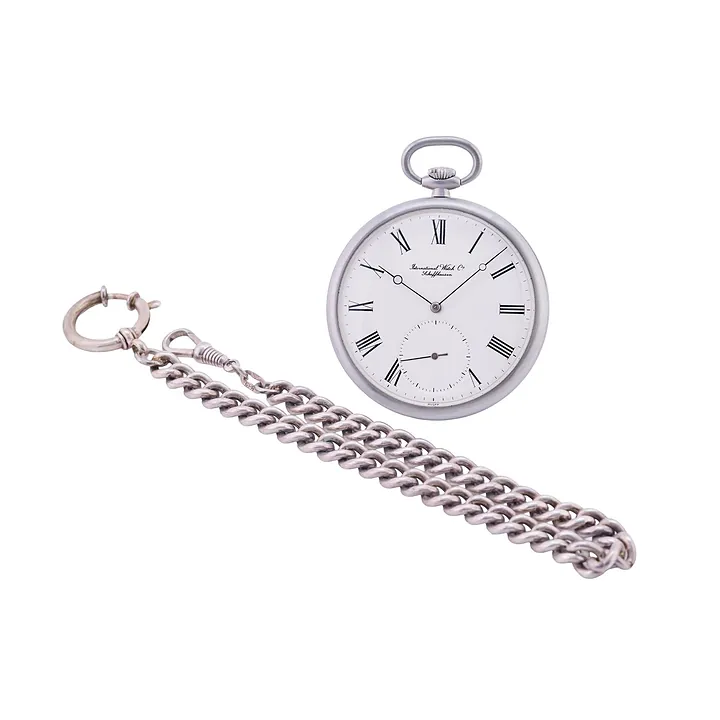
IWC pocket watch, ref. 5301, c. 1980
Antiquorum auction archive, Geneva
Wristwatches · originally sold in April 2016 (per the lot record)
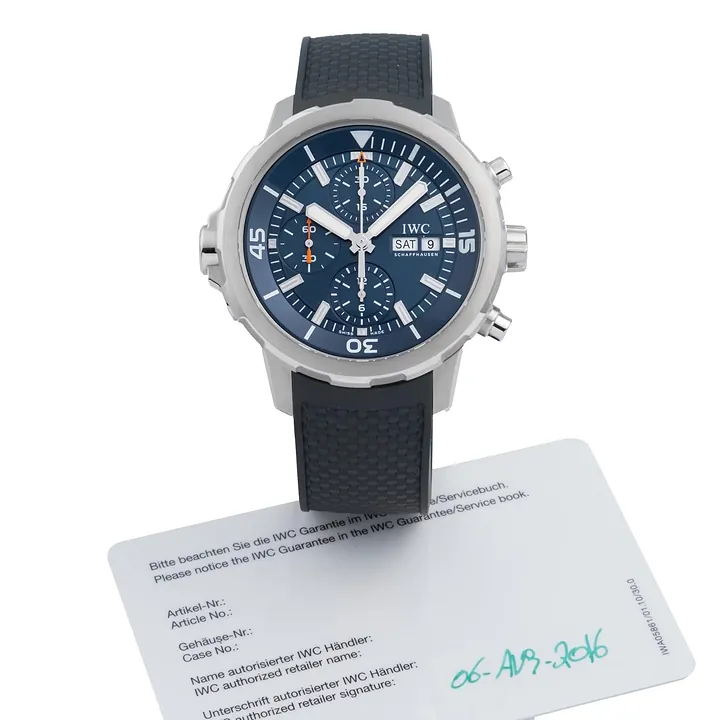
IWC Aquatimer Chronograph Cousteau, ref. IW3768, originally sold in April 2016
Antiquorum auction archive, Geneva
Wristwatches · c. 2010s
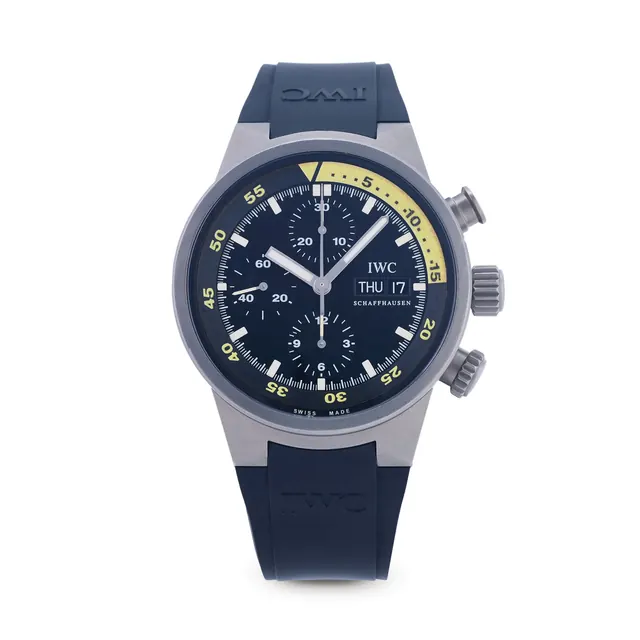
IWC wristwatch, ref. IW371918, Aquatimer, circa 2010s
Antiquorum auction archive, Geneva

Wristwatches · 1970
Wristwatch by Heno, Switzerland, 1970
Museum Rotterdam

Wristwatches · 1960–1986
'Tri-Compax' calendar chronograph wristwatch in gold case, by Universal, Geneva, Switzerland, 1960–1986.
Science Museum Group, London

Wristwatches · 1969–1970
Beta 21 Quartz wristwatch movement, made in Switzerland, 1970.
Science Museum Group, London

Wristwatches · c. 1969
Omega Speedmaster Moonwatch, ref. 145022-69st, c. 1969
Antiquorum auction archive, Geneva