
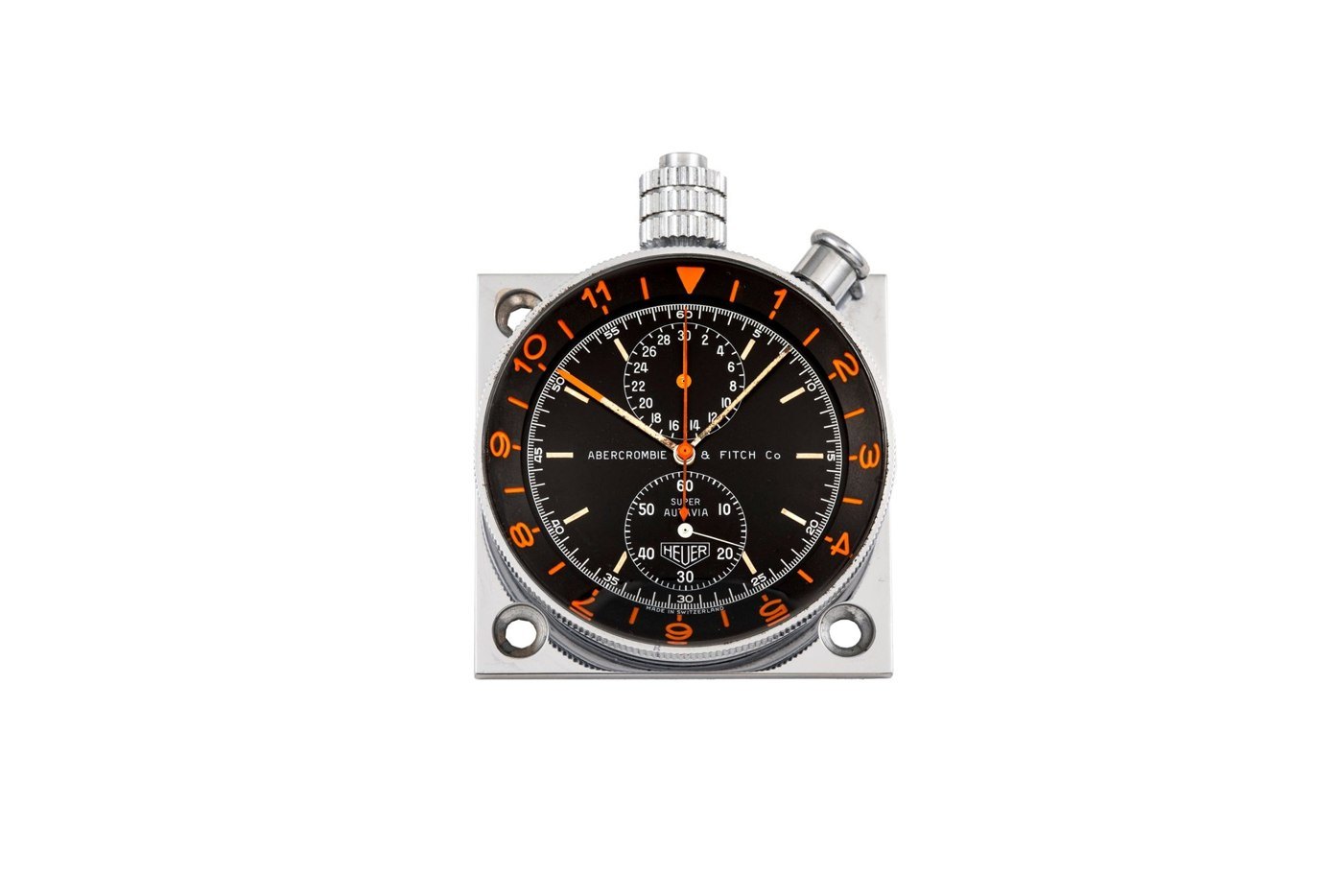
Clocks · Dashboard clock
Heuer Super Autavia Mark I Dashboard Clock and Timer
- Maker / attribution
- Heuer (source attribution)
- Date
- c. 1958
- Historical period
- Modern Mechanical Horology (1945 – 1969)
- Country of origin
- Switzerland
- Object type
- Dashboard clock
- Dimensions
- 55 mm
- Holding institution
- Zamanito
- Accession / object no.
- heuer-super-autavia-mark-i-dashboard-clock-and-timer-e6dba37014
- Credit line
- Zamanito
- Catalogue title (original)
- ساعت داشبورد و تایمر Heuer Super Autavia Mark I برای Abercrombie & Fitch (English)
View the source record ↗ (opens another website in a new tab)Suggest a correction
Record summary
Held and catalogued by Zamanito (object number heuer-super-autavia-mark-i-dashboard-clock-and-timer-e6dba37014), this is a dashboard clock attributed to Heuer, made in Switzerland, dated c. 1958. The Atlas places it in the Modern Mechanical Horology period (1945 – 1969) of its Clocks collection. Recorded dimensions: 55 mm. The record is illustrated with 1 photograph.
Assembled from the source record's structured fields. Dates and attributions are given as the source states them; where a field is missing the Atlas leaves it blank rather than estimating.
Catalogue description
Original object description
Dating to circa 1958 and commissioned for Abercrombie & Fitch in New York, this Heuer Super Autavia Mark I is an early example from the model line designed to record elapsed intervals up to 12 hours for rally, automotive, or aviation use. Its 55 mm round body with an acrylic crystal is affixed to an approximately 2.5 by 2.5-inch square steel plate drilled with four corner mounting holes. Operating controls sit atop the case, comprising an oversized ribbed winding and setting crown paired with a primary chronograph pusher at 12 o'clock, alongside an auxiliary reset button at 1 o'clock. The instrument is equipped with a bidirectional rotating bezel marked with an orange 12-hour track. The matte black dial features luminescent indicators, continuous running seconds at 6 o'clock, and a 30-minute accumulator at 12 o'clock, with hands and plots showing a uniform aged patina. A manual-wind Valjoux 76 caliber powers the unit. Catalogued in near-new condition, the clock lacks recorded mechanical service history.
Historical context
Modern Mechanical Horology (1945 – 1969)
Tool watches for divers, pilots and astronauts; electric watches anticipate the electronic age.
Post-war clocks combined new materials and industrial design: plastic and metal cases, battery-powered transistor movements from the late 1950s, and design classics by George Nelson, Max Bill and others. The first caesium atomic clock (1955) moved the definition of time from astronomy to physics.
Read the period in the timelineMore clocks from this periodEarlier: Golden Age of Mechanical Watchmaking
Atlas type guide
Timers, stopwatches, chronoscopes and time recorders
Instruments for measuring short intervals or recording when something happened form a large and practical branch of horology. Sports stopwatches and split-seconds timers, laboratory chronoscopes (such as Hipp's, which measured thousandths of a second for psychology and ballistics experiments), metronomes for music, watchmen's clocks that recorded patrol rounds, and the time recorders that clocked factory workers in and out all derive from clock and watch technology.
These objects matter historically because they show timekeeping leaving the observatory and the drawing room and entering industry, science and sport. Many were mass-produced, and their dials, scales and patents chart the rise of electrification and industrial management.
What to look for
- Scales graduated in fifths, tenths or hundredths of a second, or decimal minutes for industrial use.
- Start, stop and reset push-pieces; a second hand that can be stopped independently (split seconds).
- Recording devices: paper discs or tapes, printing mechanisms, keys or punches.
- Patent numbers and dates on the dial or case, which give a terminus post quem.
Dating clues
- Hipp chronoscopes were made from the 1840s into the twentieth century.
- Employee time recorders spread from the 1890s (Bundy, IBM, International Time Recording Co.).
- Quartz and electronic timers replaced mechanical stopwatches in sport from the 1970s.
General guidance written by the Atlas editors about this kind of object. It is not a statement about this particular piece; for that, rely on the source record above and on physical examination.
Read next:Flyback chronograph
Related records
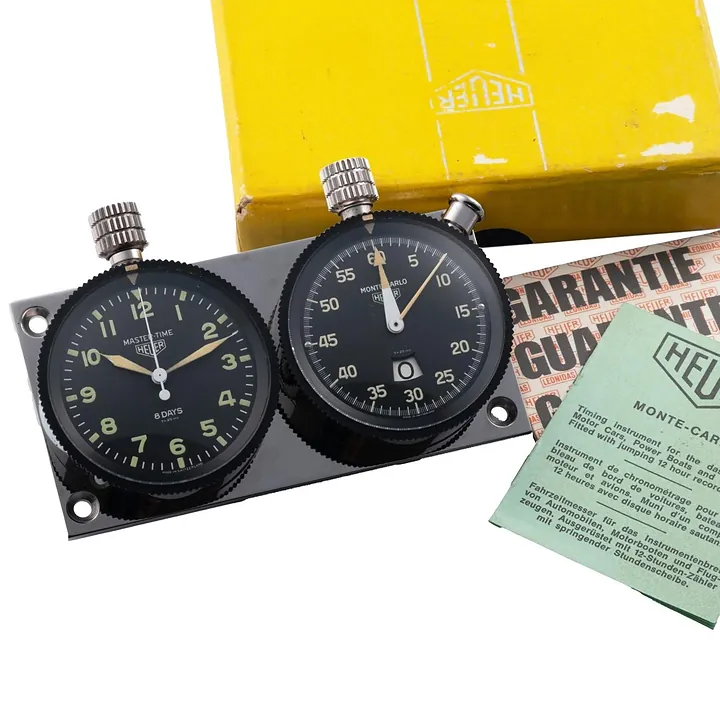
Pocket Watches · c. 1960
Heuer Racing SET, c. 1960
Antiquorum auction archive, Geneva
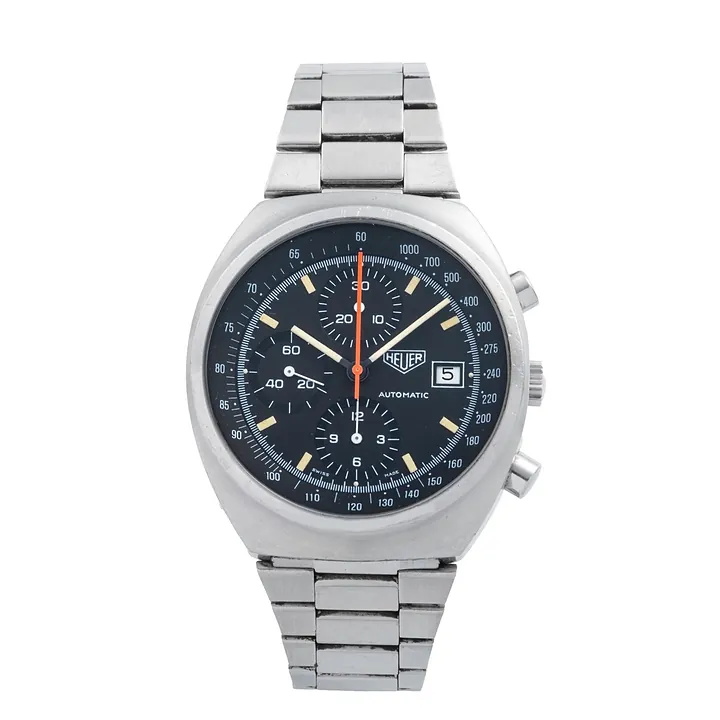
Wristwatches · c. 1980
Heuer Pasadena, ref. 750.501-3, c. 1980
Antiquorum auction archive, Geneva
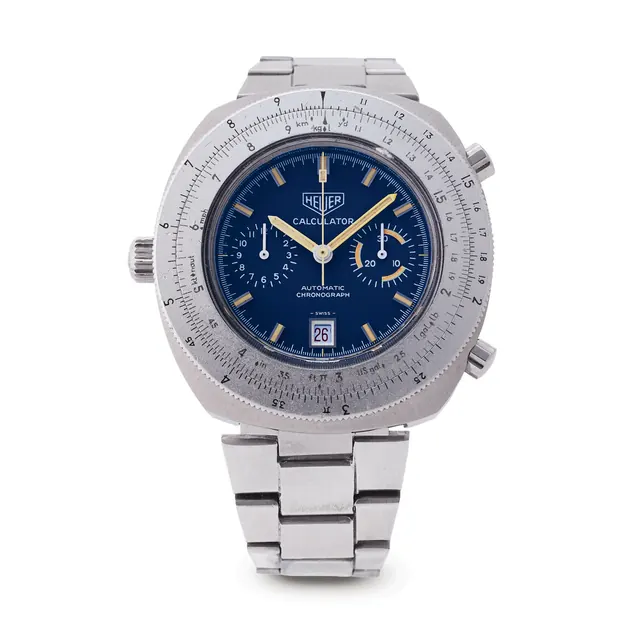
Wristwatches · c. 1970s
Heuer wristwatch, ref. 110.633, Calculator, circa 1970s
Antiquorum auction archive, Geneva
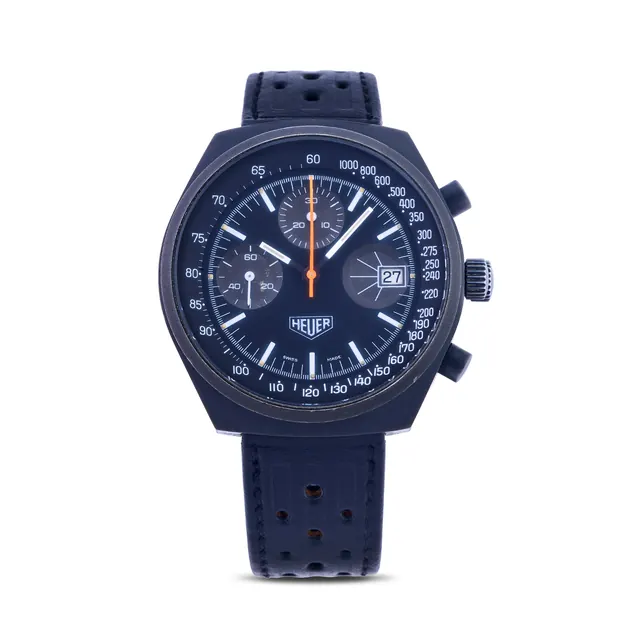
Wristwatches · c. 1975
Heuer wristwatch, ref. 13/1, circa 1975
Antiquorum auction archive, Geneva
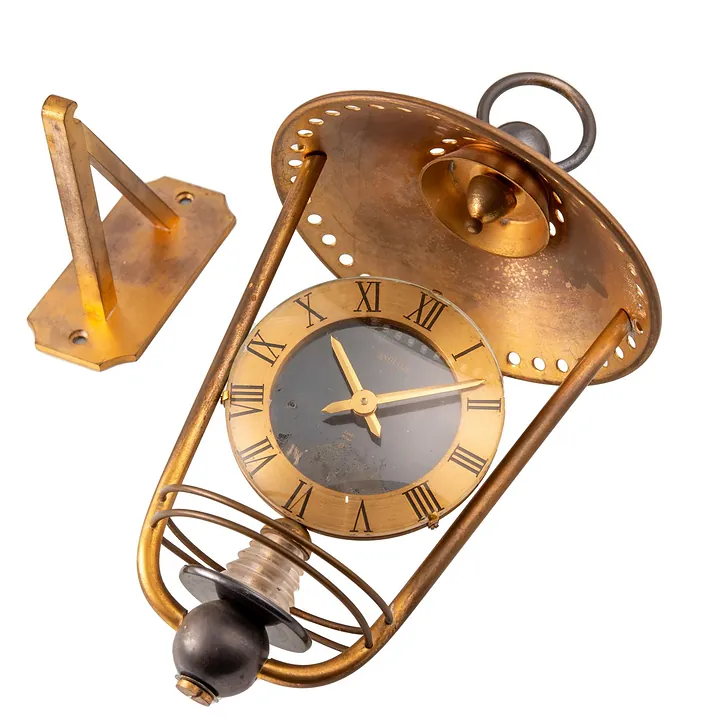
Clocks · c. 1950
Angelus Retailed by Gobbi, Milano, c. 1950
Antiquorum auction archive, Geneva
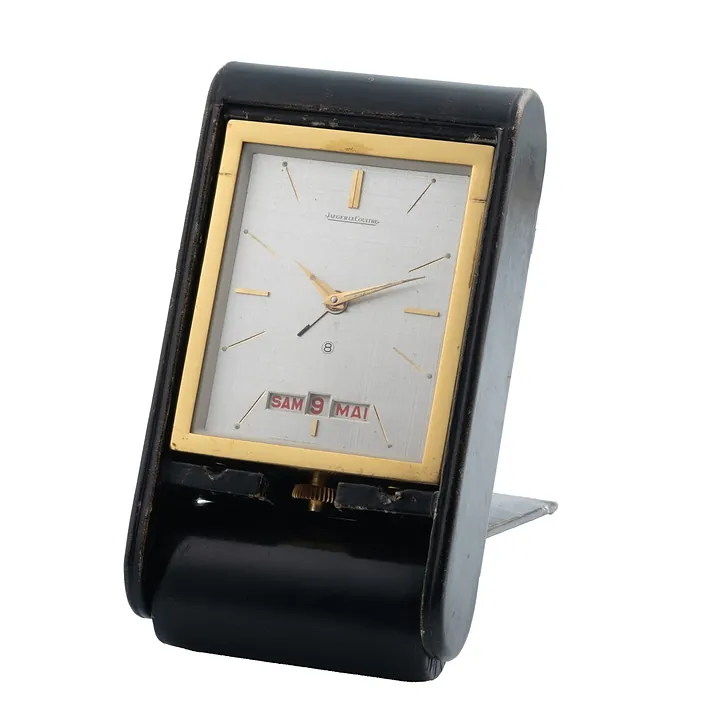
Clocks · c. 1960s
Jaeger Lecoultre Ados Calendrier, c. 1960s
Antiquorum auction archive, Geneva
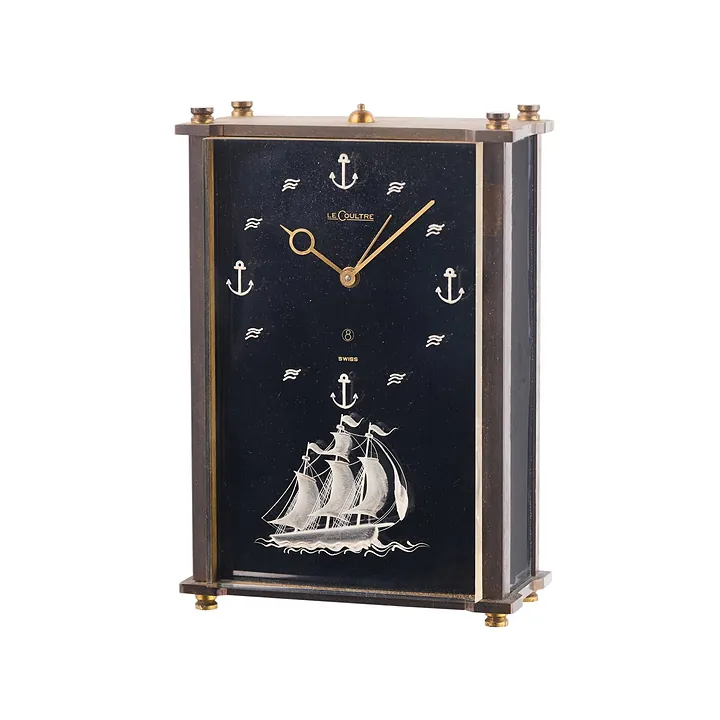
Clocks · c. 1960s
Lecoultre Music Alarm, ref. 2163, c. 1960s
Antiquorum auction archive, Geneva
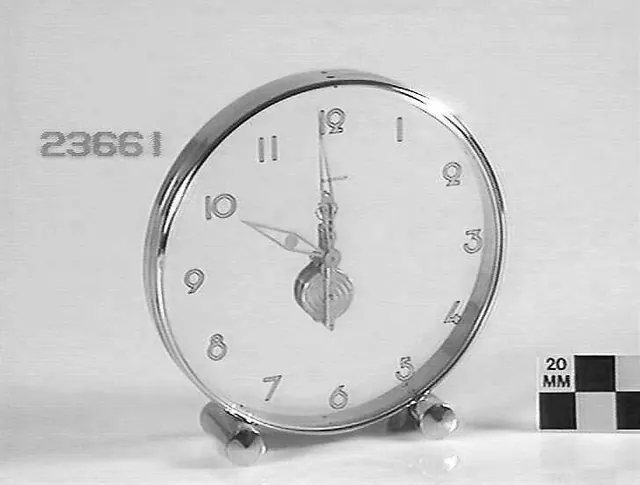
Clocks · 1953
Mantel Clock - Jaeger-LeCoultre, Switzerland, 1953
Museums Victoria, Melbourne