
Wristwatches · Wristwatch
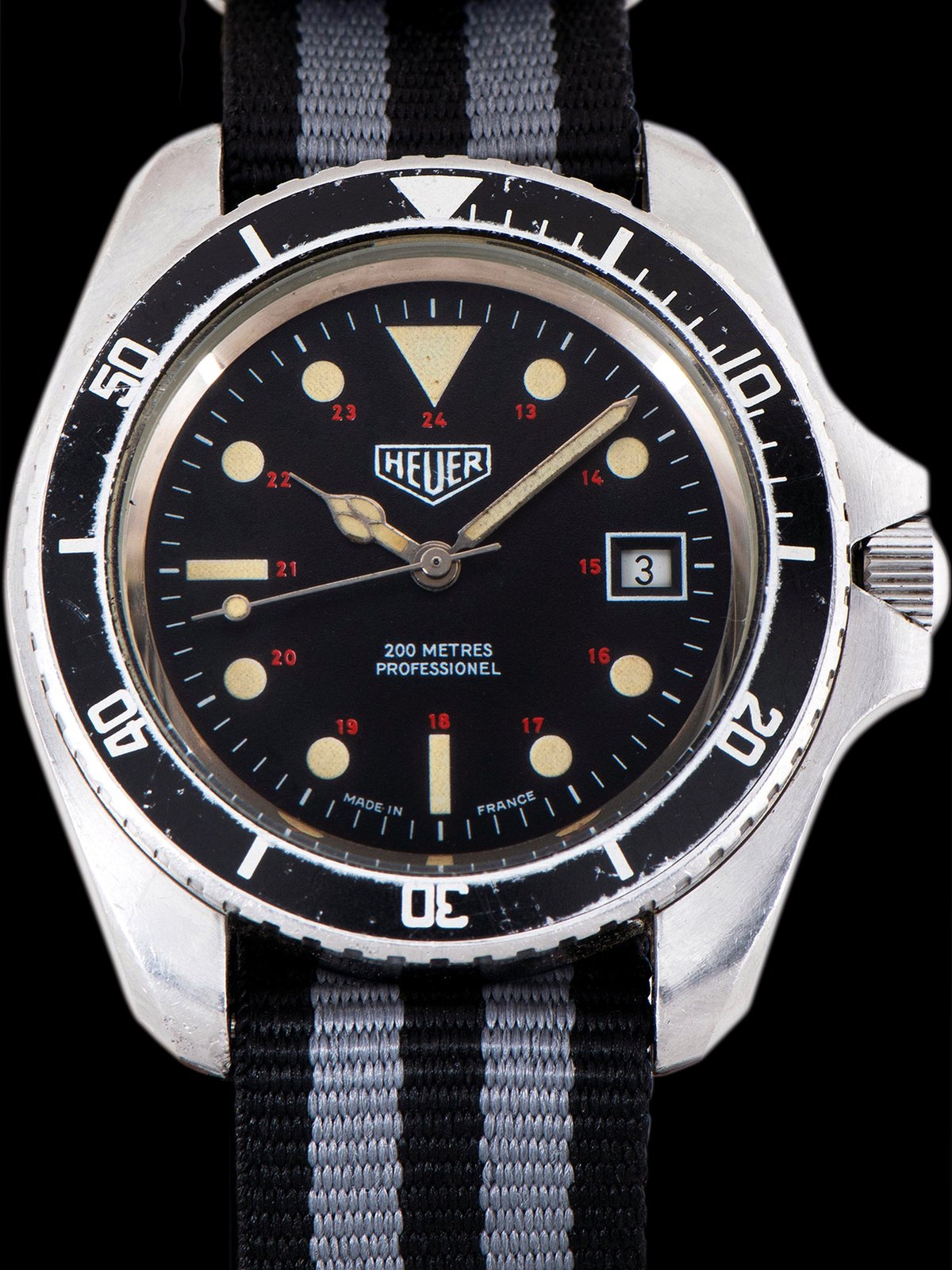
Heuer Professional Diver "Monnin Case" (Ref. 844) Mk I, 1970s
- Maker / attribution
- Heuer (maker)
- Date
- 1970s
- Historical period
- Quartz Revolution (1969 – 1990)
- Country of origin
- Switzerland
- Object type
- Wristwatch
- Stock no.
- HURPRDV8441-2
- Credit line
- Dealer listing, Craft & Tailored (HURPRDV8441-2)
- Catalogue title (original)
- 1970s Heuer Professional Diver "Monnin Case" (Ref. 844) Mk I (English)
View the source record (dealer listing) ↗ (opens another website in a new tab)Suggest a correction
Record summary
Catalogued by Craft & Tailored (dealer), Los Angeles (stock number HURPRDV8441-2), this is a wristwatch by Heuer, made in Switzerland, dated 1970s. The Atlas places it in the Quartz Revolution period (1969 – 1990) of its Wristwatches collection. The record is illustrated with 6 photographs.
Assembled from the source record's structured fields. Dates and attributions are given as the source states them; where a field is missing the Atlas leaves it blank rather than estimating.
Catalogue description
Dealer description — Craft & Tailored
By the 1970s, the Heuer brand had already amassed a rich pedigree as a watchmaker, though most of this success came from their innovations within the chronograph sector of watchmaking. And while these incredible watches, such as the Carrera and Autavia, were technically "water resistant", Heuer's first delve into the professional dive watch market wasn't until the ref. 844, known most notably for its French designer Gerald Monnin. Uncharacteristically for Heuer, the ref. 844 was an immediate commercial success. This sudden demand spawned rapid changes within the reference; these variations or "Marks" all carry distinct characteristics that set them apart from one another, with varying levels of value and collectibility attached. However, the very first version of the ref. 844, the Mark I, remains extremely collectible today. The ref. 844 Mk I, along with the Mk II, were made entirely in France before production was moved to Switzerland for the later variants. The Mk I most notably employs ornate, cathedral-style hands with a dial featuring a military-inspired red 24hr scale and text that reads "METRES" and "PROFESSIONEL" instead of the "Meters" and "Professional" seen on the later models. SPECS Stock # HURPRDV8441-2 Brand Heuer Style Professional Diver Model 844 "Mk. I" Serial 97XX Size Men's Material Stainless Steel Dial Matte Black Millimeters 42 Strap Black & Grey Nylon NATO Strap CASE & BRACELET The French-Made case is in impressive, honestly-worn condition, showing no notable evidence of prior polishing, with the original factory chamfers and geometry still fully intact. The original uni-directional bezel remains deep black in color, though it does exhibit consistent light wear throughout. The unsigned screw-down crown is original and correct for this watch. The case back retains all of its original factory markings in crisp condition. The watch comes supplied on a black and grey nylon NATO strap. DIAL & HANDS The original matte black Mk I dial is truly incredible and remains in virtually flawless condition, showing no damage or age. The tritium lume plots have achieved a beautiful creamy patina with no notable degradation present under U.V. light inspection. The original cathedral-style tritium hands match the dial perfectly with no degradation present under UV light. ACCESSORIES
Historical context
Quartz Revolution (1969 – 1990)
Seiko's Astron begins mass quartz timekeeping; traditional industries contract sharply.
Quartz and digital watches transformed the market after 1969. Swiss employment collapsed, Japanese and Hong Kong production soared, and the Swatch (1983) helped the Swiss industry recover; mechanical watches survived as luxury goods.
Read the period in the timelineMore wristwatches from this periodEarlier: Modern Mechanical Horology
Atlas type guide
Dive and water-resistant watches
Keeping water and dust out of a wristwatch was a long-standing challenge. Rolex's screw-down Oyster case (1926) and Omega's Marine (1932) were landmarks; in the early 1950s Blancpain's Fifty Fathoms and Rolex's Submariner defined the professional dive watch with rotating bezels for timing dives, luminous dials and high water resistance. The ISO 6425 standard (1982) later codified what a 'diver's watch' must do.
Dive watches became icons of post-war design and exploration, and their evolution — helium escape valves, ceramic bezels, saturation-diving depth ratings — records the history of underwater work.
What to look for
- Unidirectional or bidirectional rotating bezel with minute markings.
- Screw-down crown and case back; depth rating printed on the dial.
- Luminous hands and markers (radium before c. 1960, tritium c. 1960–1998, then Super-LumiNova).
- Reference numbers on the case between the lugs or inside the back.
Dating clues
- Screw-down Oyster cases: from 1926.
- Professional dive watches: from 1953.
- Tritium 'T' marks on dials: c. 1960–1998.
General guidance written by the Atlas editors about this kind of object. It is not a statement about this particular piece; for that, rely on the source record above and on physical examination.
Related records
Pocket Watches · c. 1960
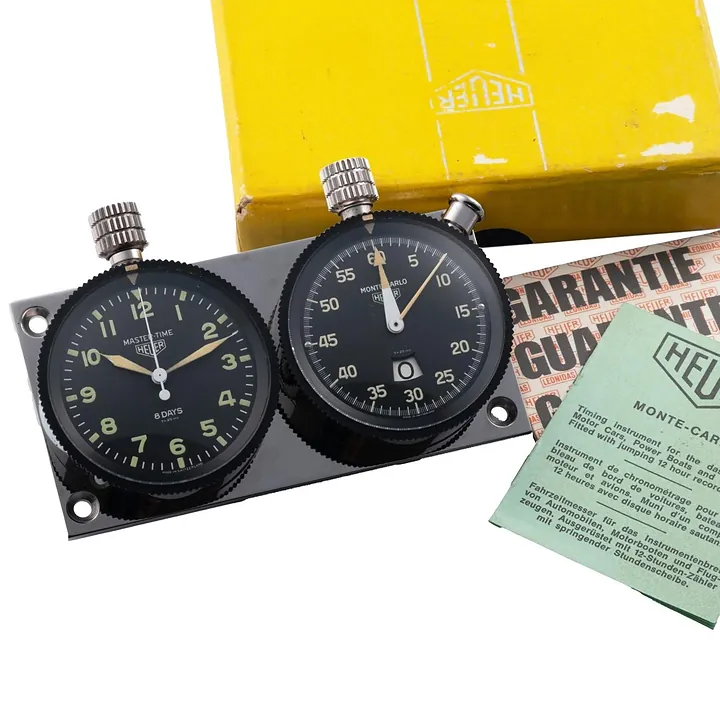
Heuer Racing SET, c. 1960
Antiquorum auction archive, Geneva
Wristwatches · c. 1980
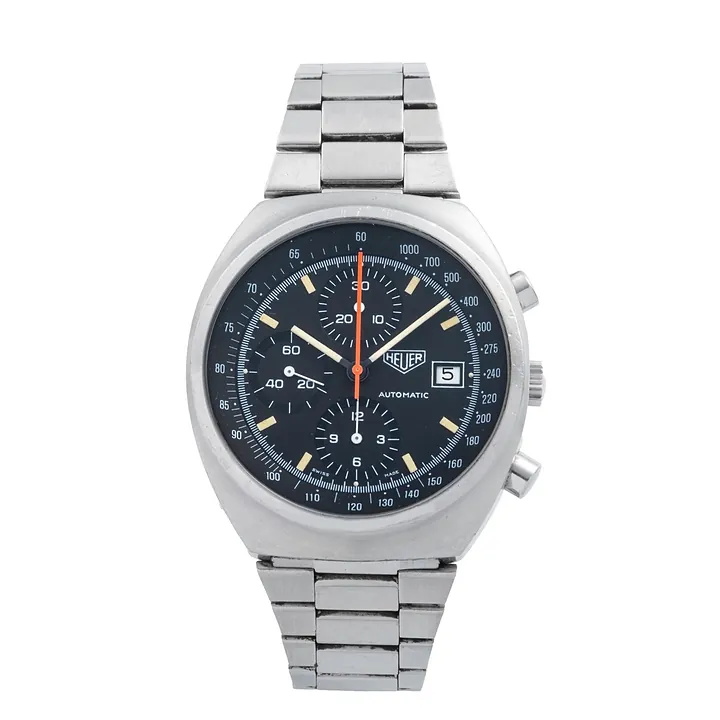
Heuer Pasadena, ref. 750.501-3, c. 1980
Antiquorum auction archive, Geneva
Wristwatches · c. 1970s
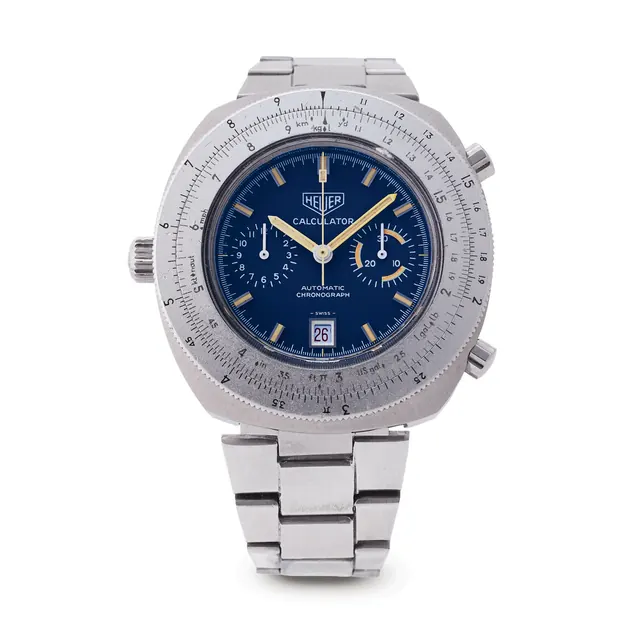
Heuer wristwatch, ref. 110.633, Calculator, circa 1970s
Antiquorum auction archive, Geneva
Wristwatches · c. 1975
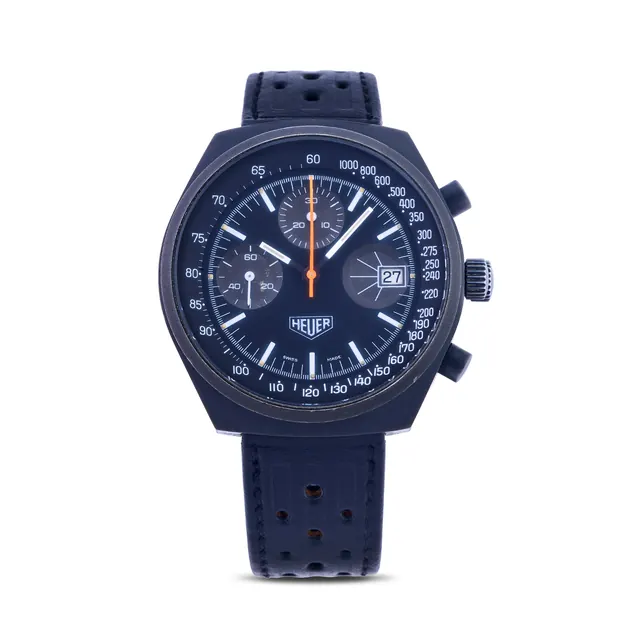
Heuer wristwatch, ref. 13/1, circa 1975
Antiquorum auction archive, Geneva

Wristwatches · 1970
Wristwatch by Heno, Switzerland, 1970
Museum Rotterdam

Wristwatches · 1960–1986
'Tri-Compax' calendar chronograph wristwatch in gold case, by Universal, Geneva, Switzerland, 1960–1986.
Science Museum Group, London

Wristwatches · 1969–1970
Beta 21 Quartz wristwatch movement, made in Switzerland, 1970.
Science Museum Group, London

Wristwatches · c. 1969
Omega Speedmaster Moonwatch, ref. 145022-69st, c. 1969
Antiquorum auction archive, Geneva