
Wristwatches · Wristwatch
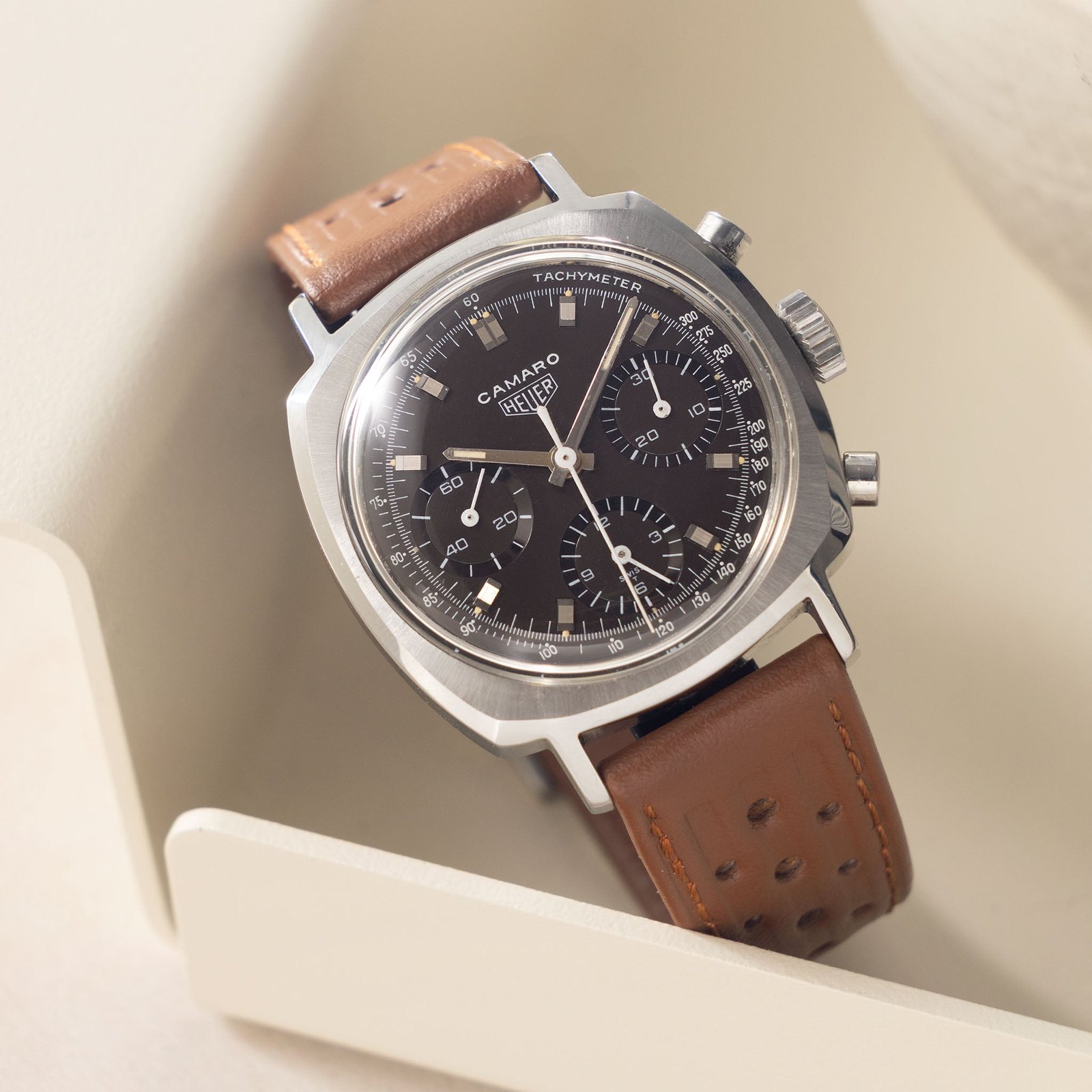
Heuer Camaro “Tachymeter” Brown Dial ref 7220, late 1960s
- Maker / attribution
- Heuer (maker)
- Date
- late 1960s
- Historical period
- Modern Mechanical Horology (1945 – 1969)
- Country of origin
- Switzerland
- Object type
- Wristwatch
- Dimensions
- Case 37 mm
- Stock no.
- W-3087
- Credit line
- Dealer listing, Bulang & Sons (W-3087)
- Catalogue title (original)
- Heuer Camaro “Tachymeter” Brown Dial ref 7220 (English)
View the source record (dealer listing) ↗ (opens another website in a new tab)Suggest a correction
Record summary
Catalogued by Bulang & Sons (dealer), Copenhagen (stock number W-3087), this is a wristwatch by Heuer, made in Switzerland, dated late 1960s. The Atlas places it in the Modern Mechanical Horology period (1945 – 1969) of its Wristwatches collection. Recorded dimensions: Case 37 mm. The record is illustrated with 6 photographs.
Assembled from the source record's structured fields. Dates and attributions are given as the source states them; where a field is missing the Atlas leaves it blank rather than estimating.
Catalogue description
Dealer description — Bulang & Sons
The Heuer Camaro was developed under the direction of Jack Heuer in the late 1960s. The name "Camaro" aligned with Heuer's focus on motorsport during that era, drawing inspiration from the Chevrolet Camaro. This was part of a broader strategy to boost sales in the American watch market. The Chevy Camaro had gained significant recognition, having served as the pace car for both the 1967 Indianapolis 500 and the American Road Race of Champions at Daytona International Speedway. By linking the watch to a well-known American motorsport brand, Heuer aimed to create a strong association that would enhance both sales and marketing efforts. Thanks to its distinctive case shape, the Camaro is frequently compared to the iconic Heuer Monaco, known for its bold, angular design. However, the Camaro is often seen as a more natural companion to its sibling, the Carrera. While the Camaro's case is slightly larger at 37mm in width compared to the Carrera's 36mm, the overall aesthetic is quite similar. This similarity is especially evident in the dial and hands, which closely resemble those of the Carrera models from the same period. Here we have a reference 7220. The first two digits of the reference indicate that it is powered by the reliable hand-wound Valjoux 72 movement. It features a lovely cushion-shaped case with a soleil finish in steel and a beautiful transition from matte black to a milk-chocolate brown dial. The dial has three black sub-dials, a tachymeter scale, and white-painted chronograph hands. The watch is paired with a lovely Bulang & Sons strap, and the movement has been fully serviced by our watchmaker. The Camaro was produced for just four years, from 1968 to 1972, a period that coincided with the development of the groundbreaking "Chronomatic" movement, which was co-invented for release in 1969. This automatic movement would go on to be integrated into many of Heuer's subsequent models. However, despite the innovation, the Camaro never received the Chronomatic movement, and production of the range came to an end in 1972. This is a beautifully designed, sophisticated sports chronograph, and we’d be delighted to share more details with you. Feel free to reach out! Specifications: Heuer Reference 7220 “Camaro “ Chronograph 37mm steel cushion form case Serial 174xxx dating to the late 1960s Tropical brown dial with black sub dials Manual wound Valjoux 72 movement Comes on the pictured Bulang and Sons strap Fully serviced by our watchmaker
Historical context
Modern Mechanical Horology (1945 – 1969)
Tool watches for divers, pilots and astronauts; electric watches anticipate the electronic age.
The classic era of the mechanical wristwatch: dive watches, chronographs for motor racing and space flight, GMT watches for jet travel, slim dress watches, automatic calendars, and the rise of Japanese manufacturers alongside Swiss, American, German and Soviet industries.
Read the period in the timelineMore wristwatches from this periodEarlier: Golden Age of Mechanical Watchmaking
Atlas type guide
Chronographs and split-seconds watches
A chronograph is a watch with an additional seconds hand that can be started, stopped and returned to zero independently of the timekeeping. Louis Moinet built an early example in 1816 and Nicolas Rieussec a recording 'chronographe' in 1821; Adolphe Nicole's heart-shaped reset cam (patented 1862) made the modern return-to-zero possible. Split-seconds (rattrapante) chronographs add a second hand that can be stopped for intermediate times; flyback chronographs restart instantly.
Chronographs were essential tools for doctors (pulsometer scales), artillery (telemeter), engineers and sport. In wristwatches, Valjoux, Venus, Lemania and later the automatic chronographs of 1969 (Zenith El Primero, the Chronomatic Calibre 11 group and Seiko 6139) are milestones.
What to look for
- Push-pieces on the case band or a single button in the crown (monopusher).
- Subsidiary registers for minutes and hours; tachymeter, telemeter or pulsometer scales.
- Column wheel versus cam control visible in the movement.
- Calibre markings of specialist makers (Valjoux, Lemania, Venus, Landeron).
Dating clues
- Pocket chronographs with heart cam reset: after 1862.
- Wrist chronographs: from c. 1910; two-button designs from the 1930s.
- Automatic chronographs: from 1969.
General guidance written by the Atlas editors about this kind of object. It is not a statement about this particular piece; for that, rely on the source record above and on physical examination.
Read next:Flyback chronographChronograph
Related records
Pocket Watches · c. 1960
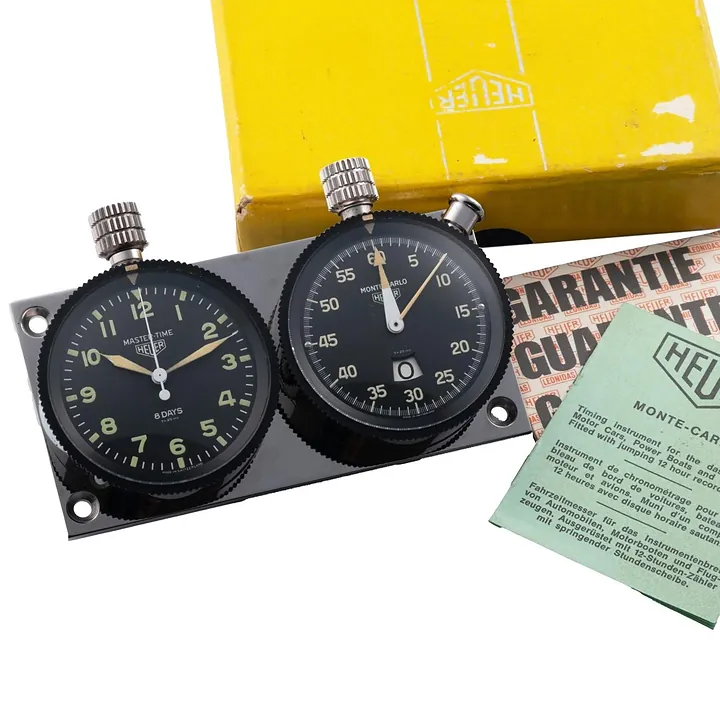
Heuer Racing SET, c. 1960
Antiquorum auction archive, Geneva
Wristwatches · c. 1980
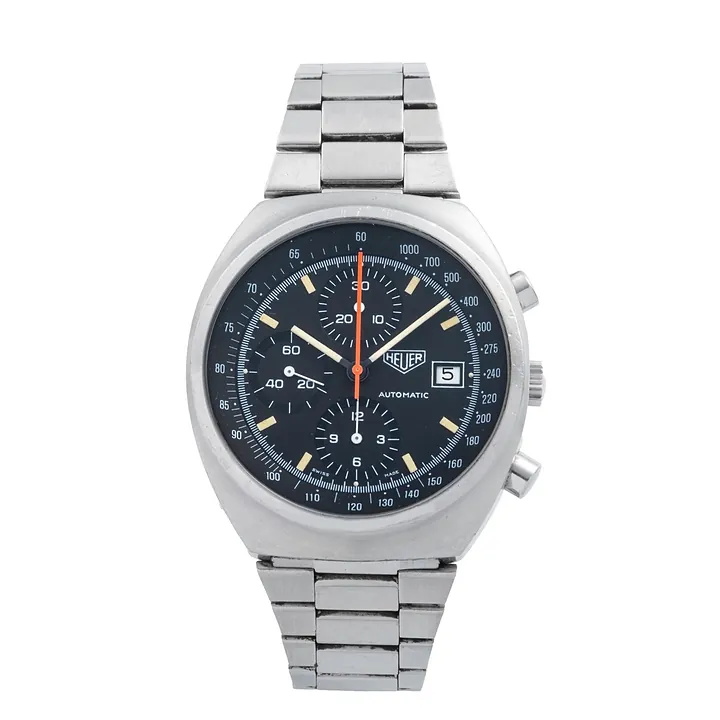
Heuer Pasadena, ref. 750.501-3, c. 1980
Antiquorum auction archive, Geneva
Wristwatches · c. 1970s
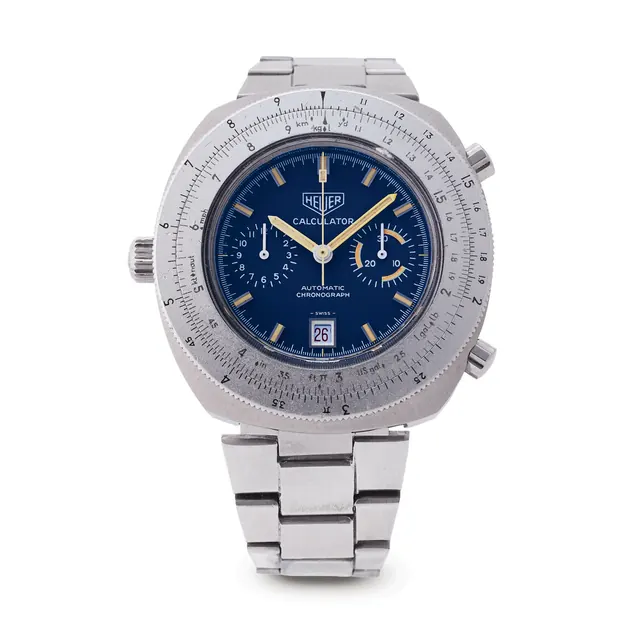
Heuer wristwatch, ref. 110.633, Calculator, circa 1970s
Antiquorum auction archive, Geneva
Wristwatches · c. 1975
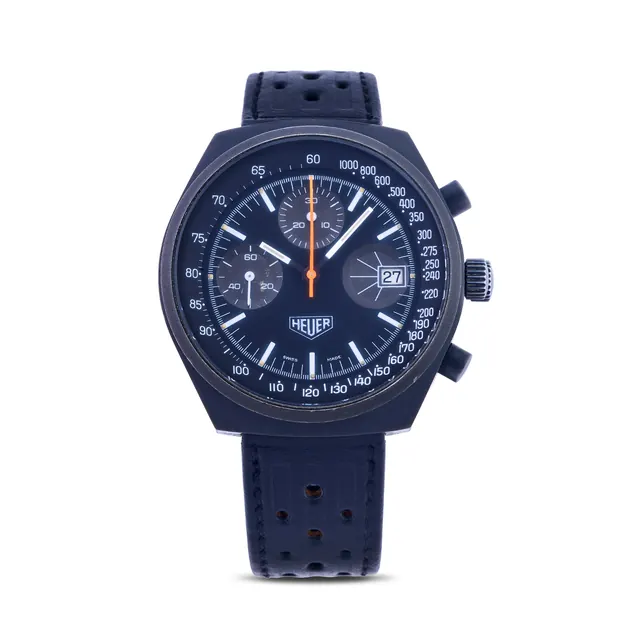
Heuer wristwatch, ref. 13/1, circa 1975
Antiquorum auction archive, Geneva

Wristwatches · 1945
Wristwatch by Eterna, 1945
Museum Rotterdam

Wristwatches · c. 1945
Breitling Premier, ref. 790, c. 1945
Antiquorum auction archive, Geneva

Wristwatches · c. 1945
Universal Genève Uni-Compax, ref. 22492, c. 1945
Antiquorum auction archive, Geneva

Wristwatches · c. 1950s
Baume & Mercier wristwatch, c. 1950s
Antiquorum auction archive, Geneva