
Wristwatches · Wristwatch
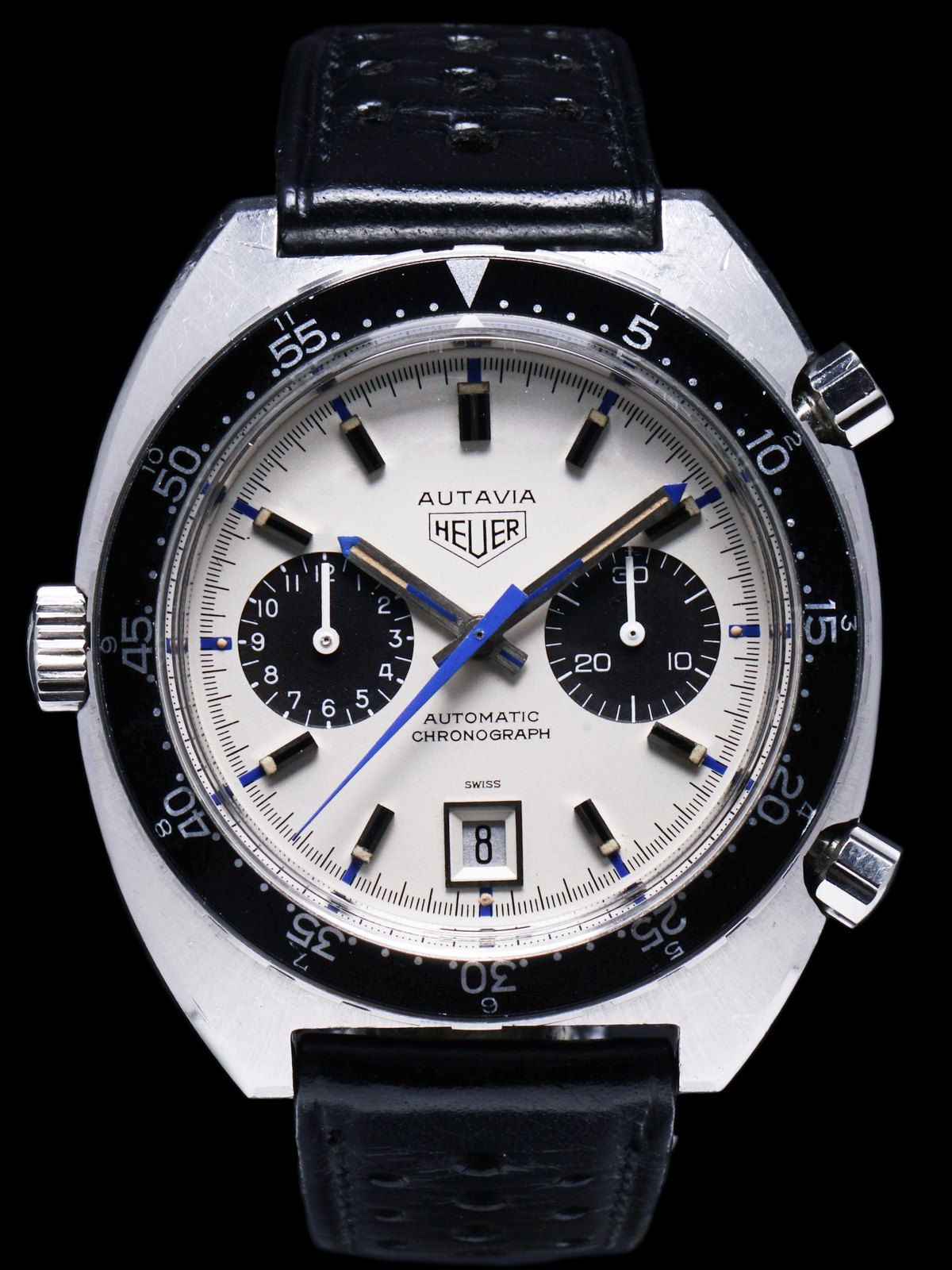
Heuer Autavia (Ref. 1163) "Jo Siffert Mk. VI" W/ Extra Bezel And Original Beads Of Rice Bracelet, 1972
- Maker / attribution
- Heuer (maker)
- Date
- 1972
- Historical period
- Quartz Revolution (1969 – 1990)
- Country of origin
- Switzerland
- Object type
- Wristwatch
- Dimensions
- Case 42 mm
- Stock no.
- HURJSAUT-2
- Credit line
- Dealer listing, Craft & Tailored (HURJSAUT-2)
- Catalogue title (original)
- 1972 Heuer Autavia (Ref. 1163) "Jo Siffert Mk. VI" W/ Extra Bezel And Original Beads Of Rice Bracelet (English)
View the source record (dealer listing) ↗ (opens another website in a new tab)Suggest a correction
Record summary
Catalogued by Craft & Tailored (dealer), Los Angeles (stock number HURJSAUT-2), this is a wristwatch by Heuer, made in Switzerland, dated 1972. The Atlas places it in the Quartz Revolution period (1969 – 1990) of its Wristwatches collection. Recorded dimensions: Case 42 mm. The record is illustrated with 6 photographs.
Assembled from the source record's structured fields. Dates and attributions are given as the source states them; where a field is missing the Atlas leaves it blank rather than estimating.
Catalogue description
Dealer description — Craft & Tailored
Jo Siffert was a Swiss racing driver who, previous to joining Formula One In 1962, made a name for himself racing motorcycles. The majority of Siffert's success was as a Porsche factory driver throughout the 60s, claiming Porsches first major outright wins and in 1966, winning the 24 hours of Le Mans. Jo was the first brand ambassador appointed by Jack Heuer and a quintessential part of Heuer’s success in Formula One. It's commonly said that Jo would taunt his peers on the racing grid to purchase a Heuer. By the early 1970s, most of the other racers had a Heuer on their wrists, including Steve McQueen. Siffert died in late 1971 during the World Championship Victory Race at Brands Hatch in England. This accident led to a rapid overhaul of safety, both in-car and on circuit. The Heuer Autavia came into production in 1933 as a dashboard timer for automotive racing and flying, where the Autavia name is derived, Auto and Aviation. The Autavia then later introduced in 1962 (The same year Jo Siffert entered Formula One) as the wristwatch we know today, and soon became the flagship for the entire Brand. This particular example features an Mk. 6 dial variation of the "Jo Siffert" dial iteration for the Autavia Ref. 1163. The Mk. 6 dial is the only 1163T dial variation to feature 1-through-12 on hour recorder, opposed to the more common 3-6-9-12. The steel markers are polished with black inserts and the hands are brushed steel with blue inserts and tips. Stock # HURJSAUT-2 Brand Heuer Style Chronograph Model Autavia Serial 22XXXX Size Mens Material Stainless Dial White "Mk. 6" Millimeters 42mm Strap Gay Freres Beads of Rice Bracelet W/ HLF End Pieces & Original Heuer Strap CASE & BRACELET The unpolished case retains sharp factory finishing showing light, honest wear. The original rotating Hours/Minutes bezel shows little wear and retains a deep black coloration. The Heuer signed crown and pushers are original to the watch. The watch comes with both original Gay Freres beads of rice bracelet with HLF end pieces and also an original black leather rally strap and Heuer stainless steel buckle. Additionally, the watch also comes supplied with an additional tachymeter bezel which will be included with the watch. DIAL & HANDS The original Mk. 6 Jo Siffert white and blue dial remains in stunning condition. The dial is free from any marks or blemishes and is flawless in condition. Under U.V. light inspection, the tritium lume plots on the dial remain fully intact and, the original tritium filled hands also remain fully intact showing no lume loss or degradation. ACCESSORIES The watch comes with both an original Heuer Gay Freres beads of rice bracelet as well as an additional tachymeter bezel which will be included with the watch. The watch is keeping time at spec but additional service history is unknown.
Historical context
Quartz Revolution (1969 – 1990)
Seiko's Astron begins mass quartz timekeeping; traditional industries contract sharply.
Quartz and digital watches transformed the market after 1969. Swiss employment collapsed, Japanese and Hong Kong production soared, and the Swatch (1983) helped the Swiss industry recover; mechanical watches survived as luxury goods.
Read the period in the timelineMore wristwatches from this periodEarlier: Modern Mechanical Horology
Atlas type guide
Wristwatches
Bracelet watches were worn by women from the early nineteenth century — Breguet made one for Caroline Murat, Queen of Naples, in 1810–12 — but the wristwatch only became a man's instrument with military use and aviation in the early twentieth century. Between the World Wars it overtook the pocket watch; the 1920s and 1930s brought rectangular Art Deco cases, water-resistant cases and the first automatic winding systems.
After 1945 the wristwatch became a carrier of identity — dress watches, sports and dive watches, chronographs, calendars — produced by Swiss, American, Japanese, German, Soviet and Chinese industries. The quartz revolution after 1969 and the mechanical renaissance since the 1990s, including the rise of independent watchmakers, complete the story.
What to look for
- The reference number (between the lugs or inside the case back) and serial number, the starting point for dating.
- The calibre: its maker and number are often stamped under the dial or on the bridge.
- Originality of dial, hands and crown — refinished ('redial') dials are common.
- Case material marks: 18K/750, 14K/585, stainless steel, gold-filled, plated.
Dating clues
- Wire-lug cases: before c. 1925.
- Water-resistant screw-down cases: from 1926.
- Quartz movements: from 1969; sapphire crystals widespread after c. 1980.
General guidance written by the Atlas editors about this kind of object. It is not a statement about this particular piece; for that, rely on the source record above and on physical examination.
Related records
Pocket Watches · c. 1960
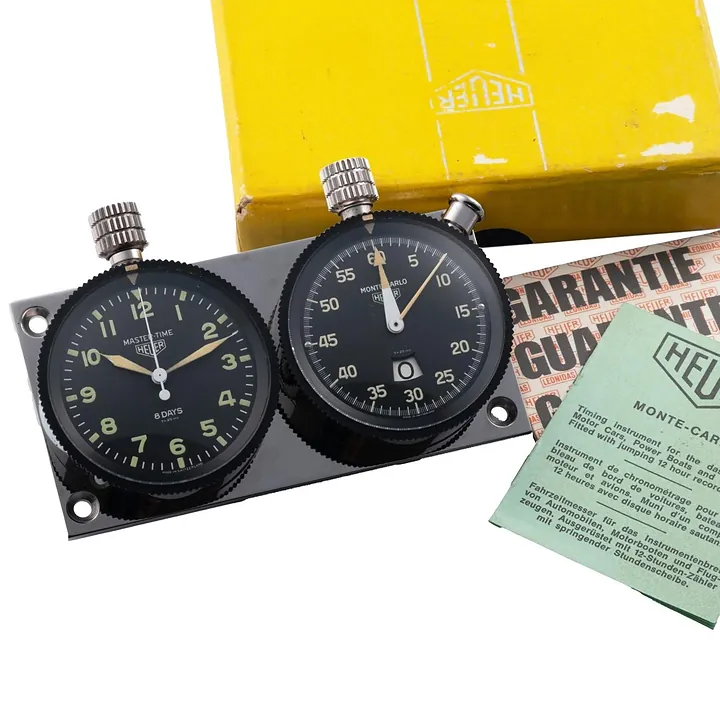
Heuer Racing SET, c. 1960
Antiquorum auction archive, Geneva
Wristwatches · c. 1980
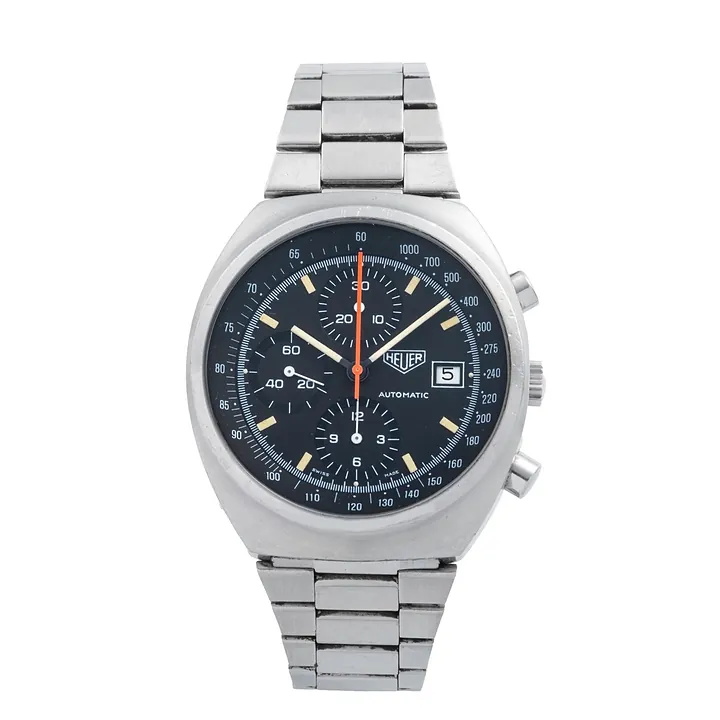
Heuer Pasadena, ref. 750.501-3, c. 1980
Antiquorum auction archive, Geneva
Wristwatches · c. 1970s
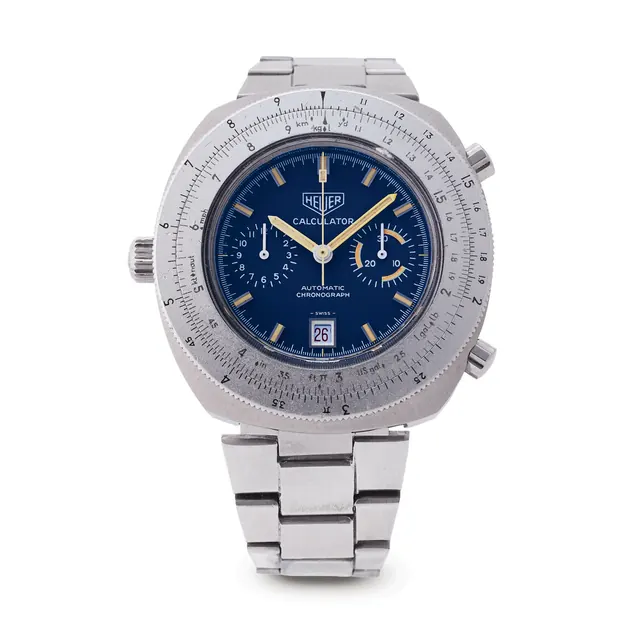
Heuer wristwatch, ref. 110.633, Calculator, circa 1970s
Antiquorum auction archive, Geneva
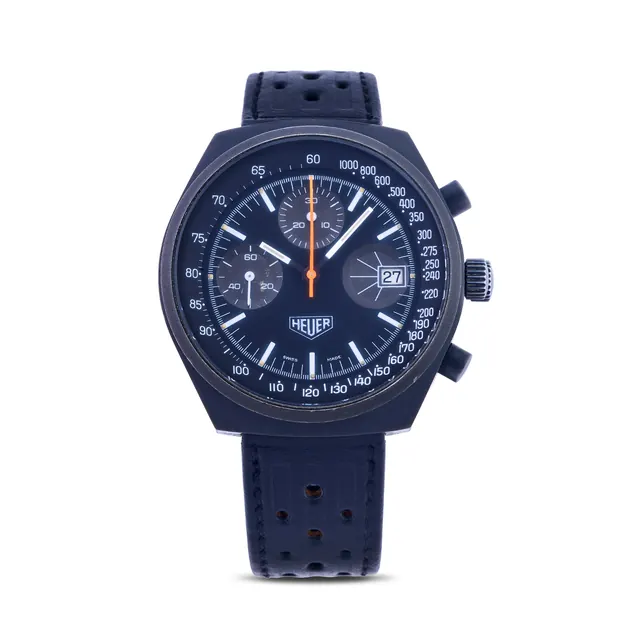
Wristwatches · c. 1975
Heuer wristwatch, ref. 13/1, circa 1975
Antiquorum auction archive, Geneva

Wristwatches · 1970
Wristwatch by Heno, Switzerland, 1970
Museum Rotterdam

Wristwatches · 1960–1986
'Tri-Compax' calendar chronograph wristwatch in gold case, by Universal, Geneva, Switzerland, 1960–1986.
Science Museum Group, London

Wristwatches · 1969–1970
Beta 21 Quartz wristwatch movement, made in Switzerland, 1970.
Science Museum Group, London

Wristwatches · c. 1969
Omega Speedmaster Moonwatch, ref. 145022-69st, c. 1969
Antiquorum auction archive, Geneva