
Wristwatches · Wristwatch
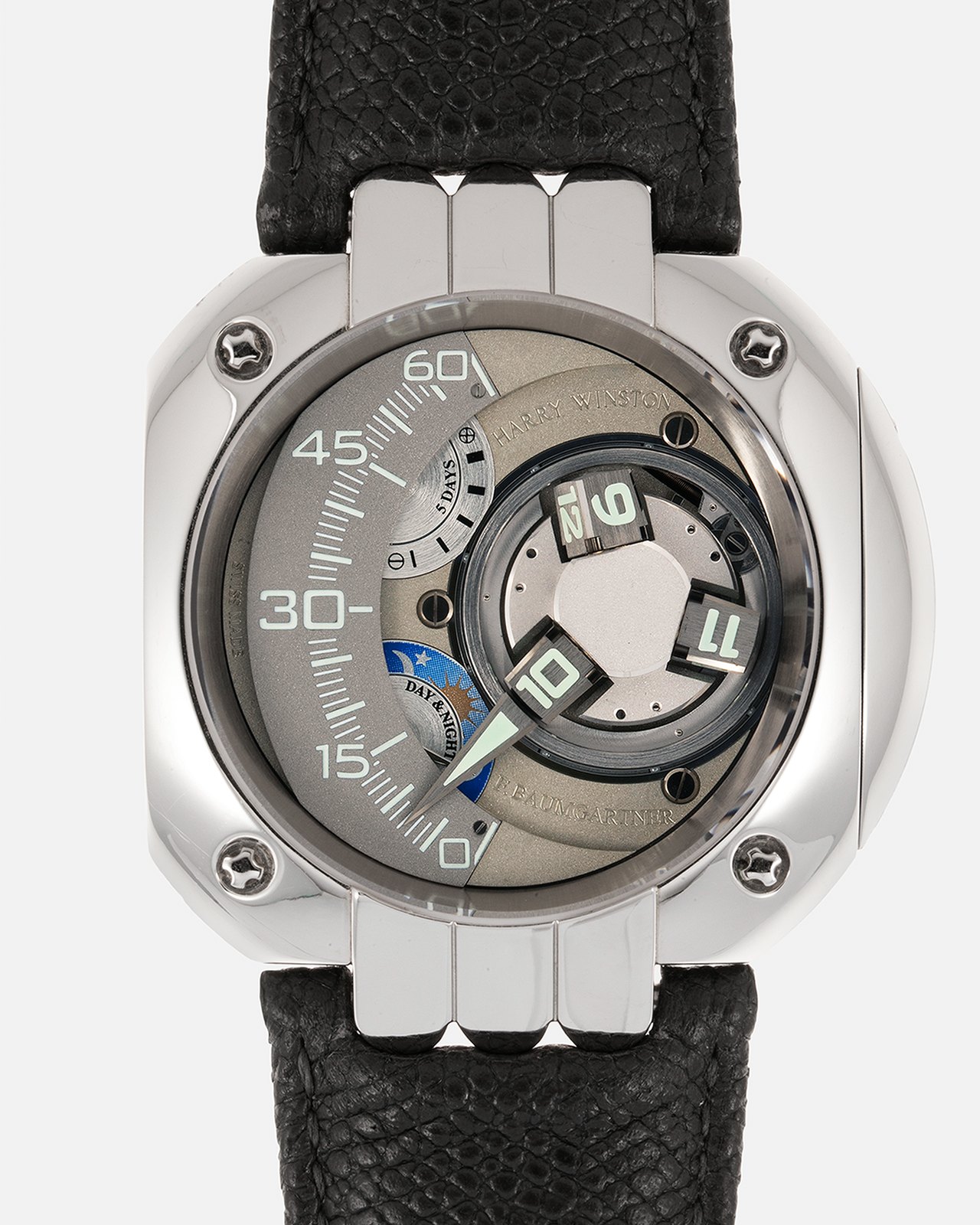
Harry Winston Opus V Felix Baumgartner, 2005
- Maker / attribution
- Harry Winston (maker)
- Date
- 2005
- Historical period
- Mechanical Renaissance (1990 – 2010)
- Country of origin
- Unrecorded in source
- Object type
- Wristwatch
- Stock no.
- Product 6971080998999
- Credit line
- Dealer listing, S.Song Watches (product 6971080998999)
- Catalogue title (original)
- Harry Winston Opus V Felix Baumgartner (English)
View the source record (dealer listing) ↗ (opens another website in a new tab)Suggest a correction
Record summary
Catalogued by S.Song Watches (dealer), Seattle (stock number Product 6971080998999), this is a wristwatch by Harry Winston, dated 2005. The Atlas places it in the Mechanical Renaissance period (1990 – 2010) of its Wristwatches collection. The record is illustrated with 6 photographs.
Assembled from the source record's structured fields. Dates and attributions are given as the source states them; where a field is missing the Atlas leaves it blank rather than estimating.
Catalogue description
Dealer description — S.Song Watches
The captivating tale of the Harry Winston Opus V begins with the visionary leadership of Max Büsser during his tenure at Harry Winston's 'Rare Timepieces' division. What unfolded was beyond the anticipation of the horological world, as this eventually evolved into the birthplace of some of the most extraordinary and impactful watch designs over the past couple of decades, collectively known and celebrated as the Opus collection. For those who do not know, the Opus collection revolved around collaborations between Harry Winston and renowned independent watchmakers. These collaborations were fueled by a shared passion for crafting unconventional and creatively inspired designs for the brand. Within this distinguished collection stands the Harry Winston Opus V, a timepiece we are pleased to offer here. The Opus V is truly a masterpiece, as there is simply nothing quite like it when it first came out in 2005. The genesis of this groundbreaking collaboration dates back to Baselworld 2003 when Max Büsser crossed paths with Felix Baumgartner, an up-and-coming watch designer (and co-founder of Urwerk), showcasing his latest creation at the time - the Urwerk UR-103, featuring a revolutionary satellite display indication, which laid the foundation for the concept of the Opus V. The example we have on offer today is encased within a hefty platinum case with a radically unusual construction. While incorporating certain classic design elements (i.e. the tri-fluted mounting case bands) reminiscent of earlier Opus references, the Opus V introduces a distinctive feature where the winding crown is seemingly hidden and guarded by a portion of the case that unfolds upwards (and outwards) akin to the door of a sports car. As a bonus, this unique feature extends beyond the timepiece itself and is mirrored in the presentation box. Much like the watch, the box also opens similarly, offering users a unique unboxing experience. Moving on to the dial, the Opus V seamlessly integrates some of the earliest hallmarks of Urwerk's iconic 'satellite display' DNA. It presents a mesmerizing visual spectacle to observe, featuring three miniature cubes, each adorned with four numbers arranged like satellites in a three-dimensional rotating orbit axis. This intricate mechanism turns and revolves dynamically to showcase the current hour, complemented by a retractable minute pointer gracefully moving over a 120-degree graduated scale and ‘jumping’ back to the ‘0’ minute mark as each hour passes. There is also a power reserve indication at 11 o ‘clock and a day/night indicator at 7 o ‘clock. Powering this complexity from within is Harry Winston’s manual-winding Cal. HW1026 which is crafted out of ARCAP alloy, a copper-nickel-zinc alloy known for its corrosion resistance properties. It also holds a capacity of a whopping 122 hours in power reserve. Crazy stuff, I know. In addition to this, Felix also designed and incorporated a ‘service indicator’, a world first in a wristwatch. Discreetly placed on the caseback, this indicator serves to notify the user about the impending need for maintenance. Adjacent to this, also on the caseback, an index adjustment screw is strategically placed, allowing precise calibration of the calibre's beat rate. Limited to a production run of a mere 45 pieces, the Opus V stands as a highly coveted gem in the world of independent watchmaking. However, due to its horological importance, it is often only kept within the safes of collectors, rarely finding its way to any public sale. Moreover, the Opus V also marks the final creation within the Opus collection under the management of Max Büsser , who left Harry Winston in 2005 to establish his eponymous brand MB&F. For those in search of something genuinely avant-garde and horologically significant, your quest ends here. How often do you come across the chance to possess an important piece of horological history, not to mention a work of art, co-created by two of the most brilliant luminaries in the world of independent watchmaking? This is simply an opportunity not to be missed.
Historical context
Mechanical Renaissance (1990 – 2010)
Mechanical watches return as cultural objects; independent watchmaking flourishes.
Mechanical watches returned as cultural and luxury objects. Complications, tourbillons and new materials proliferated; independent watchmakers such as George Daniels, F.P. Journe and Philippe Dufour revived artisanal watchmaking; collecting vintage watches became a major field.
Read the period in the timelineMore wristwatches from this periodEarlier: Quartz Revolution
Atlas type guide
Wristwatches
Bracelet watches were worn by women from the early nineteenth century — Breguet made one for Caroline Murat, Queen of Naples, in 1810–12 — but the wristwatch only became a man's instrument with military use and aviation in the early twentieth century. Between the World Wars it overtook the pocket watch; the 1920s and 1930s brought rectangular Art Deco cases, water-resistant cases and the first automatic winding systems.
After 1945 the wristwatch became a carrier of identity — dress watches, sports and dive watches, chronographs, calendars — produced by Swiss, American, Japanese, German, Soviet and Chinese industries. The quartz revolution after 1969 and the mechanical renaissance since the 1990s, including the rise of independent watchmakers, complete the story.
What to look for
- The reference number (between the lugs or inside the case back) and serial number, the starting point for dating.
- The calibre: its maker and number are often stamped under the dial or on the bridge.
- Originality of dial, hands and crown — refinished ('redial') dials are common.
- Case material marks: 18K/750, 14K/585, stainless steel, gold-filled, plated.
Dating clues
- Wire-lug cases: before c. 1925.
- Water-resistant screw-down cases: from 1926.
- Quartz movements: from 1969; sapphire crystals widespread after c. 1980.
General guidance written by the Atlas editors about this kind of object. It is not a statement about this particular piece; for that, rely on the source record above and on physical examination.
Related records
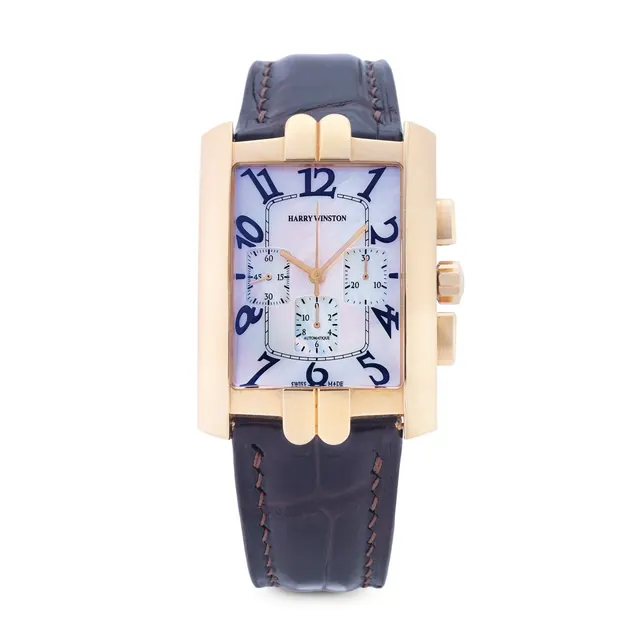
Wristwatches · originally sold on 4 January 2005 (per the lot record)
Harry Winston wristwatch, ref. 330/MCA, Avenue Chronograph Mop Dial, originally sold on 4 January 2005
Antiquorum auction archive, Geneva
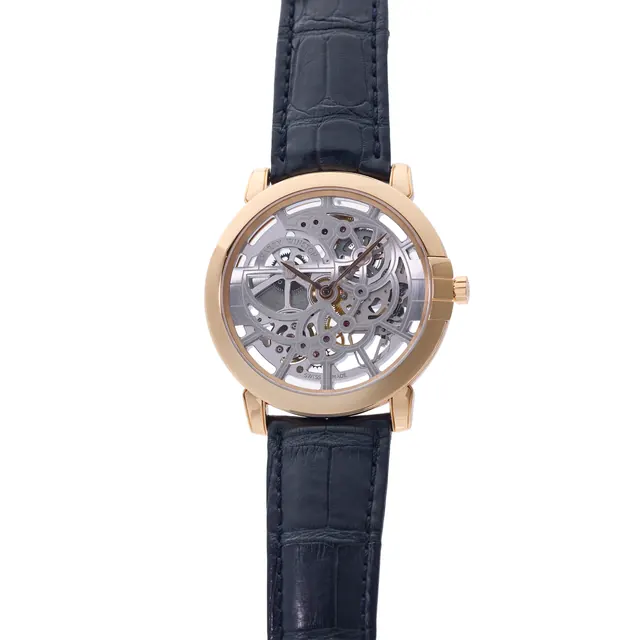
Wristwatches · c. 2015
Harry Winston wristwatch, ref. 450-MAS42R, Midnight Skeleton, circa 2015
Antiquorum auction archive, Geneva
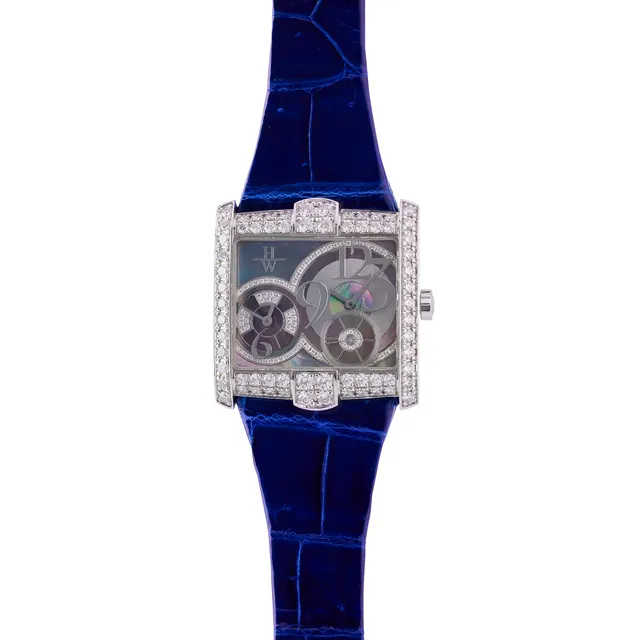
Wristwatches · c. 2008
Harry Winston wristwatch, ref. 350/LQTZW, Avenue Two Time Zone, circa 2008
Antiquorum auction archive, Geneva
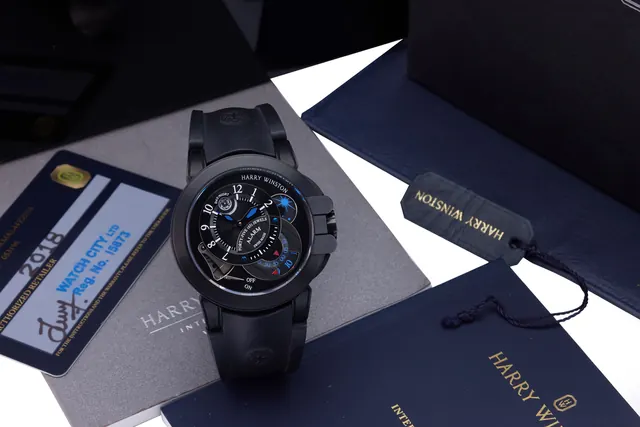
Wristwatches · c. 2014
Harry Winston wristwatch, ref. 400/MMAC44ZK, Ocean Project Z6 Zalium, circa 2014
Antiquorum auction archive, Geneva
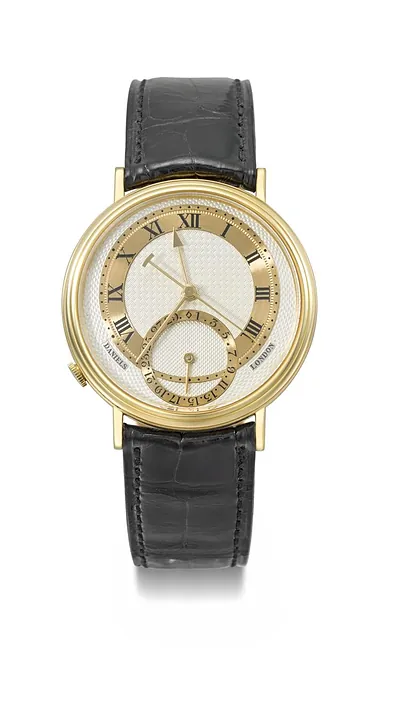
Wristwatches · 1999
'Millennium' co-axial wristwatch by George Daniels and Omega, England, 1999
Science Museum Group, London

Wristwatches · 2008
Wristwatch by Breitling?, 2008
Museum Rotterdam
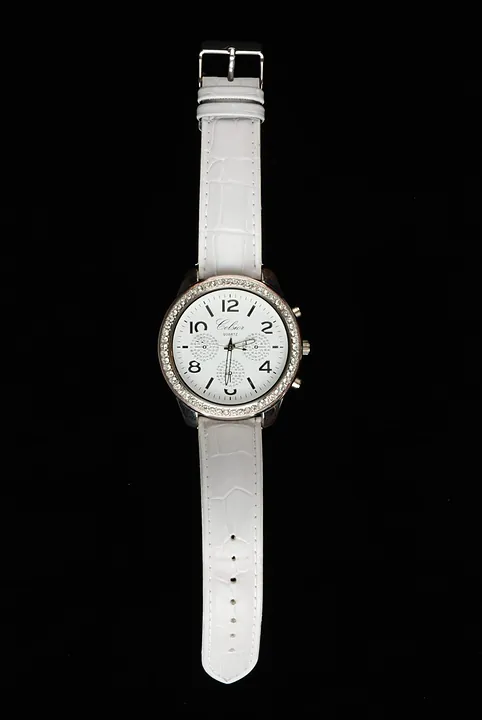
Wristwatches · 2008
Wristwatch by Celsior Quartz, 2008
Museum Rotterdam
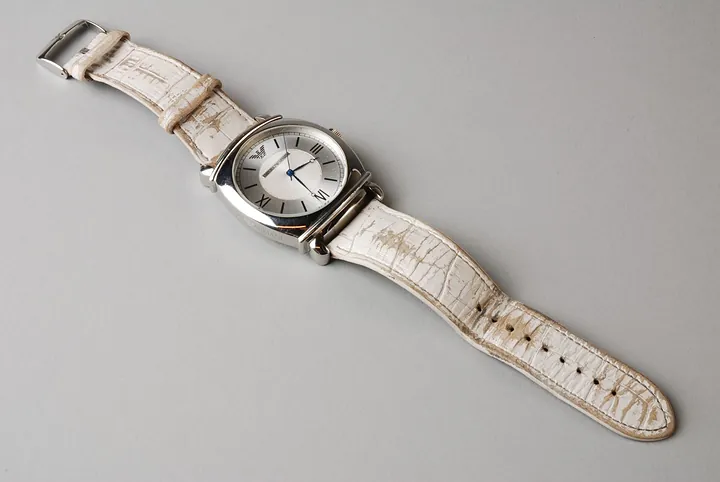
Wristwatches · 2008
Wristwatch possibly by Emporio Armani, 2008
Museum Rotterdam