
Wristwatches · Wristwatch
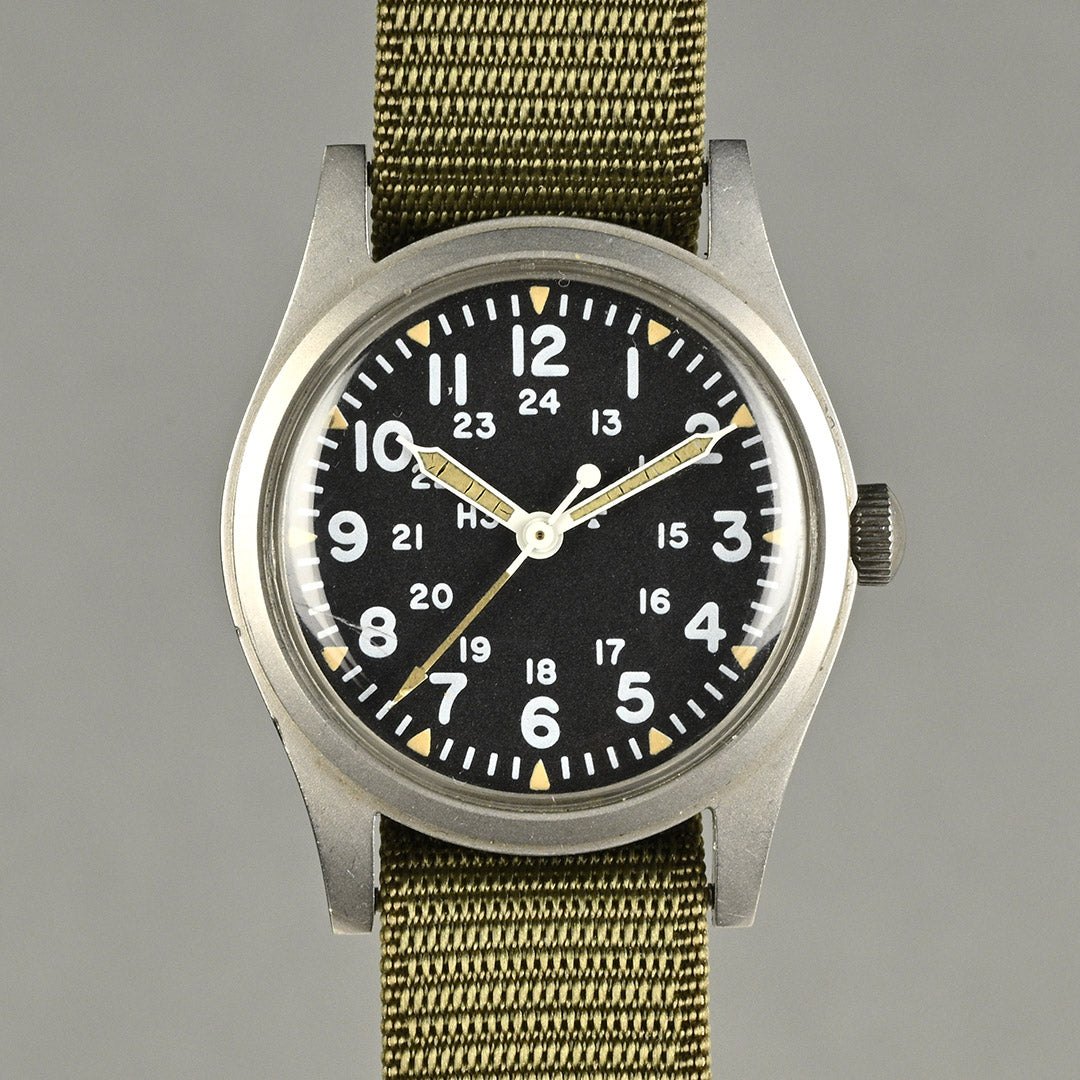
Hamilton US Military Field Watch ref. MIL-W-46374B, 1983
- Maker / attribution
- Hamilton (maker)
- Date
- 1983
- Historical period
- Quartz Revolution (1969 – 1990)
- Country of origin
- Switzerland
- Object type
- Wristwatch
- Dimensions
- Case 33 mm
- Stock no.
- vws4325
- Credit line
- Dealer listing, Vintage Watch Specialist (vws4325)
- Catalogue title (original)
- Hamilton US Military Field Watch Reference MIL-W-46374B – 1983 (English)
View the source record (dealer listing) ↗ (opens another website in a new tab)Suggest a correction
Record summary
Catalogued by Vintage Watch Specialist (dealer), United Kingdom (stock number vws4325), this is a wristwatch by Hamilton, made in Switzerland, dated 1983. The Atlas places it in the Quartz Revolution period (1969 – 1990) of its Wristwatches collection. Recorded dimensions: Case 33 mm. The record is illustrated with 6 photographs.
Assembled from the source record's structured fields. Dates and attributions are given as the source states them; where a field is missing the Atlas leaves it blank rather than estimating.
Catalogue description
Dealer description — Vintage Watch Specialist
The Hamilton MIL-W-46374B belongs to a fascinating period in American military watchmaking, when practicality, legibility and reliability mattered far more than decoration. Developed to meet US military requirements, watches produced under the MIL-W-46374 specification were intended to provide straightforward, dependable timekeeping for service personnel. Their uncomplicated design reflected the needs of military life: a highly legible dial, a robust case, a simple mechanical movement and a strap that could be replaced without difficulty. Hamilton was already well established as a supplier of military timepieces, having produced watches for American forces during the Second World War. Its later field watches continued that tradition, combining practical construction with an instantly recognisable military appearance. The MIL-W-46374B specification was part of this evolution. These watches featured a black dial with contrasting white numerals, an inner 24-hour scale and luminous markings for improved visibility. An especially interesting feature of surviving examples is the information engraved on their casebacks. Military specifications, contract numbers and manufacturing dates provide a direct connection to the procurement system under which the watches were supplied. Today, Hamilton's military field watches remain popular with collectors who appreciate their purposeful design, historical background and uncomplicated mechanical movements. What's on Offer Here we have a Hamilton US military field watch manufactured in July 1983 to the MIL-W-46374B specification , an excellent example of a classic American military timepiece. The watch has a stainless steel case measuring 33mm across, with a 41mm lug-to-lug length. Its proportions are typical of military field watches of the period, designed to be practical and comfortable rather than oversized. The black dial is in excellent condition and offers superb legibility. Large white Arabic numerals mark the hours, accompanied by a smaller inner 13–24-hour scale. A white minute track runs around the perimeter, punctuated by triangular luminous hour markers. The luminous-filled hands are complemented by a slender central seconds hand, while the understated H3 marking on the dial identifies the tritium-based luminous material used in this type of military watch. One of the most interesting features is the caseback, which carries extensive US military markings: MIL-W-46374B – the military specification. Hamilton – the manufacturer. 6645-00-952-3767 – the NATO Stock Number. MFG. PART NO. 39988 – the manufacturer's part number. DLA-400-82-C-4845 – the military procurement contract reference. JUL 1983 – the manufacturing date. DISPOSE RAD. WASTE U.S. – the radioactive-waste disposal instruction associated with the watch's luminous material. These markings are an appealing part of the watch's history, connecting it directly to the US military supply system of the early 1980s. Inside is the manually wound Hamilton Calibre 466 , a seven-jewel mechanical movement with an approximate 38-hour power reserve. The movement has been serviced by our watchmaker and is currently recording +4 seconds per day with an amplitude of 264° on the timegrapher. The watch is fitted with a green NATO-style strap, complementing its military origins and understated appearance. Condition is excellent overall. The dial and case are excellent, the crystal is very good, and the bezel is described as mint/unworn. There are only modest signs of age and handling. For collectors of American military watches, this 1983 Hamilton offers an appealing combination of authentic military markings, classic field-watch design and a freshly serviced mechanical movement. Condition Report: Crystal: Very Good Dial: Excellent Bezel: Mint / Unworn Case: Excellent Movement: Serviced +4s/d 264° Overall: Excellent
Historical context
Quartz Revolution (1969 – 1990)
Seiko's Astron begins mass quartz timekeeping; traditional industries contract sharply.
Quartz and digital watches transformed the market after 1969. Swiss employment collapsed, Japanese and Hong Kong production soared, and the Swatch (1983) helped the Swiss industry recover; mechanical watches survived as luxury goods.
Read the period in the timelineMore wristwatches from this periodEarlier: Modern Mechanical Horology
Atlas type guide
Military, pilot and travel watches
The wristwatch owes much of its adoption by men to warfare and aviation. Wristlets — small pocket watches soldered with lugs and worn on a strap — were used in colonial campaigns and became standard equipment in the First World War, with protective grilles over the crystal ('shrapnel guards'). Louis Cartier's Santos (1904), designed for the aviator Alberto Santos-Dumont, is often cited as an early purpose-made pilot's watch.
In the Second World War governments specified watches in detail: the German B-Uhr observation watches, the American A-11, and the British 'W.W.W.' (the 'Dirty Dozen' set of 1945). After the war, jet travel brought GMT and world-time watches, which show two or more time zones at once — Louis Cottier's world-time mechanism and the Rolex GMT-Master (1955) are examples.
What to look for
- Military markings on the case back: broad arrow, issue numbers, 'W.W.W.', 'A.T.P.'
- High-legibility black dials with luminous Arabic numerals; oversized crowns for gloved hands.
- 24-hour hands and rotating 24-hour bezels or city rings on GMT/world-time watches.
- Wire lugs on early wristlets converted from pocket watches.
Dating clues
- Wire-lug wristlets: c. 1900–1925.
- Military specifications of the Second World War: 1939–1945.
- GMT and world-time wristwatches: mainly after 1950.
General guidance written by the Atlas editors about this kind of object. It is not a statement about this particular piece; for that, rely on the source record above and on physical examination.
Related records
Pocket Watches · c. 1943
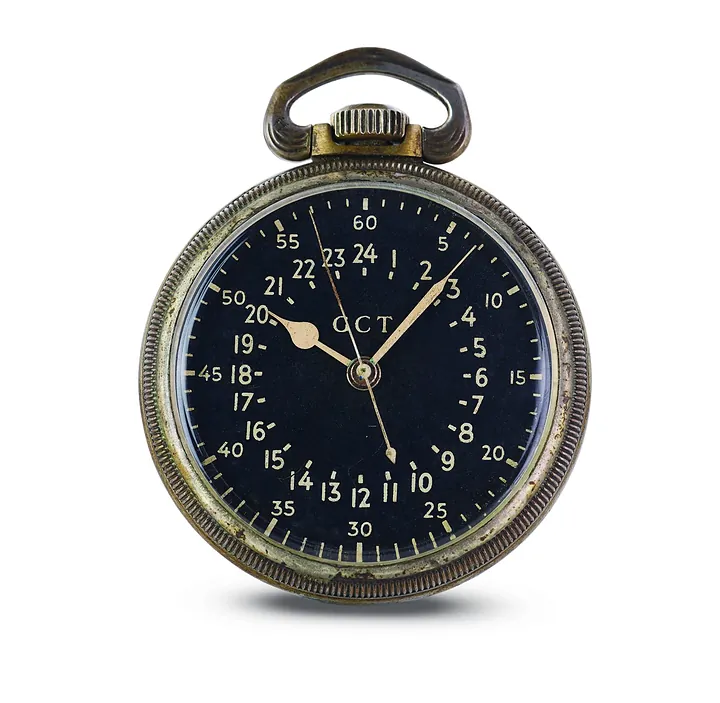
Hamilton 4992B, GCT Navigation U.S Air Force, c. 1943
Antiquorum auction archive, Geneva
Wristwatches · c. 1940s
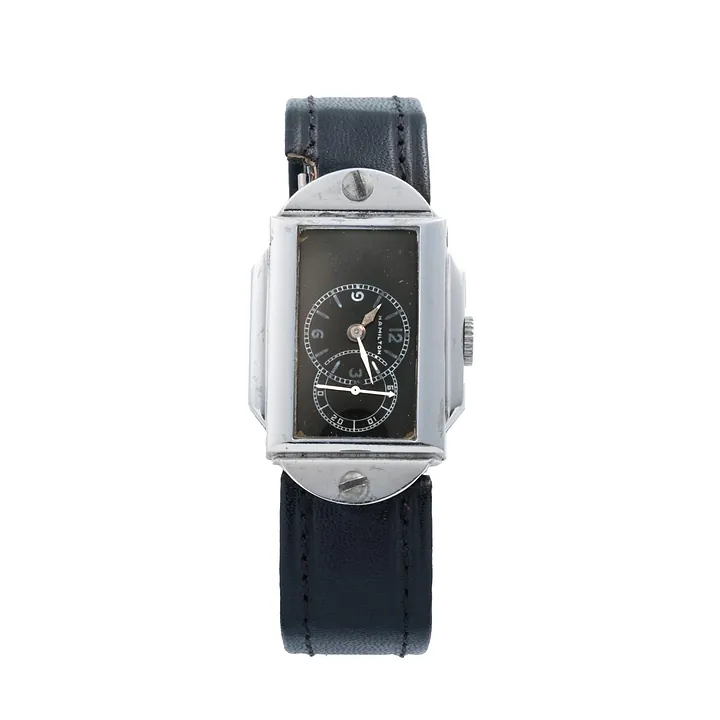
Hamilton Bomb Timer, c. 1940s
Antiquorum auction archive, Geneva
Wristwatches · originally sold in February 2025 (per the lot record)
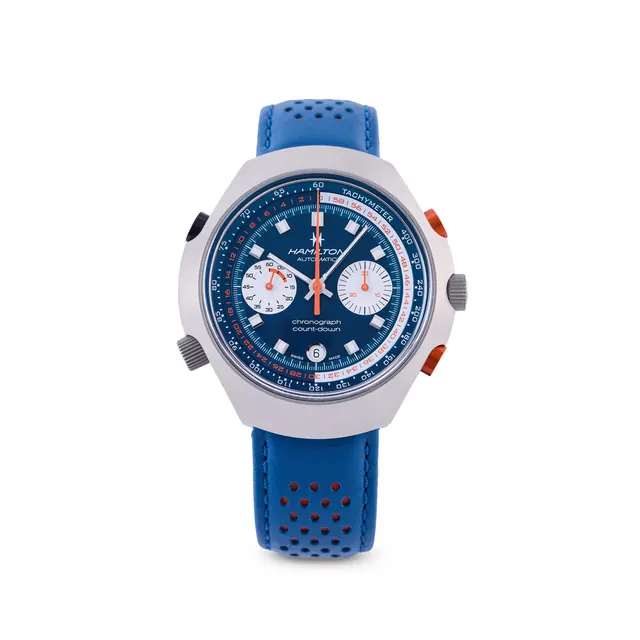
Hamilton wristwatch, ref. H51606640, American Classic Chrono-Matic 50 Limited Edition, originally sold in February 2025 (per the lot record)
Antiquorum auction archive, Geneva
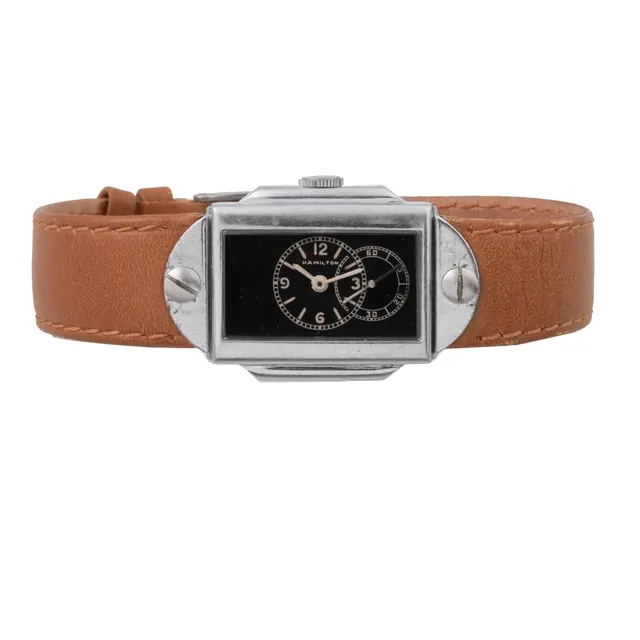
Wristwatches · c. 1940s
Hamilton wristwatch, Bomb Timer Watch, circa 1940's
Antiquorum auction archive, Geneva

Wristwatches · 1970
Wristwatch by Heno, Switzerland, 1970
Museum Rotterdam

Wristwatches · 1960–1986
'Tri-Compax' calendar chronograph wristwatch in gold case, by Universal, Geneva, Switzerland, 1960–1986.
Science Museum Group, London

Wristwatches · 1969–1970
Beta 21 Quartz wristwatch movement, made in Switzerland, 1970.
Science Museum Group, London

Wristwatches · c. 1969
Omega Speedmaster Moonwatch, ref. 145022-69st, c. 1969
Antiquorum auction archive, Geneva