
Wristwatches · Wristwatch
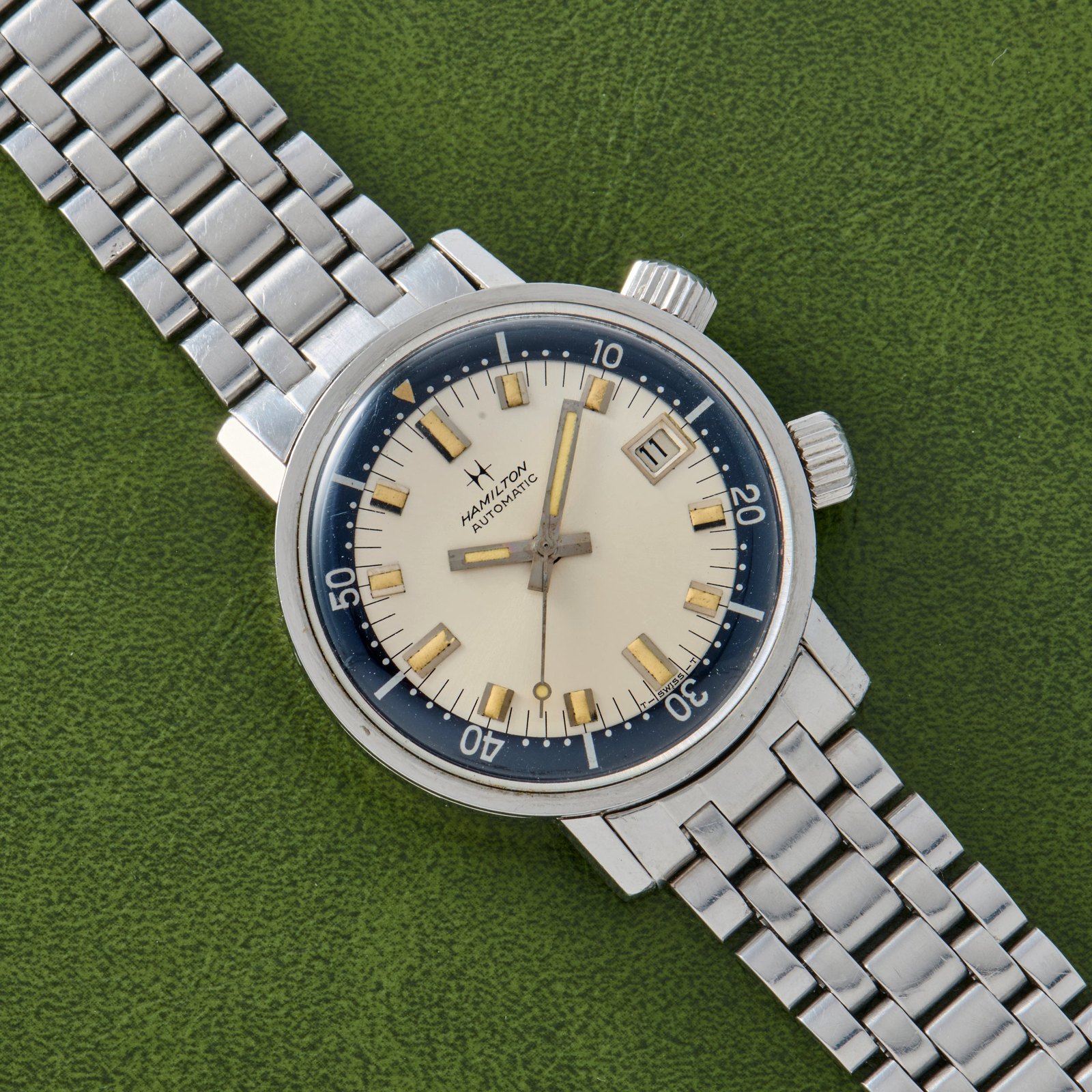
Hamilton Super Compressor 600 Diver, c. early 1970s
- Maker / attribution
- Hamilton (maker)
- Date
- c. early 1970s
- Historical period
- Quartz Revolution (1969 – 1990)
- Country of origin
- Switzerland
- Object type
- Wristwatch
- Dimensions
- Case 36 mm
- Stock no.
- 40992525
- Credit line
- Dealer listing, Analog/Shift (40992525)
- Catalogue title (original)
- Hamilton Super Compressor 600 Diver (English)
View the source record (dealer listing) ↗ (opens another website in a new tab)Suggest a correction
Record summary
Catalogued by Analog/Shift (dealer), New York (stock number 40992525), this is a wristwatch by Hamilton, made in Switzerland, dated c. early 1970s. The Atlas places it in the Quartz Revolution period (1969 – 1990) of its Wristwatches collection. Recorded dimensions: Case 36 mm. The record is illustrated with 6 photographs.
Assembled from the source record's structured fields. Dates and attributions are given as the source states them; where a field is missing the Atlas leaves it blank rather than estimating.
Catalogue description
Dealer description — Analog/Shift
Never heard of a ‘Super Compressor’ before? Check it out — this is dive watch history, right here: The Super Compressor name refers to an innovative case design that utilizes a ‘compressor’ system to increase watertightness the deeper a watch was submerged. As the atmospheric pressure increased, the case back compressed, pushing on the gaskets and creating a tighter seal. Despite the logic of the design, the compressor case wasn’t any better at preventing water intrusion than the garden-variety screw-down crown — in fact, it was less effective in many models — but due to their good looks, compressor cases proved to be wildly popular during the 1960s. Eager to get into the burgeoning dive watch market, many of the best Swiss brands turned to EPSA (Ervin Piquerez, S.A.), the leading manufacturer of compressor cases at the time, for cases within which to house their divers. This particular Super Compressor is from Hamilton, which had moved its American manufacturing base to Switzerland in the 1960s. Dating to circa the early 1970s, it features a 36mm stainless steel Super Compressor case, an acrylic crystal, twin, cross-hatched crowns, a polished bezel, and a sunburst silver Tritium dial with applied indices and a date window at 3 o’clock, a matching handset, and a inner, rotating black timing ring. Powered by the automatic Hamilton Caliber movement, it comes paired to a multi link bracelet. While the technology of the Super Compressor may be superfluous considering the simple, effective design of the contemporary diver with screw-down crown, vintage Super Compressor watches themselves continue to fascinate collectors with their history and good looks. Try this one on, and we’ll sure you’ll find it as compelling as we do!
Historical context
Quartz Revolution (1969 – 1990)
Seiko's Astron begins mass quartz timekeeping; traditional industries contract sharply.
Quartz and digital watches transformed the market after 1969. Swiss employment collapsed, Japanese and Hong Kong production soared, and the Swatch (1983) helped the Swiss industry recover; mechanical watches survived as luxury goods.
Read the period in the timelineMore wristwatches from this periodEarlier: Modern Mechanical Horology
Atlas type guide
Dive and water-resistant watches
Keeping water and dust out of a wristwatch was a long-standing challenge. Rolex's screw-down Oyster case (1926) and Omega's Marine (1932) were landmarks; in the early 1950s Blancpain's Fifty Fathoms and Rolex's Submariner defined the professional dive watch with rotating bezels for timing dives, luminous dials and high water resistance. The ISO 6425 standard (1982) later codified what a 'diver's watch' must do.
Dive watches became icons of post-war design and exploration, and their evolution — helium escape valves, ceramic bezels, saturation-diving depth ratings — records the history of underwater work.
What to look for
- Unidirectional or bidirectional rotating bezel with minute markings.
- Screw-down crown and case back; depth rating printed on the dial.
- Luminous hands and markers (radium before c. 1960, tritium c. 1960–1998, then Super-LumiNova).
- Reference numbers on the case between the lugs or inside the back.
Dating clues
- Screw-down Oyster cases: from 1926.
- Professional dive watches: from 1953.
- Tritium 'T' marks on dials: c. 1960–1998.
General guidance written by the Atlas editors about this kind of object. It is not a statement about this particular piece; for that, rely on the source record above and on physical examination.
Related records
Pocket Watches · c. 1943
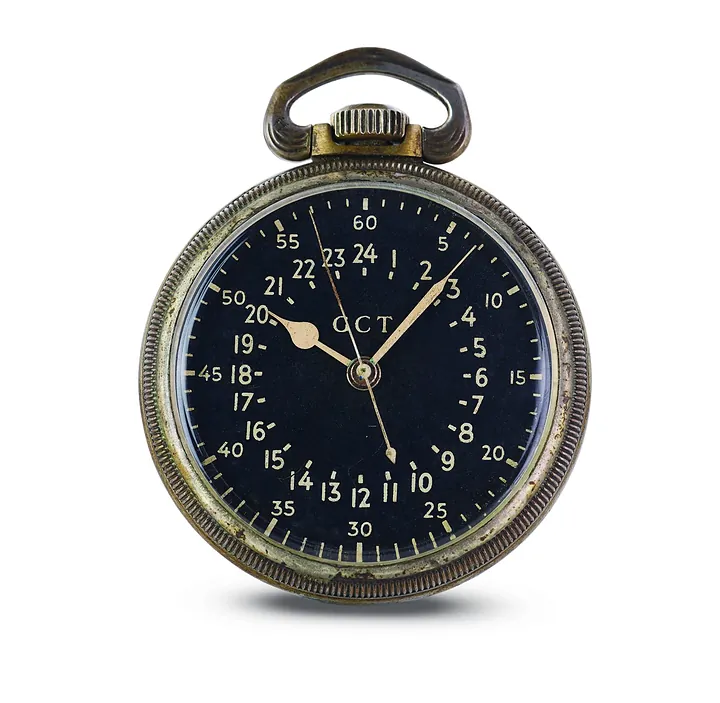
Hamilton 4992B, GCT Navigation U.S Air Force, c. 1943
Antiquorum auction archive, Geneva
Wristwatches · c. 1940s
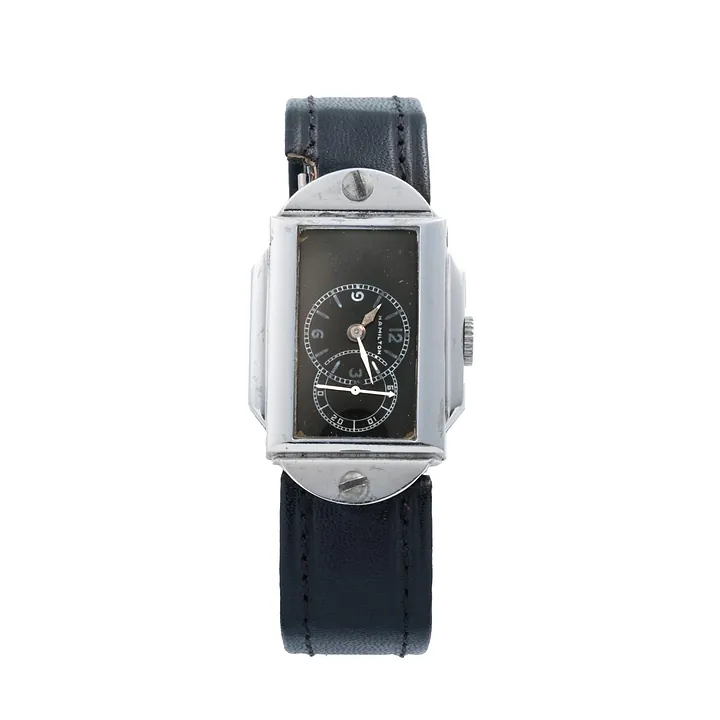
Hamilton Bomb Timer, c. 1940s
Antiquorum auction archive, Geneva
Wristwatches · originally sold in February 2025 (per the lot record)
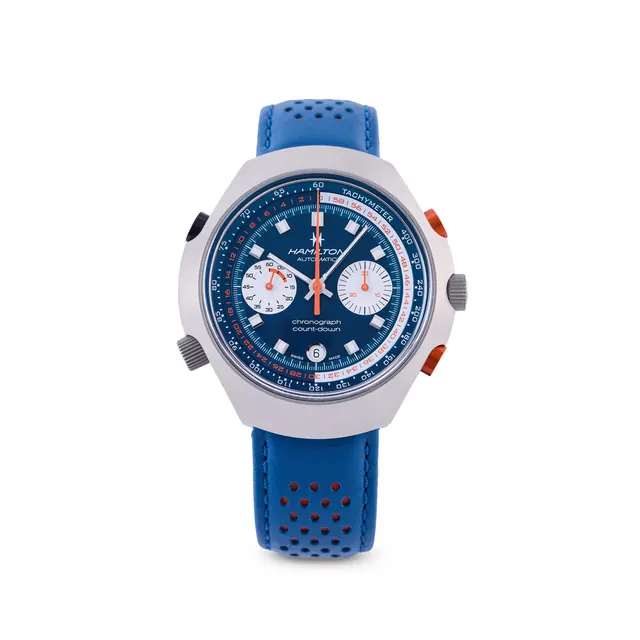
Hamilton wristwatch, ref. H51606640, American Classic Chrono-Matic 50 Limited Edition, originally sold in February 2025 (per the lot record)
Antiquorum auction archive, Geneva
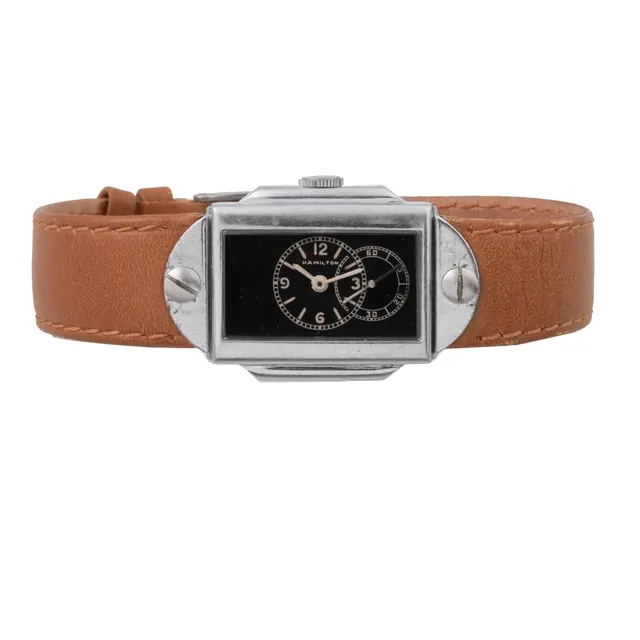
Wristwatches · c. 1940s
Hamilton wristwatch, Bomb Timer Watch, circa 1940's
Antiquorum auction archive, Geneva

Wristwatches · 1970
Wristwatch by Heno, Switzerland, 1970
Museum Rotterdam

Wristwatches · 1960–1986
'Tri-Compax' calendar chronograph wristwatch in gold case, by Universal, Geneva, Switzerland, 1960–1986.
Science Museum Group, London

Wristwatches · 1969–1970
Beta 21 Quartz wristwatch movement, made in Switzerland, 1970.
Science Museum Group, London

Wristwatches · c. 1969
Omega Speedmaster Moonwatch, ref. 145022-69st, c. 1969
Antiquorum auction archive, Geneva