
Wristwatches · Wristwatch
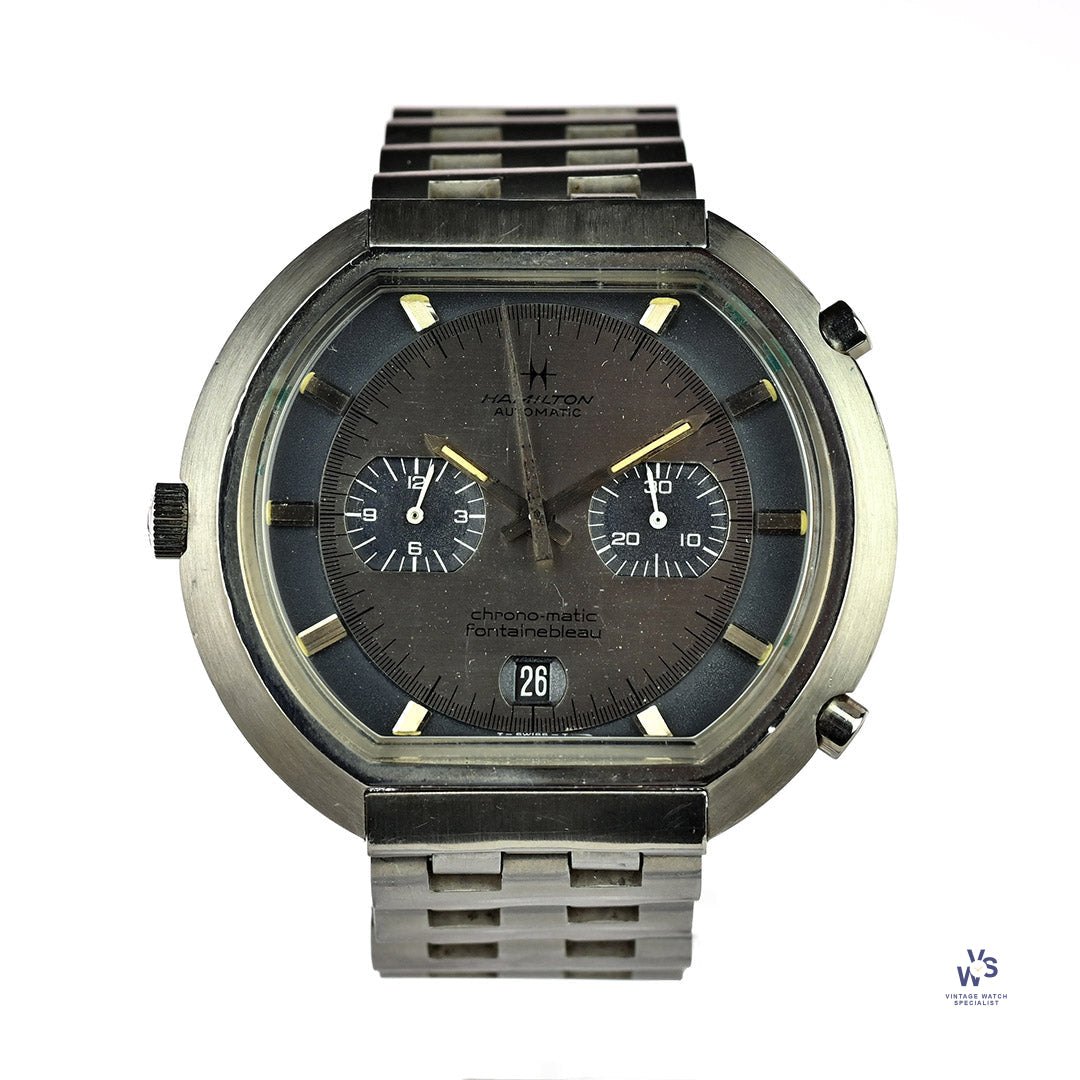
Hamilton Fontainebleau Automatic Chrono-Matic, ref. 11001-3, circa 1970s
- Maker / attribution
- Hamilton (maker)
- Date
- c. 1970s
- Historical period
- Quartz Revolution (1969 – 1990)
- Country of origin
- Switzerland
- Object type
- Wristwatch
- Stock no.
- vws3525
- Credit line
- Dealer listing, Vintage Watch Specialist (vws3525)
- Catalogue title (original)
- Hamilton Fontainebleau Automatic Chrono-Matic - Model Ref: 11001-3 - c.1970s (English)
View the source record (dealer listing) ↗ (opens another website in a new tab)Suggest a correction
Record summary
Catalogued by Vintage Watch Specialist (dealer), United Kingdom (stock number vws3525), this is a wristwatch by Hamilton, made in Switzerland, dated c. 1970s. The Atlas places it in the Quartz Revolution period (1969 – 1990) of its Wristwatches collection. The record is illustrated with 6 photographs.
Assembled from the source record's structured fields. Dates and attributions are given as the source states them; where a field is missing the Atlas leaves it blank rather than estimating.
Catalogue description
Dealer description — Vintage Watch Specialist
A Superb and Very Collectable Hamilton Fontainebleau Automatic Chrono-Matic 11001 in Fantastic Condition - Rare to Find in Such Fine Condition, c.1970s The Hamilton Chrono-Matic Fontainebleau watch is a significant piece in horological history, debuting in 1969. Named after the historic Fontainebleau Château in France, this watch represents a bold and avant-garde design period. The Chrono-Matic moniker denotes its revolutionary movement: the Caliber 11, one of the first automatic chronograph movements, developed in collaboration with Heuer, Breitling, and Dubois Dépraz. The Fontainebleau’s distinctive cushion-shaped case and 1970s aesthetic set it apart, featuring bold geometric lines and an unusual dial layout. Its robust stainless-steel construction housed advanced features such as the chronograph function, date display, and a rotating bezel. The original model is particularly sought after by collectors for its unique aesthetics and technical innovation, embodying the era's spirit of experimentation in both form and function. The Hamilton Chrono-Matic Fontainebleau endures as a celebrated example of mid-20th-century watchmaking ingenuity. What's on Offer This is a fantastic example of the Hamilton Fontainebleau, its substantial proportions give a superb presence on the wrist. It's definitely the holy grail watch for the Fontainebleau series of Hamilton and iconic 70's chronographs in general. The two-tone dial is wonderfully preserved and boasts two recessed chrono counters and a useful date aperture at 6 o'clock. To the outer edge of the dial, there are faceted applied baton markers with luminous pips on the hour and stylish pencil hands with luminous inserts for visibility in low light. It has a Brevet waterproof case, sealed with a ring that holds the caseback. The case is in nice shape with no notable marks to mention. The crown is on the left and the pushers are on the right of this watch. The caseback is engraved with the Fontainebleau emblem. The watch is paired with its original stainless steel bracelet which is also in superb shape and boasts the Hamilton signature on the fold clasp. This is a great watch and very rare to find in such incredible condition - a real collectors piece and a fantastic addition to any collection.
Historical context
Quartz Revolution (1969 – 1990)
Seiko's Astron begins mass quartz timekeeping; traditional industries contract sharply.
Quartz and digital watches transformed the market after 1969. Swiss employment collapsed, Japanese and Hong Kong production soared, and the Swatch (1983) helped the Swiss industry recover; mechanical watches survived as luxury goods.
Read the period in the timelineMore wristwatches from this periodEarlier: Modern Mechanical Horology
Atlas type guide
Automatic (self-winding) watches
Self-winding watches use the wearer's motion to wind the mainspring. Abraham-Louis Perrelet and Breguet made 'perpétuelle' pocket watches with oscillating weights in the late eighteenth century, but the principle only became practical in the wristwatch. John Harwood patented a bumper automatic in 1923; Rolex's Perpetual rotor (1931) winding in one direction, and later bidirectional rotors (Eterna, Felsa Bidynator), established the modern form. Micro-rotors (Universal Genève, Buren) and peripheral rotors made automatic watches thinner.
What to look for
- A semicircular rotor turning 360° over the movement, or a 'bumper' weight that rebounds between springs.
- 'Automatic', 'Perpetual' or 'Self-winding' on the dial.
- A sealed screw-back case, since automatic watches are wound less often by the crown.
Dating clues
- Bumper automatics: 1923–c. 1955.
- Full rotors: from 1931 (Rolex); widespread after c. 1950.
- Micro-rotors: from 1954–1958.
General guidance written by the Atlas editors about this kind of object. It is not a statement about this particular piece; for that, rely on the source record above and on physical examination.
Related records
Pocket Watches · c. 1943
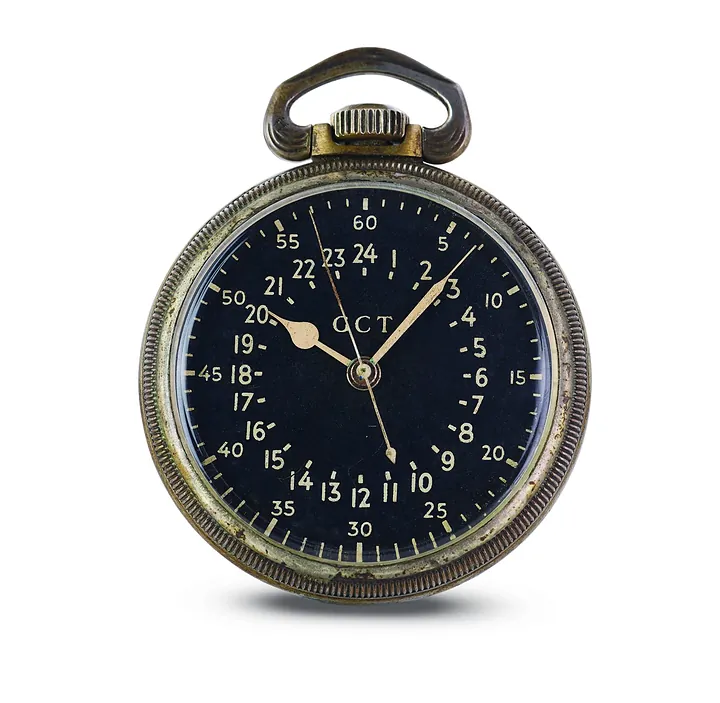
Hamilton 4992B, GCT Navigation U.S Air Force, c. 1943
Antiquorum auction archive, Geneva
Wristwatches · c. 1940s
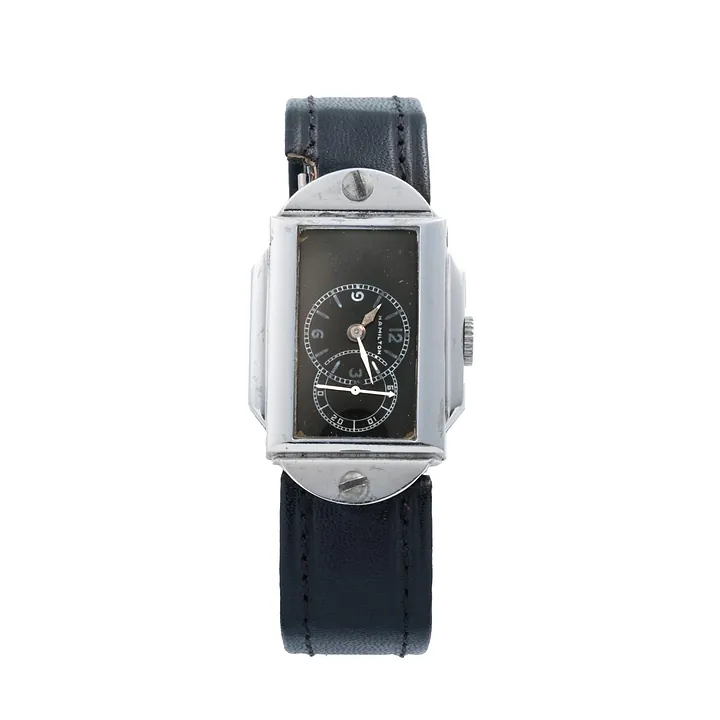
Hamilton Bomb Timer, c. 1940s
Antiquorum auction archive, Geneva
Wristwatches · originally sold in February 2025 (per the lot record)
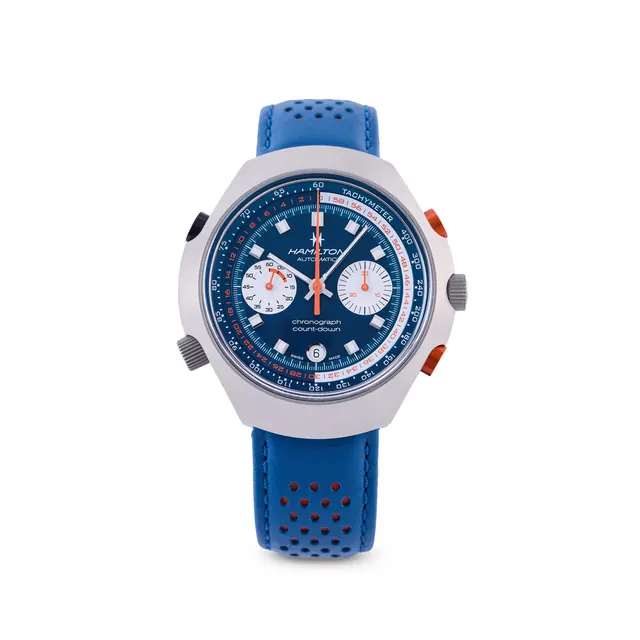
Hamilton wristwatch, ref. H51606640, American Classic Chrono-Matic 50 Limited Edition, originally sold in February 2025 (per the lot record)
Antiquorum auction archive, Geneva
Wristwatches · c. 1940s
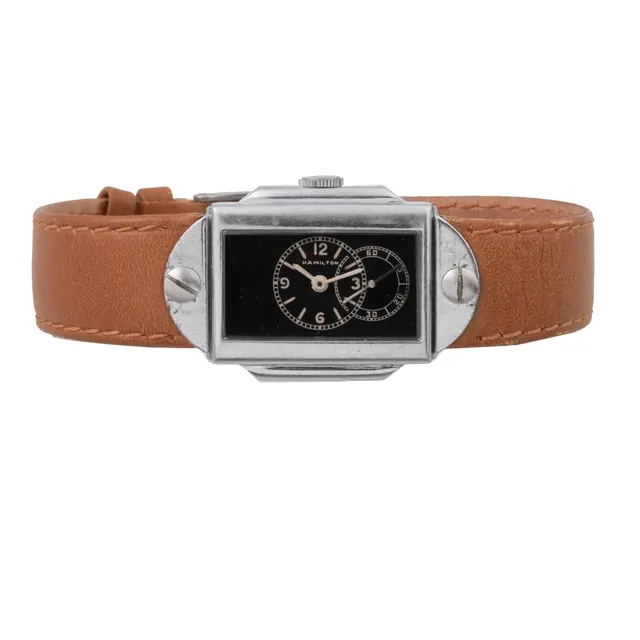
Hamilton wristwatch, Bomb Timer Watch, circa 1940's
Antiquorum auction archive, Geneva

Wristwatches · 1970
Wristwatch by Heno, Switzerland, 1970
Museum Rotterdam

Wristwatches · 1960–1986
'Tri-Compax' calendar chronograph wristwatch in gold case, by Universal, Geneva, Switzerland, 1960–1986.
Science Museum Group, London

Wristwatches · 1969–1970
Beta 21 Quartz wristwatch movement, made in Switzerland, 1970.
Science Museum Group, London

Wristwatches · c. 1969
Omega Speedmaster Moonwatch, ref. 145022-69st, c. 1969
Antiquorum auction archive, Geneva