
Wristwatches · Wristwatch
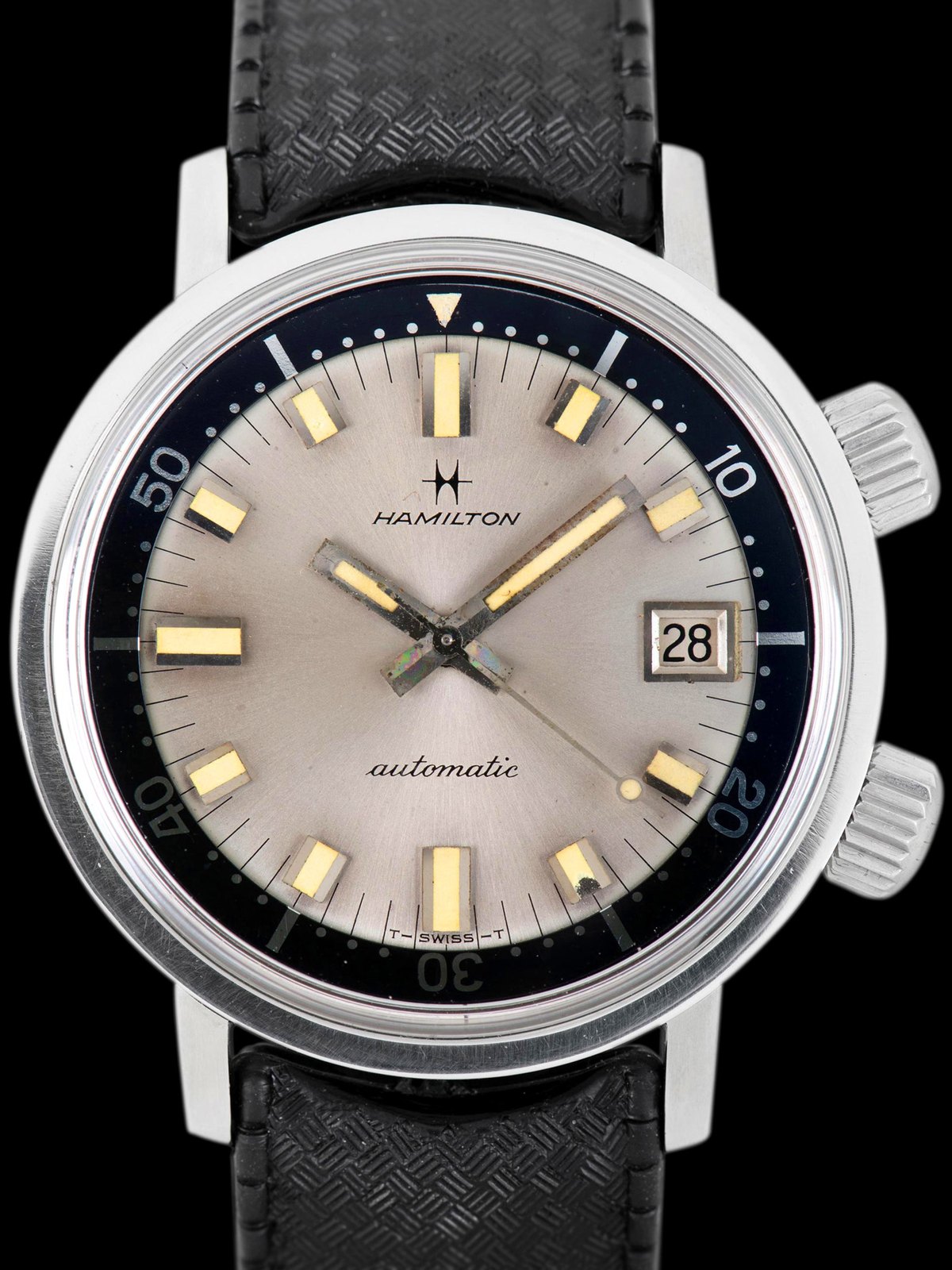
Hamilton Automatic Super Compressor 600 (Ref. 64040-3), 1970s
- Maker / attribution
- Hamilton (maker)
- Date
- 1970s
- Historical period
- Quartz Revolution (1969 – 1990)
- Country of origin
- Switzerland
- Object type
- Wristwatch
- Dimensions
- Case 42 mm
- Stock no.
- HAMSPC640403/5
- Credit line
- Dealer listing, Craft & Tailored (HAMSPC640403/5)
- Catalogue title (original)
- 1970s Hamilton Automatic Super Compressor 600 (Ref. 64040-3) (English)
View the source record (dealer listing) ↗ (opens another website in a new tab)Suggest a correction
Record summary
Catalogued by Craft & Tailored (dealer), Los Angeles (stock number HAMSPC640403/5), this is a wristwatch by Hamilton, made in Switzerland, dated 1970s. The Atlas places it in the Quartz Revolution period (1969 – 1990) of its Wristwatches collection. Recorded dimensions: Case 42 mm. The record is illustrated with 6 photographs.
Assembled from the source record's structured fields. Dates and attributions are given as the source states them; where a field is missing the Atlas leaves it blank rather than estimating.
Catalogue description
Dealer description — Craft & Tailored
The Super Compressor case was developed by Ervin Piquerez S.A. (EPSA) in the late 1950s with production lasting into the 1970s. The term "Super Compressor" comes from a Patented design that Ervin Piquerez S.A. (EPSA) created in which the case sealing method actually became more watertight with increased pressure as a result of increasing depth. The design is complex yet simple in that the deeper in-depth that the watch wen the more watertight the watch would become as a result. The increased pressure by design would allow the case-back to press against the O-ring gasket within the mid-case again increasing water resistance. Super compressors leverage two crowns, one in which operates the winding and setting of the watch and one that operates an inner rotating bezel ring which is also a unique design feature specific to super compressors that allowed for greater security of setting the inner timing bezel inside of the watch instead of externally whereas if the bezel was located externally it could be bumped out of position rendering an accurate measurement of elapsed time. Brands that utilized the super compressor cases included Longines, Hamilton, Universal Genéve, and Enicar. The Super Compressor cases came in two sizes: 42mm, as seen in vintage Longines Skin Divers, and in 36mm, as seen watches like this Hamilton 600. The Hamilton Super Compressor 600 is eyecatching and the perfect example of a Super Compressor. The silver/white dial with its contrasting and reflective inner rotating bezel makes the watch eye-catching while on the wrist without drawing too much attention. The mid-century vibe and feel of this watch are very much apparent with the early Hamilton logo that is to us reminiscent of Eames-era design which can also be seen on the case back of the watch. This Hamilton bridges the gap between sport diver and dress seamlessly and is also functional as the date complication located at the 3 o'clock position and inner rotating bezel will come in handy for keeping track of the date and for timing things such as parking meters and or decompression stops during the ascent of a deep dive! Stock # HAMSPC640403/5 Brand Hamilton Style Super Compressor 600 Model 64040-3 Serial N/A Size Men's Material Stainless Steel Dial Silver Millimeters 36 Strap 2pc Rubber Tropic Strap CASE & BRACELET The classic super compressor case is in wonderful, well-preserved condition with minimal signs of previous gentle polishing and light signs of honest use. The case retains its original cross-hatched twin crowns. The case back retains all of its factory markings and shows signs of gentle use. The watch comes supplied on a 2pc rubber tropic strap. DIAL & HANDS The original silver sunburst dial very presentable vintage condition with some light marks and spots from age that have no effect on the overall aesthetic of the watch. The inner rotating dark metallic bezel is also in exceptional condition and retains its matching tritium triangle at the 12 o'clock position which shows very minor degradation. The tritium lume in the dial and hands has taken on an incredible vivid banana yellow coloration. Under U.V. light inspection the hands exhibit no degradation, on the dial, the 5 o'clock lume plot does show some lume loss while the 11 o'clock lume plot displays a small portion of degradation, the rest of the lume plots exhibit no degradation. ACCESSORIES
Historical context
Quartz Revolution (1969 – 1990)
Seiko's Astron begins mass quartz timekeeping; traditional industries contract sharply.
Quartz and digital watches transformed the market after 1969. Swiss employment collapsed, Japanese and Hong Kong production soared, and the Swatch (1983) helped the Swiss industry recover; mechanical watches survived as luxury goods.
Read the period in the timelineMore wristwatches from this periodEarlier: Modern Mechanical Horology
Atlas type guide
Automatic (self-winding) watches
Self-winding watches use the wearer's motion to wind the mainspring. Abraham-Louis Perrelet and Breguet made 'perpétuelle' pocket watches with oscillating weights in the late eighteenth century, but the principle only became practical in the wristwatch. John Harwood patented a bumper automatic in 1923; Rolex's Perpetual rotor (1931) winding in one direction, and later bidirectional rotors (Eterna, Felsa Bidynator), established the modern form. Micro-rotors (Universal Genève, Buren) and peripheral rotors made automatic watches thinner.
What to look for
- A semicircular rotor turning 360° over the movement, or a 'bumper' weight that rebounds between springs.
- 'Automatic', 'Perpetual' or 'Self-winding' on the dial.
- A sealed screw-back case, since automatic watches are wound less often by the crown.
Dating clues
- Bumper automatics: 1923–c. 1955.
- Full rotors: from 1931 (Rolex); widespread after c. 1950.
- Micro-rotors: from 1954–1958.
General guidance written by the Atlas editors about this kind of object. It is not a statement about this particular piece; for that, rely on the source record above and on physical examination.
Related records
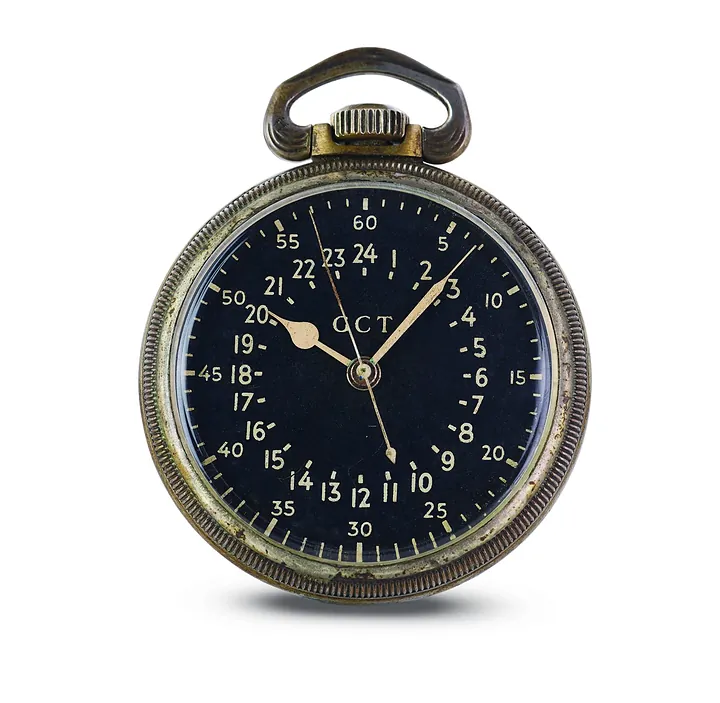
Pocket Watches · c. 1943
Hamilton 4992B, GCT Navigation U.S Air Force, c. 1943
Antiquorum auction archive, Geneva
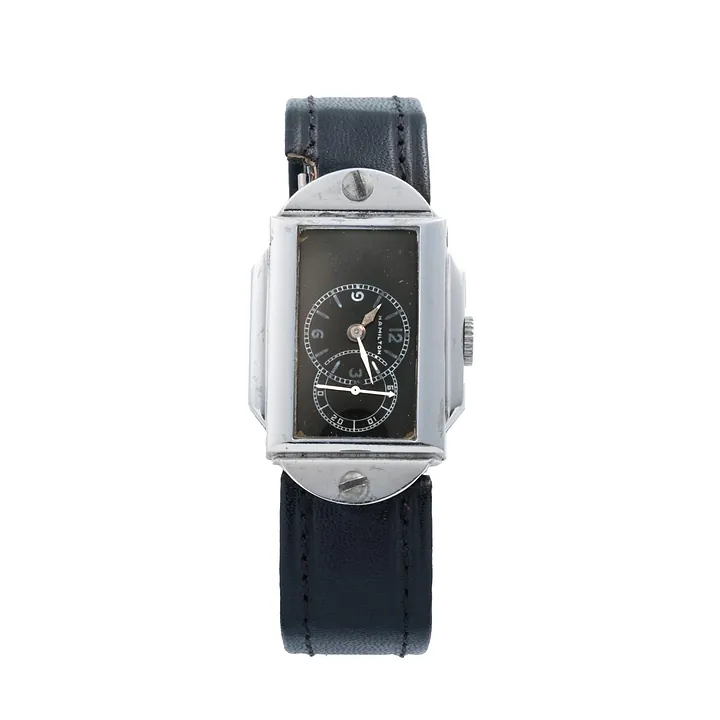
Wristwatches · c. 1940s
Hamilton Bomb Timer, c. 1940s
Antiquorum auction archive, Geneva
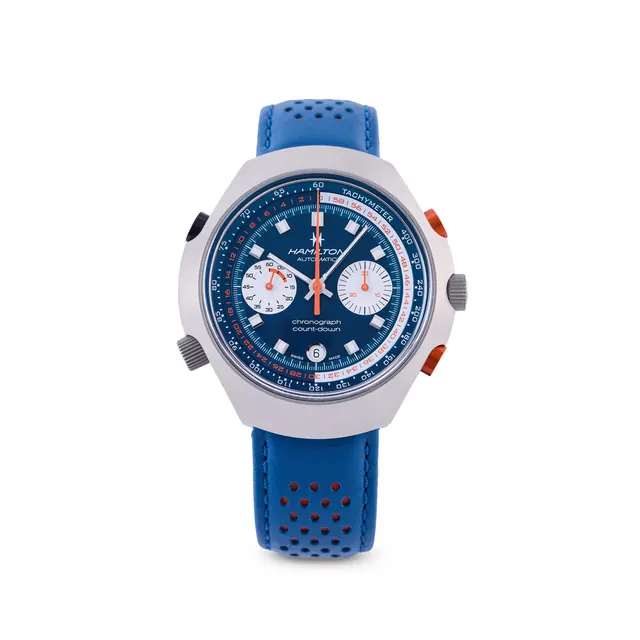
Wristwatches · originally sold in February 2025 (per the lot record)
Hamilton wristwatch, ref. H51606640, American Classic Chrono-Matic 50 Limited Edition, originally sold in February 2025 (per the lot record)
Antiquorum auction archive, Geneva
Wristwatches · c. 1940s
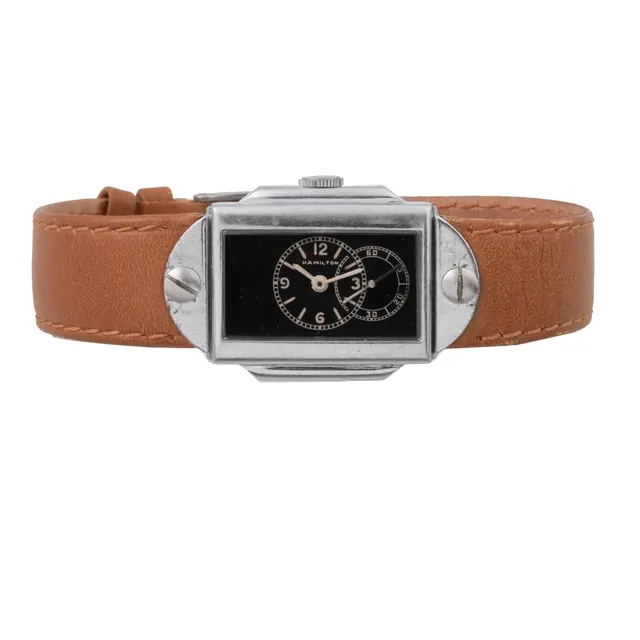
Hamilton wristwatch, Bomb Timer Watch, circa 1940's
Antiquorum auction archive, Geneva

Wristwatches · 1970
Wristwatch by Heno, Switzerland, 1970
Museum Rotterdam

Wristwatches · 1960–1986
'Tri-Compax' calendar chronograph wristwatch in gold case, by Universal, Geneva, Switzerland, 1960–1986.
Science Museum Group, London

Wristwatches · 1969–1970
Beta 21 Quartz wristwatch movement, made in Switzerland, 1970.
Science Museum Group, London

Wristwatches · c. 1969
Omega Speedmaster Moonwatch, ref. 145022-69st, c. 1969
Antiquorum auction archive, Geneva