
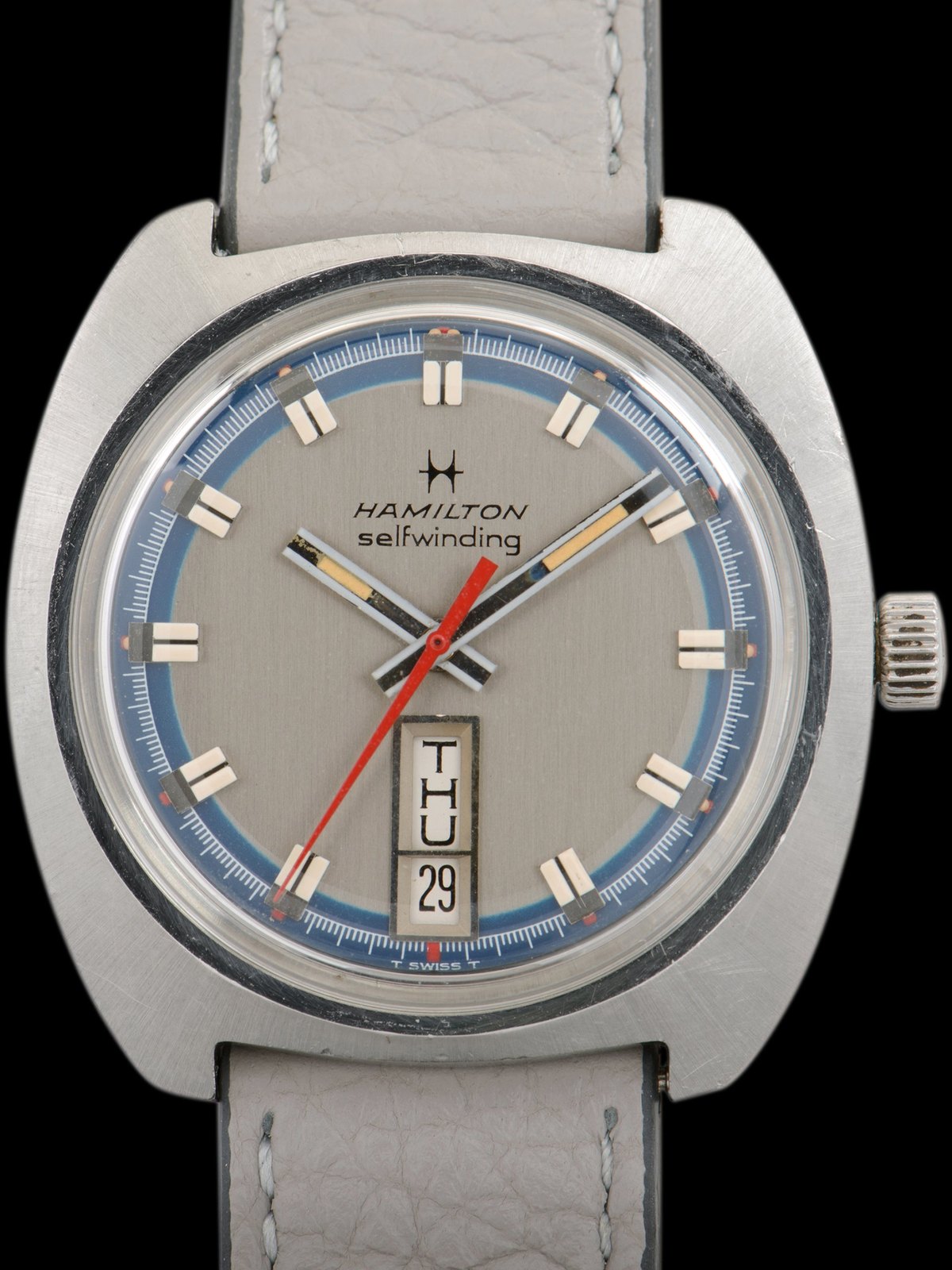
Wristwatches · Wristwatch
Hamilton Automatic Day-Date (Ref. 826002-3), 1970s
- Maker / attribution
- Hamilton (maker)
- Date
- 1970s
- Historical period
- Quartz Revolution (1969 – 1990)
- Country of origin
- Switzerland
- Object type
- Wristwatch
- Stock no.
- HTNDD8260023
- Credit line
- Dealer listing, Craft & Tailored (HTNDD8260023)
- Catalogue title (original)
- 1970s Hamilton Automatic Day-Date (Ref. 826002-3) (English)
View the source record (dealer listing) ↗ (opens another website in a new tab)Suggest a correction
Record summary
Catalogued by Craft & Tailored (dealer), Los Angeles (stock number HTNDD8260023), this is a wristwatch by Hamilton, made in Switzerland, dated 1970s. The Atlas places it in the Quartz Revolution period (1969 – 1990) of its Wristwatches collection. The record is illustrated with 6 photographs.
Assembled from the source record's structured fields. Dates and attributions are given as the source states them; where a field is missing the Atlas leaves it blank rather than estimating.
Catalogue description
Dealer description — Craft & Tailored
In 1892 Hamilton was founded in Lancaster, Pennsylvania and initially specialized in producing pocket watches. The brand boasts an impressive history of breakthroughs in the design and technology of wristwatches and has long been a fan favorite of die-hard watch enthusiasts. Thankfully for those enthusiasts, in the 1960 and 70s Hamilton took part in the funk revolution of watch design, giving birth to hit after hit of color and quirk. Stock # HTNDD8260023 Brand Hamilton Style Automatic Day-Date Model 826002-3 Serial N/A Size Men's Material Stainless Steel Dial Grey / Blue Millimeters 37 Strap 2pc Handmade Leather Strap CASE & BRACELET The case of this fantastic Hamilton self-winding is blocky, short, and lightly worn. In other words, it's just about perfect. Measuring 37-millimeters the watch sits on the wrist with a beautiful balance and the sunburst brushed finish gives the watch a handsome presence. It features a screw-down case back for water resistance and is fitted to a gorgeous 2pc handmade leather strap. DIAL & HANDS It's easy to see the dial is the main event. The vertically grained inner dial is corralled by a stunningly designed baby blue and white outer minute track. The color play between the blue and the exquisitely aged cream tritium is otherworldly, with the red second's hand peaking through tritium lume plots being the cherry on top. In a rare twist, this Hamilton features not only the time, but also day and date, so this watch isn't just exceptionally beautiful but also particularly useful. The perfect pairing. ACCESSORIES None.
Historical context
Quartz Revolution (1969 – 1990)
Seiko's Astron begins mass quartz timekeeping; traditional industries contract sharply.
Quartz and digital watches transformed the market after 1969. Swiss employment collapsed, Japanese and Hong Kong production soared, and the Swatch (1983) helped the Swiss industry recover; mechanical watches survived as luxury goods.
Read the period in the timelineMore wristwatches from this periodEarlier: Modern Mechanical Horology
Atlas type guide
Calendar, moon-phase and perpetual calendar watches
Calendar complications range from a simple date to the perpetual calendar, which automatically allows for months of different lengths and leap years until 2100. Pocket watches with perpetual calendars were made in the eighteenth and nineteenth centuries; Patek Philippe made the first perpetual calendar wristwatch in 1925, and series production followed in 1941. The annual calendar (Patek Philippe, 1996) needs correction only once a year.
Moon-phase displays use a disc with two moons and 59 teeth advanced daily, approximating the 29.5-day lunation; more precise trains reduce the error to one day in over a century.
What to look for
- Apertures or subsidiary dials for day, date, month and leap year.
- Moon disc under a 'bosom' shaped aperture.
- Recessed correctors on the case band for setting the calendar.
Dating clues
- Triple-date wristwatches: popular c. 1940–1955.
- Perpetual calendar wristwatches: from 1925 (unique) and 1941 (series).
General guidance written by the Atlas editors about this kind of object. It is not a statement about this particular piece; for that, rely on the source record above and on physical examination.
Related records
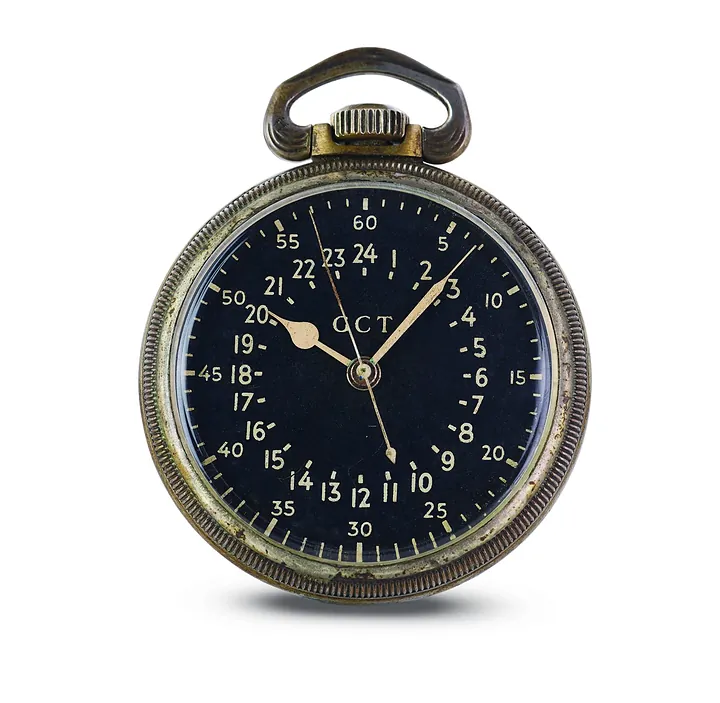
Pocket Watches · c. 1943
Hamilton 4992B, GCT Navigation U.S Air Force, c. 1943
Antiquorum auction archive, Geneva
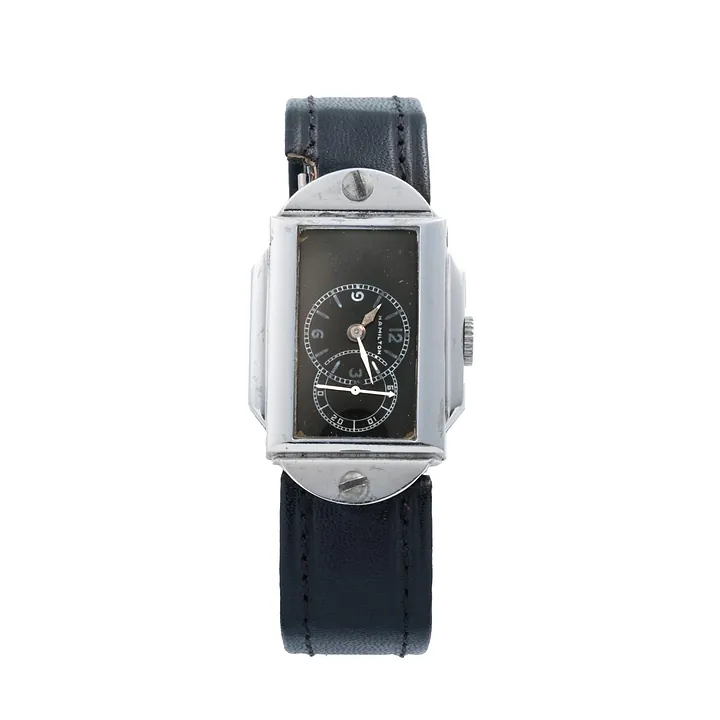
Wristwatches · c. 1940s
Hamilton Bomb Timer, c. 1940s
Antiquorum auction archive, Geneva
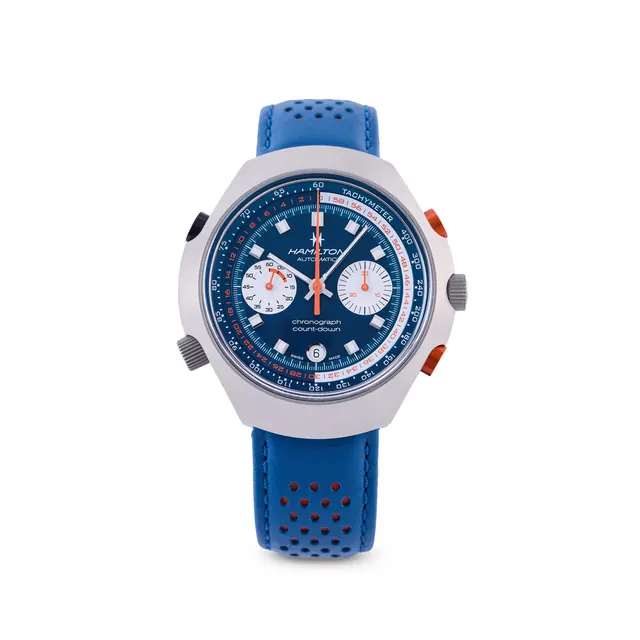
Wristwatches · originally sold in February 2025 (per the lot record)
Hamilton wristwatch, ref. H51606640, American Classic Chrono-Matic 50 Limited Edition, originally sold in February 2025 (per the lot record)
Antiquorum auction archive, Geneva
Wristwatches · c. 1940s
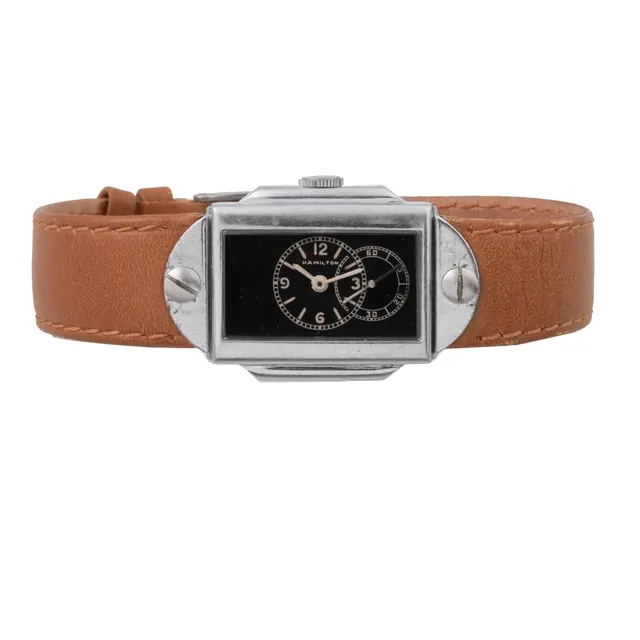
Hamilton wristwatch, Bomb Timer Watch, circa 1940's
Antiquorum auction archive, Geneva

Wristwatches · 1970
Wristwatch by Heno, Switzerland, 1970
Museum Rotterdam

Wristwatches · 1960–1986
'Tri-Compax' calendar chronograph wristwatch in gold case, by Universal, Geneva, Switzerland, 1960–1986.
Science Museum Group, London

Wristwatches · 1969–1970
Beta 21 Quartz wristwatch movement, made in Switzerland, 1970.
Science Museum Group, London

Wristwatches · c. 1969
Omega Speedmaster Moonwatch, ref. 145022-69st, c. 1969
Antiquorum auction archive, Geneva