
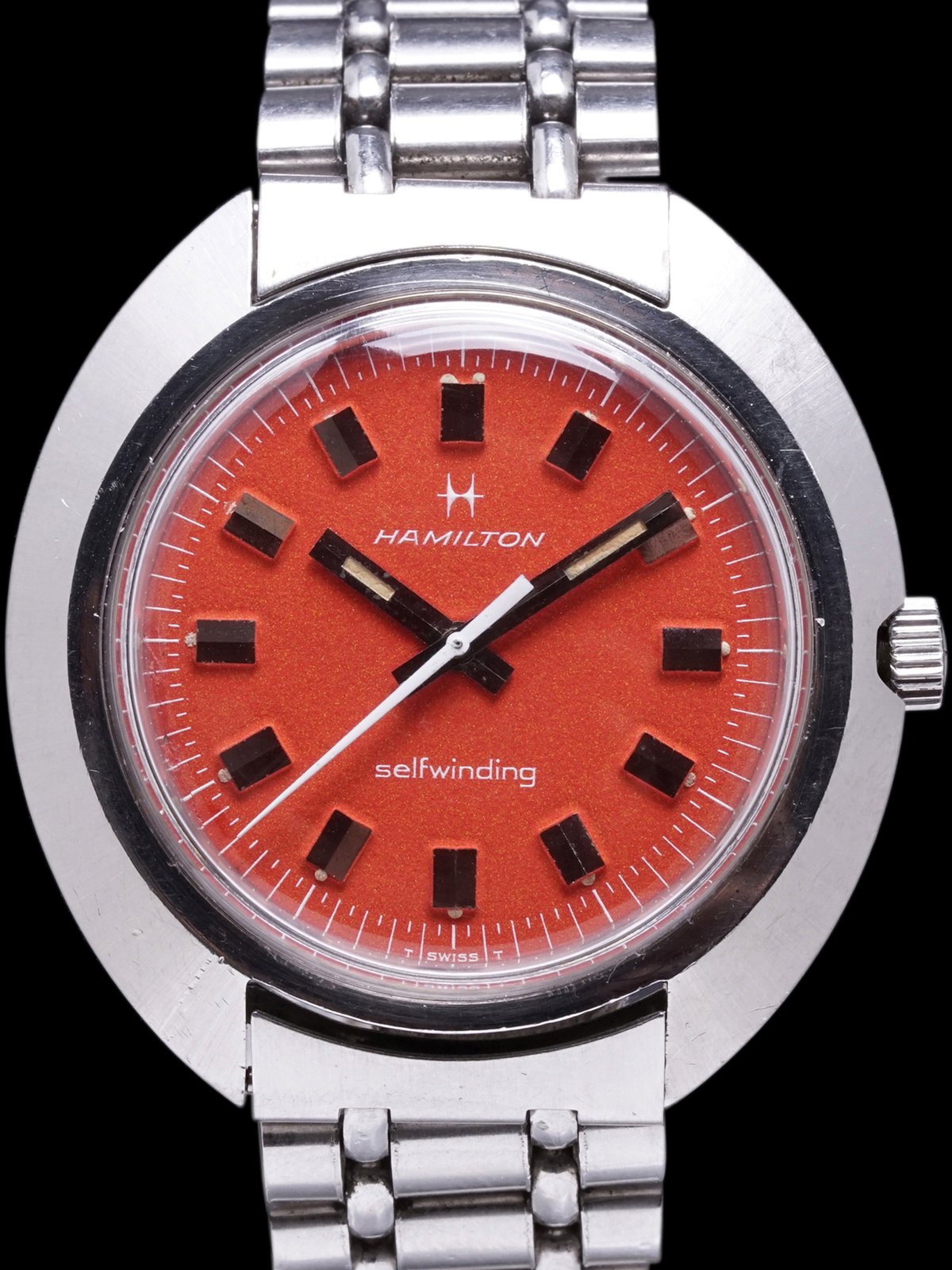
Wristwatches · Wristwatch
Hamilton Accumatic (Ref. 689032-3) Orange "Confetti" Dial, 1970s
- Maker / attribution
- Unrecorded in source
- Date
- 1970s
- Historical period
- Quartz Revolution (1969 – 1990)
- Country of origin
- Unrecorded in source
- Object type
- Wristwatch
- Dimensions
- Case 39 mm
- Stock no.
- HAMAC6890323
- Credit line
- Dealer listing, Craft & Tailored (HAMAC6890323)
- Catalogue title (original)
- 1970s Hamilton Accumatic (Ref. 689032-3) Orange "Confetti" Dial (English)
View the source record (dealer listing) ↗ (opens another website in a new tab)Suggest a correction
Record summary
Catalogued by Craft & Tailored (dealer), Los Angeles (stock number HAMAC6890323), this is a wristwatch, dated 1970s. The Atlas places it in the Quartz Revolution period (1969 – 1990) of its Wristwatches collection. Recorded dimensions: Case 39 mm. The record is illustrated with 6 photographs.
Assembled from the source record's structured fields. Dates and attributions are given as the source states them; where a field is missing the Atlas leaves it blank rather than estimating.
Catalogue description
Dealer description — Craft & Tailored
In 1982 Hamilton was founded in Lancaster, Pennsylvania, and initially specialized in producing pocket watches. The brand boasts a long and impressive history of breakthroughs in design and technology. Due to becoming an official supplier to the U.S. Armed Forces during WWI, they transitioned focus from pocket watches to wristwatches. And come WWII, they stopped producing watches for the consumer market altogether to cater to the massive demand of supplying the U.S. Armed Forces, producing over one million timepieces, including marine chronometers. Their innovations and accuracy earned the company an Army-Navy E award for their excellence in manufacturing. After recovering from the demands of war, Hamilton returned to the civilian market to continue producing innovative and truly bizarre designs for decades to come. In 1953, their first automatic winding watches were introduced as a part of the newly introduced 'Illinois' line. This was also the company’s first time experimenting with Swiss-made grades. By 1956 the Hamilton-Illinois line was discontinued, and along came the Accumatic model. This A-series of watches were produced into the 1970s and offered an array of over 65 different models. SPECS Stock # HAMAC6890323 Brand Hamilton Style Accumatic Model 689032-3 Serial N/A Size Men's Material SS Dial Orange "Confetti" Millimeters 39mm Bracelet Hamilton "Kevin Drema" SS Bracelet CASE & BRACELET The wonderful "UFO" case is believed to remain unpolished with honest wear, as the original sunburst finishing is still present. The case retains its original Hamilton-signed crown. The case back retains all of its original engravings in crisp and legible condition. The original Hamilton "Kevin Drema" stainless steel bracelet is in excellent condition and retains 17 links that show a slight amount of stretch. DIAL & HANDS The vibrant orange "confetti" dial consists of an orange base with bright yellow speckles which add a charming texture and depth to the dial. The dial itself is in very good vintage condition, and shows show light degradation in the bottom left of the outer minute track. The tritium lume plots have aged to a creamy patina, under U.V. light inspection 10 and 11 o'clock lume plots are missing with mild degradation throughout the other lume plots. The original tritium hands match the dial perfectly and exhibit no degradation when inspected under U.V. light. ACCESSORIES
Historical context
Quartz Revolution (1969 – 1990)
Seiko's Astron begins mass quartz timekeeping; traditional industries contract sharply.
Quartz and digital watches transformed the market after 1969. Swiss employment collapsed, Japanese and Hong Kong production soared, and the Swatch (1983) helped the Swiss industry recover; mechanical watches survived as luxury goods.
Read the period in the timelineMore wristwatches from this periodEarlier: Modern Mechanical Horology
Atlas type guide
Wristwatches
Bracelet watches were worn by women from the early nineteenth century — Breguet made one for Caroline Murat, Queen of Naples, in 1810–12 — but the wristwatch only became a man's instrument with military use and aviation in the early twentieth century. Between the World Wars it overtook the pocket watch; the 1920s and 1930s brought rectangular Art Deco cases, water-resistant cases and the first automatic winding systems.
After 1945 the wristwatch became a carrier of identity — dress watches, sports and dive watches, chronographs, calendars — produced by Swiss, American, Japanese, German, Soviet and Chinese industries. The quartz revolution after 1969 and the mechanical renaissance since the 1990s, including the rise of independent watchmakers, complete the story.
What to look for
- The reference number (between the lugs or inside the case back) and serial number, the starting point for dating.
- The calibre: its maker and number are often stamped under the dial or on the bridge.
- Originality of dial, hands and crown — refinished ('redial') dials are common.
- Case material marks: 18K/750, 14K/585, stainless steel, gold-filled, plated.
Dating clues
- Wire-lug cases: before c. 1925.
- Water-resistant screw-down cases: from 1926.
- Quartz movements: from 1969; sapphire crystals widespread after c. 1980.
General guidance written by the Atlas editors about this kind of object. It is not a statement about this particular piece; for that, rely on the source record above and on physical examination.
Related records

Wristwatches · 1970
Wristwatch by Heno, Switzerland, 1970
Museum Rotterdam
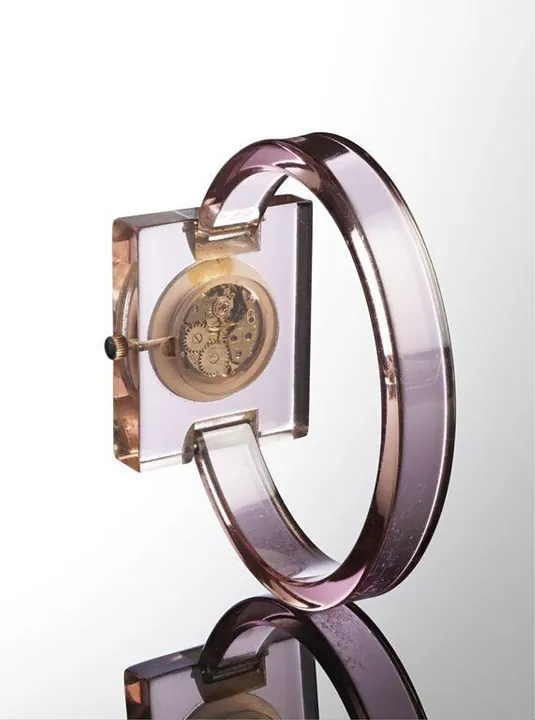
Wristwatches · 1970s
Wristwatch, plastic, by Gucci; Italy, 1970s.
Victoria and Albert Museum, London
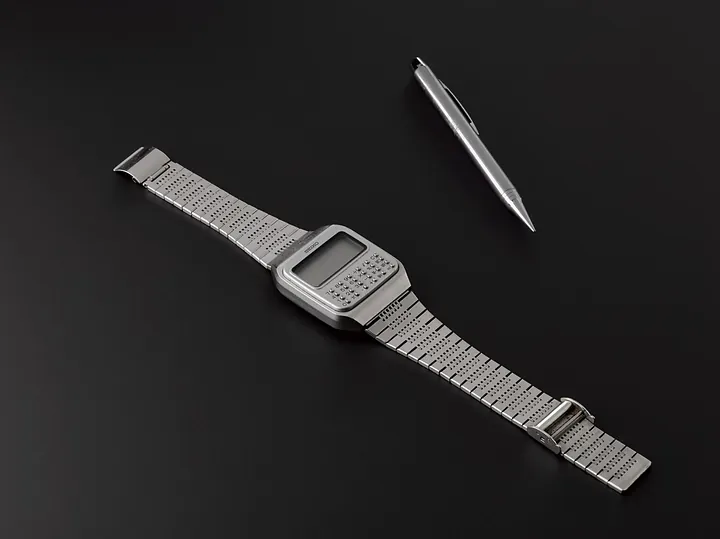
Wristwatches · 1978
Calculator wristwatch by Suwa Seikosha Co. Limited, Japan, 1978
Science Museum Group, London
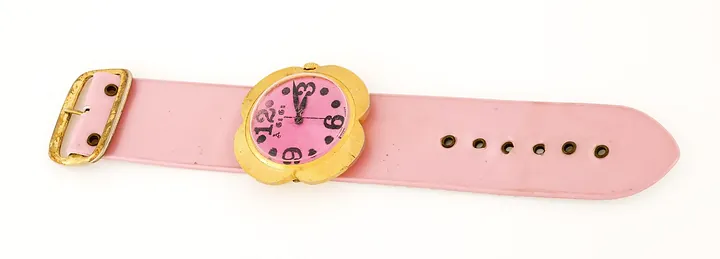
Wristwatches · 1980
Wristwatch, 1980 (no. 71413)
Museum Rotterdam
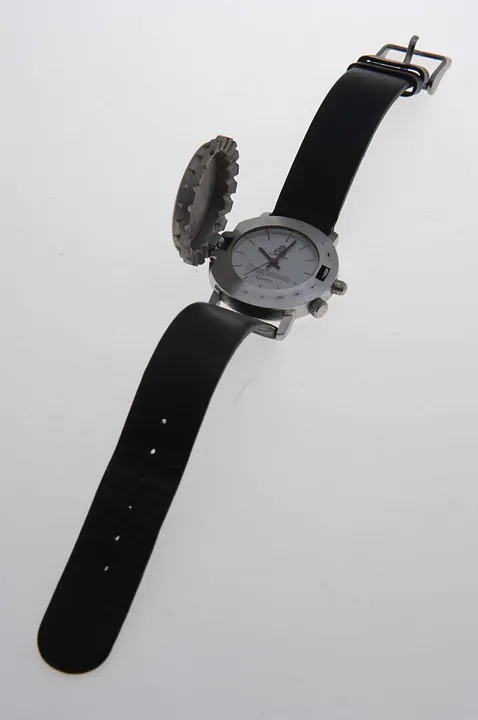
Wristwatches · 1980
Wristwatch, 1980 (no. 91477)
Museum Rotterdam
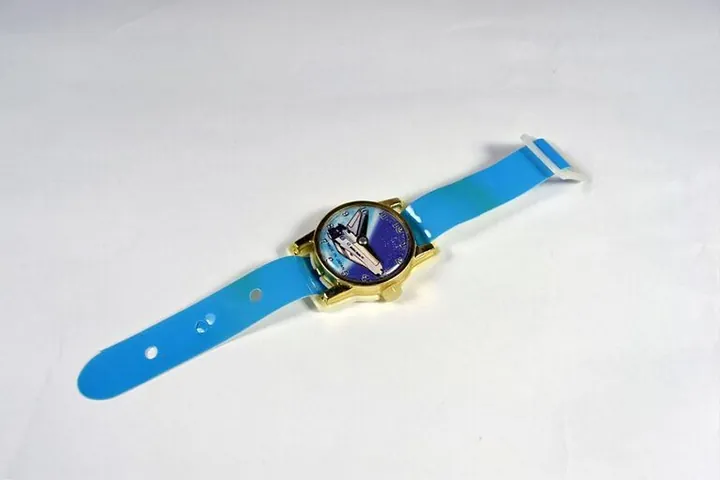
Wristwatches · 1980–1982
Wristwatch, Space Shuttle; plastic, Japan, 1970-1979?
Victoria and Albert Museum, London
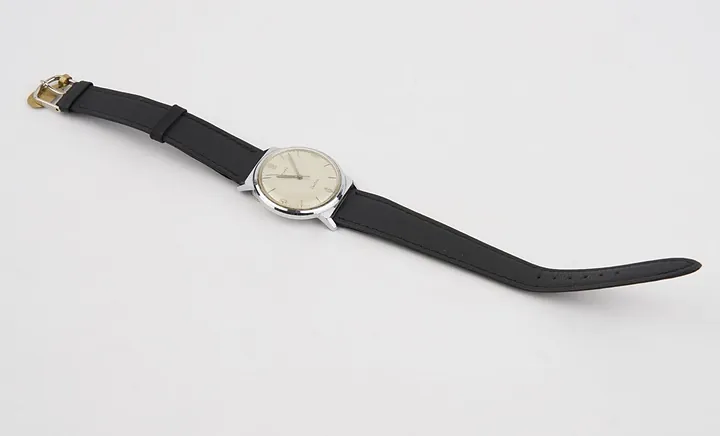
Wristwatches · 1949–1992
Timex `Electric' wristwatch, with electrically operated balance wheel mechanism, United States, 1949–1992
Science Museum Group, London

Wristwatches · 1960–1986
'Tri-Compax' calendar chronograph wristwatch in gold case, by Universal, Geneva, Switzerland, 1960–1986.
Science Museum Group, London